RETROSPECTIVE: Bowie, Standing By The Wall

Revisiting David Bowie’s Heroes decades on, this article explores its Berlin origins, the band behind the album, Brian Eno’s role and whether it stands apart from Low.

David Bowie Heroes Album Retrospective


By the time Heroes emerged in October 1977, Bowie had already disposed of the rulebook. Low had landed like a communiqué from another future, half songs, half atmosphere, a record that seemed to reject the very idea of audience comfort. The temptation has always been to frame Heroes as its louder twin, the one with the anthem, the one that returned Bowie to something approaching recognisable rock form. That reading does the album a disservice. Heroes is not a corrective to Low. It is an expansion, an album that breathes the same air but looks outward rather than inward, shaped by geography, by collaborators, and by a band operating at a rare level of collective intuition.

The setting matters. Hansa Tonstudio, perched within sight of the Berlin Wall, was not simply a studio but a vantage point. The city in 1977 was still scarred, divided, uneasy. Bowie absorbed that atmosphere completely. If Low felt like a psychological evacuation from Los Angeles excess, Heroes feels like Bowie standing still long enough to take in where he had landed. The walls, literal and emotional, are everywhere on this record.

The core band remained unchanged from Low, and that continuity is crucial. Carlos Alomar was once again the spine of the operation, his rhythm guitar style economical, precise, never showy. Alomar’s playing on Heroes is less funky than his work with the plastic soul era Bowie, but his sense of movement underpins everything. Dennis Davis on drums is similarly restrained but vital. His playing has a physical intelligence, knowing when to push and when to pull back, especially on tracks like Beauty and the Beast where tension is built through repetition rather than brute force. George Murray’s bass lines are melodic without drawing attention to themselves, often acting as a bridge between rhythm and texture.

Hovering above and around them is the now legendary pairing of Brian Eno and Tony Visconti. Eno’s influence is often overstated as some sort of ambient fog machine, but his real contribution lies in disruption. His Oblique Strategies cards, his encouragement of chance, his willingness to treat the studio as an instrument all helped Bowie escape habitual thinking. Visconti, meanwhile, grounded the chaos. His production on Heroes is cleaner and more assertive than on Low, particularly on the vocal tracks, but still full of space. The famous gated vocal effect on the title track, achieved by positioning microphones at varying distances that opened only when Bowie sang louder, is a perfect example of technology serving emotion rather than novelty.

The opening track, Beauty and the Beast, announces immediately that this is not a retreat into comfort. Bowie’s vocal is fractured, almost feral, darting between personas. Lyrically, it feels like a continuation of the internal struggle first exposed on Low, but externalised. The city is no longer a metaphor for the mind. It is the stage on which that struggle plays out. Fripp’s guitar slashes through the mix, not as a soloist but as a source of friction, pushing against the rigid rhythm beneath.

Fripp’s presence across the album cannot be overstated. Brought in at the last minute and reportedly completing his parts in a matter of hours, his playing defines the record’s emotional peaks. On Heroes the song, his sustained, soaring lines do not decorate the track, they lift it. The myth around the song often threatens to reduce it to its origin story, Bowie glimpsing Visconti and Antonia Maass kissing by the Wall. What matters more is how the music refuses sentimentality. The lyric never promises permanence, only intensity. We can be heroes, just for one day. It is defiant precisely because it accepts limitation.

Elsewhere on side one, Bowie continues to explore fractured identity and communication. Joe the Lion draws inspiration from performance artist Chris Burden, but it also feels like a self portrait in motion, Bowie throwing himself into the work with no safety net. Sons of the Silent Age is one of the album’s quieter triumphs, its crooning melody undercut by lyrics that hint at repression, at voices denied expression. Blackout closes the side in a rush of nervous energy, all clipped phrases and sudden turns, the sound of a mind overstimulated rather than soothed.

If side one is confrontation, side two is immersion. Like Low, Heroes gives over half its running time to instrumentals, but the mood is different. Where Low often felt like drifting through empty rooms, Heroes feels rooted in place. V-2 Schneider tips its hat to Kraftwerk but refuses pastiche, its groove mechanical yet strangely human. Bowie’s saxophone playing here is deliberately unschooled, cutting through the track like an alarm rather than a melody.

The trio of Sense of Doubt, Moss Garden and Neuköln forms the emotional heart of the album. These are not background pieces. They demand attention. Sense of Doubt is built on a descending piano figure that seems to sink deeper with each repetition, evoking a sense of inevitability. Moss Garden offers a brief illusion of calm, its Eastern inflections suggesting a spiritual escape that never quite arrives. Neuköln is the most unsettling of all, Eno’s treatments and Bowie’s sax combining into a mournful, alien soundscape that captures the loneliness of displacement. Named after a Berlin district known for its immigrant population, it resonates as a study in alienation without a single word being sung.

The closing track, The Secret Life of Arabia, is often treated as a curiosity, but it serves an important function. Its rhythm and melodic energy hint at movement, at travel beyond Berlin, beyond the album’s confines. It suggests that Bowie was already looking ahead, which history confirms. Lodger would soon scatter these ideas across the globe, but Heroes remains anchored, its power drawn from stillness rather than motion.

Over the decades, more details have emerged about the making of Heroes, but none of them diminish its mystery. The speed of the sessions, the reliance on instinct, the willingness to commit to first or second takes all speak to a creative moment that cannot be replicated. Bowie was sober, focused, and surrounded by collaborators who understood when to contribute and when to step back. This was not the sound of a genius imposing his will, but of a band and production team operating as a single organism.

So is Heroes merely a continuation of Low, or does it stand alone. The honest answer is both. It makes little sense without Low, yet it surpasses it in emotional range. Where Low fractures, Heroes reaches. Where Low withdraws, Heroes risks connection. In Bowie’s catalogue, it occupies a rare position. An experimental record with a genuine anthem, an art album that found its way into public consciousness without compromise.
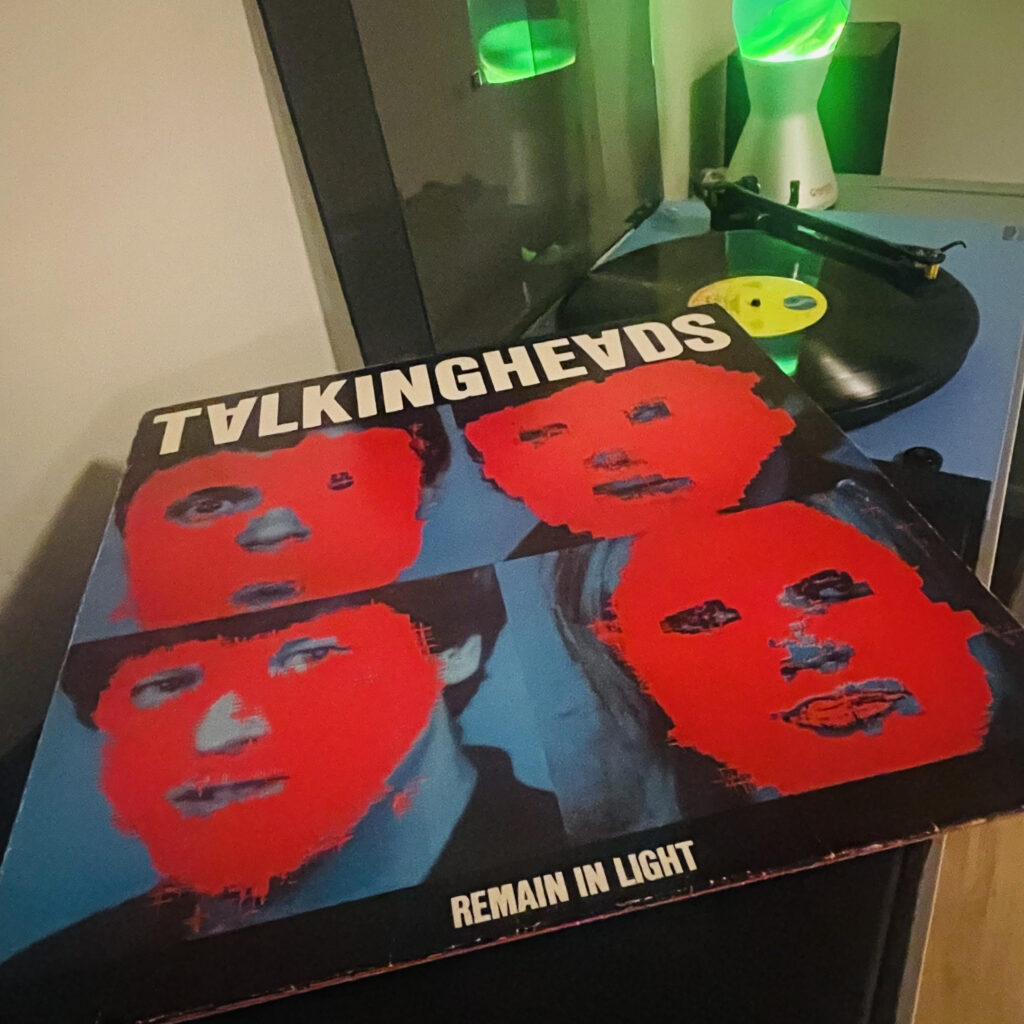
RETROSPECTIVE: Talking Heads – Remain In Light 1980

Some records arrive like a whisper and fade, others crash in like an avalanche and leave you stumbling in their wake. Remain in Light is one of the latter, a slab of paranoia, rhythm, and obsession that still sounds as unmoored and visionary in 2025 as it did in 1980. Forty-five years on, the album hums with the intensity of four New Yorkers trying to rethink the world, their identities, and what a pop record could do. It is both human and alien, cerebral and primal, art-school gone feral. Listening now, you realise Talking Heads did not so much make an album as invent a language for disorientation.

Part One: The Sleeve

Pick up the sleeve and your first impression is confusion masquerading as design. Four faces, distorted and layered, hover in red, black, and white, a simulacrum of identity rendered through early MIT image-processing technology. The work of Tibor Kalman and M&Co, it feels both robotic and living. Your eyes register familiar features, only to be immediately unmoored. Tina Weymouth’s fascination with African masks, refracted through digital manipulation, turns the human face into a machine’s suggestion. It is uncanny, a whisper of the postmodern anxiety that would haunt the next four decades of visual culture.

Every detail matters. The typography is sharp and arresting, suggesting urgency without screaming. Fighter-bomber Avenger silhouettes and ghostly abstractions hover in the margins, hinting at violence, both literal and psychic. The design does not complement the music so much as anticipate it, a visual prelude to the interlocking chaos within. In 1980, it was a statement that identity was mutable, mediated, and constantly under negotiation. Today, that’s the norm.

Kalman’s brilliance was in making technological imperfection a part of the aesthetic. The faces are corrupted, glitched, degraded – human error filtered through a machine. This is not a record cover; it is a manifesto. By the time you slide the vinyl from its jacket, you are already prepared for disorientation. What follows is not just music, it is an ecosystem, a carefully constructed labyrinth designed to engage both body and mind.

Part Two: The Music & Legacy

Recording began at Compass Point Studios in Nassau, a sun-soaked bunker that would become a crucible for genius and frustration alike. The band was joined by Brian Eno, the unofficial fifth Head, whose influence was less about notes than architecture. He arrived with a philosophy: treat the studio as an instrument, treat chaos as composition, and do not flinch at failure. The sessions were famously intense. The band worked long, bewildering hours, layering loops, polyrhythms, and improvisations until something miraculous emerged from the mess.

The foundation was African-inspired polyrhythms, specifically the hypnotic grooves of Fela Kuti. This was not mere imitation; it was a translation of complex rhythmic systems into a New York art-rock vocabulary. Each instrument moves independently, a conversation of contradictions. Drums and percussion interlock but never collide, basslines snake around vocal hooks, and guitars oscillate between melody and texture. Adrian Belew’s guitar is both nervous and ecstatic, Jon Hassell’s trumpet drifts like a mirage, and Eno’s synthesizer textures shimmer in the spaces between. The record is dense yet breathable, controlled yet chaotic, deliberate yet accidental.

Byrne’s vocals are equally layered, a collage of obsessions and idiosyncrasies. He borrows from hip-hop cadences, ritualistic chant, and fragmented narrative, creating a delivery that is more incantation than song. The lyrics often circle existential dread with playful detachment. In “Born Under Punches”, Byrne’s voice is manic and fractured, a protagonist grappling with information overload and identity crisis. “Crosseyed and Painless” is a sermon on anxiety, paranoia, and social collapse, delivered with sharp wit and relentless rhythm.

The album’s architecture is deliberate. The first side, buoyed by kinetic energy, draws you into the labyrinth. “The Great Curve” is an ecstatic frenzy, the band locked in an ecstatic groove that simultaneously propels and destabilises. By the time “Once in a Lifetime” arrives, you are primed for reflection. The song balances existential inquiry with dance floor immediacy, Byrne pondering selfhood and entropy against a backdrop of hypnotic repetition. It is both absurd and devastatingly human.

Side two darkens the palette. “Houses in Motion” jitters with post-industrial dread, a cityscape of anxiety rendered in sound. “Seen and Not Seen” drifts toward abstraction, its protagonist dissolving into observation, a meditation on presence, absence, and perception. “Listening Wind” introduces political undercurrents, a commentary on global turbulence and American complacency filtered through dense polyrhythms and hypnotic motifs. The album closes with “The Overload”, a spectral transmission that hints at collapse and transcendence simultaneously.

The genius of Remain in Light lies in its simultaneity. It is both academic and visceral, cerebral and bodily. It occupies a transitional space where intellect and instinct cohabit uneasily but beautifully. The recording process itself becomes audible: the tape loops, studio experimentation, and improvisational layering are part of the listening experience. You hear the struggle, the trial and error, the moments of panic and revelation. This is music as architecture, as experiment, as living organism.

Culturally, the album is a negotiation of influence. The band’s engagement with African rhythms is complex, filtered through Western ears and art-school sensibility. It raises questions about appropriation, translation, and homage, but the resulting work is undeniably original. It is a fusion of ideas and sounds that challenges the listener to reconsider boundaries, genres, and expectations. The record is not just a reflection of its time, it is a critique of it, questioning identity, technology, and the very notion of pop music as a commodity.

The legacy of Remain in Light is vast. Upon release, it charted modestly, yet critics recognised its audacity. The album influenced generations of musicians, from the electronic experiments of the eighties to the worldbeat experiments of later decades. It bridged punk’s urgency with funk’s elasticity, art-school conceptualism with dancefloor immediacy. Touring the album proved difficult; the complexity and intensity of the arrangements tested the band to their limits. Yet the recordings themselves endure, a testament to ambition, collaboration, and the willingness to confront chaos head-on.

Listening today, the album resonates with a prescience that is uncanny. Byrne’s exploration of selfhood, Eno’s textural interventions, the band’s rhythmic sophistication all speak to an era increasingly dominated by technology and mediated experience. Forty-five years on, the music still feels urgent, still unsettles and energises in equal measure. It is a record that rewards repeated engagement, revealing new facets with each listen. The textures, the contradictions, the obsessive layering, all retain their power to unsettle and illuminate.

In retrospect, Remain in Light is not just an album. It is a blueprint for artistic ambition, a testament to the potential of collaboration and the thrill of experimentation. It embodies the tension between accessibility and difficulty, dance and reflection, humour and despair. Its enduring influence is evident not only in the artists who followed but in the ways it continues to challenge contemporary listeners. The record is a meditation on identity, perception, and creativity itself, an exploration that remains vital and uncontainable.

Four decades on, the album hums with life, refusing to settle into nostalgia or canonisation. It is human, machine, ritual, and meditation all at once. The visual and sonic languages it employs remain radical; the ideas embedded in its grooves still resonate. Talking Heads, at their apex, were not content with simple pop. They sought transformation, and in Remain in Light they achieved it. 

Listening now, the record still demands attention. It insists on engagement, on immersion. The faces on the sleeve, the fractured rhythms, the cascading vocals – all converge to create an experience that is simultaneously exhilarating and disorienting. It is, as ever, a record that challenges, delights, and confounds.

Remain in Light remains a masterpiece because it continues to operate on multiple planes. It is art, it is music, it is philosophy, and it is ritual. It occupies a space that few albums dare to enter, and fewer still manage to navigate successfully. Forty-five years later, it retains its power, its strangeness, and its brilliance. Talking Heads created not just an album but a living organism, one that still breathes, pulses, and disrupts.

For those willing to engage fully, it remains an astonishing journey, a record that refuses to be tamed, a testament to what happens when intelligence, curiosity, and obsession collide. Remain in Light is not simply listened to. It is experienced, interrogated, and felt. It is, in every sense, timeless.

ART POP / POP ART: Brian Eno & Tom Phillips

Or ‘Two Brain’ Brian Eno’s Art School Daydreaming

In the pantheon of rock’s cerebral mavericks, Brian Peter George Jean-Baptiste de la Salle Eno AKA Brian Eno or just plain Eno stands as our premier egghead-in-residence, the boffin who turned knob-twiddling into an art form, and made the recording studio a canvas rather than a mere tool. While lesser mortals bang away at their instruments with workmanlike dedication, Eno approaches music as just another colour on his palette.

The roots of Eno’s glorious dilettantism lie not in the cramped smoky clubs of London but in the rarefied air of art school conceptualism. Before he became the feather-boa’d synth wizard of Roxy Music, before he produced landmark albums for everyone from Talking Heads to U2, before he invented ambient music while flat on his back after being walloped by a taxi, young Brian was just another paint-splattered art student at Ipswich’s Suffolk College, soaking up ideas that would later transform rock music.

“Art school didn’t teach me how to paint, it taught me how to think about why I might want to paint in the first place.” – Brian Eno.

This intellectual approach, questioning the very foundations of why we make art became the cornerstone of his musical methodology, a perpetual askance glance at rock’s tedious conventions.

At Ipswich, Eno fell under the spell of teacher and mentor Tom Phillips, a walking encyclopedia of avant-garde approaches whose influence on our hero cannot be overstated. Phillips; painter, composer, translator, and all-round Renaissance gadabout introduced the young Eno to the work of John Cage, to the mind-bending possibilities of chance operations and indeterminacy. Phillips’ own masterwork, “A Humument,” in which he transformed a Victorian novel into a series of visual poems by painting over the text, leaving selected words visible, demonstrated how one might create new meaning by obscuring the old, a strategy Eno would later deploy in his oblique collaborations with David Bowie.

“Tom showed me that art wasn’t about technical skill, it was about context, about framing experiences.” This revelation liberated the technically limited Eno, allowing him to approach music as conceptual art rather than a craft to be mastered. When he later joined Roxy Music, he proudly proclaimed his musical illiteracy as a virtue rather than a handicap.

The conceptual art movement that dominated British art schools in the late ’60s provided Eno with his intellectual toolkit. Here was an approach that valued ideas over execution, process over product, and systems over virtuosity, catnip for a mind as restlessly curious as Eno’s. From conceptualism came his fascination with self-generating systems, with setting up musical experiments and then stepping back to see what might happen. His famous Oblique Strategies cards (created with artist Peter Schmidt) with those cryptic injunctions like “Honour thy error as a hidden intention” or “Emphasise differences” are pure conceptual art, placing process above outcome.

While most rock musicians have historically treated their art school past as a brief bohemian holiday before getting down to the serious business of power chords and stadium tours, Eno has remained defiantly committed to the art school perspective. His collaborative approach, turning musicians into components in his sonic experiments derives directly from the workshop methodologies of art school. When he produced Talking Heads’ “Remain in Light,” he was essentially running the band through a series of conceptual exercises, treating David Byrne and company as materials rather than auteurs.

Even Eno’s celebrated ambient works, gossamer soundscapes made for the comedown room, can be traced back to the “expanded cinema” experiments he witnessed as an art student. These multimedia environments, combining film, light shows, and sound, were attempts to create immersive experiences rather than discrete works of art. When Eno later described ambient music as being “as ignorable as it is interesting,” he was channeling the art school notion that art need not demand attention but might instead modify an environment.

What separates Eno from the legions of other art school graduates who’ve strayed into rock’s territory is his ability to translate rarefied conceptual approaches into works that connect emotionally. His productions for U2 may have been informed by systems thinking and process art, but they also made the Irish bombast merchants sound bloody enormous. His solo works might be exercises in cybernetic theory, but they’re also strangely moving, capturing melancholy and wonder in their abstract washes.

In an age when rock has largely abandoned its art school flirtations in favour of earnest authenticity or technical showboating, Eno remains our most eloquent reminder that popular music can be a laboratory for ideas as well as emotions. The art school influence that formed him, that combination of intellectual rigour and playful experimentation continues to inform his work, whether he’s producing pop stars or creating video installations.

As we face another decade of dreary singer-songwriters emoting over acoustic guitars, we need Eno’s art school sensibility more than ever. With Eno, thinking about music can be as revolutionary as playing it.

Brian Eno attended Ipswich Art School, Winchester College of Art 1964-66 & 1966-69.

Art Pop / Pop Art: a study of the influences of art school, famous artists and movements on pop and rock music. Those institutions where failure is motivation, where the eccentric and pretentious emerge into the fascinating space where art and music meet.