Retrospective: Bending The Space Time Continuum With Siouxsie and the Banshees

What if the darkest records are not the loudest, but the most controlled? What if the albums that linger are the ones that bend the air in the room rather than batter it? In 1981, Juju by Siouxsie and the Banshees arrived without bombast, yet it altered the physics of post-punk. This is not just a revisit of a proto-gothic touchstone, but a forensic look at how tension, texture and John McGeoch’s discordant guitar architecture combined to create a record that still distorts the light more than four decades on.

Siouxsie and the Banshees Juju Retrospective


Some albums feel as though they were forged rather than pressed, as if the grooves were cut into something denser than plastic. Not vinyl, but matter with its own gravitational pull. The kind of record that seems to bend the space around the turntable, to alter the light in the room once the needle drops. Juju by Siouxsie and the Banshees is one of those records. We remember it as blacker than black not because of chemistry or pressing plant folklore, but because it behaves like dark matter, invisible yet undeniable, distorting everything that drifts too close.

When it arrived in 1981, the Banshees were not evolving so much as condensing. Earlier line-ups had explored abrasion, fracture, psychedelia. With John McGeoch fully integrated alongside Siouxsie Sioux, Steven Severin and Budgie, the band found a way to make tension feel engineered rather than instinctive. This was not a question of genre alignment. It was a question of control. The songs on Juju feel calibrated, their emotional temperature set deliberately cool, their eruptions carefully rationed.

McGeoch’s contribution is often described in terms of texture, but that risks underselling the precision of his discord. He favoured suspended fourths and fifths, open strings ringing against fretted notes a semitone away, small harmonic frictions that never quite resolve. On “Spellbound,” the signature figure is built from interlocking arpeggios that refuse to land squarely on a comforting root. The chorus effect widens the sound, but it is the interval choices that create unease. He lets notes hang just long enough for their overtones to collide. The result is tension without clutter.

Nigel Gray’s production understands that less is not emptiness. The album is remarkably defined. Budgie’s toms are tuned to resonate rather than thud, giving his circular patterns a ritualistic thrum. Severin’s bass is forward enough to be melodic but never woolly. The guitar is bright, sometimes almost metallic, carved into its own frequency range so that every harmonic scrape is audible. Nothing bleeds. Nothing smears. The darkness comes from structure, not murk.

If McGeoch bends the air, Siouxsie controls its pressure. Her vocal performance across Juju is far more technical than its reputation for incantation suggests. She uses vibrato sparingly, often holding notes straight and cool before allowing the slightest tremor at the tail end. On “Arabian Knights,” she tightens her phrasing, clipping consonants, letting certain vowels stretch into faint sneers. The effect is not melodrama but disdain sharpened to a point. She sings slightly behind the beat at key moments, creating drag against Budgie’s insistent patterns.

“Monitor” showcases another facet of her control. She narrows her tone, almost flattening it, reducing expressive flourish so that the lyric feels observed rather than confessed. The performance mirrors the theme of surveillance. She sounds as though she is watching herself sing. That self-conscious distance becomes part of the album’s architecture.

“Into the Light” deserves closer inspection than it often receives. The track is driven by a pulsing, almost motorik bass figure from Severin, but it is McGeoch’s ascending arpeggios that give it lift. He builds the main pattern from repeating shapes that shift position incrementally, creating the sensation of upward motion without obvious modulation. The guitar tone is cleaner here, less abrasive, but the intervals remain unsettled. There is always a note that sits slightly askew, preventing the euphoria from turning soft.

Siouxsie meets that structure with one of her most dynamic performances on the record. She begins in a relatively low register, voice contained, then gradually opens it out, allowing more air into the tone as the song expands. Listen to the way she attacks the word “light,” the initial consonant crisp, the vowel bright but never sentimental. She resists full-throated release. Even at the track’s most expansive moments, she maintains a core of steel in the sound. The transcendence here is disciplined. It rises, but it does not dissolve.

The production reinforces this restraint. Gray keeps the drums dry enough to feel immediate, avoiding cavernous reverb that would have pushed the track into bombast. Delay is used to create width rather than wash. The stereo image feels stretched but anchored, the rhythm section holding the centre while guitars flicker at the edges. The effect is propulsion without chaos.

“Voodoo Dolly” remains the album’s slow detonation. It begins with space. McGeoch voices chords with deliberate gaps, leaving a hollow in the middle of the mix. As the track builds, he increases density rather than distortion. Additional notes are layered, sustains lengthen, dissonances become more pronounced. Budgie tightens his patterns, the toms growing more insistent. Severin’s bass thickens the floor.

And Siouxsie changes. Her repeated line becomes progressively less contained, but never uncontrolled. She allows more grit into the upper register, pushing the note until it strains against pitch without collapsing. The tension is physical. You can hear the breath. You can hear the restraint. Gray captures this escalation with forensic clarity, ensuring each harmonic clash and vocal edge remains distinct.

More than four decades on, Juju still feels heavy because it was designed that way. Its darkness is not cosmetic. It is structural, embedded in interval choices, in drum tuning, in vocal phrasing, in the careful refusal of excess. It does not rely on atmosphere as shorthand. It constructs it from first principles.

Play it now and the vinyl looks unremarkable. The black is ordinary. What is not ordinary is the way the room seems to contract once it begins, the way the air feels fractionally denser. The gravitational pull was never in the plastic. It was in the decisions. And those decisions continue to bend the space around the record, holding it in orbit long after so many of its contemporaries have drifted into background radiation.
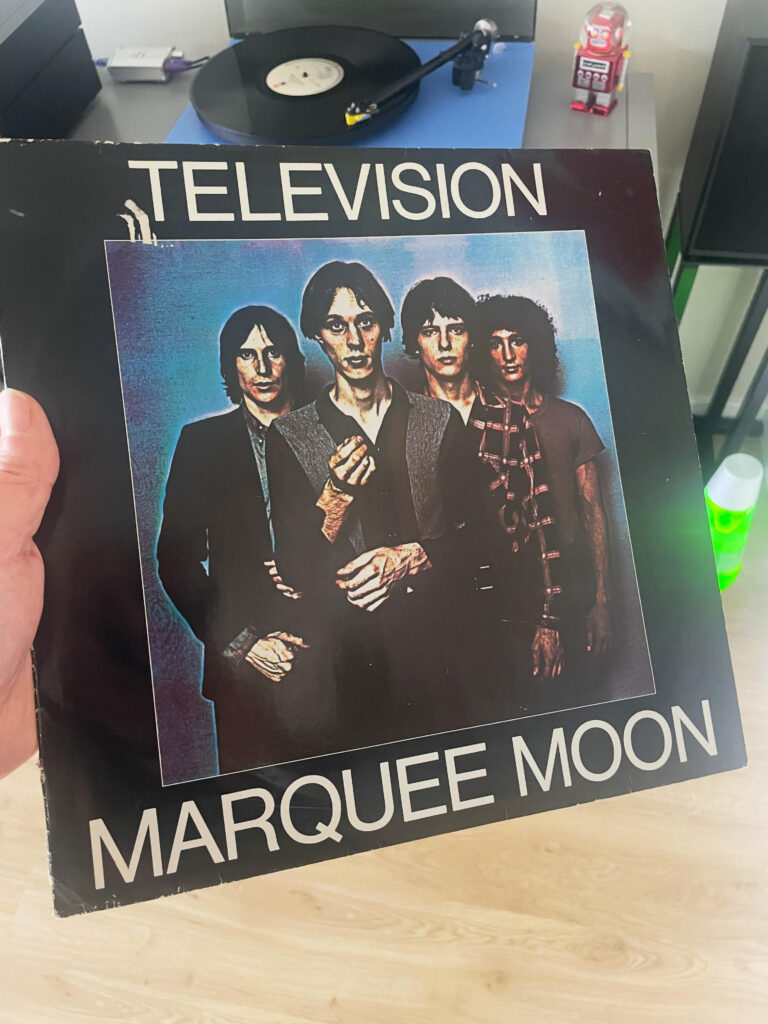
Retrospective: Television – Marquee Moon

New York in the mid to late Seventies was a city eating itself alive. Bankrupt on paper, feral in practice, littered with burnt-out cars, shuttered storefronts and the low-level menace of economic collapse. Out of this came CBGB, a former biker bar on the Bowery whose original promise of roots music curdled almost immediately into something far more interesting. It became a refuge for the literate, the maladjusted and the terminally dissatisfied. Punk did not so much arrive there as coagulate. And among the first bands to understand that this new language could be stretched, warped and interrogated rather than simply shouted was Television.

Tom Verlaine had already been living inside this world for years by the time Marquee Moon appeared in early 1977. Alongside Richard Hell he had escaped New Jersey boredom, bonded over poetry, speed and a shared belief that rock music should aspire to something sharper than stadium heroics. The Neon Boys, their early incarnation, were less a band than a sketchbook. When Hell departed in 1975 to form the Voidoids taking with him the ripped shirts and confrontational nihilism that would become punk’s uniform, Television were freed from the obligation to perform rebellion in quotation marks. What remained was a band increasingly obsessed with structure, tone and the slow burn of ideas unfolding over time.

CBGB became their proving ground. While other groups detonated through short sets like flash-bangs, Television played long, winding songs night after night, refining them in public. Guitar lines evolved incrementally. Tempos breathed. Solos were not indulgences but arguments. By the time Elektra committed them to tape, these songs had been lived inside, paced around, stripped back and rebuilt. This was not punk as rupture but post-punk as concentration.

The first thing that still startles about Marquee Moon is its clarity. In an era obsessed with distortion and speed, Television chose exposure. Verlaine and Richard Lloyd rejected the familiar hierarchy of rhythm and lead, opting instead for two guitars in constant dialogue. Lines coil, overlap and contradict each other. Melodies appear, dissolve, then reappear altered. Verlaine’s tone is all treble edge and nervous elegance, like fluorescent light flickering on wet pavement. Lloyd grounds the music without weighing it down, muscular but articulate. Beneath them, Fred Smith’s bass moves rather than anchors, while Billy Ficca’s drumming borrows from jazz as much as punk, restless, rolling, impatient with straight lines.

Andy Johns’ production deserves credit for knowing when to disappear. Best known for capturing the brute force of Zeppelin and the Stones, here he allows space to remain space. You hear fingers scrape strings, cymbals decay naturally, air move in the room. Nothing is smothered. Nothing is disguised.

The album unfolds like a series of nocturnal walks through the same city seen from different angles. “See No Evil” announces itself with a rush of romantic urgency, its guitars darting ahead of the beat as if chasing something just out of reach. “Venus” reframes desire as motion and uncertainty, its lyric more impression than declaration. “Friction” hums with paranoia, Verlaine’s voice hovering between detachment and barely concealed anxiety, a perfect document of urban overstimulation.

Then there is the title track, still one of the most audacious statements ever made by a band nominally associated with punk. Ten minutes long, refusing any conventional chorus, it unfolds patiently, methodically. The closing guitar passage is not a solo in the heroic sense but a gradual ascent, Verlaine circling a figure, stretching it, worrying at it, until something breaks open. It feels earned rather than delivered. The listener is trusted to stay with it.

That trust is why Marquee Moon continues to endure. It has never belonged comfortably to its moment. While safety pins and sneers quickly dated, this record remained oddly ageless. Its concerns alienation, romantic idealism, intellectual hunger, the solitude of city life still resonate because they were never tied to fashion. Each generation finds it not as an artefact but as an invitation.

Its influence is everywhere yet curiously diffuse. You hear its DNA in post-punk, indie and art rock, in bands who learned that guitars could converse rather than compete. Sonic Youth, R.E.M., The Strokes and countless others absorbed its lessons, but no one has ever really replicated it. That is because its magic lies in a precise convergence of people, place and temperament that cannot be reverse engineered.

Most new wave guitar records chased velocity and attitude. Marquee Moon chased precision and clarity. It demonstrated that intensity did not require volume, that virtuosity did not need flash, and that punk’s most radical gesture might be patience. Television never surpassed it and never needed to. The album stands complete, self-contained, immune to time.

It remains the sound of New York before it was cleaned up, when danger and beauty shared the same bar stool and ideas mattered as much as noise. A record that asks you to listen closely, think longer, and walk home alone replaying its guitar lines like secret diagrams. Not just one of the greatest new wave guitar albums, but one of the rare rock records that feels inevitable, as though it was always there, waiting for the right minds to tune into it.

OPINION: Art Punk & The Dismissal Of Punk Orthodoxy

Art punk was the moment punk stopped congratulating itself and started asking harder questions. Emerging in the late Seventies as a dismissal of punk orthodoxy and refusal to let that rebellion calcify into costume. It channelled punk’s energy through conceptual art, minimalism, electronics and a deep suspicion of rock mythology. Bands on both sides of the Atlantic treated punk less as a sound than as a method, stripping it down, warping it and, in some cases, dismantling it altogether. What followed was music that alienated as often as it thrilled, and in doing so quietly reshaped everything that came after.


Art punk was never a genre anyone involved bothered to name at the time. Like most labels that later harden into received wisdom, it was applied by critics trying to explain why certain Seventies punk records sounded wilfully strange, emotionally evasive and intellectually awkward compared to the pub-brawl version of punk that nostalgia prefers to freeze-frame. Punk, in the familiar story, was about demolition, a righteous zero hour where rock was burned down and rebuilt from instinct alone. Art punk accepted the need for destruction, then immediately started asking what else might be salvaged from the wreckage. Ideas, for one. Doubt, irony, formal experiment, the suspicion that rock music might actually benefit from thinking too hard about itself.

The distinction was not technical ability or even experimentation for its own sake, but intent. Art punk distrusted punk’s own emerging clichés almost as much as it despised the bloated theatrics of Seventies rock. It had no interest in authenticity as sweat or sincerity, seeing both as just another costume. Instead, it treated rock as a medium to be dismantled, reframed and occasionally mocked. Songs could be cut short, stretched into abstraction or reduced to repetition. Lyrics might read like fragments, slogans or private jokes at the listener’s expense. Performance itself became a problem to be solved, often by draining it of charisma altogether.

New York provided the first sustained proof that punk did not have to mean bluntness. Television looked like a rock band but behaved like a literary salon with amplifiers. Their long, spiralling guitar lines owed more to jazz, poetry and restraint than to punk’s scorched-earth economy. Marquee Moon remains a provocation precisely because it refuses easy allegiance. It is neither punk-as-slogan nor rock-as-spectacle, but something cool, elevated and faintly aloof, a record that suggested punk might be a framework rather than a rulebook.

Talking Heads took a different route, draining punk of romance and replacing it with tension. Early Talking Heads records sound like anxiety formalised, clipped rhythms and minimal figures supporting lyrics obsessed with alienation, systems and self-surveillance. Borrowing freely from Dada, conceptual art and pop anthropology, they treated the modern city as both subject and laboratory. Punk here was no longer about escape but about exposure, about making the listener sit with their own discomfort.

If Talking Heads intellectualised punk, Suicide obliterated its remaining assumptions. Drum machines, primitive synthesisers and confrontational repetition stripped rock to its barest, most threatening elements. Suicide were not interested in scenes, solidarity or even approval. Their music functioned like an endurance test, daring audiences to confront boredom, menace and emotional void. In retrospect, they feel less like a punk band than a warning about where punk might end up if it followed its own logic to the extreme.

That logic became even more unstable in the American Midwest. Pere Ubu sounded like industrial collapse rendered as art. Drawing on musique concrète, free jazz and an atmosphere of civic decay, they made punk that felt genuinely alien. The Modern Dance was not a refinement of punk but a mutation, proving that the form could absorb noise, abstraction and paranoia without becoming polite. It is no accident that later British post-punk musicians treated Pere Ubu less as peers than as evidence that almost anything was possible.

Conceptual control reached its most explicit form with Devo, who turned the band into a piece of performance art. Their theory of de-evolution, identical uniforms and mechanical rhythms drained rock of humanist pretence. Devo’s satire was not playful but forensic, exposing the stupidity and conformity beneath American optimism. Punk, for them, was simply the most efficient delivery system for bad news.

In Britain, art punk arrived not as an opening statement but as punk’s second thought. Once the safety pins were commodified and the outrage routinised, bands began interrogating what punk could still do. Wire understood earlier than most that punk’s real weapon was not speed or volume but reduction. Pink Flag treated songs as raw material, slogans rather than statements. What followed was even more radical: a steady erasure of punk itself in favour of electronics, abstraction and distance. Wire did not betray punk. They completed it, then moved on.

Magazine offered a more overtly literary escape route. Howard Devoto replaced punk’s blunt nihilism with modernist unease, his lyrics circling alienation, desire and power rather than simply rejecting everything in sight. The music incorporated keyboards and art-rock structures without lapsing into comfort. Magazine mattered because they insisted that punk intelligence did not have to disguise itself as rage.

If some of this still looked like rock music, Throbbing Gristle arrived to ensure that nobody in the U.K. at least felt safe confusing art punk with entertainment. Emerging directly from the performance art collective COUM Transmissions, Throbbing Gristle treated sound as material and provocation as principle. Tape loops, electronics, transgression and deliberate moral discomfort replaced songs altogether. Their work sits at the outer edge of art punk, but it is essential, because it demonstrates the endgame of punk taken seriously as an artistic idea rather than a style. Once you accept that anything can be questioned, you eventually question whether music needs to behave like music at all.

The influences that shaped these bands rarely pointed backwards. Minimalism suggested repetition without payoff. Krautrock offered propulsion without blues heritage. In praise of negative space Dub revealed space and absence as compositional tools. Conceptual art legitimised irony, framing and emotional detachment. Above all, art punk rejected sincerity as a moral virtue. Authenticity, as rock had defined it, was exposed as another sentimental fiction.

What makes art punk still matter is how badly it fits with the way punk is now remembered. Contemporary punk nostalgia prefers leather jackets, simple narratives and the comforting lie that rebellion can be endlessly replayed without consequence. Art punk tells a harsher truth. It says that punk only mattered when it refused to behave, when it alienated its audience, when it dismantled its own myths faster than the market could package them. Very little of that spirit survives in a culture that treats punk as heritage branding.

Art punk was not about saving punk. It was about proving that punk was disposable. That once its job was done, the only honest response was to push it somewhere uncomfortable and leave it there. The real scandal is not that punk ended, but that so much of what followed pretended it never asked these questions at all.