RETROSPECTIVE: Bowie, Standing By The Wall

Revisiting David Bowie’s Heroes decades on, this article explores its Berlin origins, the band behind the album, Brian Eno’s role and whether it stands apart from Low.

David Bowie Heroes Album Retrospective


By the time Heroes emerged in October 1977, Bowie had already disposed of the rulebook. Low had landed like a communiqué from another future, half songs, half atmosphere, a record that seemed to reject the very idea of audience comfort. The temptation has always been to frame Heroes as its louder twin, the one with the anthem, the one that returned Bowie to something approaching recognisable rock form. That reading does the album a disservice. Heroes is not a corrective to Low. It is an expansion, an album that breathes the same air but looks outward rather than inward, shaped by geography, by collaborators, and by a band operating at a rare level of collective intuition.

The setting matters. Hansa Tonstudio, perched within sight of the Berlin Wall, was not simply a studio but a vantage point. The city in 1977 was still scarred, divided, uneasy. Bowie absorbed that atmosphere completely. If Low felt like a psychological evacuation from Los Angeles excess, Heroes feels like Bowie standing still long enough to take in where he had landed. The walls, literal and emotional, are everywhere on this record.

The core band remained unchanged from Low, and that continuity is crucial. Carlos Alomar was once again the spine of the operation, his rhythm guitar style economical, precise, never showy. Alomar’s playing on Heroes is less funky than his work with the plastic soul era Bowie, but his sense of movement underpins everything. Dennis Davis on drums is similarly restrained but vital. His playing has a physical intelligence, knowing when to push and when to pull back, especially on tracks like Beauty and the Beast where tension is built through repetition rather than brute force. George Murray’s bass lines are melodic without drawing attention to themselves, often acting as a bridge between rhythm and texture.

Hovering above and around them is the now legendary pairing of Brian Eno and Tony Visconti. Eno’s influence is often overstated as some sort of ambient fog machine, but his real contribution lies in disruption. His Oblique Strategies cards, his encouragement of chance, his willingness to treat the studio as an instrument all helped Bowie escape habitual thinking. Visconti, meanwhile, grounded the chaos. His production on Heroes is cleaner and more assertive than on Low, particularly on the vocal tracks, but still full of space. The famous gated vocal effect on the title track, achieved by positioning microphones at varying distances that opened only when Bowie sang louder, is a perfect example of technology serving emotion rather than novelty.

The opening track, Beauty and the Beast, announces immediately that this is not a retreat into comfort. Bowie’s vocal is fractured, almost feral, darting between personas. Lyrically, it feels like a continuation of the internal struggle first exposed on Low, but externalised. The city is no longer a metaphor for the mind. It is the stage on which that struggle plays out. Fripp’s guitar slashes through the mix, not as a soloist but as a source of friction, pushing against the rigid rhythm beneath.

Fripp’s presence across the album cannot be overstated. Brought in at the last minute and reportedly completing his parts in a matter of hours, his playing defines the record’s emotional peaks. On Heroes the song, his sustained, soaring lines do not decorate the track, they lift it. The myth around the song often threatens to reduce it to its origin story, Bowie glimpsing Visconti and Antonia Maass kissing by the Wall. What matters more is how the music refuses sentimentality. The lyric never promises permanence, only intensity. We can be heroes, just for one day. It is defiant precisely because it accepts limitation.

Elsewhere on side one, Bowie continues to explore fractured identity and communication. Joe the Lion draws inspiration from performance artist Chris Burden, but it also feels like a self portrait in motion, Bowie throwing himself into the work with no safety net. Sons of the Silent Age is one of the album’s quieter triumphs, its crooning melody undercut by lyrics that hint at repression, at voices denied expression. Blackout closes the side in a rush of nervous energy, all clipped phrases and sudden turns, the sound of a mind overstimulated rather than soothed.

If side one is confrontation, side two is immersion. Like Low, Heroes gives over half its running time to instrumentals, but the mood is different. Where Low often felt like drifting through empty rooms, Heroes feels rooted in place. V-2 Schneider tips its hat to Kraftwerk but refuses pastiche, its groove mechanical yet strangely human. Bowie’s saxophone playing here is deliberately unschooled, cutting through the track like an alarm rather than a melody.

The trio of Sense of Doubt, Moss Garden and Neuköln forms the emotional heart of the album. These are not background pieces. They demand attention. Sense of Doubt is built on a descending piano figure that seems to sink deeper with each repetition, evoking a sense of inevitability. Moss Garden offers a brief illusion of calm, its Eastern inflections suggesting a spiritual escape that never quite arrives. Neuköln is the most unsettling of all, Eno’s treatments and Bowie’s sax combining into a mournful, alien soundscape that captures the loneliness of displacement. Named after a Berlin district known for its immigrant population, it resonates as a study in alienation without a single word being sung.

The closing track, The Secret Life of Arabia, is often treated as a curiosity, but it serves an important function. Its rhythm and melodic energy hint at movement, at travel beyond Berlin, beyond the album’s confines. It suggests that Bowie was already looking ahead, which history confirms. Lodger would soon scatter these ideas across the globe, but Heroes remains anchored, its power drawn from stillness rather than motion.

Over the decades, more details have emerged about the making of Heroes, but none of them diminish its mystery. The speed of the sessions, the reliance on instinct, the willingness to commit to first or second takes all speak to a creative moment that cannot be replicated. Bowie was sober, focused, and surrounded by collaborators who understood when to contribute and when to step back. This was not the sound of a genius imposing his will, but of a band and production team operating as a single organism.

So is Heroes merely a continuation of Low, or does it stand alone. The honest answer is both. It makes little sense without Low, yet it surpasses it in emotional range. Where Low fractures, Heroes reaches. Where Low withdraws, Heroes risks connection. In Bowie’s catalogue, it occupies a rare position. An experimental record with a genuine anthem, an art album that found its way into public consciousness without compromise.

RETROSPECTIVE: The Thin White Duke’s Disappearing Act

Bowie’s Low nearly half a century on.


In the pantheon of rock’s great reinventions, few albums have aged as gracefully, or as mysteriously as David Bowie’s Low. Released in January 1977 to widespread bewilderment and commercial indifference, this curious hybrid of fractured pop songs and ambient soundscapes now appears, from our 2025 vantage point, to be one of the most prophetic statements in popular music’s history.

The conventional narrative surrounding ‘Low’ has always centred on geography and biography: Bowie fleeing Los Angeles and its pharmaceutical temptations for the disciplined clarity of divided Berlin, collaborating with the electronic music pioneer Brian Eno to create something entirely new. Yet recent archival research has complicated this neat story considerably. Much of the album’s foundational work actually took place at the Château d’Hérouville studios in France, months before Bowie’s Berlin sojourn began in earnest. The geographical mythology, it transpires, was partly retrospective construction, though no less meaningful for that.

What emerges most clearly, nearly half a century on, is how ‘Low’ functions as both ending and beginning. It represents the final flowering of the rhythmic obsessions that had driven Bowie through his American soul period, yet subjects those same impulses to a process of systematic deconstruction that would influence popular music for decades to come. The rhythm section of Dennis Davis and George Murray, veterans of ‘Young Americans’ and ‘Station to Station’, found themselves playing against type – their customary precision dissolved into something more impressionistic, more concerned with atmosphere than with groove.

The Brian Eno collaboration proved transformative in ways that have become clearer with time. Eno’s methodology, the famous “Oblique Strategies” cards, his insistence on removing conventional guitar solos, his suggestion that Carlos Alomar play rhythm parts without chord progressions, represented a systematic assault on rock orthodoxy. The results were songs that barely qualified as songs at all: “Breaking Glass” distils two minutes of nervous energy into treated percussion and fractured vocals, whilst “What in the World” transforms romantic yearning into something that might have been transmitted from outer space.

The album’s bipartite structure – seven relatively orthodox pop songs followed by four extended instrumental pieces – baffled RCA’s marketing department and contributed to its commercial failure in America. From today’s perspective, however, this division appears remarkably prescient. The instrumental suite that occupies ‘Low’ s second side anticipates much of what we now recognise as ambient music, electronic composition, and even certain aspects of contemporary hip-hop production. These are not songs to be sung along with but environments to be inhabited.

Recent scholarship has illuminated the extent to which these instrumentals drew from Bowie’s direct observation of Berlin’s divided landscape. “Warszawa”, despite its Polish title, was inspired by a fragment of Eastern European folk music encountered during train travel, yet the wordless vocal improvisations that crown the piece were shaped by Bowie’s response to the city’s displaced populations. The recent revelation that much of the composition employed a Chamberlin keyboard loaded with authentic folk samples adds another layer to its haunting effectiveness.

“Art Decade”, the album’s most austere moment, benefits enormously from contextualisation within Berlin’s cultural and physical landscape. The title references both artistic periods and the literal decay Bowie witnessed in the city’s bombed-out quarters. The track’s processed saxophone, actually Bowie himself, electronically treated beyond recognition – creates a soundtrack for urban desolation that prefigures everything from post-punk’s architectural obsessions to contemporary electronic music’s fascination with industrial decay.

Perhaps most remarkably, ‘Low’ anticipated many of the anxieties that characterise our current cultural moment. The paranoia that suffuses tracks such as “Always Crashing in the Same Car” was attributed at the time to pharmaceutical excess, yet it reads today as remarkably prescient about our surveillance-saturated digital existence. The isolation and disconnection that runs through the album’s emotional landscape prefigures our contemporary struggles with technology-mediated relationships and algorithmic social control.

The album’s commercial disappointment, number three in Britain, invisible in America – now appears less like failure than validation. Records of this ambition and difficulty are not intended for mass consumption; they are designed to influence everything that follows. And the influence has been extraordinary: the template ‘Low’ established can be traced through post-punk, new wave, ambient house, and contemporary art-pop. Its innovations have become so thoroughly absorbed into popular music’s vocabulary that they no longer sound revolutionary – the ultimate mark of success.

What continues to astonish is how genuinely futuristic much of Low remains. The drum sound that producer Tony Visconti achieved by positioning microphones in a stairwell – compressed, gated, artificially enhanced – established the template for 1980s pop production. Yet it originated here, in service of compositions that had no commercial ambitions whatsoever. Similarly, the harmonic treatments applied to Bowie’s vocals created textures that sound alien even today.

Recent discoveries in the Bowie estate’s archives have only confirmed ‘Low’s status as a masterpiece of studio technique. Alternate mixes recently made available reveal the extraordinary care that went into every sonic decision. The stripped-back version of “Sound and Vision” demonstrates how much archaeological work underpinned the finished product – every element feels essential, irreducible, the result of countless hours of experimentation distilled into perfect miniatures.

‘Low’ endures because it solved a problem most popular artists never recognise: how to maintain visibility whilst achieving genuine artistic invisibility. Bowie created his most personal statement by becoming deliberately less human. The electronic processing, the ambient diversions, the systematic removal of conventional rock signifiers – these represent methods of artistic evacuation, ways of escaping the personality cult that threatened to consume him.

From our current perspective, with knowledge of everything that followed – the completion of the Berlin trilogy, the commercial rehabilitation, the decades of recycling past innovations – ‘Low’ appears as Bowie’s most courageous artistic statement. It represents the sound of a major popular artist refusing the safety of established success, choosing instead to venture into genuinely uncharted musical territory.

The album concludes with “Subterraneans”, originally conceived as music for The Man Who Fell to Earth, and the piece provides an apt metaphor for the entire enterprise. It is the sound of something recognisably human being processed through alien technology, emerging transformed but not destroyed. Nearly fifty years after its creation, this remains the most accurate description of what ‘Low’ achieved – and why it continues to matter.

ART POP / POP ART: The Surrealist Madness Of Vivian Stanshall

In the pantheon of British eccentrics who emerged from the art school movement of the 1960s, few figures loom as large or as magnificently unhinged as Vivian Stanshall. The towering frontman of the Bonzo Dog Doo-Dah Band represented something rather special in the landscape of British popular culture, a genuine surrealist who happened to stumble into rock and roll, bringing with him all the anarchic spirit and intellectual rigour of the art college underground.

Stanshall’s journey began at the Central School of Art and Design in London, where he arrived in the early 1960s with a head full of ideas and a theatrical sensibility that would prove impossible to contain within the conventional boundaries of fine art. The art schools of this period were hotbeds of creative ferment, places where the rigid class structures of British society seemed temporarily suspended, allowing working-class lads and middle-class misfits to rub shoulders with genuine bohemians and intellectual provocateurs.

At Central, Stanshall encountered not just the formal education in painting and sculpture that one might expect, but a whole universe of avant-garde thinking. The influence of Dada and Surrealism was particularly strong, movements that had already begun to seep into British popular culture through the work of figures like Spike Milligan and the Goons. For Stanshall, these weren’t merely historical curiosities but living, breathing philosophies that could be applied to everything from performance art to popular music.

The formation of the Bonzo Dog Doo-Dah Band in 1962 represented a natural evolution of Stanshall’s art school sensibilities. Originally conceived as a traditional jazz band with a twist, they initially called themselves the Bonzo Dog Dada Band – the group quickly evolved into something far more ambitious and bizarre. Stanshall’s vision was to create a kind of musical vaudeville that would incorporate elements of Victorian music hall, dadaist performance art, and rock and roll rebellion into a coherent (if completely mad) whole.

What made Stanshall particularly remarkable was his ability to synthesise high art concepts with genuinely popular entertainment. His lyrics displayed an encyclopaedic knowledge of British cultural history, from music hall traditions to surrealist poetry, yet they were delivered with such theatrical panache that they connected with audiences who might never have set foot in an art gallery. Songs like “I’m the Urban Spaceman” and “The Intro and the Outro” demonstrated his genius for creating pieces that were simultaneously sophisticated artistic statements and genuinely catchy pop songs.

The art school influence on Stanshall’s work manifested itself in numerous ways. His approach to performance was thoroughly theatrical, incorporating costume changes, elaborate props, and a kind of arch, self-aware humour that owed as much to conceptual art as it did to traditional comedy. The Bonzos’ performances were events rather than mere concerts, multimedia happenings that anticipated the performance art movement by several years.

Stanshall’s visual sensibility, honed during his time at Central, was equally important to the band’s identity. He was intimately involved in the design of album covers, stage sets, and promotional materials, ensuring that every aspect of the Bonzo Dog experience reflected his particular vision of organised chaos. The band’s aesthetic, a collision of Victorian imagery, psychedelic colour schemes, and surrealist juxtapositions became as important to their identity as their music.

Perhaps most significantly, Stanshall embodied the art school principle that popular culture could be a legitimate vehicle for serious artistic expression. At a time when the boundaries between high and low culture were being enthusiastically demolished by figures like Andy Warhol and Roy Lichtenstein, Stanshall demonstrated that a rock band could function as a kind of conceptual art project. The Bonzos weren’t simply making music; they were creating a complete artistic statement that encompassed music, performance, visual art, and cultural commentary.

The influence of particular teachers and movements within the art school system can be traced throughout Stanshall’s career. The emphasis on interdisciplinary collaboration that characterised art education in the 1960s clearly shaped his approach to the Bonzos, where traditional hierarchies between musicians, artists, and performers were gleefully ignored. The group functioned more like a collective of artists than a conventional rock band, with members contributing visual ideas, theatrical concepts, and musical arrangements in equal measure.

Stanshall’s later work, including his collaborations with Mike Oldfield and his extraordinary radio series “Rawlinson End,” (find it and thank me) continued to reflect his art school background. His ability to create rich, detailed fictional worlds populated by eccentric characters drew heavily on the surrealist tradition of automatic writing and stream-of-consciousness narrative. The character of Sir Henry Rawlinson, in particular, represented a kind of literary performance art, a sustained act of creative imagination that existed across multiple media.

The tragedy of Stanshall’s career was that his artistic vision was perhaps too uncompromising for the commercial music industry. Whilst the Bonzos achieved considerable success in the late 1960s including a number one hit with “I’m the Urban Spaceman” their refusal to conform to conventional expectations of what a pop group should be ultimately limited their commercial appeal. Stanshall’s perfectionism and his insistence on creative control made him a difficult figure for record companies to manage, and his later career was marked by periods of creative frustration, alcoholism and tragic personal difficulty.

Yet this very uncompromising quality was what made Stanshall such an important figure in the intersection of art and popular music. He demonstrated that it was possible to maintain artistic integrity whilst operating within the commercial music industry, albeit at considerable personal cost. His influence can be traced through subsequent generations of British musicians who have sought to combine intellectual rigour with popular appeal, from David Bowie’s theatrical persona to the conceptual complexity of bands like Radiohead.

The art school tradition that produced Stanshall represented a unique moment in British cultural history, a brief period when the boundaries between different forms of artistic expression seemed genuinely permeable. The education he received at Central School of Art and Design didn’t simply provide him with technical skills; it gave him a framework for understanding culture as a kind of raw material that could be manipulated, subverted, and transformed through the application of artistic imagination.

In the end, Vivian Stanshall’s legacy lies not simply in the music he made with the Bonzo Dog Doo-Dah Band, remarkable though that was, but in his demonstration that popular culture could be a vehicle for genuine artistic expression. His career represented a sustained argument for the possibility of maintaining artistic integrity within the commercial music industry, and his influence on subsequent generations of musicians who have sought to blur the boundaries between high and low culture cannot be overstated. He remains one of the most compelling examples of how the art school tradition of the 1960s could produce figures who were simultaneously serious artists and genuine eccentric entertainers, a combination that seems increasingly rare in our more compartmentalised cultural landscape.

He was also a collaborator with and close friend of Keith Moon which is a whole other story.

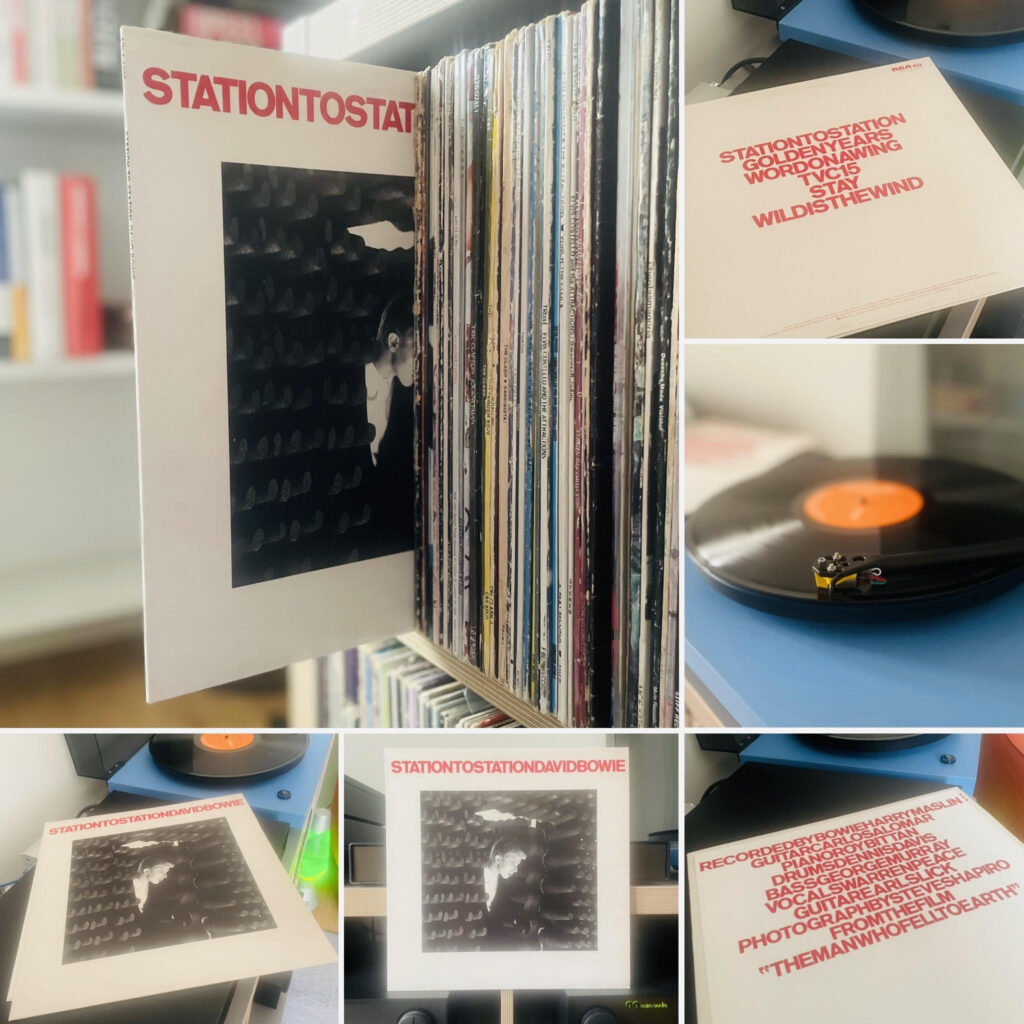
RETROSPECTIVE: Bowie’sStationTo StationWithNoDartsInLovers’Eyes

Time takes a Bowie album… and spawns the definitive retrospective.


It’s time for a Bowie Retrospective. After Young Americans, this is his trans-Atlantic mid-Seventies masterpiece signposting the genius redux on the horizon.

Nearly fifty years hence, Station To Station remains David Bowie’s most perplexing achievement, neither his most revolutionary nor his most accessible, but certainly his most necessary. Released in January 1976, it occupies that peculiar position in an artist’s canon where personal crisis, manic depression and artistic clarity converge with inspired precision. That Bowie himself claims to remember virtually nothing of its creation only deepens the mystery: how does one’s most cohesive statement emerge from complete psychological fragmentation? Or does it? It’s common knowledge people often have little or no recollection of bipolar episodes, and Seventies’ Bowie (Class A aside) is textbook manic episode creativity. But I digress.

The album functions as a fulcrum upon which Bowie’s entire career pivots, the moment when the glitter-encrusted showman shed his sequined skin and at this time alien contacts, to reveal something altogether more unsettling beneath. Six tracks, just six, yet each one a movement in what amounts to a symphony of identity crisis. This is Bowie as musical Dr. Jekyll, conducting experiments upon his own psyche with the detached fascination of a laboratory technician.

Musically, Station To Station represents Bowie’s most successful synthesis of seemingly incompatible elements. The Philadelphia soul he’d absorbed during his Young Americans period, that white British art-school graduate slumming it in the City of Brotherly Love (Brother Lee Love I only just got it during research) collides head-on with the mechanical metronomic precision of European electronic music. It shouldn’t work, this marriage of American warmth and Teutonic coldness, yet somehow it births something entirely new.

Earl Slick’s guitar work deserves particular attention. Gone are the bluesy histrionics and Sixties influences that had characterised Bowie’s previous guitar heroes; instead, Slick delivers lines that cut like scalpels, each note placed with obsessive precision. Listen to his work on “Stay”, those slashing chords that punctuate the verses aren’t mere rock posturing but architectural elements, supporting the song’s claustrophobic emotional weight. It’s guitar playing as urban planning, all sharp angles and deliberate omissions. The track itself embodies the album’s central tension: a seemingly straightforward rocker that reveals layers of unease beneath its propulsive surface. Bowie’s vocal alternates between desperate pleading and detached observation, while the band locks into a groove that feels simultaneously urgent and mechanical, the sound of someone running in place, trapped by their own momentum.

The rhythm section of Dennis Davis and George Murray provides the album’s mechanical heartbeat, a pulse that feels simultaneously human and robotic. Their work on the title track’s opening section transforms a simple 4/4 into something approaching industrial music, three years before Throbbing Gristle made such sounds esoterically fashionable. This is the rhythm of assembly lines and commuter trains, the metronomic beat of modern alienation. But “Station To Station” functions as more than mere sonic experimentation it’s a ten-minute manifesto of identity dissolution. The track’s structure mirrors its lyrical journey from European mysticism to American soul, with Bowie literally traveling from one musical station to another. The opening’s stark, almost ritualistic atmosphere gives way to the gospel-influenced finale, yet something essential remains lost in translation. The Duke emerges not as synthesis but as absence, the negative space between stations where no trains stop. Thankfully the Trilogy confirms he bought a return ticket.

Lyrically, Bowie constructs a peculiar theology that borrows from Nietzsche, Cambridge educated bisexual Aleister Crowley, the Kabbalah’s occultism, Judeo-Christianity and his infamous cocaine, milk and peppers fuelled paranoia. It’s a sort of spiritual algebra where traditional religious symbols are multiplied by pharmaceutical insight and divided by sexual desperation. If a Rock Star could be thus – gender confusion? The results don’t always make sense indeed, they’re not supposed to. This is the sound of a mind in free fall, grasping at mystical straws.

“TVC 15” transforms what might have been a simple paranoid episode into a peculiar love song addressed to a television set, the kind of domestic surrealism that would later mark Talking Heads’ best work. Yet where David Byrne would approach such material with Asperger’s detachment, Bowie invests it with genuine longing. The Duke may be emotionally vacant, but he’s not entirely dead inside.

It’s “Word On A Wing,” however, that provides the album’s most naked moment. Disguised as a love song but functioning as a prayer, it finds Bowie reaching towards something approaching grace. His vocal performance here, multi-tracked harmonies that create a choir of Bowies, each one seeking salvation in a slightly different key, represents perhaps his most vulnerable moment on record. The Duke’s marble facade cracks just enough to reveal the frightened human beneath.

The album’s visual identity proves equally calculated. That stark red-black-and-white cover avec an iconic still from Nicolas Roeg’s The Man Who Fell To Earth captures something essential about both album and era. Here is Bowie mid-stride, embodying alien detachment that defined the star mid-Seventies. The bold, minimalist typography strips away baroque excess, replacing it with corporate authority. This is alienation made manifest through graphic design, the Duke as extraterrestrial advertising executive smack bang in the peak Fifth Avenue heyday. And a lovely futuristic font style it is and stylistically redeployed here.

The synchronicity between album and film feels almost too neat, yet it works. Thomas Jerome Newton, Bowie’s gin-soaked alien entrepreneur, shares the Duke’s emotional remove and otherworldly perspective. Both exist as commentaries on American excess, observers rather than participants in the society they critique. That both emerged from the same period of pharmaceutical dissolution creates a multimedia meditation on identity and exile that feels genuinely prophetic.

Yet Station To Station is not without its limitations. The album’s brevity at barely 38 minutes is cruel to fans. Similarly, the album’s obsessive perfectionism occasionally works against it. Every element serves the whole, certainly, but sometimes one craves the messy humanity of Diamond Dogs’ unguarded moments. The Duke’s emotional detachment, while conceptually fascinating, can feel genuinely cold, a frigid barrier between artist and audience that even Bowie’s considerable charisma cannot entirely overcome. There’s a warmth in “Golden Years” that’s residual from the previous Young Americans album but different enough to spawn it’s own Bowie-generation, a stunning inclusion and single release that almost makes up for any deficiencies. We’re not going near the infamous salute and flirtation with the far right or any misunderstandings, but they exist so merit this mention.

The cover of “Wild Is The Wind” succeeds brilliantly as vocal performance but fails to entirely justify its inclusion. While Bowie’s voice stretches towards notes that seem almost beyond reach, a man grasping for salvation it remains unclear what this particular song adds to the album’s overarching narrative. It’s beautiful certainly, and would we be without it (a non-album single?) but beautiful in a way that feels slightly disconnected from the Duke’s particular path right then .

What makes Station To Station essential is not its perfection but its necessity. This is Bowie’s ‘Exile on Main St.’ an album born from extremity that transcends its circumstances. Where other artists might have been consumed by such personal turmoil, Bowie channelled it into his most disciplined statement. The cocaine psychosis that nearly destroyed him instead crystallised into diamond-hard brilliance.

The album’s influence can be traced through decades of post-punk anxiety, from Joy Division’s mechanical depression to The Prodigy’s electro-dance-punk hybrid. The Thin White Duke’s aesthetic all sharp suits and sharper cheekbone became a shorthand for alienated glamour, reimagined via the New Romantic Blitz Club Bowie Nights while the music’s marriage of warmth and coldness prefigured everything from New Order to Bloc Party.

Yet its true achievement lies in its function as an artistic Ground Zero. This is Bowie burning down his house to see what survives the flames, and discovering that what emerges from the ashes (to ashes) is something genuinely new. The Duke may be dead, but his ghost haunts everything Bowie would subsequently create, a reminder that sometimes the most profound art emerges not from comfort but from the desperate need to survive one’s own worst impulses or embedded periodic psychopathy.

Station To Station endures as proof that artistic necessity and personal crisis can produce results that transcend both. It’s neither Bowie’s most adventurous work nor his most commercially successful, but it may be his most honest and human, a document of a mind at war with itself, achieving temporary ceasefire through the discipline of writing and playing. In its now frozen perfection, it captures something essential about the terror of an artist in free fall, creating masterpieces from a wreckage of his own making.

#nowplaying Golden Years whap whap.

ART POP / POP ART: David Bowie, Art Classes & Derek Boshier

The Art School Dandy. Bowie’s Brush With Bohemia.

There was always something different about David Bowie, wasn’t there? While his contemporaries were busy being rock stars, he was busy being something else entirely: an art project with a guitar. As the rest of rock’s aristocracy draped themselves in velvet and attitude, young David Jones was meticulously crafting personas with the same care a painter applies to canvas or a sculptor to stone. And why wouldn’t he? The lad was steeped in art school sensibilities before he ever picked up a microphone.

When Bowie space-walked into our consciousness in the late Sixties, he brought with him the baggage of Bromley Technical High School, where his art teacher Owen Frampton (incredibly the father of “Frampton Comes Alive” Pete, as cosmic coincidence would have it) had stuffed the boy’s head with possibilities. It was here that our man first encountered the heady brew of visual thinking that would define his career. While most pop stars were channeling Elvis and Chuck Berry, Bowie was communing with the ghosts of Marcel Duchamp and Kurt Schwitters.

“I’ve always been a visual thinker, the music was always just one part of the whole package. I needed the visual element to complete the circuit.” David Bowie.

And complete it he did, in a series of personas that functioned less as costumes and more as living exhibitions of performance art: Ziggy Stardust, Aladdin Sane, the Thin White Duke. Each one a walking gallery installation, meticulously curated down to the last detail.

But it was his relationship with the British Pop Art movement that truly illuminated Bowie’s approach. Enter Derek Boshier, the pioneering artist whose conceptual thinking provided the spark for one of Bowie’s most iconic album sleeves.

Boshier, a graduate of the Royal College of Art and contemporary of David Hockney, had been pushing the boundaries of Pop Art since the early Sixties. By the time he encountered Bowie in the mid-Seventies, both men were operating in that fertile territory where high art and pop culture collide with the force of subatomic particles in CERN’s hadron collider.

The concept for “Heroes” that stark, Eno-drenched masterpiece of 1977, came directly from Boshier’s fascination with gesture and posture. The now iconic image of Bowie, arm raised in a peculiar mime salute that’s neither fascist nor friendly, was Boshier’s suggestion: a visual quotation of Erich Heckel’s painting “Roquairol.” It’s the kind of art-historical reference that would fly over the heads of most rock stars, but for Bowie, it was the nectar of Zeus.

“David understood exactly what I was trying to do, most musicians want to look cool or dangerous. David wanted to look interesting. That’s the art school influence right there choosing the intellectually provocative over the merely attractive.” Derek Boshier.

This wasn’t just about album covers, either. When Bowie moved to the Brutalist rebuilt concrete city of Berlin in the late Seventies, he wasn’t just running from cocaine and Los Angeles; he was deliberately placing himself in the epicentre of European expressionism. While holed up in that apartment above the auto parts shop, he wasn’t just sharing with Iggy Pop or recording with Eno; he was making pilgrimages to the Brücke Museum, communing with the ghosts of German expressionism.

The Berlin trilogy of “Low,” “Heroes,” and “Lodger” wasn’t just a musical departure; it was Bowie’s most explicit attempt to translate the fractured perspectives of expressionist art into sound. Listen to the instrumental second side of “Low” and you will ‘hear’ the angular distortions of Kirchner or the colour explosions of Nolde translated into synthesiser washes and oblique rhythms.

Even his collaborators were chosen with an art school sensibility. Brian Eno wasn’t just a sonic innovator; he was a graduate of the Winchester School of Art and a student of cybernetic theory and systems thinking. Their collaborations were less traditional songwriting sessions and more like conceptual art happenings, with Eno’s Oblique Strategies cards, themselves pure art school, directing the creative flow.

“The thing about David is that he approached recording studios the way other artists approach galleries. Each album was an installation, a complete environment with its own rules and internal logic.” Tony Visconti Record Producer.

This approach reached its zenith with Boshier’s involvement in the “Lodger” sleeve, an elaborate piece of conceptual art disguised as an album cover. The distorted image of Bowie falling, the deliberate reference to Polaroid manipulation techniques this wasn’t just packaging; it was a manifesto.

Throughout the Eighties, as Bowie’s commercial star rose and his artistic credibility occasionally wobbled, the art school influence remained his secret weapon. Even at his most commercial, during the “Let’s Dance” period, there was always something slightly off-kilter about his presentation a knowing wink to the cognoscenti that this, too, was performance art.

By the time he re-emerged with the industrial crunch of “Outside” in 1995, Bowie had circled back to his art school roots with a vengeance. Collaborating with Brian Eno again, he created not just an album but a complete fictional world populated by characters like Nathan Adler and Baby Grace Blue a concept album that owed more to installation art than it did to “The Rise and Fall of Ziggy Stardust.”

For his part, Boshier remained a touchstone throughout Bowie’s career, the connection to an art school sensibility that never left him. Their collaborations from “Heroes” through to Bowie’s later years represented one of pop music’s most enduring dialogues between rock and visual art.

In an era when most rock stars were content to be rock stars, Bowie remained defiantly, stubbornly, gloriously an art student at heart the smartest kid in the classroom who never stopped asking “what if?” While others were content to give the audience what they wanted, Bowie insisted on giving them what they didn’t know they needed.

His final album, “Blackstar,” released just days before his death in 2016, was perhaps his most complete art statement; a multimedia farewell that incorporated music, video, graphic design, and performance into a single, devastating whole. The falling astronaut, the blind prophet, the button-eyed specter weren’t just music video conceits; they were the culmination of a lifetime spent at the intersection of rock and conceptual art.

David Bowie wasn’t just influenced by art school thinking; he was its greatest ambassador in the realm of popular music. He took the experimental, boundary-pushing ethos of the art school and smuggled it into the mainstream inside trojan horses made of glitter, lightning bolts, and a space travelling Pierrot.

As we approach the tenth anniversary of his departure from this particular dimension, it’s worth remembering that Bowie’s greatest creation wasn’t Ziggy or the Thin White Duke or even his fabulous canon. It was the concept of David Bowie himself, the ultimate mixed-media art project, a half-century in the making, that changed not just music but the very idea of what a pop star could be.

For that, we have the art schools to thank. Not bad for an education that most parents would have considered a waste of time, eh?

__

Art Pop / Pop Art: a study of the influences of art school, famous artists and movements on pop and rock music. Those institutions where failure is motivation, where the eccentric and pretentious emerge into the fascinating space where art and music meet.