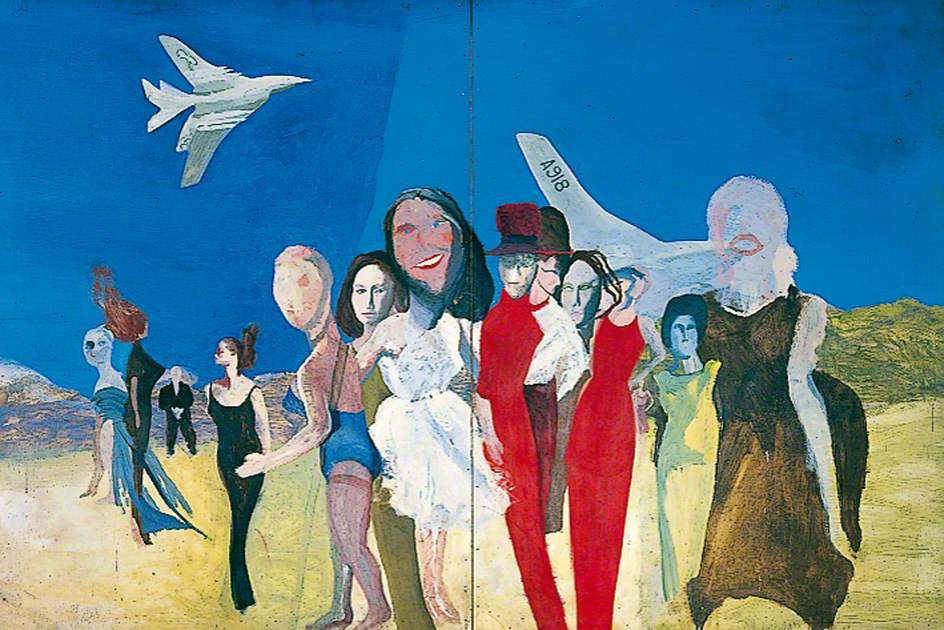
Art: Waiting Women and 2 Nuclear Bombers (Handley Page Victors) – Colin Self (b.1941)

While the world waits as the United States and Israel rains missiles on Iran and Iran rains missiles on its neighbours I’m reminded of this Pop Art painting in the permanent collection at the Pallant House Gallery in Chichester, West Sussex. United Kingdom.

Colin Self Waiting Women and Two Nuclear Bombers (Handley Page Victors) (1962)


Somewhere between the optimism of early Sixties Pop Art and the shadow cast by the hydrogen bomb sits Waiting Women and Two Nuclear Bombers (Handley Page Victors), painted in 1962 by Colin Self. It is a strange, poised work. Bright on the surface, quietly uneasy underneath.

1962 is not just a date in an art catalogue for me. It is the year I was born. That makes the painting feel less like distant history and more like a snapshot taken at the exact moment my own life begins. Britain a nuclear Superpower was entering the decade of The Beatles, Carnaby Street and colour television. Yet it was also the year of the Cuban Missile Crisis, when the United States and the Soviet Union came within days of nuclear war.

Self captured that contradiction before it had even settled into the culture.

The image itself is deceptively simple. Women stand in a flattened, stylised landscape while, above them, two Handley Page Victor aircraft cross the sky. The Victor was one of Britain’s V-force nuclear bombers, designed in the 1950s to carry atomic weapons deep into Soviet territory. Alongside the Vulcan and the Valiant it formed the backbone of the United Kingdom’s airborne nuclear deterrent until the Royal Navy’s Polaris submarines took over the role at the end of the 1960s.

The Victor itself was a remarkable aircraft. With its crescent shaped wing and high mounted tailplane it looked unlike anything else flying at the time. Even now it has an elegance. Self clearly recognised that. In the painting the bombers are sleek, almost beautiful silhouettes. They drift across the sky with the calm assurance of machines built to deliver unimaginable destruction.

That juxtaposition hits me in a personal way. My grandfather flew as a Flight Engineer in RAF Handley Page Halifax aircraft during the Second World War. The Halifax was a heavy bomber of an earlier generation, blunt nosed and purposeful, built for long night raids over occupied Europe. The men who flew them faced an average operational tour survival rate that was frighteningly low. To see the Victor, twenty years later, rendered with the polish of Pop Art glamour brings home how quickly aviation moved from wartime necessity to Cold War deterrence.

Below the aircraft stand the “waiting women” of the title. They are elegant figures, almost mannequin like, reminiscent of the female silhouettes used in early Sixties fashion illustration. They do not react to the bombers. They simply stand, composed and still. My grandmother Iris used to wait with other wives for their loved ones’ aircraft to return, the pilots used to ‘buzz’ the school when they returned to Tarrant Rushton.

The word “waiting” matters.

In 1962 Britain’s nuclear bombers were maintained on high readiness, able to take off quickly if war broke out. Deterrence depended on the idea that the aircraft were always ready to fly. The Cold War was therefore defined not by constant conflict between nuclear powers but by a prolonged stress position of poised anticipation.

Self’s painting captures that psychological condition with surprising accuracy.

Nothing dramatic happens in the image. The aircraft do not dive or attack. There is no explosion. No siren. Just two machines passing quietly overhead while figures remain suspended in a moment that never quite resolves.

Seen now, more than sixty years later, the painting has acquired a renewed relevance. The geopolitical landscape has shifted again. In Europe and the MIddle East nuclear armed states are involved in active conflicts or strategic confrontations. Military aircraft patrol contested borders. Political rhetoric has sharpened. Once again there is talk, however cautious, about nuclear escalation.

The uncomfortable truth is that the world still lives in the same suspended condition Self painted in 1962. The weapons exist. The delivery systems are maintained. The calculations continue.

Pop Art often celebrated the surfaces of modern life. The bright packaging, the advertisements, the sleek industrial design. British mid-century artists such as Peter Blake, Derek Boshier and Richard Hamilton found inspiration in popular culture and the everyday imagery of the new consumer society. Self shared that visual language but his subject matter was often darker.

He dropped the bomb into Pop Art.

That is what makes Waiting Women and Two Nuclear Bombers such an intriguing work. It sits between glamour and annihilation. The sky is clear, the aircraft are elegant, the figures calm. Yet the title quietly reminds us what those machines were built to carry.

More than sixty years after it was painted, the picture still feels suspended on that precipice. The bombers glide overhead. The women wait.

Retrospective: Bending The Space Time Continuum With Siouxsie and the Banshees

What if the darkest records are not the loudest, but the most controlled? What if the albums that linger are the ones that bend the air in the room rather than batter it? In 1981, Juju by Siouxsie and the Banshees arrived without bombast, yet it altered the physics of post-punk. This is not just a revisit of a proto-gothic touchstone, but a forensic look at how tension, texture and John McGeoch’s discordant guitar architecture combined to create a record that still distorts the light more than four decades on.

Siouxsie and the Banshees Juju Retrospective


Some albums feel as though they were forged rather than pressed, as if the grooves were cut into something denser than plastic. Not vinyl, but matter with its own gravitational pull. The kind of record that seems to bend the space around the turntable, to alter the light in the room once the needle drops. Juju by Siouxsie and the Banshees is one of those records. We remember it as blacker than black not because of chemistry or pressing plant folklore, but because it behaves like dark matter, invisible yet undeniable, distorting everything that drifts too close.

When it arrived in 1981, the Banshees were not evolving so much as condensing. Earlier line-ups had explored abrasion, fracture, psychedelia. With John McGeoch fully integrated alongside Siouxsie Sioux, Steven Severin and Budgie, the band found a way to make tension feel engineered rather than instinctive. This was not a question of genre alignment. It was a question of control. The songs on Juju feel calibrated, their emotional temperature set deliberately cool, their eruptions carefully rationed.

McGeoch’s contribution is often described in terms of texture, but that risks underselling the precision of his discord. He favoured suspended fourths and fifths, open strings ringing against fretted notes a semitone away, small harmonic frictions that never quite resolve. On “Spellbound,” the signature figure is built from interlocking arpeggios that refuse to land squarely on a comforting root. The chorus effect widens the sound, but it is the interval choices that create unease. He lets notes hang just long enough for their overtones to collide. The result is tension without clutter.

Nigel Gray’s production understands that less is not emptiness. The album is remarkably defined. Budgie’s toms are tuned to resonate rather than thud, giving his circular patterns a ritualistic thrum. Severin’s bass is forward enough to be melodic but never woolly. The guitar is bright, sometimes almost metallic, carved into its own frequency range so that every harmonic scrape is audible. Nothing bleeds. Nothing smears. The darkness comes from structure, not murk.

If McGeoch bends the air, Siouxsie controls its pressure. Her vocal performance across Juju is far more technical than its reputation for incantation suggests. She uses vibrato sparingly, often holding notes straight and cool before allowing the slightest tremor at the tail end. On “Arabian Knights,” she tightens her phrasing, clipping consonants, letting certain vowels stretch into faint sneers. The effect is not melodrama but disdain sharpened to a point. She sings slightly behind the beat at key moments, creating drag against Budgie’s insistent patterns.

“Monitor” showcases another facet of her control. She narrows her tone, almost flattening it, reducing expressive flourish so that the lyric feels observed rather than confessed. The performance mirrors the theme of surveillance. She sounds as though she is watching herself sing. That self-conscious distance becomes part of the album’s architecture.

“Into the Light” deserves closer inspection than it often receives. The track is driven by a pulsing, almost motorik bass figure from Severin, but it is McGeoch’s ascending arpeggios that give it lift. He builds the main pattern from repeating shapes that shift position incrementally, creating the sensation of upward motion without obvious modulation. The guitar tone is cleaner here, less abrasive, but the intervals remain unsettled. There is always a note that sits slightly askew, preventing the euphoria from turning soft.

Siouxsie meets that structure with one of her most dynamic performances on the record. She begins in a relatively low register, voice contained, then gradually opens it out, allowing more air into the tone as the song expands. Listen to the way she attacks the word “light,” the initial consonant crisp, the vowel bright but never sentimental. She resists full-throated release. Even at the track’s most expansive moments, she maintains a core of steel in the sound. The transcendence here is disciplined. It rises, but it does not dissolve.

The production reinforces this restraint. Gray keeps the drums dry enough to feel immediate, avoiding cavernous reverb that would have pushed the track into bombast. Delay is used to create width rather than wash. The stereo image feels stretched but anchored, the rhythm section holding the centre while guitars flicker at the edges. The effect is propulsion without chaos.

“Voodoo Dolly” remains the album’s slow detonation. It begins with space. McGeoch voices chords with deliberate gaps, leaving a hollow in the middle of the mix. As the track builds, he increases density rather than distortion. Additional notes are layered, sustains lengthen, dissonances become more pronounced. Budgie tightens his patterns, the toms growing more insistent. Severin’s bass thickens the floor.

And Siouxsie changes. Her repeated line becomes progressively less contained, but never uncontrolled. She allows more grit into the upper register, pushing the note until it strains against pitch without collapsing. The tension is physical. You can hear the breath. You can hear the restraint. Gray captures this escalation with forensic clarity, ensuring each harmonic clash and vocal edge remains distinct.

More than four decades on, Juju still feels heavy because it was designed that way. Its darkness is not cosmetic. It is structural, embedded in interval choices, in drum tuning, in vocal phrasing, in the careful refusal of excess. It does not rely on atmosphere as shorthand. It constructs it from first principles.

Play it now and the vinyl looks unremarkable. The black is ordinary. What is not ordinary is the way the room seems to contract once it begins, the way the air feels fractionally denser. The gravitational pull was never in the plastic. It was in the decisions. And those decisions continue to bend the space around the record, holding it in orbit long after so many of its contemporaries have drifted into background radiation.

Opinion: Damnatio Memoriae To You Two

The Romans believed you could kill a man twice: once with a knife, and once with a chisel. Damnatio memoriae was the final insult – the attempt to erase a disgraced leader not just from power, but from history itself. Names scraped from stone. Faces smashed out of marble. A bureaucratic fantasy that if you removed the image, the damage would politely follow it into oblivion.

It never did.

Which is worth remembering when people fantasise about a future where Donald Trump or Nigel Farage are somehow airbrushed out of the record, as if history might do us the courtesy of forgetting its own mistakes. They won’t be erased. They’ll be preserved, not as heroes, but as warnings.

Rome’s condemned emperors weren’t nobodies. They were reminders of moments when the system broke down, when spectacle replaced competence and grievance became governance. That’s why the Senate went after their memory so aggressively: not because they were insignificant, but because they were awkward. Proof that power had slipped the leash.

Trump and Farage sit in that same uncomfortable space. Not great statesmen, not master strategists, just opportunists who learned how to monetise anger in an era of economic erosion and cultural exhaustion. They didn’t invent the decay; they surfed it, grinning, while institutions buckled beneath them.

Like those defaced Roman busts, their absence would tell a louder story than their presence ever could. You don’t explain the early 21st century without explaining how democratic systems proved so pliable, how media ecosystems rewarded provocation over truth, how resentment was sold as authenticity and bought in bulk.

History doesn’t forget figures like this. It labels them. Contextualises them. Pins them to the page with a quiet but devastating caption: this is what happens when inequality deepens, trust collapses, and politics becomes theatre. The real memorial isn’t a statue, it’s the wreckage left behind. Fractured discourse. Weakened norms. A lingering sense that the rules are optional if you shout loudly enough.

So no damnatio memoriae here. No chisels, no erasure. Just the long, cold afterlife of being remembered as a cautionary tale, the kind future generations study not with admiration, but with disbelief that it was ever allowed to happen at all.

OPINION: The 51st State Thought Experiment

Britain becoming the 51st state is fantasy. Britain choosing to behave like one is not. This what-if examination explores how a pro-US Reform government could radically reshape the economy, science and social contract by embracing American models rather than apologising for them.


The fantasy is not that Britain becomes the 51st state of America. The fantasy is that Britain can continue as it is – adrift from Europe and with a tenuous US trade agreement. The more plausible future is less dramatic and far more unsettling: a sovereign Britain that keeps the Crown, the pound and its sense of self, but quietly reorganises its economy and institutions around an American centre of gravity.

A pro-US Reform government would not ask for stars on the flag. It would do something more radical and more realistic. It would ask whether Britain’s post-war settlement, its economic etiquette and its suspicion of ambition are still fit for a century shaped by American power, capital and technology.

The 51st state thought experiment matters not because it might happen, but because it exposes what would change if Britain stopped pretending it was something other than what it already is: a mid-sized, high-talent, under-leveraged economy living inside an American system without admitting it.

Britain already inhabits an American world. Its security is guaranteed by American military power. Its technology sector is fuelled by American capital. Its cultural output is measured against American benchmarks, even when it pretends to resist them. What Britain lacks is not independence, but honesty.

A Reform government aligned with the United States would frame this not as submission, but as realism. Growth before comfort. Scale before sentiment. Outcomes before process. Britain would remain sovereign, but it would stop behaving as though sovereignty meant insulation from global gravity.

This would mark the end of Britain’s long habit of moralising its own inertia. The language would change. Decline would no longer be described as dignity. Stagnation would no longer be defended as fairness. Alignment would become a choice, not an embarrassment.

The central economic shift would be philosophical. Growth would cease to be treated as a happy accident and start being treated as a moral obligation. Labour markets would be loosened. Planning laws would be stripped back in the name of speed. Capital would be welcomed without apology. Failure would be tolerated rather than stigmatised.

The results would look uncomfortably American. More volatility. More visible inequality. More upside for those prepared to move quickly and take risk. Regions that adapt would accelerate. Regions that do not would fall further behind.

This would be defended as an end to managed decline. Britain has spent decades spreading stagnation evenly and calling it social justice. A pro-US Reform government would argue that fairness without growth is simply decay with better manners.

In this Britain, personal wealth would stop being something that required apology. Equity would matter more than salary. Ownership would matter more than tenure. The cultural suspicion of ambition would be quietly retired.

This would produce more millionaires and more discomfort. Britain’s class system has always existed, but it prefers to operate in soft focus. An American-style economic reboot would sharpen the image. Winners would be obvious. So would those left behind.

The political wager would be that aspiration matters more than equality, and that people tolerate inequality better than they tolerate the sense that nothing ever improves.

Britain’s strongest case for alignment lies in science and technology. This is not a declining sector, nor a fragile one. Britain is already a serious force in artificial intelligence, life sciences, quantum computing, climate tech and fintech. Its problem is not ideas, but scale.

A pro-US Reform government would align regulation, funding and research priorities with the American innovation system. Capital would move more freely. Defence and dual-use research would be expanded. Universities would be treated less as heritage institutions and more as strategic assets.

The effect would be immediate. Fewer startups selling early to Silicon Valley. More companies scaling at home. London, Cambridge, Oxford, Manchester and Edinburgh operating as an integrated research and innovation corridor plugged directly into American capital and compute.

The cost would be autonomy. Britain would risk becoming a research engine for American priorities rather than a global rule-setter in its own right. But the counter-argument would be blunt. Ideas without scale are just exports waiting to happen.

The NHS would survive a Reform reboot, but it would lose its untouchable status. A hybrid system would emerge, closer to American reality than European idealism. Public provision would remain a floor, not a ceiling. Private care would be normalised rather than whispered about. Insurance-style supplementation would spread quietly.

Outcomes would improve for those with money and worsen for those without resilience. Access would speed up. Anxiety would rise. But the system would become more honest about what it can and cannot provide.

The Reform case would be unapologetic. A healthcare system that functions primarily as a moral symbol is not a functioning system.

Education would be reframed as strategic infrastructure. Elite universities would be celebrated rather than apologised for. Fees would be defended as investment. Student debt would be normalised. Skills pipelines would be aligned ruthlessly with technology, defence, engineering and energy.

Inequality would arrive earlier, but ceilings would rise. Britain would stop pretending that universal sameness produces excellence, and start admitting that outcomes depend on concentration of resources and intent.

The most disruptive change would be cultural. Politics would become louder, faster and more confrontational. Consensus would be treated as delay. Consultation would be seen as obstruction. Media would grow more polarised, more performative and more American.

Britain would lose some of its quiet decency and gain a sense of direction. Whether that trade is worth making depends on how much one values calm over momentum.

Would this Britain work? Economically, almost certainly. Technologically, very likely. Socially, only if Britain accepts that equality of outcome is no longer the organising principle.

This is the truth buried inside the 51st state thought experiment. Britain does not need to become American. It needs to decide whether it still believes in growth, ambition and power, or whether it prefers decline that feels fair.

A pro-US Reform government would not be asking Britain to surrender its identity. It would be asking whether that identity has become a comfortable excuse for underperformance. The future on offer is not annexation. It is acceleration.

The real question is not whether Britain could survive behaving more like America. It is whether it can survive continuing to pretend it is not already living in America’s world.

OPINION: Is A Purged Conservative Party More Electable?

Part two of a two part article analysing Conservatism in the U.K. in the medium term.

There is a quietly growing temptation within Conservative circles to believe that renewal might come not through unity, but through separation. Let the hard right go, the thinking runs. Let the most ideologically driven MPs, the culture-war entrepreneurs and permanent insurgents, drift over to Reform. Once they are gone, the Conservative Party can finally stop arguing with itself and start sounding like a government again.

In this version of events, Reform ends up holding the baby. All the anger, all the absolutism, all the promises that only work so long as nobody has to implement them. The Conservatives, relieved of the need to placate a faction that thrives on opposition, are left with something closer to a centre-right governing party. Sober, technocratic, mildly unexciting. In other words, electable.

It is an attractive theory. It also carries far more risk than many of its advocates are willing to admit.

The case for letting the far right peel away is rooted in the damage the Conservative brand has suffered over the past decade. This is no longer simply about policy disagreement. It is about credibility. After fourteen years in office, the party is widely seen as chaotic, emotionally volatile and prone to promising things it knows it cannot deliver. Much of that impression has been reinforced by a wing of the party that treats compromise as weakness and governing constraints as proof of betrayal.

Remove that faction and something important changes. A Conservative Party no longer constantly looking over its shoulder could talk about the economy without indulging in unfunded tax fantasies. It could talk about immigration without theatrical cruelty or legal brinkmanship. It could stop flirting with withdrawal from international frameworks it has no realistic intention of leaving, and start presenting itself once more as a steward of institutions rather than their sworn enemy.

That kind of party would not excite. But it might begin, slowly, to rebuild trust.

The assumption underpinning this strategy is that Reform, emboldened by defecting MPs, would ultimately be exposed by proximity to responsibility. Protest parties flourish in opposition because they are never forced to reconcile slogans with consequences. Give Reform a parliamentary cohort with ministerial experience and suddenly the questions become unavoidable. How is this paid for? What happens when policy collides with the courts? How does Britain function the morning after the rhetoric ends?

In theory, Reform ends up louder but thinner, its appeal dulled by the realities of power. The Conservatives, meanwhile, recover their sense of seriousness.

The difficulty is that British elections are not won on theory. They are won under a first-past-the-post system that is unforgiving of fractured coalitions. The Conservative Party has never succeeded by being universally admired. It has succeeded by being the default option for a broad and often uneasy alliance of voters who see it as the least risky vehicle for government.

Split that alliance and the consequences are brutal. A centre-right Conservative Party polling in the mid-twenties might be more respectable than the version voters have rejected. It might even be quietly welcomed back into polite society. Under the electoral system, it would still lose heavily if Reform were taking a significant share of the vote in the same seats. Respectability does not translate into majorities. Arithmetic still matters.

This is where historical comparisons begin to mislead. There is a fond tendency to invoke the John Major era, a time when Conservatism felt quieter, less performative, more managerial. But Major governed at the end of a long period of Conservative dominance, with a Labour opposition still struggling to persuade voters it was ready for office. Neil Kinnock never governed, and by the time Labour finally won, it did so having reshaped itself almost beyond recognition.

A modern centre-right Conservative Party would be rebuilding from opposition in a far harsher environment. Labour today is not tentatively approaching power but settling into it. The media landscape is faster, angrier and less forgiving. The right is not unified but splintered, with Reform positioned not as a temporary irritant but as a permanent rival.

Competence alone will not be enough to overcome that. It may be necessary, but it is not sufficient.

Where a renewed Conservative Party could make genuine progress is not immediately at the ballot box, but in the public imagination. At present, many voters do not feel permitted to vote Conservative, even if they share some of its instincts. The party feels exhausting. Unstable. Locked in arguments that have little to do with their lives.

A post-exodus Conservative Party that quietly abandons legal grandstanding, accepts the basic architecture of the state, and speaks honestly about trade-offs would begin to change that perception. Slowly, it could restore the idea that voting Conservative is a responsible choice rather than an act of frustration.

But this is a long process. It requires a leader who looks credible rather than transitional. It requires policies designed to work rather than to signal. It requires, above all, time in opposition that is used productively rather than resentfully.

The greatest risk is that Reform does not implode on schedule. It may not collapse under the weight of responsibility. It may instead harden into a durable political identity, one that no longer sees itself as a protest but as a cause. At that point, the right does not realign. It divides permanently, leaving the Conservatives facing a choice between accommodation and irrelevance.

So could a renewed centre-right Conservative Party thrive after a far-right exodus, leaving Reform holding the baby? Eventually, perhaps. But not quickly, and not without pain.

Letting Reform take responsibility may expose its limitations. It may also entrench a split that keeps Labour in power for a generation. Renewal, if it comes, will be slow, disciplined and unglamorous. It will require the Conservatives to accept a deeply unfashionable truth.

Growing up in politics often means losing first, and learning while others govern. The question is whether the party has the patience, and the nerve, to endure that process rather than reach again for the comfort of noise.

OPINION: Reform And The Politics Of Absolution

Can Reform’s promise of a clean sweep of politics withstand the adoption of ex-Conservatives with ‘form’? Part one of a two part article considering Conservatism in the U.K. in the medium term.

There is a comforting fiction in British politics that collapse can be cured by costume change. When a party has governed badly for long enough, when the slogans curdle and the faces harden, the solution is not reckoning but relaunch. New name, new logo, new promise of authenticity. The country, weary and overstretched, is invited to believe that this time the people responsible for the mess have seen the light. History suggests otherwise.

Reform sells itself as rupture. It trades on the language of outsiders, of broken systems, of a political class that has failed and must be swept aside. It speaks fluently to a public mood shaped by falling living standards, collapsing public services and the sense that politics has become an exercise in self preservation rather than public good. This is not a marginal complaint. It is the defining economic and cultural experience of the past decade and a half. Reform’s appeal rests on the claim that it stands apart from that record, that it represents something clean, unsullied and impatient with the habits of Westminster.

That claim becomes harder to sustain the moment Conservative MPs are welcomed through the door.

The problem is not moral purity. Politics is not a monastery and experience is not a sin. The problem is narrative credibility. You cannot plausibly run as the antidote to fourteen years of Conservative economic mismanagement while recruiting people who voted for it, defended it and remained loyal to it long after its failures were obvious and cumulative. Voters may be cynical, but they are not amnesiac. They know who was in the room.

There is a sleight of hand at work here that British politics has become dangerously comfortable with. Failure is treated as a collective fog rather than a series of choices. Responsibility dissolves once a rosette is removed. The same politician who defended austerity, waved through Brexit without a delivery plan, nodded along as public investment withered and stood silent during the Truss episode is reborn overnight as a truth teller who was somehow trapped inside the wrong organisation. It is a politics of absolution without confession.

Reform’s defenders argue that these defectors were never really Conservatives in spirit, that they were marginalised or ignored, that the party left them rather than the other way round. This is a convenient story, but it collapses under even light scrutiny. Politics is not therapy. If you sit on the government benches, vote with the whip and enjoy the privileges of office, you own the outcomes. You do not get to claim outsider status simply because the building later caught fire.

What makes this more than a branding problem is the economic context. The damage of the past fourteen years is not abstract. It is felt in mortgage statements, in tax bills, in the visible decay of public space. Britain is poorer relative to its peers than it was, less confident, more tightly wound. Any party promising renewal has to reckon with that record honestly. Reform has instead chosen to blur it.

There is a cold tactical logic behind the decision. First past the post is brutal to insurgents. MPs bring procedural knowledge, media oxygen and local infrastructure. A party made entirely of political novices risks looking unserious, especially to voters who want competence as much as anger. From that perspective, defectors are not ideological converts but useful tools, proof that Reform is no longer just a protest but a parliamentary force.

The risk is that in trying to look serious, Reform ends up looking familiar.

This is where the Farage paradox becomes acute. Farage’s political strength has always rested on distance. He flourishes as a commentator on failure, not as its custodian. His gift is to articulate discontent from the outside, to channel grievance without owning the consequences of power. That posture weakens the moment his party fills up with people who very much owned things. The outsider myth frays when the insiders arrive carrying their voting records.

There is also a deeper identity problem that Reform has not resolved. Insurgent movements and replacement parties are not the same thing. Insurgents exist to destabilise, to force issues onto the agenda, to break taboos. Replacement parties inherit the system, its rules, its compromises and its moral baggage. Reform is trying to be both at once. It wants the electricity of revolt and the respectability of office. It wants to burn down the old house while quietly moving the furniture in next door.

British political history is littered with movements that failed at this exact point. They mistook anger for consent and novelty for absolution. They discovered too late that voters will forgive inexperience more readily than they forgive complicity. A fresh face can learn. A familiar one has already had their chance.

The most dangerous assumption Reform makes is that disillusioned voters are shopping only for tone. That they want someone to say the right things loudly enough and that the backstory is secondary. In reality, economic decline sharpens moral judgement. When people feel poorer, they become less tolerant of narrative tricks. They ask simpler questions. Where were you when this happened. What did you vote for. Why did you stay.

Reform could, in theory, confront this head on. It could set clear conditions for entry, demand public reckonings, draw hard lines between those who resisted and those who acquiesced. It could articulate structural reasons why it would not repeat Conservative failure rather than relying on vibes and volume. It has not done so. Instead, it has opted for absorption and hope.

The danger is not just that voters will see through it. The danger is that Reform slowly becomes what it claims to oppose, a vessel for recycled careers, a shelter for politicians seeking moral laundering rather than renewal. At that point the promise of change collapses into something more familiar and more depressing, the idea that British politics is an endless loop of the same people failing under different banners.

In the end, voters will make a judgement less ideological than Reform expects. They will not pore over manifestos or factional histories. They will look at faces and ask whether this feels like escape or continuation. If the answer is continuation, no amount of rhetoric about refreshment will save it. A system does not renew itself by rehiring its own authors and asking the public to pretend they are new.

OPINION: Art Punk & The Dismissal Of Punk Orthodoxy

Art punk was the moment punk stopped congratulating itself and started asking harder questions. Emerging in the late Seventies as a dismissal of punk orthodoxy and refusal to let that rebellion calcify into costume. It channelled punk’s energy through conceptual art, minimalism, electronics and a deep suspicion of rock mythology. Bands on both sides of the Atlantic treated punk less as a sound than as a method, stripping it down, warping it and, in some cases, dismantling it altogether. What followed was music that alienated as often as it thrilled, and in doing so quietly reshaped everything that came after.


Art punk was never a genre anyone involved bothered to name at the time. Like most labels that later harden into received wisdom, it was applied by critics trying to explain why certain Seventies punk records sounded wilfully strange, emotionally evasive and intellectually awkward compared to the pub-brawl version of punk that nostalgia prefers to freeze-frame. Punk, in the familiar story, was about demolition, a righteous zero hour where rock was burned down and rebuilt from instinct alone. Art punk accepted the need for destruction, then immediately started asking what else might be salvaged from the wreckage. Ideas, for one. Doubt, irony, formal experiment, the suspicion that rock music might actually benefit from thinking too hard about itself.

The distinction was not technical ability or even experimentation for its own sake, but intent. Art punk distrusted punk’s own emerging clichés almost as much as it despised the bloated theatrics of Seventies rock. It had no interest in authenticity as sweat or sincerity, seeing both as just another costume. Instead, it treated rock as a medium to be dismantled, reframed and occasionally mocked. Songs could be cut short, stretched into abstraction or reduced to repetition. Lyrics might read like fragments, slogans or private jokes at the listener’s expense. Performance itself became a problem to be solved, often by draining it of charisma altogether.

New York provided the first sustained proof that punk did not have to mean bluntness. Television looked like a rock band but behaved like a literary salon with amplifiers. Their long, spiralling guitar lines owed more to jazz, poetry and restraint than to punk’s scorched-earth economy. Marquee Moon remains a provocation precisely because it refuses easy allegiance. It is neither punk-as-slogan nor rock-as-spectacle, but something cool, elevated and faintly aloof, a record that suggested punk might be a framework rather than a rulebook.

Talking Heads took a different route, draining punk of romance and replacing it with tension. Early Talking Heads records sound like anxiety formalised, clipped rhythms and minimal figures supporting lyrics obsessed with alienation, systems and self-surveillance. Borrowing freely from Dada, conceptual art and pop anthropology, they treated the modern city as both subject and laboratory. Punk here was no longer about escape but about exposure, about making the listener sit with their own discomfort.

If Talking Heads intellectualised punk, Suicide obliterated its remaining assumptions. Drum machines, primitive synthesisers and confrontational repetition stripped rock to its barest, most threatening elements. Suicide were not interested in scenes, solidarity or even approval. Their music functioned like an endurance test, daring audiences to confront boredom, menace and emotional void. In retrospect, they feel less like a punk band than a warning about where punk might end up if it followed its own logic to the extreme.

That logic became even more unstable in the American Midwest. Pere Ubu sounded like industrial collapse rendered as art. Drawing on musique concrète, free jazz and an atmosphere of civic decay, they made punk that felt genuinely alien. The Modern Dance was not a refinement of punk but a mutation, proving that the form could absorb noise, abstraction and paranoia without becoming polite. It is no accident that later British post-punk musicians treated Pere Ubu less as peers than as evidence that almost anything was possible.

Conceptual control reached its most explicit form with Devo, who turned the band into a piece of performance art. Their theory of de-evolution, identical uniforms and mechanical rhythms drained rock of humanist pretence. Devo’s satire was not playful but forensic, exposing the stupidity and conformity beneath American optimism. Punk, for them, was simply the most efficient delivery system for bad news.

In Britain, art punk arrived not as an opening statement but as punk’s second thought. Once the safety pins were commodified and the outrage routinised, bands began interrogating what punk could still do. Wire understood earlier than most that punk’s real weapon was not speed or volume but reduction. Pink Flag treated songs as raw material, slogans rather than statements. What followed was even more radical: a steady erasure of punk itself in favour of electronics, abstraction and distance. Wire did not betray punk. They completed it, then moved on.

Magazine offered a more overtly literary escape route. Howard Devoto replaced punk’s blunt nihilism with modernist unease, his lyrics circling alienation, desire and power rather than simply rejecting everything in sight. The music incorporated keyboards and art-rock structures without lapsing into comfort. Magazine mattered because they insisted that punk intelligence did not have to disguise itself as rage.

If some of this still looked like rock music, Throbbing Gristle arrived to ensure that nobody in the U.K. at least felt safe confusing art punk with entertainment. Emerging directly from the performance art collective COUM Transmissions, Throbbing Gristle treated sound as material and provocation as principle. Tape loops, electronics, transgression and deliberate moral discomfort replaced songs altogether. Their work sits at the outer edge of art punk, but it is essential, because it demonstrates the endgame of punk taken seriously as an artistic idea rather than a style. Once you accept that anything can be questioned, you eventually question whether music needs to behave like music at all.

The influences that shaped these bands rarely pointed backwards. Minimalism suggested repetition without payoff. Krautrock offered propulsion without blues heritage. In praise of negative space Dub revealed space and absence as compositional tools. Conceptual art legitimised irony, framing and emotional detachment. Above all, art punk rejected sincerity as a moral virtue. Authenticity, as rock had defined it, was exposed as another sentimental fiction.

What makes art punk still matter is how badly it fits with the way punk is now remembered. Contemporary punk nostalgia prefers leather jackets, simple narratives and the comforting lie that rebellion can be endlessly replayed without consequence. Art punk tells a harsher truth. It says that punk only mattered when it refused to behave, when it alienated its audience, when it dismantled its own myths faster than the market could package them. Very little of that spirit survives in a culture that treats punk as heritage branding.

Art punk was not about saving punk. It was about proving that punk was disposable. That once its job was done, the only honest response was to push it somewhere uncomfortable and leave it there. The real scandal is not that punk ended, but that so much of what followed pretended it never asked these questions at all.

LITERARY REVIEW: Ian Curtis, Post Punk’s Poet.

Ian Curtis is routinely described as a singular figure in post-punk, yet the language used to discuss his work rarely escapes mythology. His lyrics are invoked as evidence of torment, prophecy or doomed authenticity, framed almost exclusively through biography rather than method. What is missing from much of the commentary is a sustained examination of how the writing actually works, its sources, its discipline, its formal intelligence. Curtis was not merely a vessel for darkness but a writer engaged with literary traditions that extend well beyond rock music, and his song lyrics reward the kind of close reading usually reserved for poets on the page. This essay approaches his work not as legend or lament, but as literature: constructed, deliberate, and deserving of serious critical attention.


Ian Curtis Post Punk Poet Joy Division


Ian Curtis and the Literary Intelligence of Joy Division

Ian Curtis never called himself a poet, and nothing in his work suggests an interest in that designation. Yet his lyrics for Joy Division display a literary intelligence rare not only in post-punk but in popular music more broadly. Where many contemporaries relied on provocation, manifesto or abstraction-as-attitude, Curtis wrote with a precision that suggests sustained engagement with language as a moral and psychological instrument. His words do not posture; they observe, diagnose and endure. Stripped of melody and arrangement, they continue to function as texts. That endurance is the mark of literature, not accident.

Curtis’s writing does not emerge from rock tradition so much as runs adjacent to it. Its lineage lies elsewhere: modernism’s fractured consciousness, expressionism’s emotional extremity, confessional poetry’s refusal of discretion, symbolism’s reliance on implication rather than declaration. These influences are not decorative. They structure the work at the level of syntax, imagery and omission.

The modernist inheritance is clearest in Curtis’s handling of fragmentation. Like T.S. Eliot, he constructs meaning through discontinuity rather than narrative development. Decades, Joy Division’s closing statement, is exemplary. The opening question, “Where have they been?” is not addressed to a listener but suspended in space, unanswered. What follows is a series of temporal dislocations: “We waited too long / Through the slackened seas / And the years have gone.” The verbs slide between past and present, action and stasis. Nothing happens, yet everything has already happened. The effect is not despair but exhaustion, a consciousness worn thin by duration itself.

This is not mere mood. Curtis understands time as pressure. His characters are not alienated in the abstract; they are eroded. Like Eliot’s city dwellers, they are trapped within systems that outlast and outscale them. Manchester’s post-industrial landscape is not a backdrop but a condition, present in the songs as corridors, factories, streets without destination. The environment does not oppress through spectacle but through repetition.

German expressionism offers a second key. Curtis was drawn to Weimar-era art for its insistence that psychological truth mattered more than realism. Expressionist distortion exaggerates form to make interior states visible. Curtis achieves something similar through restraint rather than excess. She’s Lost Control is written with clinical detachment, the language stripped of emotive cues. The seizure is described, not interpreted. That refusal of commentary amplifies the horror. We are not told what to feel; we are placed inside a system that cannot accommodate vulnerability.

Expressionist poetry deals in absolutes; guilt, decay, transcendence, annihilation. Curtis’s lyrics operate in the same register. There is little moderation. Emotional states are terminal. In Heart and Soul, the repetition of the title phrase functions less as affirmation than erosion, each return diminishing its meaning until language itself appears to fail. This is not confession but exposure, an anatomy rather than a diary.

The confessional poets provide another point of contact, though Curtis is more disciplined than the term suggests. Sylvia Plath, Anne Sexton and Robert Lowell broke with lyric decorum by writing directly about mental illness and death, yet their power lay in clarity rather than self-dramatisation. Curtis shares that discipline. New Dawn Fades is often read retrospectively as prophecy, but its strength lies in how carefully it avoids spectacle. “A loaded gun won’t set you free” is not a cry for help but a statement of limits. Violence, even self-directed, offers no transcendence. The lyric denies release even as it gestures toward it.

Similarly, Isolation gains its force from direct address stripped of metaphor. “Mother, I tried, please believe me.” The line is devastating precisely because it refuses poetic camouflage. There is no symbol to interpret, no image to decode. It reads like testimony, not performance. As with Plath, the private becomes legible because it is not aestheticised beyond necessity.

Curtis’s debt to symbolism complicates this clarity. The French symbolists believed poetry should suggest rather than explain, building meaning through resonance rather than statement. Atmosphere is perhaps the purest example of Curtis working in this mode. The song is built almost entirely on repetition and instruction: “Walk in silence / Don’t walk away, in silence.” The meaning never settles. Is silence protective or fatal? Is walking away an act of survival or abandonment? Curtis refuses to decide. The lyric functions as an environment rather than an argument, its ambiguity sustained rather than resolved.

This method distinguishes Curtis from many of his peers. He was not interested in narrative confession or social reportage. His lyrics build psychological architecture that mirrors Martin Hannett’s production: reverberant, enclosed, distant. Language and sound operate as parallel systems. Words do not explain the music; they inhabit it.

Importantly, this seriousness was not accidental. Curtis read constantly; Kafka, Ballard, Burroughs, Dostoevsky, and wrote with discipline. He revised. He understood rhythm and weight. He avoided cliché not out of aesthetic snobbery but because cliché collapses meaning into familiarity. Silence mattered as much as statement. What is omitted carries as much force as what is declared.

There are limits to Curtis’s range. His emotional palette is narrow, his imagery recurrent. One could argue that his work risks monotony when detached from Joy Division’s musical context. But limitation is not the same as weakness. Within his chosen territory; alienation, control, collapse, Curtis achieved a density and coherence rare in popular songwriting.

Rock criticism has often struggled to engage with writing that demands close reading. Curtis’s lyrics are frequently treated as artefacts of biography rather than texts in their own right, framed by his death rather than his method. That approach diminishes the work. These songs reward analysis because they are constructed, not merely felt.

If Curtis had written for the page rather than the stage, his work would invite comparison with late-twentieth-century poets concerned with urban modernity and psychological fracture. That he chose the microphone does not invalidate the seriousness of the writing; it merely situates it differently. His lyrics occupy an unstable space between literature and performance, resistant to easy categorisation.

Ian Curtis did not invent post-punk’s darkness. He articulated it. Drawing on modernism’s fragmentation, expressionism’s extremity, confessionalism’s clarity and symbolism’s atmosphere, he synthesised a language capable of bearing emotional weight without collapse. His work remains rigorous, economical and unsentimental.

The songs endure not because of tragedy but because of craft. They read as poems because they were written with a poet’s attention to language, its pressure, its limits, its failures. Curtis understood that words could not save you, but they could tell the truth about why they wouldn’t. That, finally, is his literary achievement.

Ian Curtis 1956-1980.

POP CULTURE: The Proto-Punk Who Sparked London’s Seditionaries

Malcolm McLaren and Vivienne Westwood’s mid-1970s New York encounter with polymath Richard Hell, the New York Dolls and the CBGB scene reshaped British music, feeding directly into Seditionaries, punk rock, the Sex Pistols and the confrontational style that defined 1976–77.

The punk provocateurs Malcolm McLaren and Vivienne Westwood’s time in New York in 1974–75 was brief, but it was decisive. They arrived in a city that was fraying at the edges, financially broken and culturally fertile, and they treated it less as a destination than as a raid. What they encountered downtown was not simply music or fashion, but a way of assembling identity from debris. It was a lesson they would carry back to London and weaponise.

New York at that moment was defined by a ragged glamour. Clothes were cheap, borrowed, stolen or simply falling apart. The New York Dolls embodied this most theatrically, collapsing glam rock’s lipstick excess into something louche and desperate. Their women’s dresses, platform boots and smeared makeup looked less like fantasy and more like survival. McLaren was drawn to them precisely because they treated image as confrontation. He briefly managed the band, dressed them, and attempted to frame them as a kind of moving scandal. Although the relationship was short-lived and commercially unsuccessful, it sharpened his understanding of how style could precede sound.

More influential still was Richard Hell. If the Dolls represented decadent collapse, Hell represented refusal. His look, assembled rather than designed, became one of punk’s most enduring visual templates. Torn T-shirts held together with safety-pins, hair hacked short and spiked by accident rather than design, trousers ripped at the knee not for effect but because they had given up. Hell’s clothes were not costumes, they were statements of indifference, and that indifference was the point. He did not dress to shock so much as to signal disengagement from polish, aspiration or glamour. McLaren saw immediately that this look was infinitely reproducible and deeply symbolic. You did not need money, training or permission to look like Richard Hell. You only needed nerve.

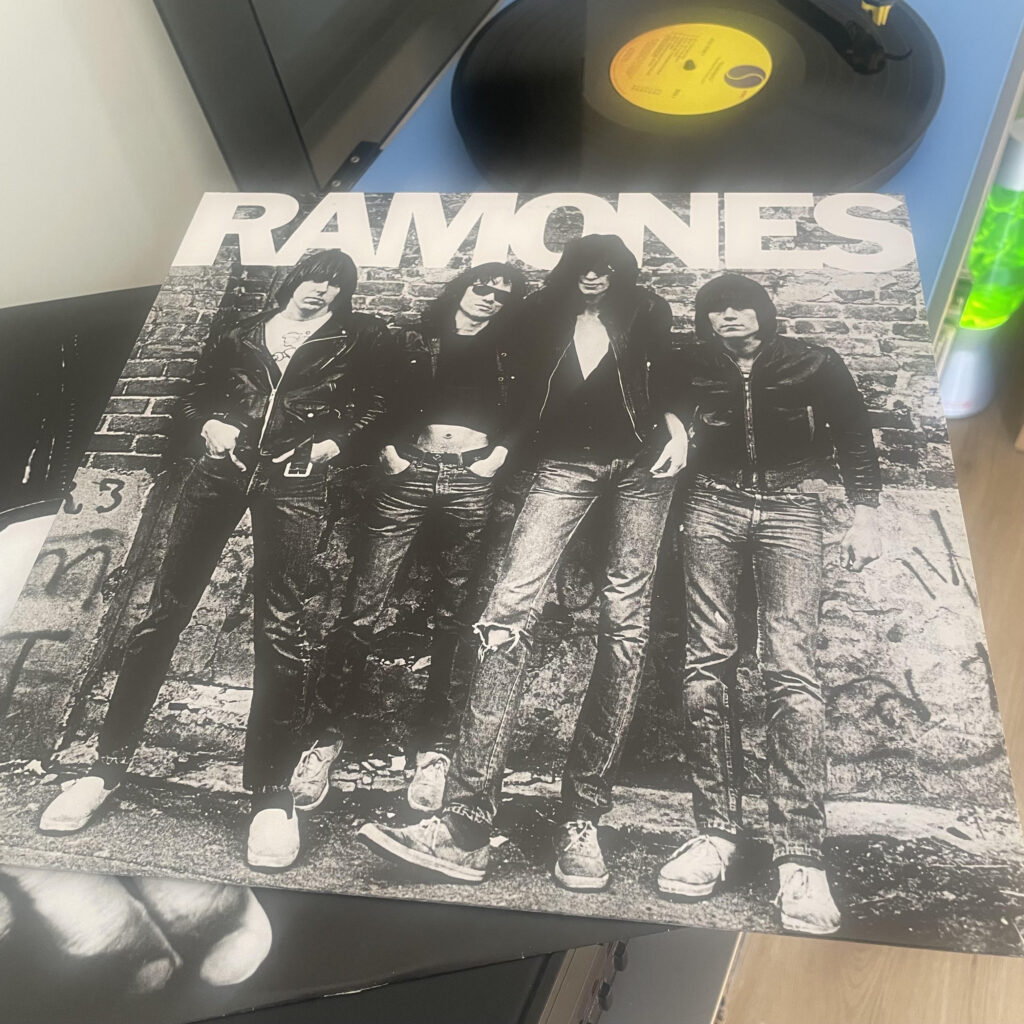
The music around CBGB reinforced this. Bands played fast, loud and with minimal technique. The Ramones reduced rock to its skeleton, Television stretched it nervously, and Hell’s own bands treated lyrics as fragments rather than sermons. The common thread was an amateur ethic that felt closer to art-school provocation than rock professionalism. McLaren absorbed this wholesale. He was less interested in fidelity than in effect. What mattered was how quickly an idea could be communicated, worn, photographed and copied.

When McLaren and Westwood returned to London, the King’s Road shop became the site where these ideas were translated. By 1974 it was trading as SEX, and it already specialised in provocation, fetish references and sexual frankness. But the New York influence sharpened its focus. The clothes became rougher, more aggressive, and more deliberately unfinished. Westwood began turning garments into arguments. Rips were left visible. Pins were exposed. Slogans were confrontational rather than decorative. This was not nostalgia or homage. It was adaptation.

By 1976 the shop had evolved again, this time into Seditionaries. The name itself signalled intent. Seditionaries crystallised what punk looked like at the moment it broke into public consciousness. Bondage trousers, destroyed knitwear, obscene or political graphics, tartan subverted into something hostile rather than heritage. The lineage from New York was clear. Richard Hell’s torn shirts reappeared, reworked and intensified. The Dolls’ theatricality was stripped of camp and replaced with menace. What had been downtown nonchalance became London antagonism.

Seditionaries did not merely sell clothes. It defined a uniform. This was crucial. Punk’s power lay in its immediacy and recognisability. The clothes could be assembled cheaply, but the Westwood versions carried authority. They were prototypes, templates for replication. Teenagers across Britain copied them with bin bags, razors and marker pens. The look travelled faster than the music.

The Sex Pistols emerged directly from this environment. McLaren’s genius intervention was assembling the band as a Situationist art statement as much as a musical unit. The Situationists were a mid-century art movement made up of artists, writers and political agitators and based in Paris. Their mission was nothing less than the complete transformation of everyday life through carefully engineered provocations designed to expose the empty spectacle of consumer capitalism.  McLaren’s vision for the band was to embody this. John Lydon, later Rotten was recruited because he was not only intelligent and well read but also looked right. His genuine alienation and sneering confrontational vocal delivery was totally on spec. The Pistols wore Seditionaries clothes because they were made for them. The band became the shop’s loudest advertisement, and the shop became the band’s ideological bunker. The Pistols did not invent punk style. They broadcast it. Also in a musical style unlike the atypical New York-New Wave-CBGBs bands. Their sound is more attributable to Detroit, Michigan’s Iggy Pop and MC5, British Glam Rock riffs from Bowie’s ‘Spiders From Mars’ and the original Pistols bassist and primary musical songwriter Glen Matlock was influenced by Sixties bands like The Kinks, The Who and Small Faces.

What McLaren had learned in New York was that chaos could be curated. Richard Hell had demonstrated that refusal could be worn on the body. The Dolls had shown that scandal could be staged. Westwood provided the craft, intelligence and historical literacy to turn these influences into garments that felt inevitable rather than borrowed. Seditionaries was not a copy of New York. It was a distillation, filtered through British class anxiety, boredom and anger.

In the years that followed, arguments over credit and authorship would harden. It is well documented that Hell is begrudging of the duos’ appropriation of his style. McLaren was accused of manipulation, Westwood was elevated to designer-genius status, and the American roots of punk style were sometimes obscured by nationalist mythology. But the chain remains visible. From downtown Manhattan thrift-store wreckage to King’s Road sedition, the same ideas recur: clothes as provocation, music as delivery system, style as a form of speech.

The New York visit did not invent punk, but it gave McLaren and Westwood a grammar. They returned with a sense that culture could be assembled quickly, aggressively and in public. Seditionaries was the proof of concept. Punk, as it appeared in 1976 and 1977, wore its influences openly, ripped and repurposed. It looked the way it did because someone had seen Richard Hell and understood immediately that the future of style lay not in polish, but in refusal.

RETROSPECTIVE: London Is Drowning and I Live By The River

Today marks the 45th anniversary of London Calling, The Clash’s groundbreaking double album that redefined punk and reshaped British music. More than just a record, it was a bold statement, mixing genres, politics and raw emotion with a restless energy that still resonates. In this definitive retrospective, I delve into the album’s iconic sleeve, the sprawling diversity of its songs, and the pivotal role played by producer Guy Stevens in crafting a sound both urgent and timeless.

The Clash London Calling Retrospective


By the winter of nineteen seventy nine The Clash were standing at a crossroads that most bands never reach. Punk had given them a voice and a platform, but it was already clear that the narrow version of the movement being sold back to the public would not hold them. London Calling arrived not as a rejection of punk but as an argument with it. An artful double album crammed into a single sleeve, a density made up of ideas and restless energy, it sounded like a band refusing to be boxed in by its own reputation. This was The Clash insisting that urgency did not have to mean limitation, and that rebellion could be rhythmic, melodic and historically aware all at once.

“London Calling is the first of The Clash’s albums that is truly equal in stature to their legend”. Charles Shaar Murray NME 1979.

The sleeve announced that intent before a note was heard. Pennie Smith’s photograph of Paul Simonon mid swing, bass guitar raised and about to be smashed against the stage floor at the Palladium in New York, is still one of the defining images of British music. It is beautifully blurred, caught in motion rather than reverence. Overlaid with the pink and green lettering lifted from Elvis Presley’s debut album, it made a knowing claim on rock and roll history while quietly asserting ownership of it. The decision to house the double vinyl in a single sleeve was driven by CBS insistence the album was a single album but relented to the inclusion of a 12 inch single. Artfully the band added the further nine tracks to the extra vinyl and flipped the 45rpm to 33rpm – the finished ‘double’ album complimented by a “Pay No More Than” hype sticker. So no gatefold excess, the lyrics were printed on the inner sleeves, practical and open, inviting the listener to engage with the words as part of the experience rather than as an accessory.

Musically the record sprawls, but it never drifts. The title track opens like an emergency broadcast, Strummer’s voice riding a sinewy rhythm as images of nuclear anxiety, flooding and social collapse tumble out with the urgency of a last transmission. From there the album refuses to settle into any single identity. Brand New Cadillac barrels through rockabilly with reckless joy. Jimmy Jazz slouches through smoky shadows. Rudie Can’t Fail lifts the mood with warmth and swing, its horns and skank rhythm sounding like celebration as defiance.

What becomes clear as the sides unfold is that this breadth is not a stunt. These styles were absorbed, argued over and lived with. The historically underrated Mick Jones brings melody and pop intelligence, shaping songs that are generous and emotionally direct. One of the album’s most cherished moments, Train in Vain, sits at the very end of Side Four and was a late addition, originally intended to be given away as a free flexi-disc with NME before that plan fell through. The band insisted it be included on the album, but because the sleeves were already printed it was not listed on the cover or lyric sheets and initially appeared as a surprise hidden track etched into the run-off groove. Its immediacy and vulnerability, sung by Jones, with a narrative of love lost, feel like the intimate counterpoint to the political breadth that precedes it.

Joe Strummer’s writing elsewhere on the record grows more impressionistic and humane, trading blunt slogans for scenes, doubts and contradictions. Paul Simonon’s bass is central to the record’s physical pull, and his vocal turn on Guns of Brixton adds a colder, more controlled shade to the palette. Built on a taut reggae rhythm, the song’s sense of unease and inevitability reflects the lived tensions of South London without theatrical exaggeration. “When they knock on your front door, how you gonna come? With your hands on your head or on the trigger of your gun.” – now that is Thatcher’s London Punk ‘1979 style’.

The deeper cuts are where London Calling truly reveals its confidence. Koka Kola disguises its critique of creeping Americanisation beneath a jaunty shuffle, its irony sharpened by how pleasant it sounds. Spanish Bombs is one of Strummer’s finest lyrics, fragmented and poetic, its half-remembered Spanish phrases and images of civil war and tourism colliding into a meditation on distance, memory and solidarity. The Four Horsemen lurches forward with apocalyptic humour, biblical imagery delivered with a grin that barely masks the anxiety beneath. Death or Glory pairs one of Jones’s most immediate melodies with a lyric that quietly punctures the romance of rebellion itself.

Even the stylistic detours serve a purpose. Lover’s Rock leans into reggae’s sensuality without losing tension. Wrong ’Em Boyo tips its hat to ska’s roots with genuine affection, not as nostalgia but as acknowledgement. Each track adds another voice, another rhythm, sketching a map of London as a listening city where cultures collide and converse.

Holding this sprawl together was producer Guy Stevens, a volatile and divisive presence whose background proved crucial. Stevens came from an earlier era, steeped in rhythm and blues and shaped by his work with Mott the Hoople. He believed in feel above all else. Precision bored him. Commitment did not. His behaviour in the studio has become part of the album’s mythology, but beneath the chaos was a clear philosophy. Stevens pushed the band to play as if the songs might fall apart at any moment, to reach for performances that felt dangerous rather than correct.

That approach suits London Calling perfectly. The record breathes. Tempos flex. Instruments bleed into one another. There is space in the sound, even at its densest, and a looseness that gives tracks like Clampdown and Guns of Brixton their physical weight. The tension between band and producer was real, but it was productive, forcing instinct to override caution.

As a production, the album strikes a rare balance. It sounds expansive without being bloated, raw without being thin. The double album format could easily have sunk it, but instead it allows the band to pace the journey, each side carrying its own momentum and mood. By the time Train in Vain fades out, there is a sense of having travelled not just through styles, but through arguments, fears and affirmations.

Decades on, London Calling remains a challenge as much as a classic. It asks whether a band can grow without losing its edge, whether politics and pleasure can coexist, whether history can be acknowledged without becoming a trap. The sleeve still feels perfect. The songs still feel urgent. Guy Stevens’s restless spirit still hums through the grooves. The Clash did not simply make a great double album. They made a statement of intent that continues to sound alive, unresolved and necessary.