RETROSPECTIVE: Bowie, Standing By The Wall

Revisiting David Bowie’s Heroes decades on, this article explores its Berlin origins, the band behind the album, Brian Eno’s role and whether it stands apart from Low.

David Bowie Heroes Album Retrospective


By the time Heroes emerged in October 1977, Bowie had already disposed of the rulebook. Low had landed like a communiqué from another future, half songs, half atmosphere, a record that seemed to reject the very idea of audience comfort. The temptation has always been to frame Heroes as its louder twin, the one with the anthem, the one that returned Bowie to something approaching recognisable rock form. That reading does the album a disservice. Heroes is not a corrective to Low. It is an expansion, an album that breathes the same air but looks outward rather than inward, shaped by geography, by collaborators, and by a band operating at a rare level of collective intuition.

The setting matters. Hansa Tonstudio, perched within sight of the Berlin Wall, was not simply a studio but a vantage point. The city in 1977 was still scarred, divided, uneasy. Bowie absorbed that atmosphere completely. If Low felt like a psychological evacuation from Los Angeles excess, Heroes feels like Bowie standing still long enough to take in where he had landed. The walls, literal and emotional, are everywhere on this record.

The core band remained unchanged from Low, and that continuity is crucial. Carlos Alomar was once again the spine of the operation, his rhythm guitar style economical, precise, never showy. Alomar’s playing on Heroes is less funky than his work with the plastic soul era Bowie, but his sense of movement underpins everything. Dennis Davis on drums is similarly restrained but vital. His playing has a physical intelligence, knowing when to push and when to pull back, especially on tracks like Beauty and the Beast where tension is built through repetition rather than brute force. George Murray’s bass lines are melodic without drawing attention to themselves, often acting as a bridge between rhythm and texture.

Hovering above and around them is the now legendary pairing of Brian Eno and Tony Visconti. Eno’s influence is often overstated as some sort of ambient fog machine, but his real contribution lies in disruption. His Oblique Strategies cards, his encouragement of chance, his willingness to treat the studio as an instrument all helped Bowie escape habitual thinking. Visconti, meanwhile, grounded the chaos. His production on Heroes is cleaner and more assertive than on Low, particularly on the vocal tracks, but still full of space. The famous gated vocal effect on the title track, achieved by positioning microphones at varying distances that opened only when Bowie sang louder, is a perfect example of technology serving emotion rather than novelty.

The opening track, Beauty and the Beast, announces immediately that this is not a retreat into comfort. Bowie’s vocal is fractured, almost feral, darting between personas. Lyrically, it feels like a continuation of the internal struggle first exposed on Low, but externalised. The city is no longer a metaphor for the mind. It is the stage on which that struggle plays out. Fripp’s guitar slashes through the mix, not as a soloist but as a source of friction, pushing against the rigid rhythm beneath.

Fripp’s presence across the album cannot be overstated. Brought in at the last minute and reportedly completing his parts in a matter of hours, his playing defines the record’s emotional peaks. On Heroes the song, his sustained, soaring lines do not decorate the track, they lift it. The myth around the song often threatens to reduce it to its origin story, Bowie glimpsing Visconti and Antonia Maass kissing by the Wall. What matters more is how the music refuses sentimentality. The lyric never promises permanence, only intensity. We can be heroes, just for one day. It is defiant precisely because it accepts limitation.

Elsewhere on side one, Bowie continues to explore fractured identity and communication. Joe the Lion draws inspiration from performance artist Chris Burden, but it also feels like a self portrait in motion, Bowie throwing himself into the work with no safety net. Sons of the Silent Age is one of the album’s quieter triumphs, its crooning melody undercut by lyrics that hint at repression, at voices denied expression. Blackout closes the side in a rush of nervous energy, all clipped phrases and sudden turns, the sound of a mind overstimulated rather than soothed.

If side one is confrontation, side two is immersion. Like Low, Heroes gives over half its running time to instrumentals, but the mood is different. Where Low often felt like drifting through empty rooms, Heroes feels rooted in place. V-2 Schneider tips its hat to Kraftwerk but refuses pastiche, its groove mechanical yet strangely human. Bowie’s saxophone playing here is deliberately unschooled, cutting through the track like an alarm rather than a melody.

The trio of Sense of Doubt, Moss Garden and Neuköln forms the emotional heart of the album. These are not background pieces. They demand attention. Sense of Doubt is built on a descending piano figure that seems to sink deeper with each repetition, evoking a sense of inevitability. Moss Garden offers a brief illusion of calm, its Eastern inflections suggesting a spiritual escape that never quite arrives. Neuköln is the most unsettling of all, Eno’s treatments and Bowie’s sax combining into a mournful, alien soundscape that captures the loneliness of displacement. Named after a Berlin district known for its immigrant population, it resonates as a study in alienation without a single word being sung.

The closing track, The Secret Life of Arabia, is often treated as a curiosity, but it serves an important function. Its rhythm and melodic energy hint at movement, at travel beyond Berlin, beyond the album’s confines. It suggests that Bowie was already looking ahead, which history confirms. Lodger would soon scatter these ideas across the globe, but Heroes remains anchored, its power drawn from stillness rather than motion.

Over the decades, more details have emerged about the making of Heroes, but none of them diminish its mystery. The speed of the sessions, the reliance on instinct, the willingness to commit to first or second takes all speak to a creative moment that cannot be replicated. Bowie was sober, focused, and surrounded by collaborators who understood when to contribute and when to step back. This was not the sound of a genius imposing his will, but of a band and production team operating as a single organism.

So is Heroes merely a continuation of Low, or does it stand alone. The honest answer is both. It makes little sense without Low, yet it surpasses it in emotional range. Where Low fractures, Heroes reaches. Where Low withdraws, Heroes risks connection. In Bowie’s catalogue, it occupies a rare position. An experimental record with a genuine anthem, an art album that found its way into public consciousness without compromise.
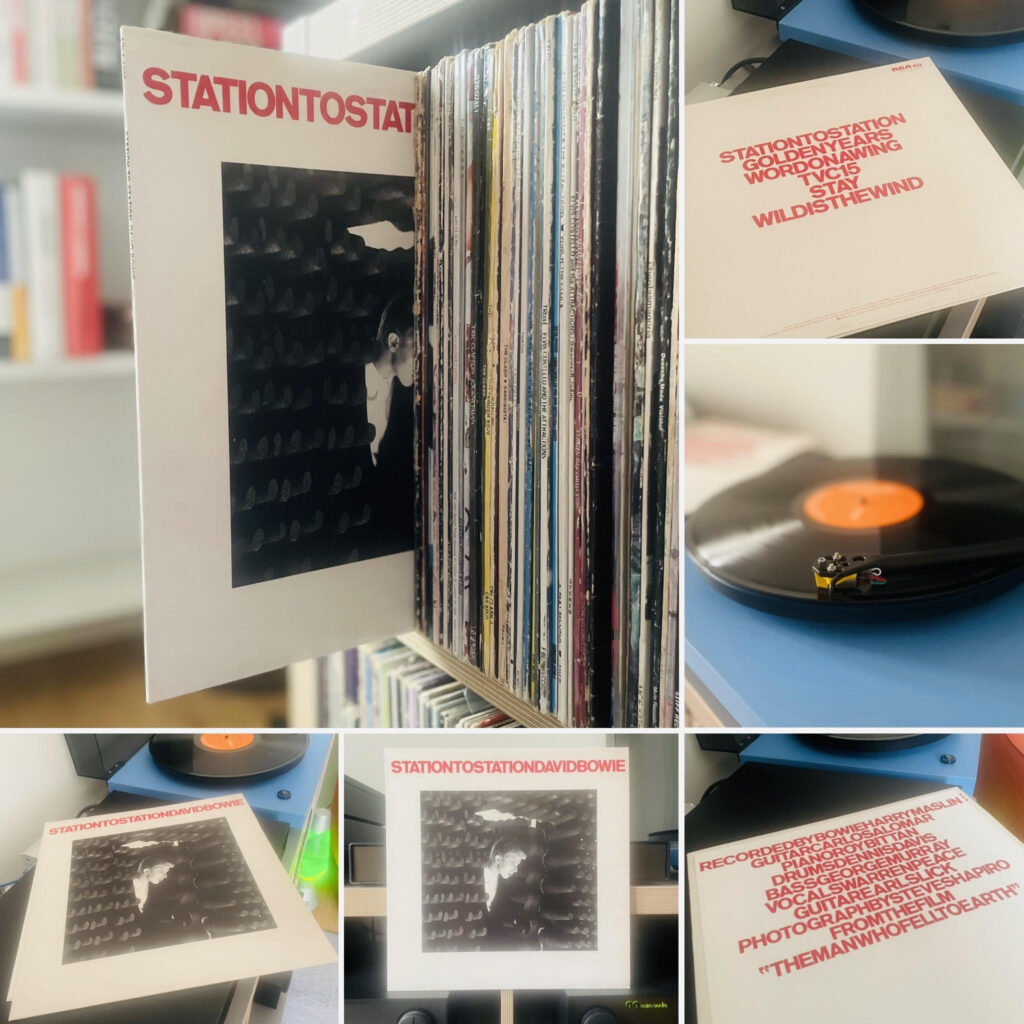
RETROSPECTIVE: Bowie’sStationTo StationWithNoDartsInLovers’Eyes

Time takes a Bowie album… and spawns the definitive retrospective.


It’s time for a Bowie Retrospective. After Young Americans, this is his trans-Atlantic mid-Seventies masterpiece signposting the genius redux on the horizon.

Nearly fifty years hence, Station To Station remains David Bowie’s most perplexing achievement, neither his most revolutionary nor his most accessible, but certainly his most necessary. Released in January 1976, it occupies that peculiar position in an artist’s canon where personal crisis, manic depression and artistic clarity converge with inspired precision. That Bowie himself claims to remember virtually nothing of its creation only deepens the mystery: how does one’s most cohesive statement emerge from complete psychological fragmentation? Or does it? It’s common knowledge people often have little or no recollection of bipolar episodes, and Seventies’ Bowie (Class A aside) is textbook manic episode creativity. But I digress.

The album functions as a fulcrum upon which Bowie’s entire career pivots, the moment when the glitter-encrusted showman shed his sequined skin and at this time alien contacts, to reveal something altogether more unsettling beneath. Six tracks, just six, yet each one a movement in what amounts to a symphony of identity crisis. This is Bowie as musical Dr. Jekyll, conducting experiments upon his own psyche with the detached fascination of a laboratory technician.

Musically, Station To Station represents Bowie’s most successful synthesis of seemingly incompatible elements. The Philadelphia soul he’d absorbed during his Young Americans period, that white British art-school graduate slumming it in the City of Brotherly Love (Brother Lee Love I only just got it during research) collides head-on with the mechanical metronomic precision of European electronic music. It shouldn’t work, this marriage of American warmth and Teutonic coldness, yet somehow it births something entirely new.

Earl Slick’s guitar work deserves particular attention. Gone are the bluesy histrionics and Sixties influences that had characterised Bowie’s previous guitar heroes; instead, Slick delivers lines that cut like scalpels, each note placed with obsessive precision. Listen to his work on “Stay”, those slashing chords that punctuate the verses aren’t mere rock posturing but architectural elements, supporting the song’s claustrophobic emotional weight. It’s guitar playing as urban planning, all sharp angles and deliberate omissions. The track itself embodies the album’s central tension: a seemingly straightforward rocker that reveals layers of unease beneath its propulsive surface. Bowie’s vocal alternates between desperate pleading and detached observation, while the band locks into a groove that feels simultaneously urgent and mechanical, the sound of someone running in place, trapped by their own momentum.

The rhythm section of Dennis Davis and George Murray provides the album’s mechanical heartbeat, a pulse that feels simultaneously human and robotic. Their work on the title track’s opening section transforms a simple 4/4 into something approaching industrial music, three years before Throbbing Gristle made such sounds esoterically fashionable. This is the rhythm of assembly lines and commuter trains, the metronomic beat of modern alienation. But “Station To Station” functions as more than mere sonic experimentation it’s a ten-minute manifesto of identity dissolution. The track’s structure mirrors its lyrical journey from European mysticism to American soul, with Bowie literally traveling from one musical station to another. The opening’s stark, almost ritualistic atmosphere gives way to the gospel-influenced finale, yet something essential remains lost in translation. The Duke emerges not as synthesis but as absence, the negative space between stations where no trains stop. Thankfully the Trilogy confirms he bought a return ticket.

Lyrically, Bowie constructs a peculiar theology that borrows from Nietzsche, Cambridge educated bisexual Aleister Crowley, the Kabbalah’s occultism, Judeo-Christianity and his infamous cocaine, milk and peppers fuelled paranoia. It’s a sort of spiritual algebra where traditional religious symbols are multiplied by pharmaceutical insight and divided by sexual desperation. If a Rock Star could be thus – gender confusion? The results don’t always make sense indeed, they’re not supposed to. This is the sound of a mind in free fall, grasping at mystical straws.

“TVC 15” transforms what might have been a simple paranoid episode into a peculiar love song addressed to a television set, the kind of domestic surrealism that would later mark Talking Heads’ best work. Yet where David Byrne would approach such material with Asperger’s detachment, Bowie invests it with genuine longing. The Duke may be emotionally vacant, but he’s not entirely dead inside.

It’s “Word On A Wing,” however, that provides the album’s most naked moment. Disguised as a love song but functioning as a prayer, it finds Bowie reaching towards something approaching grace. His vocal performance here, multi-tracked harmonies that create a choir of Bowies, each one seeking salvation in a slightly different key, represents perhaps his most vulnerable moment on record. The Duke’s marble facade cracks just enough to reveal the frightened human beneath.

The album’s visual identity proves equally calculated. That stark red-black-and-white cover avec an iconic still from Nicolas Roeg’s The Man Who Fell To Earth captures something essential about both album and era. Here is Bowie mid-stride, embodying alien detachment that defined the star mid-Seventies. The bold, minimalist typography strips away baroque excess, replacing it with corporate authority. This is alienation made manifest through graphic design, the Duke as extraterrestrial advertising executive smack bang in the peak Fifth Avenue heyday. And a lovely futuristic font style it is and stylistically redeployed here.

The synchronicity between album and film feels almost too neat, yet it works. Thomas Jerome Newton, Bowie’s gin-soaked alien entrepreneur, shares the Duke’s emotional remove and otherworldly perspective. Both exist as commentaries on American excess, observers rather than participants in the society they critique. That both emerged from the same period of pharmaceutical dissolution creates a multimedia meditation on identity and exile that feels genuinely prophetic.

Yet Station To Station is not without its limitations. The album’s brevity at barely 38 minutes is cruel to fans. Similarly, the album’s obsessive perfectionism occasionally works against it. Every element serves the whole, certainly, but sometimes one craves the messy humanity of Diamond Dogs’ unguarded moments. The Duke’s emotional detachment, while conceptually fascinating, can feel genuinely cold, a frigid barrier between artist and audience that even Bowie’s considerable charisma cannot entirely overcome. There’s a warmth in “Golden Years” that’s residual from the previous Young Americans album but different enough to spawn it’s own Bowie-generation, a stunning inclusion and single release that almost makes up for any deficiencies. We’re not going near the infamous salute and flirtation with the far right or any misunderstandings, but they exist so merit this mention.

The cover of “Wild Is The Wind” succeeds brilliantly as vocal performance but fails to entirely justify its inclusion. While Bowie’s voice stretches towards notes that seem almost beyond reach, a man grasping for salvation it remains unclear what this particular song adds to the album’s overarching narrative. It’s beautiful certainly, and would we be without it (a non-album single?) but beautiful in a way that feels slightly disconnected from the Duke’s particular path right then .

What makes Station To Station essential is not its perfection but its necessity. This is Bowie’s ‘Exile on Main St.’ an album born from extremity that transcends its circumstances. Where other artists might have been consumed by such personal turmoil, Bowie channelled it into his most disciplined statement. The cocaine psychosis that nearly destroyed him instead crystallised into diamond-hard brilliance.

The album’s influence can be traced through decades of post-punk anxiety, from Joy Division’s mechanical depression to The Prodigy’s electro-dance-punk hybrid. The Thin White Duke’s aesthetic all sharp suits and sharper cheekbone became a shorthand for alienated glamour, reimagined via the New Romantic Blitz Club Bowie Nights while the music’s marriage of warmth and coldness prefigured everything from New Order to Bloc Party.

Yet its true achievement lies in its function as an artistic Ground Zero. This is Bowie burning down his house to see what survives the flames, and discovering that what emerges from the ashes (to ashes) is something genuinely new. The Duke may be dead, but his ghost haunts everything Bowie would subsequently create, a reminder that sometimes the most profound art emerges not from comfort but from the desperate need to survive one’s own worst impulses or embedded periodic psychopathy.

Station To Station endures as proof that artistic necessity and personal crisis can produce results that transcend both. It’s neither Bowie’s most adventurous work nor his most commercially successful, but it may be his most honest and human, a document of a mind at war with itself, achieving temporary ceasefire through the discipline of writing and playing. In its now frozen perfection, it captures something essential about the terror of an artist in free fall, creating masterpieces from a wreckage of his own making.

#nowplaying Golden Years whap whap.