RETROSPECTIVE: London Is Drowning and I Live By The River

Today marks the 45th anniversary of London Calling, The Clash’s groundbreaking double album that redefined punk and reshaped British music. More than just a record, it was a bold statement, mixing genres, politics and raw emotion with a restless energy that still resonates. In this definitive retrospective, I delve into the album’s iconic sleeve, the sprawling diversity of its songs, and the pivotal role played by producer Guy Stevens in crafting a sound both urgent and timeless.

The Clash London Calling Retrospective


By the winter of nineteen seventy nine The Clash were standing at a crossroads that most bands never reach. Punk had given them a voice and a platform, but it was already clear that the narrow version of the movement being sold back to the public would not hold them. London Calling arrived not as a rejection of punk but as an argument with it. An artful double album crammed into a single sleeve, a density made up of ideas and restless energy, it sounded like a band refusing to be boxed in by its own reputation. This was The Clash insisting that urgency did not have to mean limitation, and that rebellion could be rhythmic, melodic and historically aware all at once.

“London Calling is the first of The Clash’s albums that is truly equal in stature to their legend”. Charles Shaar Murray NME 1979.

The sleeve announced that intent before a note was heard. Pennie Smith’s photograph of Paul Simonon mid swing, bass guitar raised and about to be smashed against the stage floor at the Palladium in New York, is still one of the defining images of British music. It is beautifully blurred, caught in motion rather than reverence. Overlaid with the pink and green lettering lifted from Elvis Presley’s debut album, it made a knowing claim on rock and roll history while quietly asserting ownership of it. The decision to house the double vinyl in a single sleeve was driven by CBS insistence the album was a single album but relented to the inclusion of a 12 inch single. Artfully the band added the further nine tracks to the extra vinyl and flipped the 45rpm to 33rpm – the finished ‘double’ album complimented by a “Pay No More Than” hype sticker. So no gatefold excess, the lyrics were printed on the inner sleeves, practical and open, inviting the listener to engage with the words as part of the experience rather than as an accessory.

Musically the record sprawls, but it never drifts. The title track opens like an emergency broadcast, Strummer’s voice riding a sinewy rhythm as images of nuclear anxiety, flooding and social collapse tumble out with the urgency of a last transmission. From there the album refuses to settle into any single identity. Brand New Cadillac barrels through rockabilly with reckless joy. Jimmy Jazz slouches through smoky shadows. Rudie Can’t Fail lifts the mood with warmth and swing, its horns and skank rhythm sounding like celebration as defiance.

What becomes clear as the sides unfold is that this breadth is not a stunt. These styles were absorbed, argued over and lived with. The historically underrated Mick Jones brings melody and pop intelligence, shaping songs that are generous and emotionally direct. One of the album’s most cherished moments, Train in Vain, sits at the very end of Side Four and was a late addition, originally intended to be given away as a free flexi-disc with NME before that plan fell through. The band insisted it be included on the album, but because the sleeves were already printed it was not listed on the cover or lyric sheets and initially appeared as a surprise hidden track etched into the run-off groove. Its immediacy and vulnerability, sung by Jones, with a narrative of love lost, feel like the intimate counterpoint to the political breadth that precedes it.

Joe Strummer’s writing elsewhere on the record grows more impressionistic and humane, trading blunt slogans for scenes, doubts and contradictions. Paul Simonon’s bass is central to the record’s physical pull, and his vocal turn on Guns of Brixton adds a colder, more controlled shade to the palette. Built on a taut reggae rhythm, the song’s sense of unease and inevitability reflects the lived tensions of South London without theatrical exaggeration. “When they knock on your front door, how you gonna come? With your hands on your head or on the trigger of your gun.” – now that is Thatcher’s London Punk ‘1979 style’.

The deeper cuts are where London Calling truly reveals its confidence. Koka Kola disguises its critique of creeping Americanisation beneath a jaunty shuffle, its irony sharpened by how pleasant it sounds. Spanish Bombs is one of Strummer’s finest lyrics, fragmented and poetic, its half-remembered Spanish phrases and images of civil war and tourism colliding into a meditation on distance, memory and solidarity. The Four Horsemen lurches forward with apocalyptic humour, biblical imagery delivered with a grin that barely masks the anxiety beneath. Death or Glory pairs one of Jones’s most immediate melodies with a lyric that quietly punctures the romance of rebellion itself.

Even the stylistic detours serve a purpose. Lover’s Rock leans into reggae’s sensuality without losing tension. Wrong ’Em Boyo tips its hat to ska’s roots with genuine affection, not as nostalgia but as acknowledgement. Each track adds another voice, another rhythm, sketching a map of London as a listening city where cultures collide and converse.

Holding this sprawl together was producer Guy Stevens, a volatile and divisive presence whose background proved crucial. Stevens came from an earlier era, steeped in rhythm and blues and shaped by his work with Mott the Hoople. He believed in feel above all else. Precision bored him. Commitment did not. His behaviour in the studio has become part of the album’s mythology, but beneath the chaos was a clear philosophy. Stevens pushed the band to play as if the songs might fall apart at any moment, to reach for performances that felt dangerous rather than correct.

That approach suits London Calling perfectly. The record breathes. Tempos flex. Instruments bleed into one another. There is space in the sound, even at its densest, and a looseness that gives tracks like Clampdown and Guns of Brixton their physical weight. The tension between band and producer was real, but it was productive, forcing instinct to override caution.

As a production, the album strikes a rare balance. It sounds expansive without being bloated, raw without being thin. The double album format could easily have sunk it, but instead it allows the band to pace the journey, each side carrying its own momentum and mood. By the time Train in Vain fades out, there is a sense of having travelled not just through styles, but through arguments, fears and affirmations.

Decades on, London Calling remains a challenge as much as a classic. It asks whether a band can grow without losing its edge, whether politics and pleasure can coexist, whether history can be acknowledged without becoming a trap. The sleeve still feels perfect. The songs still feel urgent. Guy Stevens’s restless spirit still hums through the grooves. The Clash did not simply make a great double album. They made a statement of intent that continues to sound alive, unresolved and necessary.

RETROSPECTIVE: Thirty Minutes Of Mayhem. Damned Damned Damned

A retrospective look at The Damned’s 1976 debut Damned Damned Damned, exploring its raw punk impact, riotous sleeve photography and lasting legacy in British music history.

The Damned debut album from 1976.

The Damned crashed into 1976 like a brick through a Woolworths window. Their debut, Damned Damned Damned, was the first British punk LP that truly meant business. While others in the class of 76 mooted revolution, The Damned simply plugged in, bashed it out and left the wreckage where it fell.

Captain Sensible’s guitar is jagged and loud. Brian James’ riffs sound like they were dragged straight from a petrol soaked rehearsal room. Rat Scabies plays as if the kit has personally insulted him. Dave Vanian croons through the chaos with that odd (and enduring) mix of horror film charm and rock ’n’ roll sneer. It was equally messy, sharp and exciting.

“New Rose” remains the lightning strike. It was the first British punk single to hit the shops and it still tears out of the speakers… “Is she really going out with him?”. “Neat Neat Neat” speeds along with a bass line that seems permanently on the edge of collapse. “Born to Kill” and “Fan Club” show they had more depth than the cartoon horror look suggested. Compared to the art-school cool of some of their peers, The Damned sounded like blokes who simply wanted to play faster and louder than everyone else and didn’t care what you thought.

The decades since have added even more shine to the story. The band ended up outlasting nearly every punk rock group they were once lumped in with. While others imploded or retreated into myth, these lads carried on through countless line-up changes, resurrections and strange detours. From goth phases to psychedelic experiments, their legacy stretches far beyond this debut. Yet fans and critics always return to Damned Damned Damned as the moment punk hit tape with no filter.

The sleeve jumped out of the racks in its day. You could spot it from across the shop floor. That Brian Griffin photograph of the band splattered in cream pies looked nothing like the punk imagery doing the rounds. It was chaotic and cheeky, like a food fight in a youth club. The rough black border and the bold caps font gave it a low budget feel, yet it had real intent behind it. Stiff Records always liked sleeves that poked fun at rock seriousness and this one did it perfectly. The original release mistakenly added an Eddie and the Hotrods group pic on the reverse (now collectable) or was it a mistake? Until a reprint was ready Stiff added a sticker ‘Erratum – apologies blah blah blah”, but was that a little cash from chaos before that term was coined by the competition? You’re even wealthier if you own the sleeve with the cellophane near-obliteration of The Damned cover for those Seventies shops whose sensibilities may have been offended.

The story behind the money shot only added to the charm. The band thought it would be a quick prank. Instead the shoot descended into real mayhem, with arguments, laughter and cream everywhere. You can see it in the image. It is not staged rebellion. It is four lads caught mid racket. For fans flicking through racks in 1977, that sleeve was a promise. Buy this and you will get noise, mischief and a band who do not take themselves too seriously. It still works today. ‘Made to be played loud at low volume’, it sez so on the label

The album still feels alive. It captures a time before punk had any rules, before the press boxed it in, before major labels tried to polish it. By modern standards the record is rough. That roughness is its charm. It is the sound of four musicians in a hurry, playing like the whole world is about to shut their gig down.

Looking back almost fifty years later, Damned Damned Damned remains a blast. It is not a museum piece – although the sleeve is now peak-zeitgeist. It is not a nostalgia trip. It is a reminder that British punk began with noise, risk and instinct rather than theory. The Damned were first out of the traps and they made sure no one forgot it.

RETROSPECTIVE: He Danced Right Out The Womb.

A retrospective look at T. Rex’s Electric Warrior, exploring Marc Bolan’s electric transformation and the album’s lasting influence on glam rock and beyond.


There comes a point in every great pop myth when the curtains part. The star steps forward. Everything suddenly makes sense. For Marc Bolan, Electric Warrior is that moment. It is the glitter-splashed big bang that turned a dreamy folky into the patron saint of teenage stomp. People often compare it to Dylan going electric. Yet Bolan did not provoke outrage. He aimed straight for the nation’s hips and the Top 40 followed.

More than fifty years later the record still feels like a private universe. It is not simply a prototype for glam. It is a fully formed world that predicted the next decade before anyone else had a sniff of it. The swagger of glam, the clipped pulse of proto-punk, the teenage charge of a perfect pop single. All of it sits inside these grooves.

Tony Visconti’s genius production has been praised for decades. Hearing it now, it is striking how modern it remains. The strings glide. The guitars smirk. Even the handclaps sound like part of a secret plot. Visconti later called the album “warm and fat” and it still fits. Everything feels close yet huge, like Bolan is whispering into a microphone wired to the Milky Way. Remasters, reissues and old demos released over the years have only confirmed how deliberate the whole palette was. This was not luck. Bolan and Visconti were shaping a style they already believed would last.

“Get It On (Bang a Gong)” is still the landmark track. It has become so familiar that people forget how sly it was at the time. It is pure strut. Lust boiled into a slogan and delivered with a grin that borders on parody. Later generations absorbed it through adverts, films and compilation CDs. The original still shines brighter. Its low-slung groove feels immortal today. You can hear it in Primal Scream, in the Black Crowes and in the swaggering indie bands of the early 2000s who thought attitude alone might save them.

The deep cuts tell a richer story. “Mambo Sun” shimmers like wet tarmac under streetlights. It is languid, slippery and quietly sensual. It shows how far Bolan had travelled from his earlier, Tolkien-tinged whimsy. “Cosmic Dancer” has aged even better. It is now held up as proof that Bolan was far more than a glittered chancer. Its mix of lullaby and melancholy feels like the doorway to a career he never had the chance to complete. When the home demos surfaced in the nineties and beyond, the song grew even larger. It became a kind of Rosetta Stone for Bolan’s tender side.

The album’s afterlife has been busy. Critics were sniffy in 1971 because British reviewers often mistrust anything that sounds like fun. The reappraisals arrived quickly. By the eighties, whole glam revival movements traced their roots back to this record. By the nineties, everyone from Morrissey to Slash to the Manics cited it as essential listening. After the millennium, more reissues and recovered tapes made the craftsmanship impossible to ignore. Electric Warrior settled into its rightful place as a masterpiece of pop economy. Every track earns its keep.

Looking back now, the whole transformation feels inevitable. Bolan did not abandon his old self in the way Dylan did. He simply stepped into the brighter outline that had always hovered around him – ‘Mod Marc had been dancing since he was twelve’ after all. Electric Warrior is not the tale of an artist changing course. It is the moment he finally matched the sound in his head. Glittering stardom was then a formality.

Half a century later, the record still glows with rare magic. It captures the moment when a pop star stops becoming and finally arrives. Bolan lit the fuse for glam, reshaped the idea of pop charisma and left behind a record that refuses to grow old.

Electric influencer.

RETROSPECTIVE: Where Have They Been? Joy Division, Closer

A detailed retrospective on Joy Division’s devastatingly timeless album Closer, exploring the band’s final and most haunting studio album in all its creative, atmospheric, emotional and historical depth. The eternal question, closer or closer?

Joy Division Closer (1980)


Rarely, an album arrives haunted before you even drop the needle. Closer, released in July 1980 just weeks after Ian Curtis’s death, is the ultimate example. It arrived like a final communiqué, a cold transmission from a place beyond exhaustion. If Unknown Pleasures was the sound of a band discovering the architecture of modern despair, Closer was the completed structure: stark, beautiful, desolate and impossibly refined. It remains one of the most unsettling records ever made, not because of the tragedy that surrounds it, but because of how complete it feels. Four young men, barely out of their early twenties, constructing a monument with the calm precision of veteran craftsmen.

Recorded at Britannia Row Studios in early 1980, Closer was shaped by the same constellation of characters that defined its predecessor. Ian Curtis, Bernard Sumner, Peter Hook and Stephen Morris formed the nucleus, still working under the shadow of Manchester’s derelict industrial gloom. Tony Wilson and Alan Erasmus held Factory together with philosophy, flair and a certain reckless faith. Peter Saville designed the sleeve, this time a funereal photograph of a stone tomb from a Genoan cemetery. And Martin Hannett returned to sculpt the sound, more ghostly, more meticulous, more distant than ever. What they created no longer sounded like post-punk discovering itself. It sounded like something else entirely.

Curtis’s lyrics are the centre of gravity here. Written in short bursts of clarity amid worsening health, collapsing marriage and relentless touring, they possess a startling emotional precision. There is no flailing, no melodrama. Instead, Curtis writes like a man tracing the edges of his own disappearance. “A legacy so far removed” he intones on “Heart and Soul”, a line delivered with such resignation it feels almost weightless. On “Twenty Four Hours” he sounds caught between yearning and surrender, while “Passover” reads like a series of warnings he never expected anyone to hear. Curtis had always been precociously articulate, but on Closer his imagery crystallises. He writes with the concision of a poet and the clarity of someone who knows time is thinning.

Musically, the band had sharpened into an eerie, restrained machine. Hook’s bass leads most of the melodies, mournful but insistent. Sumner’s guitar is sparse, almost pointillist, teasing out glimmers of light through the haze. Morris remains astonishing, turning minimal drum patterns into emotional punctuation. There are moments that hint at what New Order would become, yet nothing here feels transitional. This is a closed circle.

And presiding over it all, Martin Hannett. If his work on Unknown Pleasures turned the band’s rawness into atmosphere, on Closer he goes further, transforming space into an emotional instrument. His production leaves acres of room between the notes. Drums crack like snapped bones in a cathedral. Basslines hover in negative space. Curtis’s voice floats somewhere between the living and the dead. Hannett built these tracks with the attention of a watchmaker, each mechanism ticking in isolation until it formed a whole that feels strangely inevitable.

Side one is almost liturgical. “Atrocity Exhibition” opens with a lurching rhythm and guitars that clatter like loose machinery. It is disorienting, provocative and brilliant. “Isolation” introduces a brittle electronic pulse, as if the band are already stepping into their next form. “Passover” feels like a whispered confession, “Colony” storms with controlled frenzy, and “A Means to an End” ties it all together with one of Hook’s finest basslines.

Side two is something else entirely. It is not a descent so much as a surrender. “Heart and Soul” is spacious, drifting, suspended in its own gravity. “Twenty Four Hours” is devastating, built on one of the band’s most violent dynamic shifts. “The Eternal” might be Joy Division’s most heartbreaking song, Morris’s drum pattern funereal, Sumner’s synths thin and trembling, Curtis sounding utterly alone. And then “Decades”, the closing track, a cold sunrise over ruins. Hook’s bass loops like memory itself while Curtis sings with a calm that chills the spine. It ends not with drama, but with a kind of acceptance.

When Closer arrived, it was instantly framed as a posthumous statement. It is not. It is a fully realised work by a band operating at the peak of their powers. The tragedy does not define it, but it certainly haunts it. Even without hindsight, the emotional gravity is unmistakeable. It is an album made with astonishing clarity by musicians who had no idea it would become a memorial.

Forty-five years on, Closer still stands apart. It is not a companion piece to Unknown Pleasures but a culmination. The purity of its production, the maturity of the writing, the confidence in its restraint. These were four young men building something timeless while their world was falling apart around them.

If Unknown Pleasures is the moment of ignition, Closer is the monument left behind. A cathedral of quiet despair. A masterwork of control, tension and emotional truth.

Enthusiasts return to it not because of its mythology, but because of its craftsmanship. It is immaculate, unsettling, and strangely beautiful. It remains one of the finest records ever to emerge from Britain, and one of the few that still feels like a closed door you can never fully open.

A band at the edge of collapse. A producer at the height of his powers. A label built on belief. And a singer writing with a lucidity that still feels impossible.

Closer endures because it sounds final. And because, in its own stark way, it is. Where have they been?

RETROSPECTIVE – Joy Division Unknown Pleasures

A stark, immersive deep dive into Unknown Pleasures, Joy Division’s 1979 debut that transformed post-punk into something spectral and eternal. Exploring the collision of Ian Curtis’s lyrical brilliance, Martin Hannett’s ghostly production, and Factory Records’ visionary chaos, this retrospective revisits the album that defined modern alienation and still sounds like the future.

Joy Division Unknown Pleasures, the ultimate retrospective review.


Some records don’t just capture a moment. Unknown Pleasures wasn’t merely a debut but a collision of working-class intelligence, creative genius and industrial desolation that turned late-Seventies Manchester into a kind of spiritual proving ground. Released in June 1979, it remains one of those rare works where every element; band, producer, manager, label, sleeve designer and city fuses into perfection. A flashpoint that changed everything.

Joy Division were four awkward young men who didn’t look the part. If the local council office workers put a band together this was it. No poses, no smiles, no pretence. Ian Curtis stood at the centre: pale, intense, eyes fixed somewhere beyond the crowd. Bernard Sumner, all nervous energy, turned thin air into electricity with brittle, searching guitar lines. Peter Hook, with attitude and melody, played bass like lead, as if he’d grown weary of the instrument’s traditional place and decided to reinvent it. Stephen Morris, unflappable and precise, was the human metronome keeping it all from imploding. Together they made music that sounded less performed than conjured.

And yet, at the heart of it all, stood Curtis, not simply the singer, but the reason Unknown Pleasures still feels like revelation. His lyrics weren’t slogans or statements; they were serious literature. Curtis was a working-class intellectual, a devourer of Kafka, Ballard, and Burroughs, a man who could translate alienation into poetry without losing the grit of everyday life. He wrote with eerie precocity, his words carrying the depth of someone twice his age. “Disorder” opens the record with “I’ve been waiting for a guide to come and take me by the hand”, a line that already sounds like a plea from the edge. “She’s Lost Control” was drawn from his encounters at the employment exchange, the story of a woman whose seizures mirrored the illness that would later contribute to his demise. In “New Dawn Fades”, he faces despair with devastating clarity: “A change of speed, a change of style, a change of scene, with no regrets.” Curtis never dramatised his pain; he documented it. Every lyric feels lived, every silence deliberate.

Around him, the band moved with precision. Sumner’s guitar shimmered with nervous energy. Hook’s bass carried the emotional and propulsive pulse. Morris locked everything into place with mechanical rigour. They didn’t just accompany Curtis’s words; they inhabited them, building soundscapes of claustrophobia and strange beauty.

Then came Martin Hannett, the producer who turned Joy Division’s live fury into something spectral. A sonic visionary and a mercurial eccentric, Hannett treated the studio like a laboratory. He recorded breaking glass, lift shafts, and literally empty space, turning silence itself into an instrument. The band wanted raw power*; Hannett delivered atmosphere, detachment, immortality. Hook complained it was too clean, too cold. But Hannett understood that this wasn’t a record about noise, it was about isolation. What he built in Strawberry Studios wasn’t just a mix; it was an environment.

(*for a heavier Joy Division listen to the live side of Still and the BBC John Peel Sessions available on the ‘Best Of’ CD)

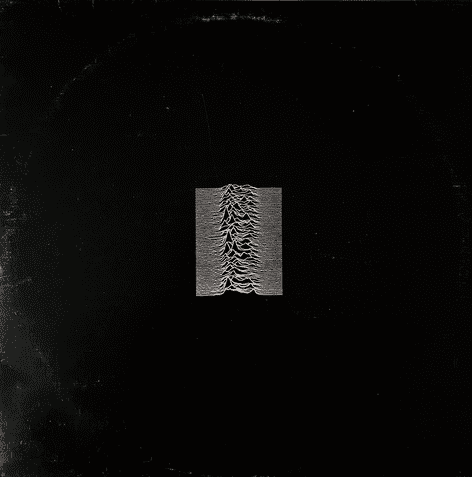
Overseeing it all, Factory Records, Anthony H Wilson’s impossible dream. Tony Wilson was the showman-philosopher-TV presenter and new music advocate, preaching art over commerce. Alan Erasmus his quiet lieutenant, Peter Saville the young graphic designer and aesthetic genius who gave Factory its visual language. Saville’s historic sleeve design for Unknown Pleasures, the white-on-black pulsar from a Cambridge astronomy textbook, became the perfect visual echo of the sound within. No title, no band name, no marketing. Just a transmission from the void. Inspired.

The record unfolds like a descent. “Disorder” rushes in with nervous urgency. “Day of the Lords” trudges through a wasteland. “Insight” floats in eerie calm, as if overheard from another world. “New Dawn Fades” devastates with Hook’s bass in lament, Sumner’s guitar shimmering like fluorescent light. Then side two opens with “She’s Lost Control”, a mechanised tragedy pulsing with inevitability. “Shadowplay” prowls through dim alleyways, “Wilderness” and “Interzone” flicker with punk afterglow before “I Remember Nothing” ends in collapse, static, glass, and Curtis’s voice dissolving into silence.

When it was released, Unknown Pleasures barely registered commercially. Factory’s distribution (like Rough Trade in London) was chaotic, and Manchester’s cultural importance had yet to be mythologised. But those who found it; the lost, the restless, the disillusioned recognised something transcendent. Punk had been about confrontation; Joy Division turned inward and found a new vocabulary for despair. They had created the post punk meisterwerk.

Within just a year, the story turned tragic. Curtis, battling epilepsy and emotional turmoil, took his own life on the eve of the band’s first American tour. Closer followed posthumously an austere requiem with prescient sleeve to match, but Unknown Pleasures remains the genesis, the moment the ordinary became eternal.

It endures because it was never really of its time. Curtis’s lyrics read like prophecy; Hannett’s production sounds perpetually modern. Sumner, Hook and Morris would carry fragments of its brilliance into New Order, but they never recaptured this particular alchemy, the balance of tension and restraint, intellect and instinct, belief and doom.

Unknown Pleasures isn’t just the greatest post-punk album. It’s the blueprint for everything that followed. The hum of fluorescent light in an empty flat. The heartbeat of a city rediscovering its soul. The poetry of disconnection made sacred by four ordinary lads, one visionary producer, and one man’s terrible genius.

Forty-six years on, it still sounds like the future, it still hurts but as Tony Wilson later mused, a record that launched a band responsible for the renaissance and redevelopment of an entire city.

RETROSPECTIVE: We’re Selling England By The Pound

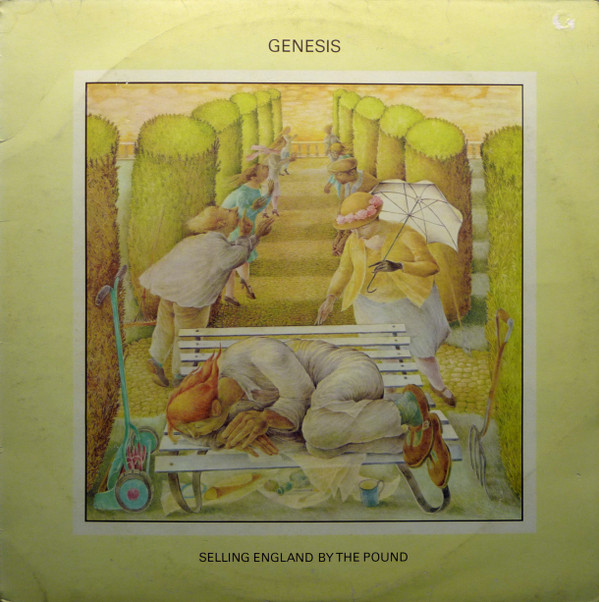
A retrospective of Genesis’ ‘Selling England By The Pound’. The band’s fifth long player from 1973 is a Progressive Rock classic that captured a changing newly decimal Britain through Mellotrons, lawnmower men and Cockney villains. Essential listening for anyone who thinks Prog Rock was all capes and codswallop. Genesis proved you could be both preposterous and profound.


GENESIS: Selling England By The Pound (Charisma) 1973

There was something gloriously, quintessentially English about Genesis that set them apart from the prog rock pack cluttering up the album charts in 1973. Where Yes disappeared up their own cosmic backsides and ELP bludgeoned you with their virtuosity, Peter Gabriel and his merry band of public schoolboys crafted something altogether more peculiar and affecting with this, their fifth album.

Selling England By The Pound arrived at a curious juncture for the band. After the commercial disappointment of Foxtrot failing to break America (despite ‘Supper’s Ready’ being the sort of 23-minute epic that should have had the Yanks weeping into their cornflakes), Genesis regrouped and produced what many consider their defining statement. Recorded at Island Studios with John Burns and the band sharing production duties, this was a record that positively reeked of England in 1973: a country caught between nostalgia for its crumbling past and uncertainty about its increasingly tatty future.

The album opened with ‘Dancing With The Moonlit Knight’, which nicked its central melody from ‘I Know What I Like’ before that song even appeared. Gabriel’s lyrics were stuffed with references to Wimpy Bars, breakfast cereal mascots and Churchill’s England, painting a portrait of a nation flogging off its heritage for American consumer tat. “Can you tell me where my country lies?” he asked, and you suspected he already knew the answer. Tony Banks’ Mellotron swirled around like fog over the Home Counties while Steve Hackett’s guitar work was, as ever, economical but devastating.

‘I Know What I Like (In Your Wardrobe)’ was the obvious single, and it proved a canny choice. Built around Phil Collins’ crisp, almost funky drumming and a nursery rhyme melody, it told the story of a lawnmower man content with his lot. It was Genesis at their most accessible, which wasn’t saying much, but there was real charm in its eccentricity. The promotional film they shot, with Gabriel prancing about in a cloth cap and braces, was either brilliant or barmy. Possibly both.

But it was ‘Firth of Fifth’ that had the musos wetting themselves. Banks’ opening piano passage was genuinely beautiful, all cascading romanticism and melancholy, before the band crashed in with typical Genesis precision. Hackett’s guitar solo in the instrumental section was an absolute belter, soaring and lyrical without ever tipping into tedious showboating. If you needed to convince someone that progressive rock could be genuinely moving rather than just technically accomplished, this was the track to stick on the turntable.

‘More Fool Me’, sung by Collins, was a bit of pleasant fluff really, though his voice had a vulnerability that suited the material. ‘The Battle of Epping Forest’, however, was vintage Gabriel madness: a nine-minute saga about rival gangs of Cockney villains that name-checked half of East London and featured more characters than a Dickens novel. It was exhausting, occasionally bewildering, but never boring. The time signatures flipped about like eels while Gabriel adopted various accents and personas. You either thought it was genius or pretentious twaddle. This writer leaned towards the former.

The album closed with ‘The Cinema Show’ and ‘Aisle of Plenty’, the latter essentially a reprise that bookended the record nicely. ‘The Cinema Show’ was another lengthy piece that referenced T.S. Eliot and featured some of the most intricate playing on the record. Banks’ organ work was particularly fine, while the rhythm section of Collins and Mike Rutherford locked together with the sort of telepathy that only came from years of playing school halls and student unions together.

What was remarkable about Selling England By The Pound was how distinctly British it sounded. This wasn’t blues-rock or heavy metal or glam. It was something altogether stranger: folk melodies colliding with classical pretensions, Edwardian music hall meeting avant-garde rock, all filtered through the sensibilities of five blokes who probably read too much Tolkien at Charterhouse.

Gabriel remained one of rock’s most fascinating frontmen, a genuine oddball who could make theatrical gestures seem vital rather than risible. His lyrics here were his best yet, full of wordplay and social observation, even if they occasionally veered into sixth-form poetry territory. The rest of the band were operating at a level of musicianship that would have been intimidating if it wasn’t in service of actual songs rather than mere technical exercises.

Did this prove to be the album that broke Genesis to a wider audience? Not quite. They were far too weird, too English, too prog for that. But for those willing to enter their peculiar world, Selling England By The Pound was a rich and rewarding experience.

RETROSPECTIVE: Dire Straits’ 1980 Audiophile Delight

A retrospective review of Dire Straits’ 1980 album Making Movies. Knopfler’s technical brilliance meets romantic melancholy in an era that supposedly had no use for either. In my heavily late Seventies NME hack influenced style.


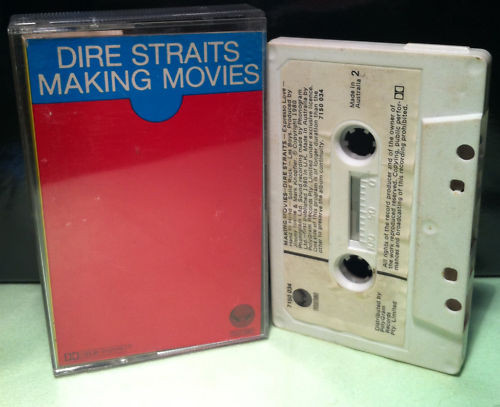
DIRE STRAITS: Making Movies (Vertigo) 1980

There was something deeply suspicious about a band this technically accomplished in 1980. While half of London was still thrashing about in bin liners and safety pins, Mark Knopfler’s lot turned up with an album so pristine, 38 minutes so meticulously crafted, that you half expected to find the corners mitred.

Making Movies arrived eighteen months after their self-titled debut made them improbable millionaires in America, and it was clear they’d been spending the intervening period in expensive studios rather than the back rooms of grotty pubs. Recorded at New York’s Power Station with Jimmy Iovine producing – the man who’d just finished polishing Springsteen’s The River – this was Dire Straits going for broke, or rather, going for more money than they’d already got.

The opening salvo, “Tunnel of Love,” sprawled across eight minutes like some Dylanesque fever dream filtered through a Tyneside accent. It was all fairgrounds and Spanish guitars, with Knopfler’s finger-picked lines circling each other like moths round a sodium lamp. The man played like he was being paid by the note, which he probably was.

“Romeo and Juliet” – which got played to death on Radio 1 – was the sort of thing that had sixth-formers scribbling lyrics in the back of their French textbooks for years. It was wretchedly romantic, all unrequited longing and cinema queues, with Knopfler doing his best to sound like he’d actually had his heart broken rather than just read about it in a Leonard Cohen novel.

But here was the rub: it worked. Despite themselves, despite the almost offensive levels of musicianship on display, despite the fact that punk never happened in their world, Dire Straits crafted something genuinely affecting. “Hand in Hand” swung like prime-era Dylan, while “Les Boys” – a tawdry tale of Parisian transvestites – had the sort of seediness that Bowie used to do before he discovered Switzerland and synthos.

The centrepiece, though, was “Skateaway,” a peculiar bit of New Wave-ish funk about a rollerskating girl cruising through urban decay. It had synthesizers, for God’s sake. Synthesizers! On a Dire Straits record! Pick Withers’ drumming was tighter than a gnat’s chuff, and the whole thing sounded like what might happen if Steely Dan decided to have a go at writing a hit single.

Mark Knopfler remained an enigma wrapped in a headband. His vocals sounded like he was perpetually on the verge of nodding off, yet there was a sly intelligence to his wordplay that elevated this above standard-issue soft rock tedium. He’d clearly listened to a lot of JJ Cale, a lot of Dylan, a lot of those American FM radio staples, and he wasn’t afraid to nick the best bits.

The production was, predictably, immaculate. Every hi-hat shimmer, every bass throb from John Illsley, every keyboard wash from Roy Bittan (on loan from the E Street Band, no less) sat exactly where it should. It was the sonic equivalent of a freshly Hoovered front room with the cushions all plumped up.

Which brought us back to that initial suspicion. In an era when the most exciting music was being made by people who could barely play their instruments, Dire Straits were almost confrontationally competent. They weren’t interested in year zero, in tearing it all down and starting again. They wanted to take you to the pictures, buy you chips on the way home, and maybe have a bit of a cuddle if you were lucky.

And you know what? Sometimes that was enough. Making Movies didn’t change your life or inspire you to form a band in your mate’s garage. But on a rainy Tuesday evening when you were skint and miserable and the world seemed determined to grind you down, it might just have made things seem temporarily bearable.

Which, in 1980, was worth something.

RETROSPECTIVE: Talking Heads – Remain In Light 1980

Some records arrive like a whisper and fade, others crash in like an avalanche and leave you stumbling in their wake. Remain in Light is one of the latter, a slab of paranoia, rhythm, and obsession that still sounds as unmoored and visionary in 2025 as it did in 1980. Forty-five years on, the album hums with the intensity of four New Yorkers trying to rethink the world, their identities, and what a pop record could do. It is both human and alien, cerebral and primal, art-school gone feral. Listening now, you realise Talking Heads did not so much make an album as invent a language for disorientation.

Part One: The Sleeve

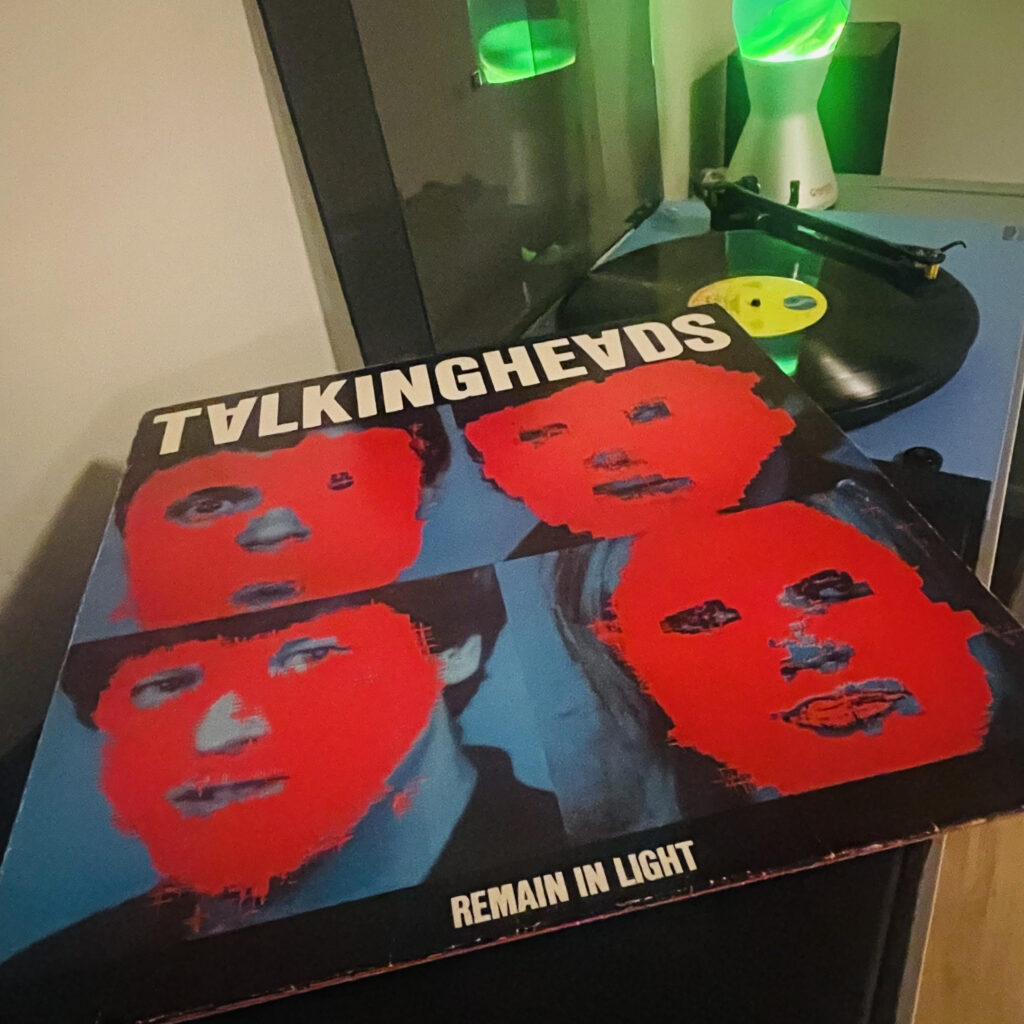
Pick up the sleeve and your first impression is confusion masquerading as design. Four faces, distorted and layered, hover in red, black, and white, a simulacrum of identity rendered through early MIT image-processing technology. The work of Tibor Kalman and M&Co, it feels both robotic and living. Your eyes register familiar features, only to be immediately unmoored. Tina Weymouth’s fascination with African masks, refracted through digital manipulation, turns the human face into a machine’s suggestion. It is uncanny, a whisper of the postmodern anxiety that would haunt the next four decades of visual culture.

Every detail matters. The typography is sharp and arresting, suggesting urgency without screaming. Fighter-bomber Avenger silhouettes and ghostly abstractions hover in the margins, hinting at violence, both literal and psychic. The design does not complement the music so much as anticipate it, a visual prelude to the interlocking chaos within. In 1980, it was a statement that identity was mutable, mediated, and constantly under negotiation. Today, that’s the norm.

Kalman’s brilliance was in making technological imperfection a part of the aesthetic. The faces are corrupted, glitched, degraded – human error filtered through a machine. This is not a record cover; it is a manifesto. By the time you slide the vinyl from its jacket, you are already prepared for disorientation. What follows is not just music, it is an ecosystem, a carefully constructed labyrinth designed to engage both body and mind.

Part Two: The Music & Legacy

Recording began at Compass Point Studios in Nassau, a sun-soaked bunker that would become a crucible for genius and frustration alike. The band was joined by Brian Eno, the unofficial fifth Head, whose influence was less about notes than architecture. He arrived with a philosophy: treat the studio as an instrument, treat chaos as composition, and do not flinch at failure. The sessions were famously intense. The band worked long, bewildering hours, layering loops, polyrhythms, and improvisations until something miraculous emerged from the mess.

The foundation was African-inspired polyrhythms, specifically the hypnotic grooves of Fela Kuti. This was not mere imitation; it was a translation of complex rhythmic systems into a New York art-rock vocabulary. Each instrument moves independently, a conversation of contradictions. Drums and percussion interlock but never collide, basslines snake around vocal hooks, and guitars oscillate between melody and texture. Adrian Belew’s guitar is both nervous and ecstatic, Jon Hassell’s trumpet drifts like a mirage, and Eno’s synthesizer textures shimmer in the spaces between. The record is dense yet breathable, controlled yet chaotic, deliberate yet accidental.

Byrne’s vocals are equally layered, a collage of obsessions and idiosyncrasies. He borrows from hip-hop cadences, ritualistic chant, and fragmented narrative, creating a delivery that is more incantation than song. The lyrics often circle existential dread with playful detachment. In “Born Under Punches”, Byrne’s voice is manic and fractured, a protagonist grappling with information overload and identity crisis. “Crosseyed and Painless” is a sermon on anxiety, paranoia, and social collapse, delivered with sharp wit and relentless rhythm.

The album’s architecture is deliberate. The first side, buoyed by kinetic energy, draws you into the labyrinth. “The Great Curve” is an ecstatic frenzy, the band locked in an ecstatic groove that simultaneously propels and destabilises. By the time “Once in a Lifetime” arrives, you are primed for reflection. The song balances existential inquiry with dance floor immediacy, Byrne pondering selfhood and entropy against a backdrop of hypnotic repetition. It is both absurd and devastatingly human.

Side two darkens the palette. “Houses in Motion” jitters with post-industrial dread, a cityscape of anxiety rendered in sound. “Seen and Not Seen” drifts toward abstraction, its protagonist dissolving into observation, a meditation on presence, absence, and perception. “Listening Wind” introduces political undercurrents, a commentary on global turbulence and American complacency filtered through dense polyrhythms and hypnotic motifs. The album closes with “The Overload”, a spectral transmission that hints at collapse and transcendence simultaneously.

The genius of Remain in Light lies in its simultaneity. It is both academic and visceral, cerebral and bodily. It occupies a transitional space where intellect and instinct cohabit uneasily but beautifully. The recording process itself becomes audible: the tape loops, studio experimentation, and improvisational layering are part of the listening experience. You hear the struggle, the trial and error, the moments of panic and revelation. This is music as architecture, as experiment, as living organism.

Culturally, the album is a negotiation of influence. The band’s engagement with African rhythms is complex, filtered through Western ears and art-school sensibility. It raises questions about appropriation, translation, and homage, but the resulting work is undeniably original. It is a fusion of ideas and sounds that challenges the listener to reconsider boundaries, genres, and expectations. The record is not just a reflection of its time, it is a critique of it, questioning identity, technology, and the very notion of pop music as a commodity.

The legacy of Remain in Light is vast. Upon release, it charted modestly, yet critics recognised its audacity. The album influenced generations of musicians, from the electronic experiments of the eighties to the worldbeat experiments of later decades. It bridged punk’s urgency with funk’s elasticity, art-school conceptualism with dancefloor immediacy. Touring the album proved difficult; the complexity and intensity of the arrangements tested the band to their limits. Yet the recordings themselves endure, a testament to ambition, collaboration, and the willingness to confront chaos head-on.

Listening today, the album resonates with a prescience that is uncanny. Byrne’s exploration of selfhood, Eno’s textural interventions, the band’s rhythmic sophistication all speak to an era increasingly dominated by technology and mediated experience. Forty-five years on, the music still feels urgent, still unsettles and energises in equal measure. It is a record that rewards repeated engagement, revealing new facets with each listen. The textures, the contradictions, the obsessive layering, all retain their power to unsettle and illuminate.

In retrospect, Remain in Light is not just an album. It is a blueprint for artistic ambition, a testament to the potential of collaboration and the thrill of experimentation. It embodies the tension between accessibility and difficulty, dance and reflection, humour and despair. Its enduring influence is evident not only in the artists who followed but in the ways it continues to challenge contemporary listeners. The record is a meditation on identity, perception, and creativity itself, an exploration that remains vital and uncontainable.

Four decades on, the album hums with life, refusing to settle into nostalgia or canonisation. It is human, machine, ritual, and meditation all at once. The visual and sonic languages it employs remain radical; the ideas embedded in its grooves still resonate. Talking Heads, at their apex, were not content with simple pop. They sought transformation, and in Remain in Light they achieved it. 

Listening now, the record still demands attention. It insists on engagement, on immersion. The faces on the sleeve, the fractured rhythms, the cascading vocals – all converge to create an experience that is simultaneously exhilarating and disorienting. It is, as ever, a record that challenges, delights, and confounds.

Remain in Light remains a masterpiece because it continues to operate on multiple planes. It is art, it is music, it is philosophy, and it is ritual. It occupies a space that few albums dare to enter, and fewer still manage to navigate successfully. Forty-five years later, it retains its power, its strangeness, and its brilliance. Talking Heads created not just an album but a living organism, one that still breathes, pulses, and disrupts.

For those willing to engage fully, it remains an astonishing journey, a record that refuses to be tamed, a testament to what happens when intelligence, curiosity, and obsession collide. Remain in Light is not simply listened to. It is experienced, interrogated, and felt. It is, in every sense, timeless.

RETROSPECTIVE: The Thin White Duke’s Disappearing Act

Bowie’s Low nearly half a century on.


In the pantheon of rock’s great reinventions, few albums have aged as gracefully, or as mysteriously as David Bowie’s Low. Released in January 1977 to widespread bewilderment and commercial indifference, this curious hybrid of fractured pop songs and ambient soundscapes now appears, from our 2025 vantage point, to be one of the most prophetic statements in popular music’s history.

The conventional narrative surrounding ‘Low’ has always centred on geography and biography: Bowie fleeing Los Angeles and its pharmaceutical temptations for the disciplined clarity of divided Berlin, collaborating with the electronic music pioneer Brian Eno to create something entirely new. Yet recent archival research has complicated this neat story considerably. Much of the album’s foundational work actually took place at the Château d’Hérouville studios in France, months before Bowie’s Berlin sojourn began in earnest. The geographical mythology, it transpires, was partly retrospective construction, though no less meaningful for that.

What emerges most clearly, nearly half a century on, is how ‘Low’ functions as both ending and beginning. It represents the final flowering of the rhythmic obsessions that had driven Bowie through his American soul period, yet subjects those same impulses to a process of systematic deconstruction that would influence popular music for decades to come. The rhythm section of Dennis Davis and George Murray, veterans of ‘Young Americans’ and ‘Station to Station’, found themselves playing against type – their customary precision dissolved into something more impressionistic, more concerned with atmosphere than with groove.

The Brian Eno collaboration proved transformative in ways that have become clearer with time. Eno’s methodology, the famous “Oblique Strategies” cards, his insistence on removing conventional guitar solos, his suggestion that Carlos Alomar play rhythm parts without chord progressions, represented a systematic assault on rock orthodoxy. The results were songs that barely qualified as songs at all: “Breaking Glass” distils two minutes of nervous energy into treated percussion and fractured vocals, whilst “What in the World” transforms romantic yearning into something that might have been transmitted from outer space.

The album’s bipartite structure – seven relatively orthodox pop songs followed by four extended instrumental pieces – baffled RCA’s marketing department and contributed to its commercial failure in America. From today’s perspective, however, this division appears remarkably prescient. The instrumental suite that occupies ‘Low’ s second side anticipates much of what we now recognise as ambient music, electronic composition, and even certain aspects of contemporary hip-hop production. These are not songs to be sung along with but environments to be inhabited.

Recent scholarship has illuminated the extent to which these instrumentals drew from Bowie’s direct observation of Berlin’s divided landscape. “Warszawa”, despite its Polish title, was inspired by a fragment of Eastern European folk music encountered during train travel, yet the wordless vocal improvisations that crown the piece were shaped by Bowie’s response to the city’s displaced populations. The recent revelation that much of the composition employed a Chamberlin keyboard loaded with authentic folk samples adds another layer to its haunting effectiveness.

“Art Decade”, the album’s most austere moment, benefits enormously from contextualisation within Berlin’s cultural and physical landscape. The title references both artistic periods and the literal decay Bowie witnessed in the city’s bombed-out quarters. The track’s processed saxophone, actually Bowie himself, electronically treated beyond recognition – creates a soundtrack for urban desolation that prefigures everything from post-punk’s architectural obsessions to contemporary electronic music’s fascination with industrial decay.

Perhaps most remarkably, ‘Low’ anticipated many of the anxieties that characterise our current cultural moment. The paranoia that suffuses tracks such as “Always Crashing in the Same Car” was attributed at the time to pharmaceutical excess, yet it reads today as remarkably prescient about our surveillance-saturated digital existence. The isolation and disconnection that runs through the album’s emotional landscape prefigures our contemporary struggles with technology-mediated relationships and algorithmic social control.

The album’s commercial disappointment, number three in Britain, invisible in America – now appears less like failure than validation. Records of this ambition and difficulty are not intended for mass consumption; they are designed to influence everything that follows. And the influence has been extraordinary: the template ‘Low’ established can be traced through post-punk, new wave, ambient house, and contemporary art-pop. Its innovations have become so thoroughly absorbed into popular music’s vocabulary that they no longer sound revolutionary – the ultimate mark of success.

What continues to astonish is how genuinely futuristic much of Low remains. The drum sound that producer Tony Visconti achieved by positioning microphones in a stairwell – compressed, gated, artificially enhanced – established the template for 1980s pop production. Yet it originated here, in service of compositions that had no commercial ambitions whatsoever. Similarly, the harmonic treatments applied to Bowie’s vocals created textures that sound alien even today.

Recent discoveries in the Bowie estate’s archives have only confirmed ‘Low’s status as a masterpiece of studio technique. Alternate mixes recently made available reveal the extraordinary care that went into every sonic decision. The stripped-back version of “Sound and Vision” demonstrates how much archaeological work underpinned the finished product – every element feels essential, irreducible, the result of countless hours of experimentation distilled into perfect miniatures.

‘Low’ endures because it solved a problem most popular artists never recognise: how to maintain visibility whilst achieving genuine artistic invisibility. Bowie created his most personal statement by becoming deliberately less human. The electronic processing, the ambient diversions, the systematic removal of conventional rock signifiers – these represent methods of artistic evacuation, ways of escaping the personality cult that threatened to consume him.

From our current perspective, with knowledge of everything that followed – the completion of the Berlin trilogy, the commercial rehabilitation, the decades of recycling past innovations – ‘Low’ appears as Bowie’s most courageous artistic statement. It represents the sound of a major popular artist refusing the safety of established success, choosing instead to venture into genuinely uncharted musical territory.

The album concludes with “Subterraneans”, originally conceived as music for The Man Who Fell to Earth, and the piece provides an apt metaphor for the entire enterprise. It is the sound of something recognisably human being processed through alien technology, emerging transformed but not destroyed. Nearly fifty years after its creation, this remains the most accurate description of what ‘Low’ achieved – and why it continues to matter.

RETROSPECTIVE: Sex Pistols’ Punk Detonation

Nearly fifty years after its release, the Sex Pistols’ incendiary debut remains punk’s perfect storm, a molotov cocktail of working-class rage, musical brilliance, and media manipulation that changed British culture forever….


The album that didn’t just break rules – it obliterated the rulebook

Never Mind the Bollocks didn’t just land in 1977, it crashed through the plate-glass window of British society and sprayed the drawing room with cultural shrapnel. Nearly fifty years on, it still snarls like a kicked dog. In a landscape now wallpapered with playlist-core, TikTok hooks and sanitised rebellion-by-subscription, Bollocks feels like a holy relic from a time when music had the power to make the establishment sweat.

The Pistols weren’t a band in the traditional sense. They were a detonation. The result of a chemical reaction in the King’s Road boutique Sex, where Malcolm McLaren, part art school agitator, part snake-oil messiah set out to manufacture a British answer to the Ramones. What he ended up with was something far more combustible: four working-class lads with nothing to lose, contempt for the sacred, and just enough talent to weaponise it.

It was John Lydon, not McLaren, who gave the Pistols their real teeth. That infamous audition, Lydon miming Alice Cooper in a torn “I Hate Pink Floyd” T-shirt wasn’t an audition at all. It was a warning. And from the moment he snarled into a mic, Rotten was born. Not a singer in the usual sense, but a frontman who could turn a howl into a manifesto. His was a voice shaped by failed systems and boarded-up futures. You believed him not because he told the truth, but because he believed his own bile. And in a cultural moment drowning in fakes, that was radical.

His lyrics didn’t sermonise like The Clash or cartoon like the Ramones—they targeted. They named names. “The fascist regime.” “The tourists.” “The Queen.” This wasn’t abstract anger. This was brutalist literary wit, honed on council estates and spat back at a country that had turned its back on him.

Behind Rotten, the band were better than they ever get credit for. Steve Jones’ guitar work was pure sledgehammer pinched from Ronnie Wood’s toolkit and stripped of all bluesy indulgence. Paul Cook held it all together with dead-eyed discipline. And then there was Glen Matlock, the band’s melodic spine, the one who actually wrote songs. Before McLaren booted him out for liking the Beatles (the horror) in fairness his mum and dad weren’t too keen on his band membership either – Matlock laid the foundation for nearly every track that matters. Sid might’ve looked the part, but Glen sounded it.

And that brings us to Sid Vicious: the icon who couldn’t play. The most famous non-musician in music history. He brought nothing to the table musically, less than nothing, in fact but gave the tabloids something they couldn’t resist: a photogenic train wreck in safety pins and blood. He turned the band from agitators into tabloid currency, and McLaren milked every drop of it. Sid was myth in motion. His tragic end, overdosing after allegedly stabbing Nancy Spungen, would become punk’s dark parable. The image devoured the music.

But Never Mind the Bollocks is no chaotic mess. It’s a tight, brutal record, shaped by Chris Thomas, a producer fresh from Floyd’s palaces of sound, now neck-deep in spit and swearing. It shouldn’t have worked. But it did. It worked because the songs were solid, the delivery vicious, and the band at least for one special moment, utterly focused.

“Anarchy in the UK” starts with a leer and explodes into a full-throttle riot. “Pretty Vacant” is practically power pop under the sneer. And “Bodies”? Still disturbing, still necessary a razor blade of a song about abortion, trauma, and madness that no one today would dare touch.

And then there’s Art School McLaren’s marketing sorcery. Every cancelled gig, every court case, every playground rumour was stoked by him. The infamous Bill Grundy interview, the Jubilee boat stunt, contracts signed outside Buckingham Palace it was all punk as performance art. The Pistols were slashed, banned, burned, boycotted. Which, of course, meant they sold more records than God.

But you can’t sustain that level of heat. The 1978 U.S. tour, an mis-booked shambles by design saw Sid out of his mind, the band disintegrating, and Rotten fed up with being a performing monkey for the media circus. At Winterland in San Francisco, he looked out at the crowd and delivered the perfect punk epitaph: “Ever get the feeling you’ve been cheated?”

That line still echoes because it summed it all up; the manipulation, the disillusionment, the raw, ugly brilliance of it all. The Pistols didn’t burn out so much as combust in real time. And what followed, Sid’s death, McLaren’s myth-making, Lydon’s post-punk messiah rebirth in Public Image Ltd wasn’t an epilogue but a necessary failing forward.

Lydon, to his credit, didn’t retreat into parody. PiL pushed boundaries most punk bands wouldn’t touch; dub, experimentalism, post-punk minimalism. It didn’t make headlines, but it made art. Meanwhile, the world turned the Pistols into a brand. Punk became a T-shirt slogan, rebellion a marketing brief. Rotten became John Lydon again, appearing on butter ads and talk shows, but Bollocks remained.

And that’s the point. You can license the image, sell the nostalgia, but you can’t fake what this album captured. Never Mind the Bollocks is a time capsule filled with rage, wit, and electricity. It’s the sound of a band and a country on the brink. Could something like this happen today? Not a chance. The algorithms wouldn’t allow it. The PR team would step in. The snarl would be filtered and auto-tuned.

But that’s why this record matters more than ever. It reminds us that music can scare people. That songs can shake the foundations of the establishment. That sometimes, four angry kids with guitars can tell the world exactly where to stick it and be heard.

Never Mind the Bollocks isn’t just a punk album. It’s a battering ram through the front door of British culture. Nearly fifty years on, drop the needle and hear it again: that beautiful unrepeatable roar of latent energy stored in the opening chords of Holidays In The Sun.