There’s a moment during The Afterlife where the whole thing sounds like Kraftwerk and Can have conspired to kidnap Tangerine Dream then lock themselves in a European particle accelerator propelled by Red Bull and amphetamines.
I know this because I’ve recently been playing YouTube recordings of 1977 editions of the Alan Freeman Saturday Rock Show and the vibe is remarkably similar to the Pernod and Black or Motorik and Synth of those West German Krautrock influencers and any number of Seventies Prog Rockers.
The kosmische jazz rock soundz summoned by The Comet Is Coming are not so much tunes as weather systems. Saxophones spiral like sirens stretched by singularity while the rhythm section hammers away with the pitiless pulse of Seventies Neu! There’s plenty of Soft Machine lurking too especially when the valve sounding synths start bubbling like a chemistry set too close to a Bunsen burner. But where the old Canterbury lot occasionally disappeared up their own intellectual exhaust pipes, this lot remember the crucial detail – that repetition is meant to induce delirium, not exam success.
The electronics drift and pulse with a cosmic glow, but what saves the whole enterprise from prog-rock self-abuse is sheer brute force. The grooves don’t noodle, they pummel. This is dance music for people who think nightclubs should be held inside abandoned observatories just off the M25 at midnight and before any thought of ‘chilling out’.
When the album ended my Spotify ‘Radio’ continued da beat – and it could have been the same band, GoGo Penguin, Ishmael Ensemble, Sons Of Kemet all sounded remarkably similar. Finally, Avishai Cohen & Big Vicious made it start to sound more like Massive Attack because it was Massive Attack, a cover of Teardrop which reminds us that these Comets are in a long orbit, returning to earth every few decades, the same, but different.
The Comet Is Coming – The Aftermath (2019) EP or mini album of 32 mins 21 seconds
Favourite Track: The Seven Planetary Heavens
Although Summon The Fire on another album is the best TCIC track I heard.
A crossover between my business marketing day job and five decade interest in the Punk Rock ethic.
This book began as an attempt to explain a pattern I kept encountering across different industries, decades, and technologies.
‘Long before the language of lean startups, bootstrapping, or the creator economy, punk had already solved many of the same problems. How to act without permission. How to operate with limited resources. How to build audiences into communities. How to grow without losing coherence. And, crucially, how to stop.‘
Rather than treating punk as a cultural moment or aesthetic, this project examines it as a working system. A set of practical decisions about production, attention, exchange, and ethics made under conditions of exclusion and constraint.
The aim is not nostalgia, instruction, or revival. It is orientation. To understand how independence is constructed, what it costs, and why these same structures continue to reappear whenever formal systems become rigid or inaccessible.
This is a book about choosing coherence over scale, limits over optimisation, and intent over accidental growth.
Trump is not the architect of America’s new posture. He is the solvent that dissolves the restraints which once contained it.
The Technate Turns North
For decades, the northern flank of the Western alliance was treated as geopolitical furniture. Solid, dependable, and largely ignored. Canada was the polite neighbour. Greenland the distant outpost. The Arctic an abstraction, invoked mostly by climate scientists and defence white papers, its strategic relevance filed away for a later date.
That later date has arrived.
If the American strike on Venezuela marked a shift in how power is exercised, then the north is where the consequences may be felt most quietly and most profoundly. Not through invasion or formal coercion, but through something more contemporary and harder to contest: reclassification. Territories are no longer judged primarily by sovereignty or history, but by function. By what they provide, how quickly, and with how little friction.
This shift is often misunderstood because it is too easily reduced to personality. The temptation is to read recent American behaviour solely through the temperament of its president: impatient, unsubtle, dismissive of process and restraint. Yet personality alone does not explain what is happening. It merely accelerates it.
The United States is not reverting to empire in the old sense. It does not seek colonies, flags or formal annexation. It seeks optimisation. Supply chains that cannot be interrupted. Energy flows that cannot be leveraged by rivals. Security corridors that remain under American control. Technological advantage preserved at speed. In such a system, sovereignty is not abolished. It is conditional.
This is the emerging logic of what might be called the Technate of America. Power is exercised less through diplomacy than through infrastructure, logistics, data and security necessity. Borders remain on maps, but matter less than access. Alliances remain intact, but only so long as they do not obstruct momentum.
Trump’s place within this system is often misread. He is neither its architect nor its aberration. He is its solvent.
Where previous administrations layered power with language, Trump strips it bare. Where restraint once required explanation, assertion now suffices. He does not patiently build systems. He dissolves the assumptions that once constrained them. By acting first and justifying later, he lowers the political and psychological cost of unilateralism for those who follow. What he breaks publicly, others normalise quietly.
Venezuela was not significant simply because of what was done, but because of how little effort was made to dress it up. Once the taboo is broken without apology, it does not need to be broken again. The system adjusts.
Seen through that lens, the north looks less stable than it once did.
Canada is not a target. It is something more awkward. It is an ally that increasingly slows things down.
The United States depends on Canada more than it often admits. Critical minerals essential to advanced manufacturing and defence. Vast freshwater reserves. Energy infrastructure. Arctic access. Integrated air defence through NORAD. The northern border is not merely long. It is strategically dense.
Yet Canada remains a sovereign democracy with its own constraints. Environmental regulation. Indigenous land rights. Parliamentary scrutiny. Decisions that take time. From Ottawa’s perspective, these are features of legitimacy. From a technocratic security mindset in Washington, they increasingly resemble delay.
The tension is not ideological. It is procedural.
Trump’s impatience sharpens this fault line. He does not view Canadian sovereignty as something to be negotiated delicately, but as friction to be managed. Not through force, but through assumption. Projects framed as urgent move ahead. Timelines are compressed. Canadian consent becomes implicit rather than explicit.
The danger is not coercion. It is bypass.
Decisions taken in Washington are implemented through markets, defence frameworks, corporate investment and emergency alignment. Ottawa is informed, rarely consulted, never formally overruled, but increasingly irrelevant. Sovereignty erodes not through confrontation, but through attrition.
The Arctic intensifies this dynamic. As ice retreats, abstraction gives way to urgency. Shipping lanes, undersea cables, surveillance systems and missile defence shift from long-term planning to operational concern. Canada insists the Northwest Passage is internal waters. The United States treats it as an international strait. This disagreement has existed for decades. What has changed is pace.
In a technate, pace wins.
If Canada is the complication, Greenland is the test case.
Greenland is small, sparsely populated and strategically immense. It sits astride Arctic approaches, hosts critical American military infrastructure, and contains significant mineral reserves. It is geographically North American, politically European, and increasingly global. It is also semi-detached from its sovereign authority, governing most domestic affairs while Denmark retains responsibility for defence and foreign policy.
That arrangement functioned when interest was low and time abundant. Neither condition applies now.
Climate change has turned Greenland from periphery into prize. As ice melts, access improves. As access improves, competition follows. Rare earth independence from China has shifted from aspiration to operational requirement. Missile defence and early warning systems grow more valuable as polar routes shorten.
Here, Trump’s lack of subtlety becomes revealing rather than disqualifying.
He did not seek to deepen influence quietly. He attempted to buy the territory outright. The proposal failed and was widely mocked, then quickly forgotten. It should not have been. What mattered was not the failure, but the framing. Greenland was approached not as a partner, nor even as an ally’s responsibility, but as an asset.
Once spoken aloud, that logic does not disappear.
In the post-Venezuela landscape, the question is no longer whether such thinking exists, but how it might be operationalised without spectacle. No troops are required. No rupture with Copenhagen. All that is needed is an expanded security responsibility, framed as protection or shared interest. Investment deepens. Military presence normalises. Decision-making migrates. Denmark objects politely. Washington proceeds. NATO looks away.
This is not invasion. It is reclassification.
Greenland becomes less Danish not because Denmark is forced out, but because it cannot keep up.
Trump is often dismissed as too erratic to sustain doctrine. That misses the point. He does not sustain it. He clears the ground for it. By removing restraint, he allows bureaucratic, military and economic systems to operate with fewer inhibitions. Others supply the patience. The system supplies continuity.
This is how the Technate advances. Not elegantly, but effectively.
The great conflicts remain elsewhere. Ukraine bleeds. Taiwan waits. The Baltic states watch. These are the theatres that command attention and rhetoric.
Yet the more revealing shifts may occur far from the noise. In infrastructure plans, defence memoranda, investment flows and security assumptions. In the slow northern turn of a power that no longer feels obliged to explain itself.
Canada and Greenland are not predictions. They are indicators.
Venezuela did not announce a doctrine. It demonstrated permission.
And once permission exists, the most consequential changes rarely occur where resistance is strongest. They occur where resistance is least expected.
The north has long been treated as stable by default. It may yet prove to be the first place where stability is quietly redefined.
Next. Do the events of January 3rd and the likelihood of a ‘Technate USA’ looking north demand a re-evaluation of Trump as a leader and the Trump 2.0 administration?
A retrospective on Echo and the Bunnymen’s Heaven Up Here, exploring the album’s epic scale, the band’s evolution from their debut, the charged atmosphere of their 1981 era and the bold creative leap that set them apart from their Liverpool contemporaries. A critical look at how the record became a windswept landmark of early eighties post-punk and the defining moment in the Bunnymen’s ascent.
By 1981 Echo and the Bunnymen had already outgrown the tag of Liverpool’s next big thing. The city was awash with bands skulking through basement venues and chasing the last echoes of post-punk, yet the Bunnymen always felt slightly apart from the scrum. They were part of the scene but never defined by it. Where other groups favoured jagged swagger or nervy pop, the Bunnymen carried themselves with a chilly grandeur, as if they had been imported from some vast, wind-stripped plateau rather than the banks of the Mersey.
Crocodiles had won them attention and a clutch of admirers but there was a sense, even then, that the band were bracing for something larger. They wanted scale. They wanted to escape the cramped rooms and conventional expectations that could easily have boxed them in. Heaven Up Here is the sound of that escape, recorded in Rockfield Studios in Wales where the weather and landscape matched the band’s mood. The sessions, monastic by all accounts, the group shutting themselves away and drawing out a sharper, more elemental version of their sound.
From the first moments of Show of Strength, you can hear that shift. The song doesn’t ease itself in but storms the gates, every instrument sounding taut and ready for impact. Les Pattinson had grown into an astonishingly melodic bassist by this point. His lines on the debut were confident. Here they are commanding. Pete de Freitas, the fated, youngest and in many ways the quietest member, drives the entire record with a precision that never loses its human edge. His drumming on Heaven Up Here explains why the band were so protective of him. He had that rare gift of making a rhythm feel both anchored and restless, a pulse that pushes the band into braver territory.
Will Sergeant is the architect of the album’s vast spaces. Critics often latch on to guitarists who fill every second with notes. Sergeant did the opposite. He left gaps, held back, let certain chords ring until they seemed to glow in the mix. On Over the Wall, his playing becomes a kind of topography, mapping out the contours of an imagined coastline. He had already shown flashes of this approach on Crocodiles but here he fully embraced it, giving the record its sense of scale without resorting to bombast.
Ian McCulloch, meanwhile, had grown into the frontman he always hinted he might become. There is confidence in his voice on Heaven Up Here but it is not a swaggering confidence. It’s something more guarded. He sounds like a man making sense of a world that is shifting under his feet. His lyrics during this era often veered into impressionistic fragments, the kind that prioritised atmosphere over narrative, yet they land with surprising clarity. On A Promise, there is a tension between the romantic and the resigned. All My Colours feels like the inside of a fever dream, equal parts yearning and disorientation.
Crucially, Heaven Up Here is a record shaped not only by ambition but by discipline. The band were not chasing complexity for its own sake. They were chiselling away at their own ideas, stripping the songs of anything superfluous. The result is an album that feels both lean and expansive, intimate yet immense. There is nothing indulgent in it. Nothing that feels tacked on. Every track serves the larger landscape the band were building.
The Liverpool environment of the time also left its mark. The city was in economic decline and cultural flux, yet bursting with creative energy. The Bunnymen were surrounded by other rising acts the best piloted by others of The Crucial Three; Wah!, The Teardrop Explodes, A Flock of Seagulls, but while some chased pop brightness or flamboyance, the Bunnymen were drawn to something more elemental. They carried with them a strand of romantic fatalism that owed as much to windswept beaches and night bus rides across Merseyside as it did to their musical influences.
Sergeant’s fondness for Led Zeppelin often surprises people until they actually listen to Heaven Up Here with that in mind. Not the bluster or blues rock, but the sense of dynamic tension, the interplay between hush and detonation, the way space is used as effectively as noise. The leap from Crocodiles to Heaven Up Here mirrors, in its own way, the leap Zeppelin made from their debut to Led Zeppelin II. A sudden widening of scope. A feeling that the band have discovered their engine and decided to rev the bollocks off it.
You could draw parallels with Joy Division’s shift from Unknown Pleasures to Closer, or The Cure’s move from Seventeen Seconds to Faith. But the Bunnymen’s progression feels more rooted in a sense of physical geography, as if the band had stepped outside northern post-punk entirely and wandered off onto a grey beach at dusk, taking their music with them. The sea imagery in their work wasn’t poetic window dressing. It was part of who they were. They sounded like the tides they grew up near.
When Heaven Up Here was released, some listeners were thrown by its severity. It didn’t offer easy singles or radio-friendly warmth. It demanded attention and rewarded patience. Over time, though, it has become one of those albums that grows larger in the memory, a record bands cite when they want to talk about artistic leaps rather than career maintenance. It remains a totem of what can happen when a young group, still burning with hunger, refuses to play safe.
By the final notes of the title track, the storm has passed yet the air still seems charged. You come away from Heaven Up Here with the sense that you’ve walked through a landscape rather than listened to a collection of songs. The Bunnymen would go on to make more polished and more commercially resonant records, but they never again captured this exact combination of youthful intensity and hardwired harder rock purpose.
Heaven Up Here remains not only a leap forward but a declaration of identity. A moment when Echo and the Bunnymen realised the size of the world they could build and stepped straight into it without flinching. It stands, even now, like a cliff face on the musical map of the early eighties. Stark, beautiful and utterly its own.
Review of Andy Crofts live at Pier Road Gallery, Littlehampton.
Crofts’ own compositions; catchy, well-crafted pop songs that wear their Ray Davies influences proudly formed the heart of the evening. English Summer, Westway, Jennifer Sits Alone, Sleep, Wondering, An Ordinary Romance and more. These songs resonate as a thoughtful canon and shine in an acoustic setting stripped of embellishment and with clear enunciation.
Doors at 6.45. Leave your smart phone apps and your algorithmic advances at home, if you want proof that music still needs human hands, a heart and a mid-session tune up or two Andy Crofts delivered it with authenticity at the final PRCA Session of this year.
You might know Crofts as the Brazil-born multi-disciplinary instrumentalist formerly integral to Paul Weller’s outfit or as the main man behind indie band The Moons. But strip away studio sheen and a full band arrangement, his particular forte, what you’re left with is something far more essential: one bloke, two young colouring-in kids, an electric acoustic six-string, a new amplifier, and a well employed songbook that spans his own Home Counties folk pop and some perfectly curated covers.
The intimate setting suited him, even if as he confessed with disarming honesty that he finds these close-quarters gigs more nerve-wracking than playing to hundreds of thousands at Glastonbury. Out there you can hide behind the lights; here, if your music stand collapses, you forget a chord (D7) or your young daughter clatters off her chair mid-song, everyone notices. The beauty and terror of ‘the toilet tour’ eh?
Crofts’ own compositions; catchy, well-crafted pop songs that wear their Ray Davies influences proudly formed the heart of the evening. English Summer, Westway, Jennifer Sits Alone, Sleep, Wondering, An Ordinary Romance and more. These songs resonate as a thoughtful canon and shine in an acoustic setting stripped of embellishment and with clear enunciation.
The covers arrived like love letters from a pre-digital age. Honeybus’ “I Can’t Let Maggie Go” emerged unplugged and liberated from its Seventies white bread-advert production. The Kinks’ “Waterloo Sunset” bounced along with an unexpected verve – Terry and Julie still crossing that river in our collective consciousness, no matter how many Reels were distracted by. From Badly Drawn Boy’s ip-so fact-o singalong “Something To Talk About”, to a Crofts meditation on Lennon’s raw demo of “Watching the Wheels,” from “And I Love Her” to “Good Thing” a formerly-reggae number rendered in acoustic pop – each reimagining proved that great songs transcend their original arrangements when you ‘handle with care’ – “over to you George”.
PRCA’s faithful got exactly what live music should be: confessional, imperfect, immediate, impossible to replicate with a million lines of code.
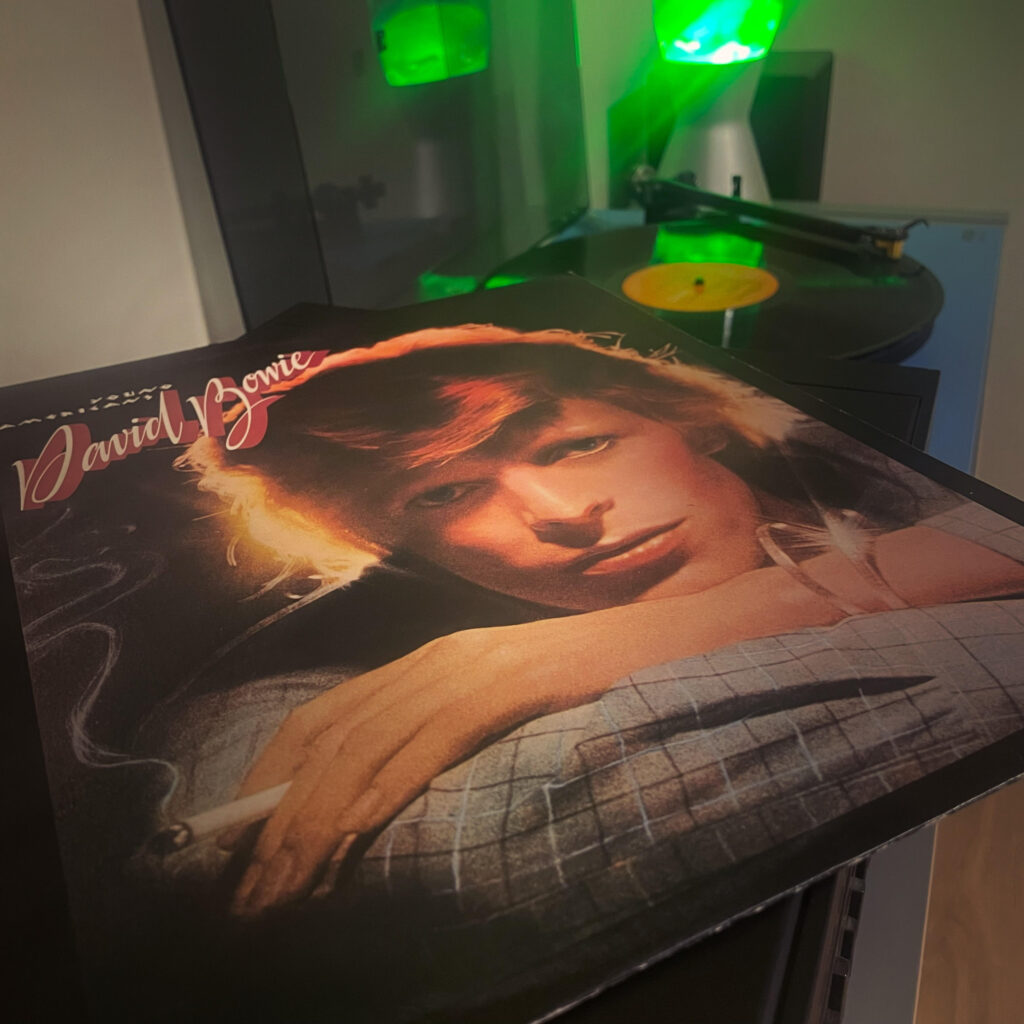
In 1975, David Bowie did what he did best and shocked everyone by completely changing direction. Fresh off the theatrical dystopia of Diamond Dogs, he abandoned glam rock for the smoky soul clubs of Philadelphia, emerging with Young Americans, an album that bewildered fans and critics alike. Was it cultural appropriation or genuine artistic evolution? A cynical cash-grab or a brave reinvention? Five decades on, Bowie’s “plastic soul” period remains one of his most divisive yet fascinating chapters – a skeletal ex-pat English art-rocker uniquely attempting American R&B and somehow pulling it off. Here’s why Young Americans deserves another listen, and why it matters more than you might think in the Bowie story.
So here’s the thing about Young Americans: it’s the sound of Bowie burning down everything that made him a star and dancing in the ashes. After the glam apocalypse of Diamond Dogs and all that Orwellian dystopia, he relocated to America, got absolutely obsessed with soul music, and came back with what might be the most audacious act of cultural appropriation – or appreciation, depending on your politics, in rock history.
Released in March ’75, this is Bowie’s “plastic soul” period, a term he coined himself with typical self-deprecating wit. But don’t let that fool you. There’s nothing remotely plastic about the grooves on this record. Recorded at Sigma Sound Studios in Philadelphia – the same room where the O’Jays and Harold Melvin cut their classics, with backing from some of the city’s finest sessionaires, this is as authentic as a skeletal English art-rock chameleon can get when he’s knee-deep in American R&B.
The title track opens proceedings like a slow-motion car crash of strings, backing vocals, and that unmistakable Bowie croon, now deeper, more soulful, dripping with a kind of desperate romanticism. “Do you remember your President Nixon?” he asks, and suddenly you’re not just listening to a pop song but witnessing Bowie’s America, all Watergate paranoia, sexual confusion, and the dying embers of the American Dream. It’s protest music for the disaffected, too fucked up to march but too aware to look away.
Then there’s “Win,” which nobody talks about enough. Luther Vandross is buried in there somewhere in the backing vocals – yes, that Luther Vandross, before anyone knew his name, and the whole thing builds like some kind of gospel testifying session that never quite commits to salvation. Bowie’s always been good at leaving you hanging, spiritually speaking.
“Fascination” came later, added for the US release, and it’s pure cocaine-and-mirrors funk, co-written with Vandross. The falsetto, the handclaps, the sheer cheek of it all – it shouldn’t work, but Bowie’s got that alchemist’s touch. He takes these American forms and filters them through his alien sensibility, and somehow it comes out sounding inevitable.
The real revelation, though, is “Somebody Up There Likes Me.” Seven minutes of strung-out funk that sounds like Bowie’s finally stopped running from something or maybe just paused for breath. The bass line alone could hypnotize you, and by the time the strings come swirling in, you’re gone. It’s the sound of 4am in a city you don’t know, with people you’ll never see again, and everything feels both meaningless and utterly vital.
Of course, there’s the Beatles cover – “Across the Universe” which some people hate on principle. Fair enough. But Bowie strips away all the cosmic whimsy and turns it into something genuinely melancholic, like he’s found Lennon’s hymn to universal consciousness at the bottom of a bottle. It’s maudlin, sure, but it fits the record’s emotional landscape perfectly.
And we can’t ignore “Fame,” can we? The funk bastard child of Bowie’s collaboration with John Lennon and Carlos Alomar, recorded during these sessions. His first proper American number one, and a deliciously bitter pill about the very celebrity machine he’d been feeding for years. The irony of becoming even more famous by singing about how much fame fucks you up wasn’t lost on anyone, least of all Bowie himself.
In the Bowie canon, Young Americans is the hinge. It’s where he stops being a glam rock prophet and starts his journey toward becoming… well, everything else. Berlin, Eno, the Thin White Duke persona, all of it begins here with this sharp left turn into soul. Some fans never forgave him for it and saw it as betrayal. But that’s always been Bowie’s genius he never gives you what you expect, and just when you think you’ve got him figured out, he’s already three moves ahead.
The album’s not perfect. It’s occasionally overwrought, sometimes too slick for its own good, and there are moments where you can hear Bowie straining against the limitations of his voice in this register. But that’s part of what makes it fascinating. You’re hearing someone genuinely stretching, genuinely trying to become something they’re not, and somehow making that transformation itself into art.
Looking back, Young Americans feels like Bowie at his most vulnerable, stripped of the sci-fi armour and glitter makeup, just a deeply weird English guy trying to make sense of America, fame, and his own restless creative spirit. It’s not his best album that’s an argument for another day, but it might be his bravest and it’s undoubtedly enduring. And in an era where most rock stars were still doing the same shtick they’d been doing since 1968, that counts for something.
The plastic soul, it turns out, had more heart than most of the genuine articles.
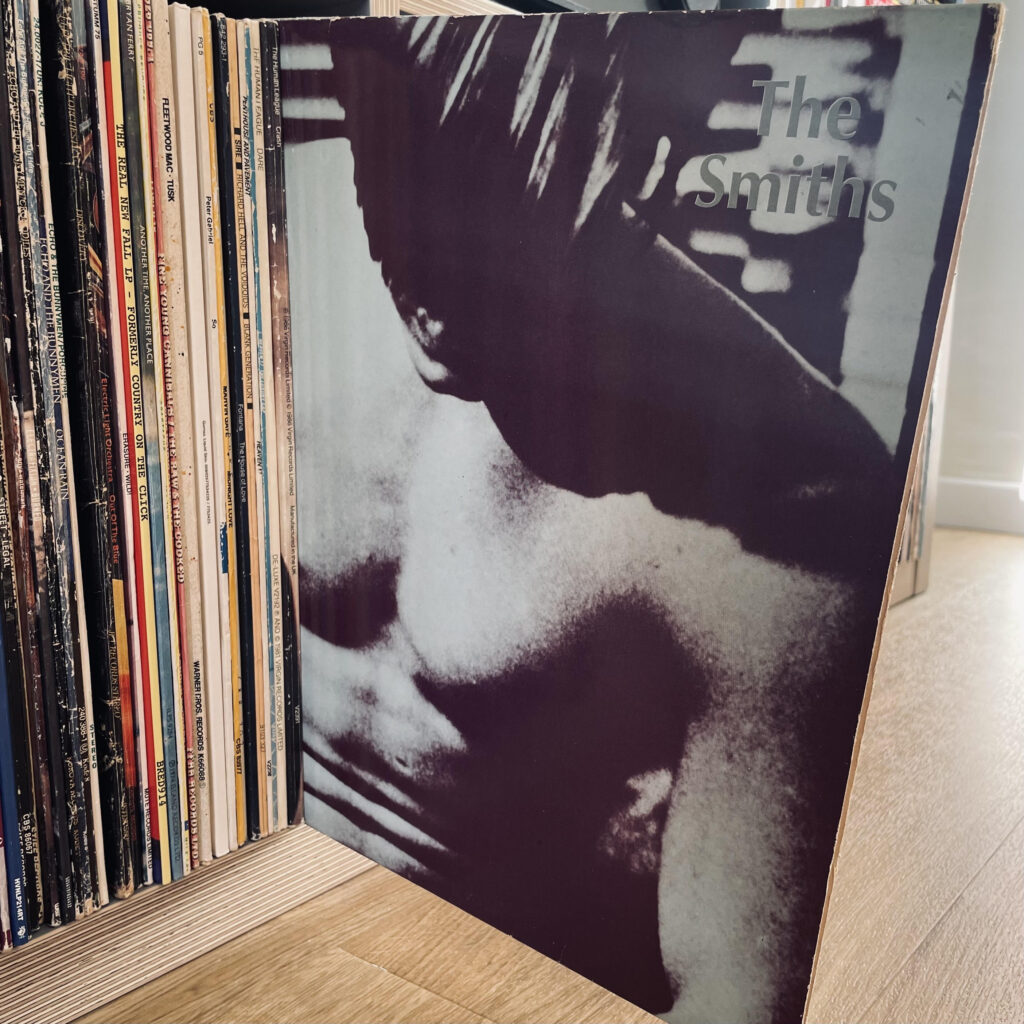
Forged in a Stretford attic, dismissed by its own singer and dogged by controversy, The Smiths’ debut still changed British music forever. Forty years on, its northern jangle, bitter poetry and doomed legacy sound sharper than ever.
The Smiths – The Smiths (Rough Trade, 1984):
Cast your mind back to February 1984 and the brittle landscape of British pop. The charts are drenched in synthesisers and covered with eyeliner, samples and sequencers are elbowing guitars into the wings. Then, out of the drizzle, four skinny lads of Irish descent from Manchester lurch onto the scene; one clutching gladioli, another his Rickenbacker like a bayonet. They call themselves The Smiths, the most ordinary name imaginable. In that choice alone lies the revolution.
The partnership had begun two years earlier with Johnny Marr knocking on Steven Patrick Morrissey’s door in Stretford a moment Morrissey would later recount in Autobiography with cinematic precision: the “handsome stranger in drainpipe jeans” standing on the doorstep, “smiling with the certainty of someone who knew what was next.” In Marr, he found his melodic twin; in Morrissey, Marr found someone who could give his guitar lines a wounded voice.
They began in Marr’s attic, crafting early songs like “The Hand That Rocks the Cradle” and “Suffer Little Children.” Morrissey later wrote of those first sessions as “a new pulse in the dull heart of the city,” though he would remain forever unsatisfied with how their debut finally sounded.
The road to that debut LP was fraught. Morrissey recalled how Rough Trade, “a label without the cash or the courage to lead,” seemed both ally and obstacle. The Troy Tate produced sessions at Elephant Studios collapsed under the heat, guitars going out of tune, tempers fraying. John Porter re-recorded the lot. Morrissey, ever the perfectionist, declared the results “not good enough,” but at a cost of £6,000 Rough Trade said it would have to do.
So The Smiths* emerged: flawed, magnificent, defiantly northern.
It opens with “Reel Around the Fountain” a slow, aching waltz of shame and seduction. Marr’s guitar drips like rain from the rooftops, Rourke’s bass curls around it, and Morrissey sighs, “It’s time the tale were told…” From the first line, it’s less an album and more a confession.
Then comes “You’ve Got Everything Now”, sharp and bitter, a howl from the uninvited. “Miserable Lie” follows, schizophrenic and breathless – part lullaby, part nervous breakdown. And then “Pretty Girls Make Graves”, all glittering guitars and doomed romance, Morrissey cutting through the post-punk fog with a sneer and a sigh.
Side two delivers the anthems that defined the band. “Still Ill”, with its tremulous jangle and weary poetry, reads like Morrissey’s entire philosophy in three minutes “Does the body rule the mind or the mind rule the body? I dunno…” Then “Hand in Glove”, the debut single that started it all, a clattering burst of urgency with the immortal claim that “the sun shines out of our behinds.” It was ludicrous, brazen, brilliant – the ultimate outsider song.
“What Difference Does It Make?” gave them their first true hit, a bruised pop song with its teeth showing, while “I Don’t Owe You Anything” slows the pulse, Paul Carrack’s organ sighing under Morrissey’s rejected torch-song croon. And closing the record, the infamous “Suffer Little Children” the Moors murders rendered as gothic lullaby. Morrissey later wrote that he “could not sing it without shivering,” but Ann West, mother of victim Lesley Ann Downey, came to see it for what it was: sorrow, not exploitation.
The album hit number two, a trend that would follow them around – blocked from the top spot by Simple Minds’ attempt at stadium rock ‘Sparkle In The Rain’. The reviews were split. NME’s Don Watson sniffed at the “lacklustre sound,” calling it “a death of the punk ideal.” Others called it genius. Critic Dave DiMartino said he hadn’t “been as fascinated by an album in years.” Morrissey, impervious as ever, proclaimed it “a signpost in the history of popular music.”
He wasn’t wrong.
In Autobiography, Morrissey remembers the aftermath with mingled pride and exasperation – a record born “out of nothing but belief” yet betrayed by “the poverty of studio time.” That tension is what keeps The Smiths alive. The imperfections are its pulse.
By 1987 the band had imploded, Marr walking away, Morrissey wallowing in resentment. The nineties brought lawsuits and character assassinations that were hard to shrug off. Mike Joyce suing for unpaid royalties and winning, the courtroom exchange finishing off whatever friendship remained. Marr and Morrissey never reconciled, and when Andy Rourke died in 2023 after a long illness, the final curtain fell. The reunion everyone wanted, the one they both secretly feared was gone forever. A relief no doubt.
So this debut remains a flawed masterpiece built on attic dreams, frustration and northern defiance. From “Reel Around the Fountain” to “Suffer Little Children”, from “Still Ill” to “Hand in Glove”, it a rain-streaked declaration that ordinary lives could sound extraordinary.
Born in drizzle and doubt, it still shines like broken glass under the streetlights of Manchester.
Released in 1973, at a point when Pink Floyd had already outgrown their psychedelic beginnings, The Dark Side Of The Moon arrived not as a burst of inspiration but as something carefully distilled. A record shaped on the road, sharpened in the studio, and built around a deceptively simple idea. Not fantasy or escape, but the mechanics of everyday life. Time, money, work, fear, and the slow, often unnoticed strain they place on the mind.
What follows isn’t just a review of a classic record. It’s a look at how that idea was constructed, why it connected so deeply, and how a band once defined by experimentation ended up making one of the most precise and enduring statements in modern music.
1. Sleeve
Before a note is heard, The Dark Side of the Moon has already made its point.
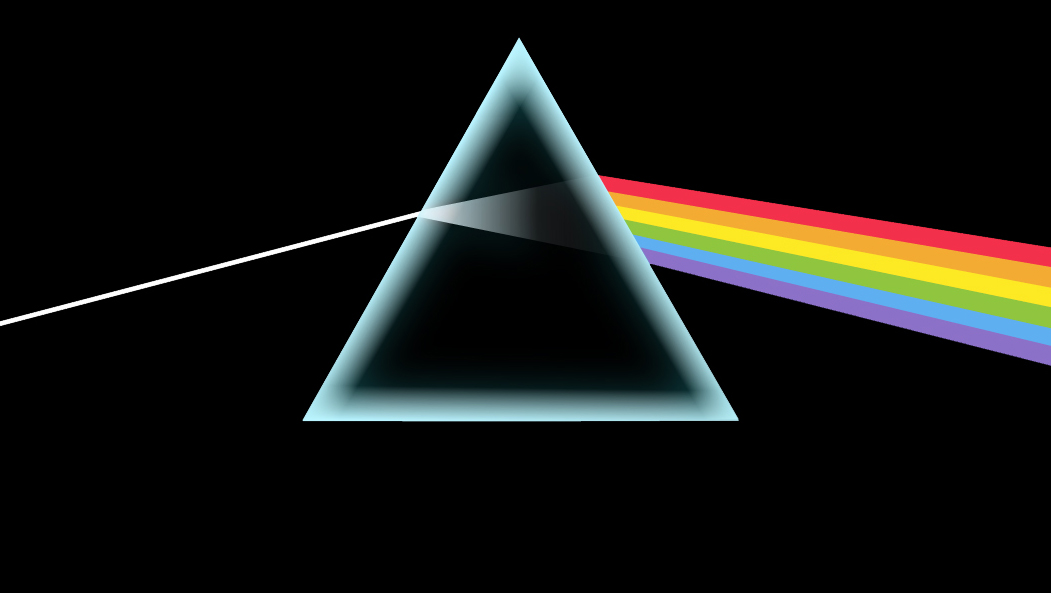
The cover, conceived by Storm Thorgerson and realised through his design partnership Hipgnosis, is almost aggressively simple. A beam of white light enters a prism, fractures into colour, exits as a spectrum against a black field. No band photograph. No title. No explanation. Just an image that feels at once scientific and faintly metaphysical.
That restraint was deliberate. Pink Floyd wanted distance from the visual clutter surrounding progressive rock. Something cleaner. More exact. Thorgerson, working alongside Aubrey Powell, drew from a physics textbook illustration of light refraction, but also from the band’s live shows, where beams of light cut through darkness with precision. The prism became a convergence point. Science, performance, and something just beyond explanation.
It also mirrors the record’s internal logic. A single source broken into its component parts, then reassembled. White light into colour. Experience into fragments. The idea of pressure refracted into time, money, fear, and mortality. It’s the concept made visible without spelling itself out.
What made it radical in 1973 was what it refused to do. Sleeve design still leaned on photography, collage, personality. Even Hipgnosis themselves were known for elaborate, often surreal imagery. Here, they stripped everything back. The result is sharper because of its absence. Nothing distracts. Nothing dates it.
The physical sleeve extended the idea. Early pressings included posters and stickers, allowing the prism to migrate beyond the record itself. Onto bedroom walls, into shared spaces, into everyday life. It stopped being packaging and became part of the culture around it.
Over time, it’s settled into design history as one of the most recognisable images in popular music. Not because it announces itself, but because it doesn’t need to. Like the album it houses, it’s controlled, precise, and quietly permanent.
2. Album
It arrived in March 1973 with the quiet confidence of a band who’d stopped chasing the ghost of Syd Barrett and instead turned their attention to something far less abstract and far more exacting. This isn’t a space record. It’s about pressure. The small, constant, grinding pressures of ordinary life and the way they accumulate until something gives.
Time slipping away without ceremony. Money warping instinct into appetite. Work becoming routine, then trap. The slow creep towards breakdown. Death as the only fixed point in the distance. Roger Waters didn’t construct a narrative. He mapped a system. Each element feeding the next, each strain bleeding into another, forming a loop that never quite releases.
By the time Pink Floyd committed it to tape at Abbey Road Studios with Alan Parsons, it had already been road-tested under the title Eclipse. That matters. This wasn’t assembled in fragments. It was honed in front of audiences until it functioned as a single, continuous piece. Even on record, it doesn’t really stop. Themes return. Voices echo. The heartbeat circles back. You’re not moving through songs. You’re contained within them.
There’s a discipline to it that still feels unusual. No indulgence. No excess. Waters provides the conceptual spine, but it’s the interplay with David Gilmour, Richard Wright and Nick Mason that gives it shape and depth. This is where the record’s quiet virtuosity sits. Not in showmanship, but in control.
Gilmour’s guitar work is exact without ever feeling clinical. His phrasing stretches time, bends it, gives it weight. Wright, often the least discussed member, is arguably the album’s tonal architect. His use of chords, space and early synthesisers creates the emotional temperature of the record. There’s a jazz sensibility to his playing, something understated but essential. Mason, too, is more than timekeeper. His drumming is economical, precise, allowing the material to breathe rather than driving it into excess.
The sound feels engineered rather than performed. Parsons’ use of tape loops, found voices and emerging studio technology binds it all together. The EMS Synthi and VCS3 systems, still relatively new at the time, aren’t used for novelty but for texture and continuity. The cash registers become rhythm. The clocks feel like impact. Even the segues, often taken for granted now, were painstakingly assembled using analogue tape, physically cut and rejoined. You can hear the craft in the joins, if you listen closely enough.
There are details that have come into sharper focus over time. Early mixes reveal alternative approaches, including longer instrumental passages and different vocal takes. The quadraphonic version, largely overseen by Parsons, shows just how ambitious the spatial design really was, with sound moving around the listener in ways that standard stereo could only hint at. Later remasters have exposed the physicality of the recordings, breaths, tape hiss, the friction of performance against machine.
The human elements remain some of its most telling. The interview snippets, gathered almost casually, now feel like a form of documentary embedded within the music. Gerry O’Driscoll’s offhand comment about death has become one of the album’s defining lines. Clare Torry’s improvised vocal, initially treated as session work, has since been recognised as a central compositional element, her later legal recognition only reinforcing how much of the album’s power lies in moments that weren’t fully understood at the time.
In the arc of Pink Floyd, this is the pivot. The point where experimentation became structure, where abstraction became communication. Earlier records hinted at ideas. Later ones, particularly Wish You Were Here and The Wall, would expand and harden them. But this is the moment where everything aligns. Concept, execution, accessibility.
Its place in popular culture is difficult to overstate. It moved beyond the usual boundaries of rock audiences and settled into everyday life. It became a staple of record collections, hi-fi demonstrations, late-night listening. It crossed generations without ever being repositioned or repackaged to do so. The longevity isn’t just commercial, it’s habitual.
And yet, for all that reach, it never feels overstated. That’s the achievement. A record built on control, on restraint, on the refusal to overplay its hand, becoming one of the most pervasive pieces of music in the modern era.
It’s often called timeless, but that misses the point. It’s rooted in its moment, shaped by post-sixties disillusionment and the creeping sense that success carries its own pressure. What’s remarkable is how little that cycle has changed.
Fifty years on, it doesn’t feel distant. It feels ongoing.
3. Urban Myth
Somewhere along the way, The Dark Side of the Moon picked up a shadow narrative. An after-hours theory that refuses to disappear.
The idea is simple. Start the album in sync with The Wizard of Oz, usually on the third roar of the MGM lion, and the two will align. Music and image falling into step. Moments of coincidence accumulating into something that feels intentional.
People point to the shift from black-and-white Kansas into colour matching the music opening out. Rhythms lining up with movement. Lyrics brushing up against scenes in ways that feel just close enough to register. It’s persuasive, in the moment. Given time, coincidence starts to feel like design.
The band have always dismissed it. There’s no evidence, and no real possibility, that it was planned. The record was built as a live piece, shaped over time, refined in the studio. It wasn’t written to picture.
What the myth reveals is something else. The way the album behaves. It’s continuous, structured, almost cinematic without attaching itself to a narrative. It invites projection. It loops, it echoes, it leaves space. Enough space for people to impose their own patterns onto it.
There’s a loose thematic overlap if you want to find it. The Wizard of Oz pulls back the curtain on illusion, revealing something ordinary behind the spectacle. Dark Side does something similar in its own way, stripping life down to its underlying pressures. But that connection is accidental, not engineered.
The myth persists because the album allows it to. It’s controlled, but open. Precise, but not closed off. People keep trying to map it onto something else, films, experiences, entire lives.
It doesn’t quite work. But it keeps working just enough to stay alive.
4. Post Script
I’ve been thinking about my own relationship to this album, and possibly other people’s. I’ve concluded that if you were aged 9 in 1971 it was an album you’d be aware of if you had an older sibling, probably a brother. Or a father with a proper stereo, the Garrard Turntable with a Shure cartridge, brushed ally 60 Watts Per Channel RMS Rotel Amp and Celestion Ditton loudspeaker set up beloved of Comet who advertised weekly in the local newspaper classifieds. Pink Floyd didn’t appear on Top Of The Pops, their band members didn’t side-hustle for other bands – so many superstars in the early seventies seemed to crop up in other bands, band swap or have solo hits, Ronnie Lane, Rod Stewart, Elton John and Roger Daltrey come to mind. Even the beloved late night DJ John Peel mimed to Maggie Mae on a mandolin for Rod Stewart on Top Of The Pops. So how would you hear any ‘Floyd tracks? I don’t even remember them being played on Alan Freeman’s Saturday Rock Show.
Another odd thing. In the period from release to when in 1977 Johnny Rotten told 15 year olds that Pink Floyd were boring, the distinctive sleeve never entranced me to by the album, nor the amazing statistics that appeared on each week’s Album Chart which was always on display behind the counter in the record shop, ‘Weeks on Chart – 310’ compared to the average of about 12.
Somewhere along the line there were enough people older than 9, with or without an older sibling or a technical father to keep this album in the U.K. album charts throughout the Seventies. And that seems to be a unique set of circumstances in my universe.
Another from my series of iconic Seventies & Eighties Punk Rock and New Wave record sleeves reimagined as standout Pop Art to show in an installation or hang in your space.
The Jam – The Modern World (1977)
600mm acrylic painting on MDF with pine former.
Despite reaching just number 36 on the UK Singles Chart, “The Modern World” is a cult classic that exemplifies The Jam’s ability to blend punk energy with mod sensibilities.
The Jam’s 1977 single “The Modern World” is a raw and energetic Paul Weller Modernist anthem that captures the spirit of new wave and the burgeoning punk scene. Released as the lead single from their second album of the same name, the track showcases Weller’s sharp songwriting and the band’s tight musicianship. The song’s defiant lyrics, including the memorable line “I don’t give two f***s about your review” (later sanitised for radio), perfectly encapsulate the rebellious attitude of youth culture in late 1970s Britain. As kids we turned our school ties back to front and wore their signature Mod ‘Jam Shoes’.
The single’s picture sleeve is a prime example of punk-inspired Pop Art design. Drawing inspiration from the Pop Art movement of the 1950s and 1960s, the sleeve features bold figures, collage elements, and imagery typical of the genre. This style, which embraced popular culture and mass media imagery, was perfectly suited to The Jam’s modern aesthetic and their critique of contemporary society.
The artwork for The Jam’s releases was typically created by Bill Smith, Polydor’s Art Director at the time. Smith was responsible for designing five of The Jam’s album covers and sixteen of their single sleeves, including the iconic spray-paint logo that became synonymous with the band. The sleeve image presented in a visually striking and provocative style consistent with the punk ethos of the time.
My large scale 600mm painted artwork emphasises the mass market printing techniques which show inaccurate origination where the face and yellow colours are printed – or was that the designer’s nod to Pop Art?
Stay tuned for my exhibition details scheduled for this Autumn and exclusive behind-the-scenes insights into my creative process.
You can join me as we celebrate the collision of music, art, and culture in the most electrifying way possible.
Another from my series of iconic Seventies & Eighties Punk Rock and New Wave record sleeves reimagined as standout Pop Art to show in an installation or hang in your space.
Buzzcocks – Orgasm Addict (1977)
Description: 600mm MDF with Pine Former. Acrylic Paint & Collage.
Orgasm Addict, Buzzcocks’ incendiary 1977 debut single, was more than just a punk anthem, it was a statement. It shattered taboos with its audacious lyrics and set the tone for a generation rebelling against conformity. Now, over four decades later, a reimagining of this punk rock milestone through a Pop Art lens, celebrating its raw energy, wit, and cultural significance.
This large-scale reinterpretation pays homage to the trailblazing visual language of Malcolm Garrett and Linder Sterling, whose iconic sleeve design remains as daring and provocative as the song itself. Sterling’s photomontage, a surreal collage of household appliances and fragmented bodies captured the disruptive ethos of punk while challenging traditional notions of sexuality and consumerism. It’s a masterpiece of subversive design, as relevant today as it was in the late ’70s.
From Punk Rock Icon to Pop Art – This reimagining amplifies the anarchic spirit of the original artwork, blending Sterling’s cut-and-paste aesthetic with the vibrant color palettes and bold forms of Pop Art. Think explosive neon hues, oversized textures, and recontextualized imagery that celebrates the song’s chaotic humor and uncompromising rebellion.
Malcolm Garrett’s typographic precision, those angular fonts and stark compositions also informs the design. This Pop Art transformation incorporates his graphic sensibility into a modernized framework, honoring his pioneering approach to blending music and bold , visual graphic art .
Why Orgasm Addict? Buzzcocks’ debut single isn’t just a punk classic; it’s a cultural landmark. The song’s tongue-in-cheek critique of excess and its frenetic energy feel tailor-made for a Pop Art transformation. This piece reexplores the tension between the song’s themes of desire, addiction, and liberation, bringing its provocative message to a new audience through a visual medium.
Experience the Rebirth. This reimagining isn’t just an homage it’s a conversation between past and present, punk rock and Pop Art, rebellion and reinvention. Whether you’re a lifelong Buzzcocks fan or a lover of bold, boundary-pushing art, this art piece invites you to rediscover Orgasm Addict as you’ve never seen it before. This may be the only large scale reinterpretaion of the single sleeve art as a painting worldwide.
Stay tuned for my exhibition details scheduled for this Autumn and exclusive behind-the-scenes insights into my creative process.
You can join me as we celebrate the collision of music, art, and culture in the most electrifying way possible.