RETROSPECTIVE: The B-52’s – S/T (1979) It’s Joy As Rebellion

Picture this, it’s ’79 – punk’s getting philosophical and Seventies disco is wheezing waiting for it’s Eighties inhaler. Then five exuberant nutters from Athens, Georgia rock up to dance this mess around a bit.
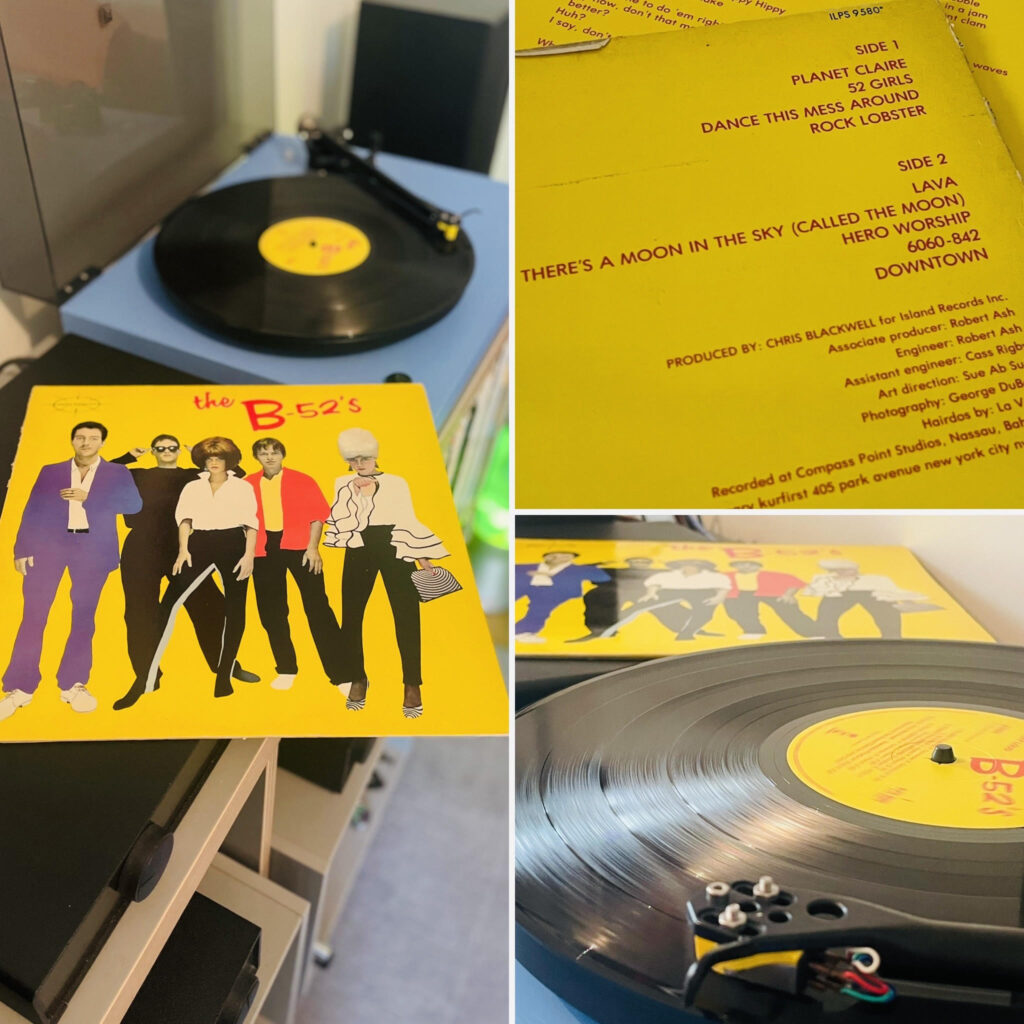
The B-52's Self Titled Debut Album From 1979 Retro Reviewed


I realised while thinking about the ‘next one’ that being a punk, new wave, indie and nowadays classic rock fan there’s not exactly much joy in my album racks. A few disco era, the Bee Gees’ Saturday Night Fever soundtrack is mostly upbeat even if the film is grittier than you’d expect.

So running my finger along the spines and out slides this bright yellow pop art cut and paste thing by Sue Ab Surd (get it?) that sounds exactly like it looks. Joyful but odd in equal measure and totally new wave – because what other genre would have them? Art Brut now included music.

Nearly half a century on, and the B-52’s debut still sounds like it was made by visitors from Planet Claire where everything’s inclusive and brilliant all the time. What we’ve learned in the intervening decades is that this wasn’t just a great teenage party record – it was the moment American rock music remembered it was allowed to smile.

Back in ‘79, punk was getting all serious and art-school, chart disco was dying on its arse, and new wave was formed sixth formers in skinny ties looking miserable. Then along came five lunatics from Athens (Georgia) – with beehive hairdos, ‘a ‘thrift store’ look before Molly Ringwald and the audacity to suggest that rock music could be simultaneously completely mental and absolutely brilliant.

The genius of it is clearer now than ever. While their contemporaries were desperately trying to be cool, the B-52’s had stumbled onto something much more powerful – they were trying to be joyful. And joy, as it turns out, is infectious.

Fred Schneider’s vocal approach was nothing short of revolutionary, though nobody realised it at the time. That Schrechgesang ‘speak-sing’ delivery that seemed bonkers in ‘79 basically invented alternative rock vocals. Indie frontman like Michael Stipe channelled a bit of Fred’s fearless weirdness. The man gave permission for rock singers to stop being frontmen and be themselves.

“Rock Lobster” once destined for the bizarre list alongside Telephone Man and Oh Superman! has revealed itself to be pure genius – a seven-minute masterclass in how to build tension, create atmosphere, “Rock lobster, down, down” and anyone that way inclined lose their mind on a dance floor. please listen to it now. It’s f***ing crazed. As the closer for side one it’s perfect, you cannot wait to hear side two. Chapeau Chris Blackwell and B-52’s.

Fun fact; Cindy Wilson’s screaming vocals, reminiscent of Yoko Ono (with the mic left on) and the album’s playful nature directly inspired John Lennon to come out of retirement to write and record Double Fantasy. That tells you everything about its power. If it was good enough to get a Beatle excited about music again, it’s worth attention. It’s hot lava!

But here’s what’s become most apparent with time, this wasn’t just novelty nonsense. The B-52’s were proper musicians creating genuinely innovative sounds. Kate Pierson and Cindy Wilson’s vocal interplay was decades ahead of its time, creating templates that alt-rock new wave bands like the Go-Go’s would follow. Ricky Wilson’s guitar, jangly alien-surf-rock, created a sound that would dominate US college rock for the next two decades.

The Athens connection looks even more significant now. That vibrant and bustling college town also produced R.E.M. and literally dozens of lesser known US indie bands. But the B-52’s got there first, proving that stateside you didn’t need to be in New York or LA to create something world-changing. All you needed was great imagination, a sense of humour, and no shame.

What’s remarkable is how modern this record still sounds. You could play “Planet Claire” today and it sounds fresh, unaffected by fashion and super upbeat. It exists outside of time, belonging to no particular era because this album created its own entire universe.

The album’s influence on fashion, art, and general cultural weirdness is immeasurable. The B-52’s made it acceptable to be fun and outrageous. Note fun. They proved that style and substance weren’t exclusive, that you could be completely over the top and still create lasting art. This is Drag Race T-40 years, no B-52’s no Scissor Sisters, maybe for a few coming out became easier and every person who’s ever teased their hair into an impossible shape owes them a drink.

Looking back, the production by Chris Blackwell is inspired. A clean, spacious mix that lets every mad element breathe – it was the perfect sonic setting for controlled chaos. While punk records were deliberately aggressive and new wave was often formulaic and sometimes saved by power pop, the B-52’s found the sweet spot where everything was clear, punchy, and completely alive. Over the next decade other US alternative bands like R.E.M applied the jangly guitar courtesy of Peter Buck and clean uncluttered mixes, Sonic Youth particularly on Daydream Nation that clarity and chaos evident here and The Go-Gos who applied similar vocal interplay, there are also similarities with Talking Heads although these are simultaneous with Brian Eno at the controls until 1981.

A then revolutionary feminist angle has only become more apparent with age. In an era when women in rock were still fighting for basic recognition, Kate and Cindy weren’t just singers – they were equal creative partners, their voices driving the songs as much as any instrument. They presented a model where gender was irrelevant; all that mattered was bringing their energy.

What’s most impressive about revisiting this album now is how it’s aged like fine wine whilst somehow getting more relevant. In our current era of manufactured authenticity and focus-grouped strategy, there’s something deeply inspiring about the B-52’s’ complete commitment to their own beautiful madness. They had a vision, admittedly involving lobsters, aliens, and enough Harmony [insert any US hair spray for local readers] to punch a hole in the ozone and they pursued it with utter conviction.

The ripple effects are still being felt. Is too much to say that without the band and this album, there’s no US college rock explosion or indie revolution, no acceptance that American rock could be colourful and strange. Kurt Cobain in those big white sunglasses. The B-52’s didn’t just make a great debut – they rewrote the rules.

Forty-six years on, “The B-52’s” debut album remains the sound of pure possibility, proof again from these retrospective reviews and research (also for my book Art Pop / Pop Art) that the best art comes from the margins, from people who care more about creating something wonderful than following the rules. It’s a record that gets better with age, revealing new layers of genius with each listen. I’ve loved playing it again.

In a world that often feels like it’s forgotten how to have fun, the B-52’s debut stands as a reminder that sometimes the most revolutionary thing you can do is refuse to take yourself too seriously. They created music that was so purely themselves that it transcended trends, genres, and decades.

Still essential. Still mental. Still absolutely bloody brilliant. 6060-842!

RETROSPECTIVE: Lennon’s Lost Weekend

John Lennon's Lost Weekend. At home in Beverly Hills.


Eighteen Months of Madness in the Heart of Hollywood. The ex-Beatle’s wildest period yet – sex, booze, and Rock’n’Roll excess that nearly destroyed a legend.

Right, so you think you know John Lennon? The peaceful Beatle, the ‘Bed-In’ revolutionary, the bloke who gave us “Imagine”? Well, think again, because between October 1973 and early 1975, our John went completely barmy in Los Angeles – and we do mean completely. They’re calling it his “Lost Weekend,” though at eighteen months, it’s more like a lost year and a half.

It all started when Yoko threw him out of their Dakota apartment. Yes, you heard right – she actually booted him out, told him to go find himself or some such psychological bollocks. “Go away and have your midlife crisis somewhere else,” was apparently the gist of it. So off trots Lennon to La-La Land with May Pang, Yoko’s 23-year-old assistant, who’d been hand-picked by Mrs Lennon herself to keep an eye on her wayward husband.

What followed was a period of such spectacular debauchery that even Keith Moon would’ve raised an eyebrow. Lennon, aged 33 and supposedly a reformed character, promptly went completely off the rails in the most American way possible.

First stop was a beach house in Santa Monica that quickly became legendary for all the wrong reasons. Lennon surrounded himself with a motley crew of musicians, hangers-on, and fellow piss heads who turned the place into something resembling a Rock’n’Roll commune crossed with a rehabilitation centre – except nobody was trying to get clean.

The core gang included Harry Nilsson (already well on his way to drinking himself to death), Ringo Starr (taking a break from his own marriage difficulties), Keith Moon (just because), and a rotating cast of session musicians, groupies, and general wastrels. They called themselves “The Hollywood Vampires” – which tells you everything you need to know about their priorities.

Days would start around noon with cocaine and brandy, move on to more serious drinking by mid-afternoon, and end with everyone unconscious in various compromising positions around dawn. Lennon, who’d supposedly given up the hard stuff years earlier, was necking everything he could get his hands on – whisky, vodka, tequila, you name it. The man who once sang about peace and love was now starting fights in nightclubs and getting thrown out of venues across Los Angeles.

The nadir came in March 1974 at the Troubadour club, where Lennon and Nilsson had gone to catch an Ann Peebles show. Both absolutely legless, they proceeded to heckle the poor woman throughout her set. When staff tried to quiet them down, Lennon apparently shouted something unrepeatable about the management’s parentage and stormed off to the toilets.

But here’s where it gets properly weird – instead of using the gents, our revolutionary hero decided to relieve himself in a cupboard, emerging with a sanitary towel stuck to his forehead like some demented tribal marking. The press had a field day, of course. “BEATLE JOHN’S TOILET SCANDAL” screamed the headlines, and suddenly the man who’d once been the most respected musician in the world was reduced to a laughing stock.

The incident became symbolic of everything wrong with Lennon’s LA period. Here was a bloke who’d written some of the most important songs of the decade, reduced to pissing in cupboards and wearing feminine hygiene products as headgear. It was pathetic, really.

Amazingly, amidst all this chaos, Lennon was still trying to make music. The problem was, he was too pissed most of the time to do it properly. Recording sessions for what would become “Walls and Bridges” were exercises in frustration, with Lennon turning up hours late, completely bladdered, and unable to remember lyrics he’d written the day before.

Producer Jack Douglas later described the sessions as “like trying to record with a very talented ghost who kept disappearing.” Lennon would start a take, wander off mid-song, and return hours later having forgotten what they were working on. It’s a miracle the album turned out as well as it did.

The saving grace was May Pang, who somehow managed to keep some semblance of order in the chaos. Twenty years younger than Lennon and completely out of her depth, she nevertheless became his anchor during this period. She’d drag him out of bars, clean him up for recording sessions, and generally prevent him from killing himself through sheer stupidity.

If you want to know how mental things got, consider this: Lennon thought it would be a brilliant idea to record an album of Rock’n’Roll covers with Phil Spector producing. Yes, that Phil Spector – the gun-toting maniac who was already showing signs of the complete breakdown that would later land him in prison for murder.

The sessions, held at various LA studios throughout 1974, were legendary for their dysfunction. Spector would turn up armed (literally), paranoid, and completely controlling. Lennon, meanwhile, was usually drunk and belligerent. The two would spend hours arguing about arrangements while session musicians sat around collecting overtime pay.

One session ended with Spector firing a gun in the studio and then disappearing with the master tapes, leaving Lennon with nothing to show for weeks of work. It was like something out of a Martin Scorsese film, except it was real life and nobody was laughing.

The thing is, beneath all the chaos and self-destruction, you could sense Lennon was actually quite miserable. This wasn’t the joyful excess of a rock star living it up – this was the desperate flailing of a man who’d lost his way completely.

Friends from the period describe him as paranoid, lonely, and increasingly aware that he was making a complete tit of himself. The press coverage was universally awful, his music was suffering, and worst of all, he was alienating himself from the son he claimed to love more than anything.

Julian was still back in England with Cynthia, and Lennon’s contact with the boy was sporadic at best. When he did ring, he was often too drunk to hold a proper conversation. It’s heartbreaking, really – here was a man who’d sung about love and peace, completely unable to maintain relationships with the people who mattered most to him.

The long and winding road back… By late 1974, even Lennon’s legendary constitution was showing signs of wear. He’d put on weight, looked terrible in photos, and was developing a reputation as one of Hollywood’s most unreliable talents. Studio executives were starting to avoid him, club owners were banning him, and his behaviour was becoming genuinely concerning to those around him.

The wake-up call came when he collapsed during a recording session, apparently from exhaustion and alcohol poisoning. Rushed to hospital, he spent several days recovering while doctors told him in no uncertain terms that his lifestyle was unsustainable.

It was then that May Pang apparently sat him down for a serious conversation about his future. According to those close to the situation, she basically told him he could continue on his current path and probably die, or he could sort himself out and try to salvage something from the wreckage of his life.

The irony is that throughout this entire period, Lennon was in regular contact with Yoko back in New York. She’d ring him every few days, ostensibly to check on his wellbeing but apparently also to monitor his behaviour. Some cynics suggest the whole “Lost Weekend” was orchestrated by Yoko from the beginning – a way of letting Lennon get all his middle-aged rebellion out of his system while keeping him on a very long leash.

Whether that’s true or not, by early 1975 it was clear that Lennon was ready to return to New York and his wife. The LA experiment had run its course, leaving behind a trail of damaged relationships, wasted opportunities, and some genuinely questionable musical decisions.

But here’s the thing – as much as the Lost Weekend period was a disaster in human terms, it also produced some of Lennon’s most honest and vulnerable music. “Walls and Bridges” contains some genuinely affecting songs about loneliness and regret, while the eventually completed “Rock’n’Roll” album, despite its troubled genesis, showed Lennon reconnecting with his musical roots in ways that would influence his later work.

So what do we make of John Lennon’s Lost Weekend? Was it a necessary period of self-exploration, or just eighteen months of expensive self-indulgence? The truth, as usual, probably lies somewhere in between.

On one hand, it’s hard to have much sympathy for a millionaire rock star whose idea of finding himself involves drinking himself senseless in beach houses while his assistant-turned-girlfriend cleans up after him. The whole thing reeks of middle-class privilege and self-pity taken to absurd extremes.

On the other hand, there’s something genuinely tragic about watching one of the most important artists of his generation lose himself so completely. Lennon’s music had always been about honesty and emotional truth, and in some perverse way, his LA breakdown was probably the most honest thing he’d done in years.

The period also demonstrated something important about the nature of creativity and self-destruction in rock music. While the myth of the tortured artist is largely bollocks, there’s no denying that some of our greatest musicians have produced their most powerful work while falling apart personally. Lennon’s Lost Weekend wasn’t pleasant to witness, but it was undeniably real in a way that his more controlled periods sometimes weren’t.

Perhaps most importantly, it showed that even John Lennon – the man who’d helped change popular music forever – was still fundamentally human, still capable of making spectacular mistakes and learning from them. The fact that he eventually sorted himself out, returned to New York, and spent his final years as a devoted father and husband suggests that the Lost Weekend, for all its chaos, might have been a necessary part of his journey.

Whether it was worth eighteen months of madness is another question entirely. But then again, that’s Rock’n’Roll for you – never simple, never clean, and never quite what you expect from the outside.

Whatever gets you thru the night eh?

*The author wishes to acknowledge that this piece is based on publicly available information and interviews from the period, and that some details remain disputed by those involved.

#nowplaying John Lennon – Walls and Bridges (1974)

CURRENT AFFAIRS: America’s Reserve Currency Status Anxiety

How Trump’s Trade Wars Threaten the US Dollar’s Global Crown

Since the Bretton Woods Agreement of 1945, the American dollar has reigned supreme in global finance. Like a trusted old friend, it has been welcomed across trading floors from Tokyo to London, from Sydney to São Paulo. Yet this remarkable privilege, often taken for granted in Washington’s corridors of power, now faces an existential challenge that few Americans properly comprehend.

When foreign manufacturers ship their trainers, televisions and trinkets to American shores, they collect dollar payments that subsequently flow through the veins of the global economy. These greenbacks grease the wheels of international commerce, particularly in vital commodities markets where oil, wheat and metals trade exclusively in Uncle Sam’s currency. The arrangement has served America handsomely, with foreigners regularly returning these dollars to purchase US Treasury bonds, effectively financing American government spending at bargain-basement interest rates.

This seemingly magical arrangement comes with a seldom-discussed requirement: America must run persistent trade deficits. Far from being an economic weakness, as populist politicians frequently claim, these deficits actually supply the world with the dollars it needs to conduct international trade. It’s a peculiar financial alchemy that transforms America’s appetite for imports into global financial influence.

The dollar’s supremacy isn’t merely about national pride, it’s the foundation of America’s financial advantage. When foreigners willingly hold dollars and dollar-denominated assets, they’re essentially providing interest-free loans to the American economy.

Yet this delicate system faces mounting pressure. The recent American embrace of punitive tariffs against major trading partners resembles nothing so much as a game of financial Russian roulette. As global commerce redirects away from American markets, the circulation of dollars naturally diminishes. Foreign exporters, holding fewer greenbacks, subsequently purchase fewer Treasury bonds.

The consequences quickly cascade. To attract sufficient buyers for its debt, the US Treasury must offer more generous returns, pushing interest rates upward across the American economy. Mortgages grow more expensive, corporate borrowing costs soar, and consumers face steeper credit card bills. Meanwhile, the American government’s interest payments balloon, exacerbating already troublesome budget deficits.

What many fail to grasp is that the dollar’s global status isn’t guaranteed by divine right, it depends entirely on the confidence of individuals and institutions worldwide, confidence that appears increasingly fragile.

Historical precedent offers little comfort. Reserve currency status, once lost, proves devilishly difficult to reclaim. The British pound’s agonising descent from global prominence after World War II provides a cautionary tale that American policymakers would be wise to heed.

Perhaps most concerning, America’s financial system operates with remarkably slim margins of safety. A Swiss watch requires a screwdriver not a hammer. The federal government’s debt has swollen to unprecedented levels, while interest payments consume an ever-larger portion of tax revenues. In this precarious context, preserving the dollar’s international standing isn’t merely a matter of prestige, it’s essential for America’s financial survival.

As spring sunshine bathes Washington’s cherry blossoms, America’s financial future hangs in the balance. Nobody but Trump and his team know if this is just a lull in the storm, or the strong arm tactics of Asia-Pacific countries and Canada selling US Treasury Bonds has given them the shock they require to back off this tough and misguided tariff policy? Do they fully appreciate the gravity of what’s at stake. For a nation accustomed to dollar dominance, the adjustment to a multipolar currency world or a pretender to the currency crown would prove jarring indeed.

See also, USA Rogue State and The Great Crypto For Gold Heist.

#GlobalFinance #DollarDominance #TradePolicy #ThinkTank #EconomicOutlook #InternationalTrade #FinancialMarkets

CURRENT AFFAIRS: The Great Crypto For Gold Heist

The Golden Cryptocurrency Caper: A Tale of Modern Alchemy

In which your correspondent discovers how America’s richest men plan to transform Fort Knox’s gold into digital fortune

Picture, if you will, the ultimate Monte Carlo card table game being played out in the Washington halls of power. The stakes? Merely the entire gold reserve of the United States. The players? A fascinating cast of characters that would make Ian Fleming envious: a maverick billionaire whose rockets link the stars, a disruptor president with a golden tower, and digital age ‘Tech Bro’ alchemists who’ve convinced themselves, and the president, they can transform base mathematics into pure profit.

The scene unfolds at Fort Knox, the imposing Kentucky fortress that has captured the imagination of many a crime writer. But unlike the unsophisticated schemes of yesteryear, this caper requires no guns, explosives, no tunneling, and no masks. Instead, our protagonists come armed with legislation, algorithms, and the kind of audacity that only billions in paper wealth can buy.

At the heart of this contemporary tale lies a simple scheme. Our casual looking crypto conspirators have discovered themselves in possession of vast digital fortunes; Bitcoin, Dogecoin, and their algorithmic kin yet find themselves unable to convert their mathematical wealth into the more traditional trappings. Their solution? Convince Uncle Sam to become the ultimate cryptocurrency whale.

The mechanics of the plan display the kind of elegant simplicity that would make a Philip Starck proud. First, manufacture a crisis, in this case, a suddenly urgent need to “verify” Fort Knox’s gold reserves, which have been resting quite comfortably these many decades. Then, through the convenient vehicle of the unwieldy entitled ‘Boosting Innovation, Technology, and Competitiveness through Optimized Investment Nationwide Act of 2024’ AKA the BITCOIN Act (a name that manages to be both simultaneously accurate and misleading), create a legal framework to revalue this gold dramatically upwards from its current modest $42 per ounce. 

Potentially a crowd silencing $400 billion in gold, transformed through legislative alchemy into $677 billion of crypto purchasing power, as per the act, to be directed toward the acquisition of Bitcoin at a pace calculated to keep the market buoyant while the currently hamstrung crypto-wealthy now out gracefully.

Consider the sophistication of the play: crypto interests have invested over $100 million in recent elections, to them an early play in thus high-stakes game. Elon Musk, a modern-day Howard Hughes, has contributed $29 million of his own funds, a trifling sum compared to the potential returns.

Most amusing is Donald Trump’s evolution from cryptocurrency skeptic to digital evangelist. DJT’s journey from declaring crypto a “scam” to embracing it as the future of finance has been both dramatic and already highly lucrative.

The true genius of the scheme lies in its solution to what one might call the cryptocurrency gentleman’s dilemma: how to convert theoretical wealth into the kind that can buy islands, yachts, or other necessities of the well-lived life. The largest holders of Bitcoin face a predicament worthy of a classical tragedy. They’re billionaires on paper, but attempting to sell would destroy the very market that makes them wealthy.

Their solution? Make the American taxpayer their buyer of last resort. Regular currency is backed by a lender of last resort; e.g. The Bank of England or the Federal Reserve. The now legally planned purchase of 200,000 Bitcoin yearly for five years isn’t just financial policy it’s an escape hatch for the digital lords, allowing them to quietly cash out their otherwise unsaleable positions while the public treasury takes their place in the crypto nobility.

One must admire the sheer panache of it all. No masks, no guns, no getaway car, just paperwork and pixels, transforming public gold into private fortune with the stroke of a pen or key. Robber barons with style. 

Where are the watchdogs? Perhaps they’re too busy admiring the technical brilliance of the plan to raise the alarm. Or perhaps, they’ve been generously encouraged to turn a blind eye.

The entire affair raises an interesting question for the modern political philosopher: When does financial innovation cross the line into grand larceny? Is there a meaningful difference between a digital heist and a legislative one? You could argue the Bush family and friends’ Gulf Wars were legitimised heists through the military industrial complex and their owners. These are the kinds of questions one might ponder over a bottle of mineral water, preferably while one’s cryptocurrency holdings are still worth something.

For now, the game continues. The players lecture the masses with the confidence of those accustomed to winning, while the rest of us watch with the kind of fascination normally reserved for high-wire acts performed without a net. One thing is certain: when the music stops, someone will be left without a chair, and it probably won’t be the gentlemen who wrote the rules. Excuse the mixing of metaphors. 

In the meantime, you can only admire the audacity, preferably from a safe distance, because they’re buying Bitcoin at a record high *cough* perhaps while enjoying a martini, shaken, not stirred as a modern day Ian Fleming may contemplate how the ancient art of the confidence trick has evolved so elegantly in our digital age. The villain elevated to the most powerful individual in the world. You couldn’t write it because in a short while, truth may be stranger than fiction. 

CURRENT AFFAIRS: USA Rogue State?

What If The United States Became a Rogue State? Should Great Britain Be Worried?

Let me be clear: I’m not engaging in hyperbole when I pose this question. As we witness the unfolding transformation of American governance under the restored Trump presidency, the international community faces an unprecedented dilemma. The special relationship between Britain and America – long the cornerstone of global democratic stability – now presents us with profound challenges.

The Project 2025 blueprint, meticulously prepared during Trump’s hiatus from power, reads less like a traditional transition plan and more like a manifesto for institutional demolition. Its architects have made no secret of their intentions: the systematic dismantling of what they term the “deep state” – in reality, the very bureaucratic safeguards that have long prevented executive overreach.

Consider the appointments. The installation of loyalists across federal agencies isn’t merely standard political patronage; it represents a fundamental restructuring of American governance. Career civil servants, those repositories of institutional knowledge and regulatory expertise, are being replaced by individuals whose primary qualification appears to be unwavering personal fealty to the president.

The consequences for Britain’s defence and security infrastructure are particularly alarming. Our military doctrine, built upon decades of joint operations and shared intelligence, suddenly stands on unstable ground. The Five Eyes intelligence-sharing agreement – arguably the most sophisticated multilateral intelligence arrangement in history – faces unprecedented strain. American intelligence agencies, now under explicitly political leadership, have already begun restricting certain intelligence flows, citing “national security reorganisation priorities.”

Consider the implications for our armed forces. Joint military exercises, long the backbone of NATO interoperability, are being cancelled or dramatically scaled back. British commanders report increasing difficulty in coordinating with their American counterparts, many of whom have been replaced by political appointees with limited military experience. The integrated defence systems that protect our shores – many reliant on American technology and real-time data sharing – face potential compromises in their effectiveness.

The economic ramifications are equally concerning. The City of London, which has thrived on its role as a crucial hub for dollar-denominated transactions, faces new uncertainties. American financial regulators, now operating under a “America First” directive, have begun implementing measures that effectively discriminate against foreign financial institutions, including British ones. The pound sterling’s traditional correlation with the dollar has become a liability rather than a stability mechanism.

Our defence industry, deeply integrated with American suppliers and technologies, faces severe disruption. Critical components for everything from our nuclear deterrent to our cyber-defence systems rely on American cooperation. The new administration’s “domestic preference” policies threaten to sever supply chains that have taken decades to build. British defence manufacturers, who have invested heavily in joint projects with American partners, now face the prospect of being frozen out of key markets.

The foreign policy pivot is particularly alarming. The new administration’s embrace of what they call “pragmatic nationalism” has effectively translated into the abandonment of longstanding alliances. NATO, already weakened during Trump’s first term, now faces existential questions about its relevance. The president’s recent remarks about “letting Putin sort out Europe” sent shockwaves through diplomatic circles, yet they barely raised eyebrows in Washington’s new political reality.

For Britain, this presents an excruciating dilemma. Our diplomatic corps, accustomed to navigating the special relationship’s occasional turbulence, now faces a fundamental question: How does one maintain a strategic partnership with a nation that increasingly rejects the very international order it helped create?

The impact on our cyber security is particularly worrying. The integrated nature of British-American cyber defence means that any degradation in cooperation immediately increases our vulnerability to state-sponsored attacks. The National Cyber Security Centre, which has relied heavily on real-time threat intelligence from American partners, reports a significant decrease in the quality and quantity of shared information.

The parallels with historical shifts in global power dynamics are unsettling. Like the decline of previous empires, America’s transition from global stabiliser to potential disruptor isn’t happening through military defeat or economic collapse, but through internal transformation. The machinery of state remains intact; it’s the operating system that’s being rewritten.

Critics might dismiss these concerns as catastrophising from the liberal establishment. But consider the concrete actions: the withdrawal from key international treaties, the deliberate undermining of multilateral institutions, the embrace of authoritarian leaders while democratic allies are publicly berated. These aren’t theoretical risks – they’re happening in real time.

The implications for Britain’s defence posture are stark. Our nuclear deterrent, while operationally independent, relies heavily on American technology and support. The new administration’s ambiguous stance on nuclear cooperation agreements has raised serious questions about long-term sustainability. The Royal Navy’s carrier strike groups, designed to operate in concert with American forces, may need to be reconceptualised for a world where such cooperation cannot be guaranteed.

Some in Whitehall advocate a “wait and see” approach, suggesting that institutional inertia will temper the administration’s more radical impulses. This misreads both the scope of the Project 2025 agenda and the determination of its implementers. The systematic placement of ideological allies throughout the federal bureaucracy creates a multiplication effect that could outlast the administration itself.

What’s required is a clear-eyed reassessment of Britain’s strategic position. This doesn’t mean abandoning the special relationship, but rather reconceptualising it for an era where American partnership comes with new risks and complications. Strengthening European security cooperation, diversifying intelligence partnerships, and building resilience against potential economic coercion should be immediate priorities.

The question isn’t whether America will remain powerful – it will. The question is how that power will be wielded, and whether the international community can adapt to an America that increasingly views global relationships through a transactional, zero-sum lens.

For Britain, this may mean making difficult choices. Our diplomatic tradition of constructive ambiguity – maintaining close ties with both Europe and America – may no longer be sustainable if those relationships pull us in fundamentally different directions.

The coming months will be crucial. As Project 2025’s implementations accelerate and the new administration’s foreign policy takes concrete form, Britain’s response will shape not just bilateral relations but our place in the emerging global order. The special relationship isn’t dead, but it’s entering uncharted territory. We must navigate with our eyes wide open to both the risks and the opportunities this presents.

This isn’t about abandoning our American allies – it’s about protecting our own interests in an era where those allies may be operating under a radically different set of priorities. The question in my headline isn’t merely provocative; it’s one that British policymakers must seriously consider as they plan for an increasingly uncertain future.