RETROSPECTIVE: The Bunnymen’s Great Leap Forward.

A retrospective on Echo and the Bunnymen’s Heaven Up Here, exploring the album’s epic scale, the band’s evolution from their debut, the charged atmosphere of their 1981 era and the bold creative leap that set them apart from their Liverpool contemporaries. A critical look at how the record became a windswept landmark of early eighties post-punk and the defining moment in the Bunnymen’s ascent.

Echo and the Bunnymen Heaven Up Here

By 1981 Echo and the Bunnymen had already outgrown the tag of Liverpool’s next big thing. The city was awash with bands skulking through basement venues and chasing the last echoes of post-punk, yet the Bunnymen always felt slightly apart from the scrum. They were part of the scene but never defined by it. Where other groups favoured jagged swagger or nervy pop, the Bunnymen carried themselves with a chilly grandeur, as if they had been imported from some vast, wind-stripped plateau rather than the banks of the Mersey.

Crocodiles had won them attention and a clutch of admirers but there was a sense, even then, that the band were bracing for something larger. They wanted scale. They wanted to escape the cramped rooms and conventional expectations that could easily have boxed them in. Heaven Up Here is the sound of that escape, recorded in Rockfield Studios in Wales where the weather and landscape matched the band’s mood. The sessions, monastic by all accounts, the group shutting themselves away and drawing out a sharper, more elemental version of their sound.

From the first moments of Show of Strength, you can hear that shift. The song doesn’t ease itself in but storms the gates, every instrument sounding taut and ready for impact. Les Pattinson had grown into an astonishingly melodic bassist by this point. His lines on the debut were confident. Here they are commanding. Pete de Freitas, the fated, youngest and in many ways the quietest member, drives the entire record with a precision that never loses its human edge. His drumming on Heaven Up Here explains why the band were so protective of him. He had that rare gift of making a rhythm feel both anchored and restless, a pulse that pushes the band into braver territory.

Will Sergeant is the architect of the album’s vast spaces. Critics often latch on to guitarists who fill every second with notes. Sergeant did the opposite. He left gaps, held back, let certain chords ring until they seemed to glow in the mix. On Over the Wall, his playing becomes a kind of topography, mapping out the contours of an imagined coastline. He had already shown flashes of this approach on Crocodiles but here he fully embraced it, giving the record its sense of scale without resorting to bombast.

Ian McCulloch, meanwhile, had grown into the frontman he always hinted he might become. There is confidence in his voice on Heaven Up Here but it is not a swaggering confidence. It’s something more guarded. He sounds like a man making sense of a world that is shifting under his feet. His lyrics during this era often veered into impressionistic fragments, the kind that prioritised atmosphere over narrative, yet they land with surprising clarity. On A Promise, there is a tension between the romantic and the resigned. All My Colours feels like the inside of a fever dream, equal parts yearning and disorientation.

Crucially, Heaven Up Here is a record shaped not only by ambition but by discipline. The band were not chasing complexity for its own sake. They were chiselling away at their own ideas, stripping the songs of anything superfluous. The result is an album that feels both lean and expansive, intimate yet immense. There is nothing indulgent in it. Nothing that feels tacked on. Every track serves the larger landscape the band were building.

The Liverpool environment of the time also left its mark. The city was in economic decline and cultural flux, yet bursting with creative energy. The Bunnymen were surrounded by other rising acts the best piloted by others of The Crucial Three; Wah!, The Teardrop Explodes, A Flock of Seagulls, but while some chased pop brightness or flamboyance, the Bunnymen were drawn to something more elemental. They carried with them a strand of romantic fatalism that owed as much to windswept beaches and night bus rides across Merseyside as it did to their musical influences.

Sergeant’s fondness for Led Zeppelin often surprises people until they actually listen to Heaven Up Here with that in mind. Not the bluster or blues rock, but the sense of dynamic tension, the interplay between hush and detonation, the way space is used as effectively as noise. The leap from Crocodiles to Heaven Up Here mirrors, in its own way, the leap Zeppelin made from their debut to Led Zeppelin II. A sudden widening of scope. A feeling that the band have discovered their engine and decided to rev the bollocks off it.

You could draw parallels with Joy Division’s shift from Unknown Pleasures to Closer, or The Cure’s move from Seventeen Seconds to Faith. But the Bunnymen’s progression feels more rooted in a sense of physical geography, as if the band had stepped outside northern post-punk entirely and wandered off onto a grey beach at dusk, taking their music with them. The sea imagery in their work wasn’t poetic window dressing. It was part of who they were. They sounded like the tides they grew up near.

When Heaven Up Here was released, some listeners were thrown by its severity. It didn’t offer easy singles or radio-friendly warmth. It demanded attention and rewarded patience. Over time, though, it has become one of those albums that grows larger in the memory, a record bands cite when they want to talk about artistic leaps rather than career maintenance. It remains a totem of what can happen when a young group, still burning with hunger, refuses to play safe.

By the final notes of the title track, the storm has passed yet the air still seems charged. You come away from Heaven Up Here with the sense that you’ve walked through a landscape rather than listened to a collection of songs. The Bunnymen would go on to make more polished and more commercially resonant records, but they never again captured this exact combination of youthful intensity and hardwired harder rock purpose.

Heaven Up Here remains not only a leap forward but a declaration of identity. A moment when Echo and the Bunnymen realised the size of the world they could build and stepped straight into it without flinching. It stands, even now, like a cliff face on the musical map of the early eighties. Stark, beautiful and utterly its own.

GIG REVIEW: Andy Crofts PRCA Session 29/11/2025

The Boy With The Guitar Strap.

Review of Andy Crofts live at Pier Road Gallery, Littlehampton.

Crofts’ own compositions; catchy, well-crafted pop songs that wear their Ray Davies influences proudly formed the heart of the evening. English Summer, Westway, Jennifer Sits Alone, Sleep, Wondering, An Ordinary Romance and more. These songs resonate as a thoughtful canon and shine in an acoustic setting stripped of embellishment and with clear enunciation.

Andy Crofts Pier Road Coffee and Art PRCA Session 29-11-1025


Doors at 6.45. Leave your smart phone apps and your algorithmic advances at home, if you want proof that music still needs human hands, a heart and a mid-session tune up or two Andy Crofts delivered it with authenticity at the final PRCA Session of this year.

You might know Crofts as the Brazil-born multi-disciplinary instrumentalist formerly integral to Paul Weller’s outfit or as the main man behind indie band The Moons. But strip away studio sheen and a full band arrangement, his particular forte, what you’re left with is something far more essential: one bloke, two young colouring-in kids, an electric acoustic six-string, a new amplifier, and a well employed songbook that spans his own Home Counties folk pop and some perfectly curated covers.

The intimate setting suited him, even if as he confessed with disarming honesty that he finds these close-quarters gigs more nerve-wracking than playing to hundreds of thousands at Glastonbury. Out there you can hide behind the lights; here, if your music stand collapses, you forget a chord (D7) or your young daughter clatters off her chair mid-song, everyone notices. The beauty and terror of ‘the toilet tour’ eh?

Crofts’ own compositions; catchy, well-crafted pop songs that wear their Ray Davies influences proudly formed the heart of the evening. English Summer, Westway, Jennifer Sits Alone, Sleep, Wondering, An Ordinary Romance and more. These songs resonate as a thoughtful canon and shine in an acoustic setting stripped of embellishment and with clear enunciation.

The covers arrived like love letters from a pre-digital age. Honeybus’ “I Can’t Let Maggie Go” emerged unplugged and liberated from its Seventies white bread-advert production. The Kinks’ “Waterloo Sunset” bounced along with an unexpected verve – Terry and Julie still crossing that river in our collective consciousness, no matter how many Reels were distracted by. From Badly Drawn Boy’s ip-so fact-o singalong “Something To Talk About”, to a Crofts meditation on Lennon’s raw demo of “Watching the Wheels,” from “And I Love Her” to “Good Thing” a formerly-reggae number rendered in acoustic pop – each reimagining proved that great songs transcend their original arrangements when you ‘handle with care’ – “over to you George”.

PRCA’s faithful got exactly what live music should be: confessional, imperfect, immediate, impossible to replicate with a million lines of code.

A one-man analog breakwater against a tech tide.

45renegade.

RETROSPECTIVE: Where Have They Been? Joy Division, Closer

A detailed retrospective on Joy Division’s devastatingly timeless album Closer, exploring the band’s final and most haunting studio album in all its creative, atmospheric, emotional and historical depth. The eternal question, closer or closer?

Joy Division Closer (1980)


Rarely, an album arrives haunted before you even drop the needle. Closer, released in July 1980 just weeks after Ian Curtis’s death, is the ultimate example. It arrived like a final communiqué, a cold transmission from a place beyond exhaustion. If Unknown Pleasures was the sound of a band discovering the architecture of modern despair, Closer was the completed structure: stark, beautiful, desolate and impossibly refined. It remains one of the most unsettling records ever made, not because of the tragedy that surrounds it, but because of how complete it feels. Four young men, barely out of their early twenties, constructing a monument with the calm precision of veteran craftsmen.

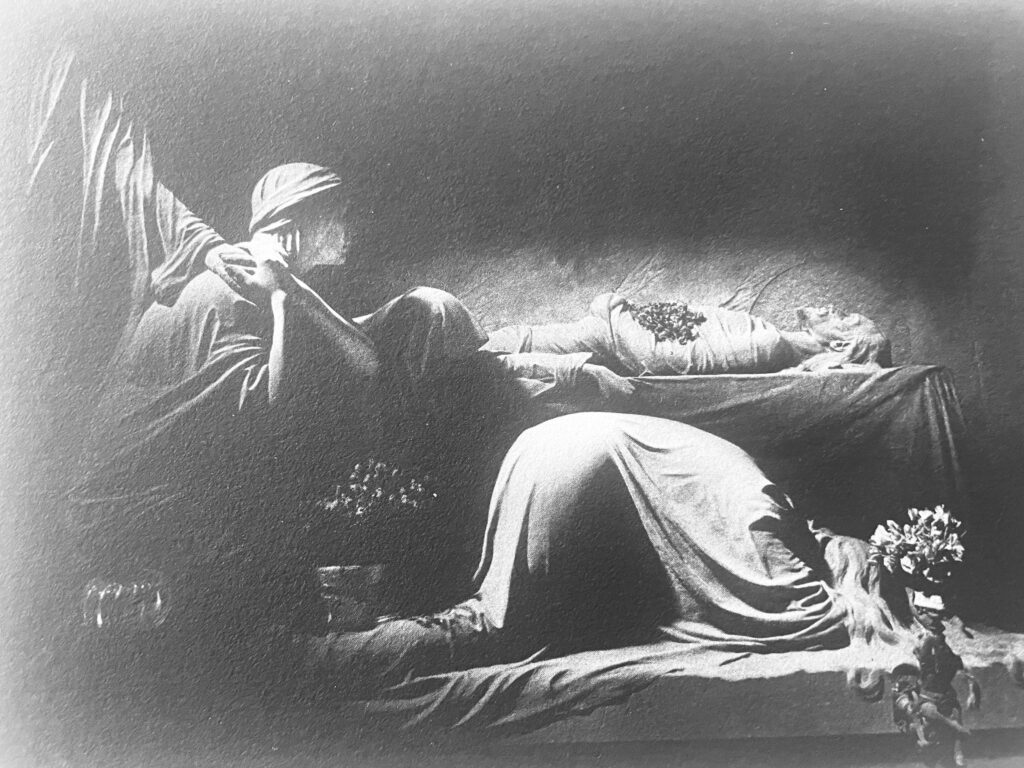
Recorded at Britannia Row Studios in early 1980, Closer was shaped by the same constellation of characters that defined its predecessor. Ian Curtis, Bernard Sumner, Peter Hook and Stephen Morris formed the nucleus, still working under the shadow of Manchester’s derelict industrial gloom. Tony Wilson and Alan Erasmus held Factory together with philosophy, flair and a certain reckless faith. Peter Saville designed the sleeve, this time a funereal photograph of a stone tomb from a Genoan cemetery. And Martin Hannett returned to sculpt the sound, more ghostly, more meticulous, more distant than ever. What they created no longer sounded like post-punk discovering itself. It sounded like something else entirely.

Curtis’s lyrics are the centre of gravity here. Written in short bursts of clarity amid worsening health, collapsing marriage and relentless touring, they possess a startling emotional precision. There is no flailing, no melodrama. Instead, Curtis writes like a man tracing the edges of his own disappearance. “A legacy so far removed” he intones on “Heart and Soul”, a line delivered with such resignation it feels almost weightless. On “Twenty Four Hours” he sounds caught between yearning and surrender, while “Passover” reads like a series of warnings he never expected anyone to hear. Curtis had always been precociously articulate, but on Closer his imagery crystallises. He writes with the concision of a poet and the clarity of someone who knows time is thinning.

Musically, the band had sharpened into an eerie, restrained machine. Hook’s bass leads most of the melodies, mournful but insistent. Sumner’s guitar is sparse, almost pointillist, teasing out glimmers of light through the haze. Morris remains astonishing, turning minimal drum patterns into emotional punctuation. There are moments that hint at what New Order would become, yet nothing here feels transitional. This is a closed circle.

And presiding over it all, Martin Hannett. If his work on Unknown Pleasures turned the band’s rawness into atmosphere, on Closer he goes further, transforming space into an emotional instrument. His production leaves acres of room between the notes. Drums crack like snapped bones in a cathedral. Basslines hover in negative space. Curtis’s voice floats somewhere between the living and the dead. Hannett built these tracks with the attention of a watchmaker, each mechanism ticking in isolation until it formed a whole that feels strangely inevitable.

Side one is almost liturgical. “Atrocity Exhibition” opens with a lurching rhythm and guitars that clatter like loose machinery. It is disorienting, provocative and brilliant. “Isolation” introduces a brittle electronic pulse, as if the band are already stepping into their next form. “Passover” feels like a whispered confession, “Colony” storms with controlled frenzy, and “A Means to an End” ties it all together with one of Hook’s finest basslines.

Side two is something else entirely. It is not a descent so much as a surrender. “Heart and Soul” is spacious, drifting, suspended in its own gravity. “Twenty Four Hours” is devastating, built on one of the band’s most violent dynamic shifts. “The Eternal” might be Joy Division’s most heartbreaking song, Morris’s drum pattern funereal, Sumner’s synths thin and trembling, Curtis sounding utterly alone. And then “Decades”, the closing track, a cold sunrise over ruins. Hook’s bass loops like memory itself while Curtis sings with a calm that chills the spine. It ends not with drama, but with a kind of acceptance.

When Closer arrived, it was instantly framed as a posthumous statement. It is not. It is a fully realised work by a band operating at the peak of their powers. The tragedy does not define it, but it certainly haunts it. Even without hindsight, the emotional gravity is unmistakeable. It is an album made with astonishing clarity by musicians who had no idea it would become a memorial.

Forty-five years on, Closer still stands apart. It is not a companion piece to Unknown Pleasures but a culmination. The purity of its production, the maturity of the writing, the confidence in its restraint. These were four young men building something timeless while their world was falling apart around them.

If Unknown Pleasures is the moment of ignition, Closer is the monument left behind. A cathedral of quiet despair. A masterwork of control, tension and emotional truth.

Enthusiasts return to it not because of its mythology, but because of its craftsmanship. It is immaculate, unsettling, and strangely beautiful. It remains one of the finest records ever to emerge from Britain, and one of the few that still feels like a closed door you can never fully open.

A band at the edge of collapse. A producer at the height of his powers. A label built on belief. And a singer writing with a lucidity that still feels impossible.

Closer endures because it sounds final. And because, in its own stark way, it is. Where have they been?

RETROSPECTIVE – Joy Division Unknown Pleasures

A stark, immersive deep dive into Unknown Pleasures, Joy Division’s 1979 debut that transformed post-punk into something spectral and eternal. Exploring the collision of Ian Curtis’s lyrical brilliance, Martin Hannett’s ghostly production, and Factory Records’ visionary chaos, this retrospective revisits the album that defined modern alienation and still sounds like the future.

Joy Division Unknown Pleasures, the ultimate retrospective review.


Some records don’t just capture a moment. Unknown Pleasures wasn’t merely a debut but a collision of working-class intelligence, creative genius and industrial desolation that turned late-Seventies Manchester into a kind of spiritual proving ground. Released in June 1979, it remains one of those rare works where every element; band, producer, manager, label, sleeve designer and city fuses into perfection. A flashpoint that changed everything.

Joy Division were four awkward young men who didn’t look the part. If the local council office workers put a band together this was it. No poses, no smiles, no pretence. Ian Curtis stood at the centre: pale, intense, eyes fixed somewhere beyond the crowd. Bernard Sumner, all nervous energy, turned thin air into electricity with brittle, searching guitar lines. Peter Hook, with attitude and melody, played bass like lead, as if he’d grown weary of the instrument’s traditional place and decided to reinvent it. Stephen Morris, unflappable and precise, was the human metronome keeping it all from imploding. Together they made music that sounded less performed than conjured.

And yet, at the heart of it all, stood Curtis, not simply the singer, but the reason Unknown Pleasures still feels like revelation. His lyrics weren’t slogans or statements; they were serious literature. Curtis was a working-class intellectual, a devourer of Kafka, Ballard, and Burroughs, a man who could translate alienation into poetry without losing the grit of everyday life. He wrote with eerie precocity, his words carrying the depth of someone twice his age. “Disorder” opens the record with “I’ve been waiting for a guide to come and take me by the hand”, a line that already sounds like a plea from the edge. “She’s Lost Control” was drawn from his encounters at the employment exchange, the story of a woman whose seizures mirrored the illness that would later contribute to his demise. In “New Dawn Fades”, he faces despair with devastating clarity: “A change of speed, a change of style, a change of scene, with no regrets.” Curtis never dramatised his pain; he documented it. Every lyric feels lived, every silence deliberate.

Around him, the band moved with precision. Sumner’s guitar shimmered with nervous energy. Hook’s bass carried the emotional and propulsive pulse. Morris locked everything into place with mechanical rigour. They didn’t just accompany Curtis’s words; they inhabited them, building soundscapes of claustrophobia and strange beauty.

Then came Martin Hannett, the producer who turned Joy Division’s live fury into something spectral. A sonic visionary and a mercurial eccentric, Hannett treated the studio like a laboratory. He recorded breaking glass, lift shafts, and literally empty space, turning silence itself into an instrument. The band wanted raw power*; Hannett delivered atmosphere, detachment, immortality. Hook complained it was too clean, too cold. But Hannett understood that this wasn’t a record about noise, it was about isolation. What he built in Strawberry Studios wasn’t just a mix; it was an environment.

(*for a heavier Joy Division listen to the live side of Still and the BBC John Peel Sessions available on the ‘Best Of’ CD)

Overseeing it all, Factory Records, Anthony H Wilson’s impossible dream. Tony Wilson was the showman-philosopher-TV presenter and new music advocate, preaching art over commerce. Alan Erasmus his quiet lieutenant, Peter Saville the young graphic designer and aesthetic genius who gave Factory its visual language. Saville’s historic sleeve design for Unknown Pleasures, the white-on-black pulsar from a Cambridge astronomy textbook, became the perfect visual echo of the sound within. No title, no band name, no marketing. Just a transmission from the void. Inspired.

The record unfolds like a descent. “Disorder” rushes in with nervous urgency. “Day of the Lords” trudges through a wasteland. “Insight” floats in eerie calm, as if overheard from another world. “New Dawn Fades” devastates with Hook’s bass in lament, Sumner’s guitar shimmering like fluorescent light. Then side two opens with “She’s Lost Control”, a mechanised tragedy pulsing with inevitability. “Shadowplay” prowls through dim alleyways, “Wilderness” and “Interzone” flicker with punk afterglow before “I Remember Nothing” ends in collapse, static, glass, and Curtis’s voice dissolving into silence.

When it was released, Unknown Pleasures barely registered commercially. Factory’s distribution (like Rough Trade in London) was chaotic, and Manchester’s cultural importance had yet to be mythologised. But those who found it; the lost, the restless, the disillusioned recognised something transcendent. Punk had been about confrontation; Joy Division turned inward and found a new vocabulary for despair. They had created the post punk meisterwerk.

Within just a year, the story turned tragic. Curtis, battling epilepsy and emotional turmoil, took his own life on the eve of the band’s first American tour. Closer followed posthumously an austere requiem with prescient sleeve to match, but Unknown Pleasures remains the genesis, the moment the ordinary became eternal.

It endures because it was never really of its time. Curtis’s lyrics read like prophecy; Hannett’s production sounds perpetually modern. Sumner, Hook and Morris would carry fragments of its brilliance into New Order, but they never recaptured this particular alchemy, the balance of tension and restraint, intellect and instinct, belief and doom.

Unknown Pleasures isn’t just the greatest post-punk album. It’s the blueprint for everything that followed. The hum of fluorescent light in an empty flat. The heartbeat of a city rediscovering its soul. The poetry of disconnection made sacred by four ordinary lads, one visionary producer, and one man’s terrible genius.

Forty-six years on, it still sounds like the future, it still hurts but as Tony Wilson later mused, a record that launched a band responsible for the renaissance and redevelopment of an entire city.

RETROSPECTIVE: The Thin White Duke Does Philly Soul

In 1975, David Bowie did what he did best and shocked everyone by completely changing direction. Fresh off the theatrical dystopia of Diamond Dogs, he abandoned glam rock for the smoky soul clubs of Philadelphia, emerging with Young Americans, an album that bewildered fans and critics alike. Was it cultural appropriation or genuine artistic evolution? A cynical cash-grab or a brave reinvention? Five decades on, Bowie’s “plastic soul” period remains one of his most divisive yet fascinating chapters – a skeletal ex-pat English art-rocker uniquely attempting American R&B and somehow pulling it off. Here’s why Young Americans deserves another listen, and why it matters more than you might think in the Bowie story.

So here’s the thing about Young Americans: it’s the sound of Bowie burning down everything that made him a star and dancing in the ashes. After the glam apocalypse of Diamond Dogs and all that Orwellian dystopia, he relocated to America, got absolutely obsessed with soul music, and came back with what might be the most audacious act of cultural appropriation – or appreciation, depending on your politics, in rock history.

Released in March ’75, this is Bowie’s “plastic soul” period, a term he coined himself with typical self-deprecating wit. But don’t let that fool you. There’s nothing remotely plastic about the grooves on this record. Recorded at Sigma Sound Studios in Philadelphia – the same room where the O’Jays and Harold Melvin cut their classics, with backing from some of the city’s finest sessionaires, this is as authentic as a skeletal English art-rock chameleon can get when he’s knee-deep in American R&B.

The title track opens proceedings like a slow-motion car crash of strings, backing vocals, and that unmistakable Bowie croon, now deeper, more soulful, dripping with a kind of desperate romanticism. “Do you remember your President Nixon?” he asks, and suddenly you’re not just listening to a pop song but witnessing Bowie’s America, all Watergate paranoia, sexual confusion, and the dying embers of the American Dream. It’s protest music for the disaffected, too fucked up to march but too aware to look away.

Then there’s “Win,” which nobody talks about enough. Luther Vandross is buried in there somewhere in the backing vocals – yes, that Luther Vandross, before anyone knew his name, and the whole thing builds like some kind of gospel testifying session that never quite commits to salvation. Bowie’s always been good at leaving you hanging, spiritually speaking.

“Fascination” came later, added for the US release, and it’s pure cocaine-and-mirrors funk, co-written with Vandross. The falsetto, the handclaps, the sheer cheek of it all – it shouldn’t work, but Bowie’s got that alchemist’s touch. He takes these American forms and filters them through his alien sensibility, and somehow it comes out sounding inevitable.

The real revelation, though, is “Somebody Up There Likes Me.” Seven minutes of strung-out funk that sounds like Bowie’s finally stopped running from something or maybe just paused for breath. The bass line alone could hypnotize you, and by the time the strings come swirling in, you’re gone. It’s the sound of 4am in a city you don’t know, with people you’ll never see again, and everything feels both meaningless and utterly vital.

Of course, there’s the Beatles cover – “Across the Universe” which some people hate on principle. Fair enough. But Bowie strips away all the cosmic whimsy and turns it into something genuinely melancholic, like he’s found Lennon’s hymn to universal consciousness at the bottom of a bottle. It’s maudlin, sure, but it fits the record’s emotional landscape perfectly.

And we can’t ignore “Fame,” can we? The funk bastard child of Bowie’s collaboration with John Lennon and Carlos Alomar, recorded during these sessions. His first proper American number one, and a deliciously bitter pill about the very celebrity machine he’d been feeding for years. The irony of becoming even more famous by singing about how much fame fucks you up wasn’t lost on anyone, least of all Bowie himself.

In the Bowie canon, Young Americans is the hinge. It’s where he stops being a glam rock prophet and starts his journey toward becoming… well, everything else. Berlin, Eno, the Thin White Duke persona, all of it begins here with this sharp left turn into soul. Some fans never forgave him for it and saw it as betrayal. But that’s always been Bowie’s genius he never gives you what you expect, and just when you think you’ve got him figured out, he’s already three moves ahead.

The album’s not perfect. It’s occasionally overwrought, sometimes too slick for its own good, and there are moments where you can hear Bowie straining against the limitations of his voice in this register. But that’s part of what makes it fascinating. You’re hearing someone genuinely stretching, genuinely trying to become something they’re not, and somehow making that transformation itself into art.

Looking back, Young Americans feels like Bowie at his most vulnerable, stripped of the sci-fi armour and glitter makeup, just a deeply weird English guy trying to make sense of America, fame, and his own restless creative spirit. It’s not his best album that’s an argument for another day, but it might be his bravest and it’s undoubtedly enduring. And in an era where most rock stars were still doing the same shtick they’d been doing since 1968, that counts for something.

The plastic soul, it turns out, had more heart than most of the genuine articles.

RETROSPECTIVE: We’re Selling England By The Pound

A retrospective of Genesis’ ‘Selling England By The Pound’. The band’s fifth long player from 1973 is a Progressive Rock classic that captured a changing newly decimal Britain through Mellotrons, lawnmower men and Cockney villains. Essential listening for anyone who thinks Prog Rock was all capes and codswallop. Genesis proved you could be both preposterous and profound.


GENESIS: Selling England By The Pound (Charisma) 1973

There was something gloriously, quintessentially English about Genesis that set them apart from the prog rock pack cluttering up the album charts in 1973. Where Yes disappeared up their own cosmic backsides and ELP bludgeoned you with their virtuosity, Peter Gabriel and his merry band of public schoolboys crafted something altogether more peculiar and affecting with this, their fifth album.

Selling England By The Pound arrived at a curious juncture for the band. After the commercial disappointment of Foxtrot failing to break America (despite ‘Supper’s Ready’ being the sort of 23-minute epic that should have had the Yanks weeping into their cornflakes), Genesis regrouped and produced what many consider their defining statement. Recorded at Island Studios with John Burns and the band sharing production duties, this was a record that positively reeked of England in 1973: a country caught between nostalgia for its crumbling past and uncertainty about its increasingly tatty future.

The album opened with ‘Dancing With The Moonlit Knight’, which nicked its central melody from ‘I Know What I Like’ before that song even appeared. Gabriel’s lyrics were stuffed with references to Wimpy Bars, breakfast cereal mascots and Churchill’s England, painting a portrait of a nation flogging off its heritage for American consumer tat. “Can you tell me where my country lies?” he asked, and you suspected he already knew the answer. Tony Banks’ Mellotron swirled around like fog over the Home Counties while Steve Hackett’s guitar work was, as ever, economical but devastating.

‘I Know What I Like (In Your Wardrobe)’ was the obvious single, and it proved a canny choice. Built around Phil Collins’ crisp, almost funky drumming and a nursery rhyme melody, it told the story of a lawnmower man content with his lot. It was Genesis at their most accessible, which wasn’t saying much, but there was real charm in its eccentricity. The promotional film they shot, with Gabriel prancing about in a cloth cap and braces, was either brilliant or barmy. Possibly both.

But it was ‘Firth of Fifth’ that had the musos wetting themselves. Banks’ opening piano passage was genuinely beautiful, all cascading romanticism and melancholy, before the band crashed in with typical Genesis precision. Hackett’s guitar solo in the instrumental section was an absolute belter, soaring and lyrical without ever tipping into tedious showboating. If you needed to convince someone that progressive rock could be genuinely moving rather than just technically accomplished, this was the track to stick on the turntable.

‘More Fool Me’, sung by Collins, was a bit of pleasant fluff really, though his voice had a vulnerability that suited the material. ‘The Battle of Epping Forest’, however, was vintage Gabriel madness: a nine-minute saga about rival gangs of Cockney villains that name-checked half of East London and featured more characters than a Dickens novel. It was exhausting, occasionally bewildering, but never boring. The time signatures flipped about like eels while Gabriel adopted various accents and personas. You either thought it was genius or pretentious twaddle. This writer leaned towards the former.

The album closed with ‘The Cinema Show’ and ‘Aisle of Plenty’, the latter essentially a reprise that bookended the record nicely. ‘The Cinema Show’ was another lengthy piece that referenced T.S. Eliot and featured some of the most intricate playing on the record. Banks’ organ work was particularly fine, while the rhythm section of Collins and Mike Rutherford locked together with the sort of telepathy that only came from years of playing school halls and student unions together.

What was remarkable about Selling England By The Pound was how distinctly British it sounded. This wasn’t blues-rock or heavy metal or glam. It was something altogether stranger: folk melodies colliding with classical pretensions, Edwardian music hall meeting avant-garde rock, all filtered through the sensibilities of five blokes who probably read too much Tolkien at Charterhouse.

Gabriel remained one of rock’s most fascinating frontmen, a genuine oddball who could make theatrical gestures seem vital rather than risible. His lyrics here were his best yet, full of wordplay and social observation, even if they occasionally veered into sixth-form poetry territory. The rest of the band were operating at a level of musicianship that would have been intimidating if it wasn’t in service of actual songs rather than mere technical exercises.

Did this prove to be the album that broke Genesis to a wider audience? Not quite. They were far too weird, too English, too prog for that. But for those willing to enter their peculiar world, Selling England By The Pound was a rich and rewarding experience.

RETROSPECTIVE: Dire Straits’ 1980 Audiophile Delight

A retrospective review of Dire Straits’ 1980 album Making Movies. Knopfler’s technical brilliance meets romantic melancholy in an era that supposedly had no use for either. In my heavily late Seventies NME hack influenced style.


DIRE STRAITS: Making Movies (Vertigo) 1980

There was something deeply suspicious about a band this technically accomplished in 1980. While half of London was still thrashing about in bin liners and safety pins, Mark Knopfler’s lot turned up with an album so pristine, 38 minutes so meticulously crafted, that you half expected to find the corners mitred.

Making Movies arrived eighteen months after their self-titled debut made them improbable millionaires in America, and it was clear they’d been spending the intervening period in expensive studios rather than the back rooms of grotty pubs. Recorded at New York’s Power Station with Jimmy Iovine producing – the man who’d just finished polishing Springsteen’s The River – this was Dire Straits going for broke, or rather, going for more money than they’d already got.

The opening salvo, “Tunnel of Love,” sprawled across eight minutes like some Dylanesque fever dream filtered through a Tyneside accent. It was all fairgrounds and Spanish guitars, with Knopfler’s finger-picked lines circling each other like moths round a sodium lamp. The man played like he was being paid by the note, which he probably was.

“Romeo and Juliet” – which got played to death on Radio 1 – was the sort of thing that had sixth-formers scribbling lyrics in the back of their French textbooks for years. It was wretchedly romantic, all unrequited longing and cinema queues, with Knopfler doing his best to sound like he’d actually had his heart broken rather than just read about it in a Leonard Cohen novel.

But here was the rub: it worked. Despite themselves, despite the almost offensive levels of musicianship on display, despite the fact that punk never happened in their world, Dire Straits crafted something genuinely affecting. “Hand in Hand” swung like prime-era Dylan, while “Les Boys” – a tawdry tale of Parisian transvestites – had the sort of seediness that Bowie used to do before he discovered Switzerland and synthos.

The centrepiece, though, was “Skateaway,” a peculiar bit of New Wave-ish funk about a rollerskating girl cruising through urban decay. It had synthesizers, for God’s sake. Synthesizers! On a Dire Straits record! Pick Withers’ drumming was tighter than a gnat’s chuff, and the whole thing sounded like what might happen if Steely Dan decided to have a go at writing a hit single.

Mark Knopfler remained an enigma wrapped in a headband. His vocals sounded like he was perpetually on the verge of nodding off, yet there was a sly intelligence to his wordplay that elevated this above standard-issue soft rock tedium. He’d clearly listened to a lot of JJ Cale, a lot of Dylan, a lot of those American FM radio staples, and he wasn’t afraid to nick the best bits.

The production was, predictably, immaculate. Every hi-hat shimmer, every bass throb from John Illsley, every keyboard wash from Roy Bittan (on loan from the E Street Band, no less) sat exactly where it should. It was the sonic equivalent of a freshly Hoovered front room with the cushions all plumped up.

Which brought us back to that initial suspicion. In an era when the most exciting music was being made by people who could barely play their instruments, Dire Straits were almost confrontationally competent. They weren’t interested in year zero, in tearing it all down and starting again. They wanted to take you to the pictures, buy you chips on the way home, and maybe have a bit of a cuddle if you were lucky.

And you know what? Sometimes that was enough. Making Movies didn’t change your life or inspire you to form a band in your mate’s garage. But on a rainy Tuesday evening when you were skint and miserable and the world seemed determined to grind you down, it might just have made things seem temporarily bearable.

Which, in 1980, was worth something.

RETROSPECTIVE: Talking Heads – Remain In Light 1980

Some records arrive like a whisper and fade, others crash in like an avalanche and leave you stumbling in their wake. Remain in Light is one of the latter, a slab of paranoia, rhythm, and obsession that still sounds as unmoored and visionary in 2025 as it did in 1980. Forty-five years on, the album hums with the intensity of four New Yorkers trying to rethink the world, their identities, and what a pop record could do. It is both human and alien, cerebral and primal, art-school gone feral. Listening now, you realise Talking Heads did not so much make an album as invent a language for disorientation.

Part One: The Sleeve

Pick up the sleeve and your first impression is confusion masquerading as design. Four faces, distorted and layered, hover in red, black, and white, a simulacrum of identity rendered through early MIT image-processing technology. The work of Tibor Kalman and M&Co, it feels both robotic and living. Your eyes register familiar features, only to be immediately unmoored. Tina Weymouth’s fascination with African masks, refracted through digital manipulation, turns the human face into a machine’s suggestion. It is uncanny, a whisper of the postmodern anxiety that would haunt the next four decades of visual culture.

Every detail matters. The typography is sharp and arresting, suggesting urgency without screaming. Fighter-bomber Avenger silhouettes and ghostly abstractions hover in the margins, hinting at violence, both literal and psychic. The design does not complement the music so much as anticipate it, a visual prelude to the interlocking chaos within. In 1980, it was a statement that identity was mutable, mediated, and constantly under negotiation. Today, that’s the norm.

Kalman’s brilliance was in making technological imperfection a part of the aesthetic. The faces are corrupted, glitched, degraded – human error filtered through a machine. This is not a record cover; it is a manifesto. By the time you slide the vinyl from its jacket, you are already prepared for disorientation. What follows is not just music, it is an ecosystem, a carefully constructed labyrinth designed to engage both body and mind.

Part Two: The Music & Legacy

Recording began at Compass Point Studios in Nassau, a sun-soaked bunker that would become a crucible for genius and frustration alike. The band was joined by Brian Eno, the unofficial fifth Head, whose influence was less about notes than architecture. He arrived with a philosophy: treat the studio as an instrument, treat chaos as composition, and do not flinch at failure. The sessions were famously intense. The band worked long, bewildering hours, layering loops, polyrhythms, and improvisations until something miraculous emerged from the mess.

The foundation was African-inspired polyrhythms, specifically the hypnotic grooves of Fela Kuti. This was not mere imitation; it was a translation of complex rhythmic systems into a New York art-rock vocabulary. Each instrument moves independently, a conversation of contradictions. Drums and percussion interlock but never collide, basslines snake around vocal hooks, and guitars oscillate between melody and texture. Adrian Belew’s guitar is both nervous and ecstatic, Jon Hassell’s trumpet drifts like a mirage, and Eno’s synthesizer textures shimmer in the spaces between. The record is dense yet breathable, controlled yet chaotic, deliberate yet accidental.

Byrne’s vocals are equally layered, a collage of obsessions and idiosyncrasies. He borrows from hip-hop cadences, ritualistic chant, and fragmented narrative, creating a delivery that is more incantation than song. The lyrics often circle existential dread with playful detachment. In “Born Under Punches”, Byrne’s voice is manic and fractured, a protagonist grappling with information overload and identity crisis. “Crosseyed and Painless” is a sermon on anxiety, paranoia, and social collapse, delivered with sharp wit and relentless rhythm.

The album’s architecture is deliberate. The first side, buoyed by kinetic energy, draws you into the labyrinth. “The Great Curve” is an ecstatic frenzy, the band locked in an ecstatic groove that simultaneously propels and destabilises. By the time “Once in a Lifetime” arrives, you are primed for reflection. The song balances existential inquiry with dance floor immediacy, Byrne pondering selfhood and entropy against a backdrop of hypnotic repetition. It is both absurd and devastatingly human.

Side two darkens the palette. “Houses in Motion” jitters with post-industrial dread, a cityscape of anxiety rendered in sound. “Seen and Not Seen” drifts toward abstraction, its protagonist dissolving into observation, a meditation on presence, absence, and perception. “Listening Wind” introduces political undercurrents, a commentary on global turbulence and American complacency filtered through dense polyrhythms and hypnotic motifs. The album closes with “The Overload”, a spectral transmission that hints at collapse and transcendence simultaneously.

The genius of Remain in Light lies in its simultaneity. It is both academic and visceral, cerebral and bodily. It occupies a transitional space where intellect and instinct cohabit uneasily but beautifully. The recording process itself becomes audible: the tape loops, studio experimentation, and improvisational layering are part of the listening experience. You hear the struggle, the trial and error, the moments of panic and revelation. This is music as architecture, as experiment, as living organism.

Culturally, the album is a negotiation of influence. The band’s engagement with African rhythms is complex, filtered through Western ears and art-school sensibility. It raises questions about appropriation, translation, and homage, but the resulting work is undeniably original. It is a fusion of ideas and sounds that challenges the listener to reconsider boundaries, genres, and expectations. The record is not just a reflection of its time, it is a critique of it, questioning identity, technology, and the very notion of pop music as a commodity.

The legacy of Remain in Light is vast. Upon release, it charted modestly, yet critics recognised its audacity. The album influenced generations of musicians, from the electronic experiments of the eighties to the worldbeat experiments of later decades. It bridged punk’s urgency with funk’s elasticity, art-school conceptualism with dancefloor immediacy. Touring the album proved difficult; the complexity and intensity of the arrangements tested the band to their limits. Yet the recordings themselves endure, a testament to ambition, collaboration, and the willingness to confront chaos head-on.

Listening today, the album resonates with a prescience that is uncanny. Byrne’s exploration of selfhood, Eno’s textural interventions, the band’s rhythmic sophistication all speak to an era increasingly dominated by technology and mediated experience. Forty-five years on, the music still feels urgent, still unsettles and energises in equal measure. It is a record that rewards repeated engagement, revealing new facets with each listen. The textures, the contradictions, the obsessive layering, all retain their power to unsettle and illuminate.

In retrospect, Remain in Light is not just an album. It is a blueprint for artistic ambition, a testament to the potential of collaboration and the thrill of experimentation. It embodies the tension between accessibility and difficulty, dance and reflection, humour and despair. Its enduring influence is evident not only in the artists who followed but in the ways it continues to challenge contemporary listeners. The record is a meditation on identity, perception, and creativity itself, an exploration that remains vital and uncontainable.

Four decades on, the album hums with life, refusing to settle into nostalgia or canonisation. It is human, machine, ritual, and meditation all at once. The visual and sonic languages it employs remain radical; the ideas embedded in its grooves still resonate. Talking Heads, at their apex, were not content with simple pop. They sought transformation, and in Remain in Light they achieved it. 

Listening now, the record still demands attention. It insists on engagement, on immersion. The faces on the sleeve, the fractured rhythms, the cascading vocals – all converge to create an experience that is simultaneously exhilarating and disorienting. It is, as ever, a record that challenges, delights, and confounds.

Remain in Light remains a masterpiece because it continues to operate on multiple planes. It is art, it is music, it is philosophy, and it is ritual. It occupies a space that few albums dare to enter, and fewer still manage to navigate successfully. Forty-five years later, it retains its power, its strangeness, and its brilliance. Talking Heads created not just an album but a living organism, one that still breathes, pulses, and disrupts.

For those willing to engage fully, it remains an astonishing journey, a record that refuses to be tamed, a testament to what happens when intelligence, curiosity, and obsession collide. Remain in Light is not simply listened to. It is experienced, interrogated, and felt. It is, in every sense, timeless.

RETROSPECTIVE: Northern Souls. The Smiths 1984 Debut Album

Forged in a Stretford attic, dismissed by its own singer and dogged by controversy, The Smiths’ debut still changed British music forever. Forty years on, its northern jangle, bitter poetry and doomed legacy sound sharper than ever.

The Smiths Debut Album 1984


The Smiths – The Smiths (Rough Trade, 1984):

Cast your mind back to February 1984 and the brittle landscape of British pop. The charts are drenched in synthesisers and covered with eyeliner, samples and sequencers are elbowing guitars into the wings. Then, out of the drizzle, four skinny lads of Irish descent from Manchester lurch onto the scene; one clutching gladioli, another his Rickenbacker like a bayonet. They call themselves The Smiths, the most ordinary name imaginable. In that choice alone lies the revolution.

The partnership had begun two years earlier with Johnny Marr knocking on Steven Patrick Morrissey’s door in Stretford a moment Morrissey would later recount in Autobiography with cinematic precision: the “handsome stranger in drainpipe jeans” standing on the doorstep, “smiling with the certainty of someone who knew what was next.” In Marr, he found his melodic twin; in Morrissey, Marr found someone who could give his guitar lines a wounded voice.

They began in Marr’s attic, crafting early songs like “The Hand That Rocks the Cradle” and “Suffer Little Children.” Morrissey later wrote of those first sessions as “a new pulse in the dull heart of the city,” though he would remain forever unsatisfied with how their debut finally sounded.

The road to that debut LP was fraught. Morrissey recalled how Rough Trade, “a label without the cash or the courage to lead,” seemed both ally and obstacle. The Troy Tate produced sessions at Elephant Studios collapsed under the heat, guitars going out of tune, tempers fraying. John Porter re-recorded the lot. Morrissey, ever the perfectionist, declared the results “not good enough,” but at a cost of £6,000 Rough Trade said it would have to do.

So The Smiths* emerged: flawed, magnificent, defiantly northern.

It opens with “Reel Around the Fountain” a slow, aching waltz of shame and seduction. Marr’s guitar drips like rain from the rooftops, Rourke’s bass curls around it, and Morrissey sighs, “It’s time the tale were told…” From the first line, it’s less an album and more a confession.

Then comes “You’ve Got Everything Now”, sharp and bitter, a howl from the uninvited. “Miserable Lie” follows, schizophrenic and breathless – part lullaby, part nervous breakdown. And then “Pretty Girls Make Graves”, all glittering guitars and doomed romance, Morrissey cutting through the post-punk fog with a sneer and a sigh.

Side two delivers the anthems that defined the band. “Still Ill”, with its tremulous jangle and weary poetry, reads like Morrissey’s entire philosophy in three minutes “Does the body rule the mind or the mind rule the body? I dunno…” Then “Hand in Glove”, the debut single that started it all, a clattering burst of urgency with the immortal claim that “the sun shines out of our behinds.” It was ludicrous, brazen, brilliant – the ultimate outsider song.

“What Difference Does It Make?” gave them their first true hit, a bruised pop song with its teeth showing, while “I Don’t Owe You Anything” slows the pulse, Paul Carrack’s organ sighing under Morrissey’s rejected torch-song croon. And closing the record, the infamous “Suffer Little Children” the Moors murders rendered as gothic lullaby. Morrissey later wrote that he “could not sing it without shivering,” but Ann West, mother of victim Lesley Ann Downey, came to see it for what it was: sorrow, not exploitation.

The album hit number two, a trend that would follow them around – blocked from the top spot by Simple Minds’ attempt at stadium rock ‘Sparkle In The Rain’. The reviews were split. NME’s Don Watson sniffed at the “lacklustre sound,” calling it “a death of the punk ideal.” Others called it genius. Critic Dave DiMartino said he hadn’t “been as fascinated by an album in years.” Morrissey, impervious as ever, proclaimed it “a signpost in the history of popular music.”

He wasn’t wrong.

In Autobiography, Morrissey remembers the aftermath with mingled pride and exasperation – a record born “out of nothing but belief” yet betrayed by “the poverty of studio time.” That tension is what keeps The Smiths alive. The imperfections are its pulse.

By 1987 the band had imploded, Marr walking away, Morrissey wallowing in resentment. The nineties brought lawsuits and character assassinations that were hard to shrug off. Mike Joyce suing for unpaid royalties and winning, the courtroom exchange finishing off whatever friendship remained. Marr and Morrissey never reconciled, and when Andy Rourke died in 2023 after a long illness, the final curtain fell. The reunion everyone wanted, the one they both secretly feared was gone forever. A relief no doubt.

So this debut remains a flawed masterpiece built on attic dreams, frustration and northern defiance. From “Reel Around the Fountain” to “Suffer Little Children”, from “Still Ill” to “Hand in Glove”, it a rain-streaked declaration that ordinary lives could sound extraordinary.

Born in drizzle and doubt, it still shines like broken glass under the streetlights of Manchester.

RETROSPECTIVE: Dark Side Of The Moon: The Quiet Architecture of Collapse

Released in 1973, at a point when Pink Floyd had already outgrown their psychedelic beginnings, The Dark Side Of The Moon arrived not as a burst of inspiration but as something carefully distilled. A record shaped on the road, sharpened in the studio, and built around a deceptively simple idea. Not fantasy or escape, but the mechanics of everyday life. Time, money, work, fear, and the slow, often unnoticed strain they place on the mind.

What follows isn’t just a review of a classic record. It’s a look at how that idea was constructed, why it connected so deeply, and how a band once defined by experimentation ended up making one of the most precise and enduring statements in modern music.

1. Sleeve

Before a note is heard, The Dark Side of the Moon has already made its point.

The cover, conceived by Storm Thorgerson and realised through his design partnership Hipgnosis, is almost aggressively simple. A beam of white light enters a prism, fractures into colour, exits as a spectrum against a black field. No band photograph. No title. No explanation. Just an image that feels at once scientific and faintly metaphysical.

That restraint was deliberate. Pink Floyd wanted distance from the visual clutter surrounding progressive rock. Something cleaner. More exact. Thorgerson, working alongside Aubrey Powell, drew from a physics textbook illustration of light refraction, but also from the band’s live shows, where beams of light cut through darkness with precision. The prism became a convergence point. Science, performance, and something just beyond explanation.

It also mirrors the record’s internal logic. A single source broken into its component parts, then reassembled. White light into colour. Experience into fragments. The idea of pressure refracted into time, money, fear, and mortality. It’s the concept made visible without spelling itself out.

What made it radical in 1973 was what it refused to do. Sleeve design still leaned on photography, collage, personality. Even Hipgnosis themselves were known for elaborate, often surreal imagery. Here, they stripped everything back. The result is sharper because of its absence. Nothing distracts. Nothing dates it.

The physical sleeve extended the idea. Early pressings included posters and stickers, allowing the prism to migrate beyond the record itself. Onto bedroom walls, into shared spaces, into everyday life. It stopped being packaging and became part of the culture around it.

Over time, it’s settled into design history as one of the most recognisable images in popular music. Not because it announces itself, but because it doesn’t need to. Like the album it houses, it’s controlled, precise, and quietly permanent.

2. Album

It arrived in March 1973 with the quiet confidence of a band who’d stopped chasing the ghost of Syd Barrett and instead turned their attention to something far less abstract and far more exacting. This isn’t a space record. It’s about pressure. The small, constant, grinding pressures of ordinary life and the way they accumulate until something gives.

Time slipping away without ceremony. Money warping instinct into appetite. Work becoming routine, then trap. The slow creep towards breakdown. Death as the only fixed point in the distance. Roger Waters didn’t construct a narrative. He mapped a system. Each element feeding the next, each strain bleeding into another, forming a loop that never quite releases.

By the time Pink Floyd committed it to tape at Abbey Road Studios with Alan Parsons, it had already been road-tested under the title Eclipse. That matters. This wasn’t assembled in fragments. It was honed in front of audiences until it functioned as a single, continuous piece. Even on record, it doesn’t really stop. Themes return. Voices echo. The heartbeat circles back. You’re not moving through songs. You’re contained within them.

There’s a discipline to it that still feels unusual. No indulgence. No excess. Waters provides the conceptual spine, but it’s the interplay with David Gilmour, Richard Wright and Nick Mason that gives it shape and depth. This is where the record’s quiet virtuosity sits. Not in showmanship, but in control.

Gilmour’s guitar work is exact without ever feeling clinical. His phrasing stretches time, bends it, gives it weight. Wright, often the least discussed member, is arguably the album’s tonal architect. His use of chords, space and early synthesisers creates the emotional temperature of the record. There’s a jazz sensibility to his playing, something understated but essential. Mason, too, is more than timekeeper. His drumming is economical, precise, allowing the material to breathe rather than driving it into excess.

The sound feels engineered rather than performed. Parsons’ use of tape loops, found voices and emerging studio technology binds it all together. The EMS Synthi and VCS3 systems, still relatively new at the time, aren’t used for novelty but for texture and continuity. The cash registers become rhythm. The clocks feel like impact. Even the segues, often taken for granted now, were painstakingly assembled using analogue tape, physically cut and rejoined. You can hear the craft in the joins, if you listen closely enough.

There are details that have come into sharper focus over time. Early mixes reveal alternative approaches, including longer instrumental passages and different vocal takes. The quadraphonic version, largely overseen by Parsons, shows just how ambitious the spatial design really was, with sound moving around the listener in ways that standard stereo could only hint at. Later remasters have exposed the physicality of the recordings, breaths, tape hiss, the friction of performance against machine.

The human elements remain some of its most telling. The interview snippets, gathered almost casually, now feel like a form of documentary embedded within the music. Gerry O’Driscoll’s offhand comment about death has become one of the album’s defining lines. Clare Torry’s improvised vocal, initially treated as session work, has since been recognised as a central compositional element, her later legal recognition only reinforcing how much of the album’s power lies in moments that weren’t fully understood at the time.

In the arc of Pink Floyd, this is the pivot. The point where experimentation became structure, where abstraction became communication. Earlier records hinted at ideas. Later ones, particularly Wish You Were Here and The Wall, would expand and harden them. But this is the moment where everything aligns. Concept, execution, accessibility.

Its place in popular culture is difficult to overstate. It moved beyond the usual boundaries of rock audiences and settled into everyday life. It became a staple of record collections, hi-fi demonstrations, late-night listening. It crossed generations without ever being repositioned or repackaged to do so. The longevity isn’t just commercial, it’s habitual.

And yet, for all that reach, it never feels overstated. That’s the achievement. A record built on control, on restraint, on the refusal to overplay its hand, becoming one of the most pervasive pieces of music in the modern era.

It’s often called timeless, but that misses the point. It’s rooted in its moment, shaped by post-sixties disillusionment and the creeping sense that success carries its own pressure. What’s remarkable is how little that cycle has changed.

Fifty years on, it doesn’t feel distant. It feels ongoing.

3. Urban Myth

Somewhere along the way, The Dark Side of the Moon picked up a shadow narrative. An after-hours theory that refuses to disappear.

The idea is simple. Start the album in sync with The Wizard of Oz, usually on the third roar of the MGM lion, and the two will align. Music and image falling into step. Moments of coincidence accumulating into something that feels intentional.

People point to the shift from black-and-white Kansas into colour matching the music opening out. Rhythms lining up with movement. Lyrics brushing up against scenes in ways that feel just close enough to register. It’s persuasive, in the moment. Given time, coincidence starts to feel like design.

The band have always dismissed it. There’s no evidence, and no real possibility, that it was planned. The record was built as a live piece, shaped over time, refined in the studio. It wasn’t written to picture.

What the myth reveals is something else. The way the album behaves. It’s continuous, structured, almost cinematic without attaching itself to a narrative. It invites projection. It loops, it echoes, it leaves space. Enough space for people to impose their own patterns onto it.

There’s a loose thematic overlap if you want to find it. The Wizard of Oz pulls back the curtain on illusion, revealing something ordinary behind the spectacle. Dark Side does something similar in its own way, stripping life down to its underlying pressures. But that connection is accidental, not engineered.

The myth persists because the album allows it to. It’s controlled, but open. Precise, but not closed off. People keep trying to map it onto something else, films, experiences, entire lives.

It doesn’t quite work. But it keeps working just enough to stay alive.

4. Post Script

I’ve been thinking about my own relationship to this album, and possibly other people’s. I’ve concluded that if you were aged 9 in 1971 it was an album you’d be aware of if you had an older sibling, probably a brother. Or a father with a proper stereo, the Garrard Turntable with a Shure cartridge, brushed ally 60 Watts Per Channel RMS Rotel Amp and Celestion Ditton loudspeaker set up beloved of Comet who advertised weekly in the local newspaper classifieds. Pink Floyd didn’t appear on Top Of The Pops, their band members didn’t side-hustle for other bands – so many superstars in the early seventies seemed to crop up in other bands, band swap or have solo hits, Ronnie Lane, Rod Stewart, Elton John and Roger Daltrey come to mind. Even the beloved late night DJ John Peel mimed to Maggie Mae on a mandolin for Rod Stewart on Top Of The Pops. So how would you hear any ‘Floyd tracks? I don’t even remember them being played on Alan Freeman’s Saturday Rock Show.

Another odd thing. In the period from release to when in 1977 Johnny Rotten told 15 year olds that Pink Floyd were boring, the distinctive sleeve never entranced me to by the album, nor the amazing statistics that appeared on each week’s Album Chart which was always on display behind the counter in the record shop, ‘Weeks on Chart – 310’ compared to the average of about 12.

Somewhere along the line there were enough people older than 9, with or without an older sibling or a technical father to keep this album in the U.K. album charts throughout the Seventies. And that seems to be a unique set of circumstances in my universe.