RETROSPECTIVE: The Thin White Duke’s Disappearing Act

Bowie’s Low nearly half a century on.


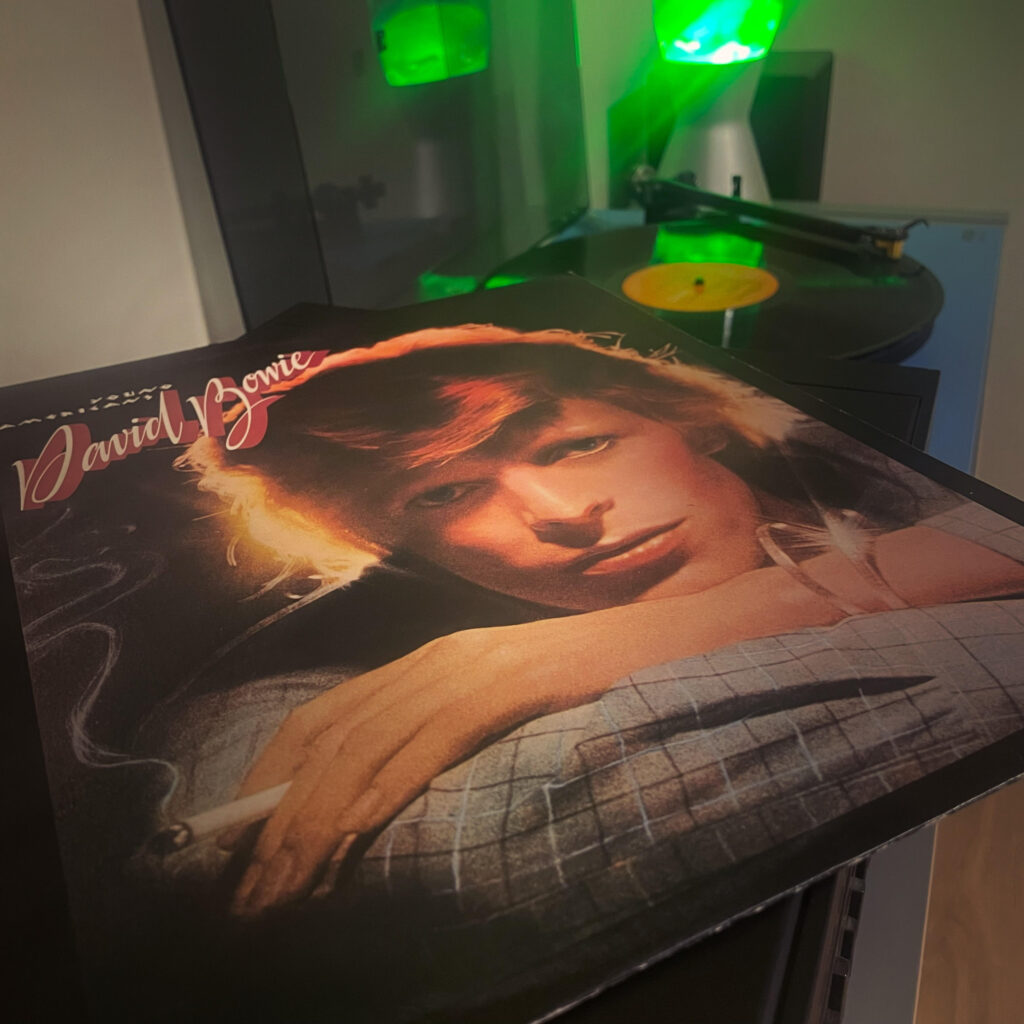
In the pantheon of rock’s great reinventions, few albums have aged as gracefully, or as mysteriously as David Bowie’s Low. Released in January 1977 to widespread bewilderment and commercial indifference, this curious hybrid of fractured pop songs and ambient soundscapes now appears, from our 2025 vantage point, to be one of the most prophetic statements in popular music’s history.

The conventional narrative surrounding ‘Low’ has always centred on geography and biography: Bowie fleeing Los Angeles and its pharmaceutical temptations for the disciplined clarity of divided Berlin, collaborating with the electronic music pioneer Brian Eno to create something entirely new. Yet recent archival research has complicated this neat story considerably. Much of the album’s foundational work actually took place at the Château d’Hérouville studios in France, months before Bowie’s Berlin sojourn began in earnest. The geographical mythology, it transpires, was partly retrospective construction, though no less meaningful for that.

What emerges most clearly, nearly half a century on, is how ‘Low’ functions as both ending and beginning. It represents the final flowering of the rhythmic obsessions that had driven Bowie through his American soul period, yet subjects those same impulses to a process of systematic deconstruction that would influence popular music for decades to come. The rhythm section of Dennis Davis and George Murray, veterans of ‘Young Americans’ and ‘Station to Station’, found themselves playing against type – their customary precision dissolved into something more impressionistic, more concerned with atmosphere than with groove.

The Brian Eno collaboration proved transformative in ways that have become clearer with time. Eno’s methodology, the famous “Oblique Strategies” cards, his insistence on removing conventional guitar solos, his suggestion that Carlos Alomar play rhythm parts without chord progressions, represented a systematic assault on rock orthodoxy. The results were songs that barely qualified as songs at all: “Breaking Glass” distils two minutes of nervous energy into treated percussion and fractured vocals, whilst “What in the World” transforms romantic yearning into something that might have been transmitted from outer space.

The album’s bipartite structure – seven relatively orthodox pop songs followed by four extended instrumental pieces – baffled RCA’s marketing department and contributed to its commercial failure in America. From today’s perspective, however, this division appears remarkably prescient. The instrumental suite that occupies ‘Low’ s second side anticipates much of what we now recognise as ambient music, electronic composition, and even certain aspects of contemporary hip-hop production. These are not songs to be sung along with but environments to be inhabited.

Recent scholarship has illuminated the extent to which these instrumentals drew from Bowie’s direct observation of Berlin’s divided landscape. “Warszawa”, despite its Polish title, was inspired by a fragment of Eastern European folk music encountered during train travel, yet the wordless vocal improvisations that crown the piece were shaped by Bowie’s response to the city’s displaced populations. The recent revelation that much of the composition employed a Chamberlin keyboard loaded with authentic folk samples adds another layer to its haunting effectiveness.

“Art Decade”, the album’s most austere moment, benefits enormously from contextualisation within Berlin’s cultural and physical landscape. The title references both artistic periods and the literal decay Bowie witnessed in the city’s bombed-out quarters. The track’s processed saxophone, actually Bowie himself, electronically treated beyond recognition – creates a soundtrack for urban desolation that prefigures everything from post-punk’s architectural obsessions to contemporary electronic music’s fascination with industrial decay.

Perhaps most remarkably, ‘Low’ anticipated many of the anxieties that characterise our current cultural moment. The paranoia that suffuses tracks such as “Always Crashing in the Same Car” was attributed at the time to pharmaceutical excess, yet it reads today as remarkably prescient about our surveillance-saturated digital existence. The isolation and disconnection that runs through the album’s emotional landscape prefigures our contemporary struggles with technology-mediated relationships and algorithmic social control.

The album’s commercial disappointment, number three in Britain, invisible in America – now appears less like failure than validation. Records of this ambition and difficulty are not intended for mass consumption; they are designed to influence everything that follows. And the influence has been extraordinary: the template ‘Low’ established can be traced through post-punk, new wave, ambient house, and contemporary art-pop. Its innovations have become so thoroughly absorbed into popular music’s vocabulary that they no longer sound revolutionary – the ultimate mark of success.

What continues to astonish is how genuinely futuristic much of Low remains. The drum sound that producer Tony Visconti achieved by positioning microphones in a stairwell – compressed, gated, artificially enhanced – established the template for 1980s pop production. Yet it originated here, in service of compositions that had no commercial ambitions whatsoever. Similarly, the harmonic treatments applied to Bowie’s vocals created textures that sound alien even today.

Recent discoveries in the Bowie estate’s archives have only confirmed ‘Low’s status as a masterpiece of studio technique. Alternate mixes recently made available reveal the extraordinary care that went into every sonic decision. The stripped-back version of “Sound and Vision” demonstrates how much archaeological work underpinned the finished product – every element feels essential, irreducible, the result of countless hours of experimentation distilled into perfect miniatures.

‘Low’ endures because it solved a problem most popular artists never recognise: how to maintain visibility whilst achieving genuine artistic invisibility. Bowie created his most personal statement by becoming deliberately less human. The electronic processing, the ambient diversions, the systematic removal of conventional rock signifiers – these represent methods of artistic evacuation, ways of escaping the personality cult that threatened to consume him.

From our current perspective, with knowledge of everything that followed – the completion of the Berlin trilogy, the commercial rehabilitation, the decades of recycling past innovations – ‘Low’ appears as Bowie’s most courageous artistic statement. It represents the sound of a major popular artist refusing the safety of established success, choosing instead to venture into genuinely uncharted musical territory.

The album concludes with “Subterraneans”, originally conceived as music for The Man Who Fell to Earth, and the piece provides an apt metaphor for the entire enterprise. It is the sound of something recognisably human being processed through alien technology, emerging transformed but not destroyed. Nearly fifty years after its creation, this remains the most accurate description of what ‘Low’ achieved – and why it continues to matter.

RETROSPECTIVE: Sex Pistols’ Punk Detonation

Nearly fifty years after its release, the Sex Pistols’ incendiary debut remains punk’s perfect storm, a molotov cocktail of working-class rage, musical brilliance, and media manipulation that changed British culture forever….


The album that didn’t just break rules – it obliterated the rulebook

Never Mind the Bollocks didn’t just land in 1977, it crashed through the plate-glass window of British society and sprayed the drawing room with cultural shrapnel. Nearly fifty years on, it still snarls like a kicked dog. In a landscape now wallpapered with playlist-core, TikTok hooks and sanitised rebellion-by-subscription, Bollocks feels like a holy relic from a time when music had the power to make the establishment sweat.

The Pistols weren’t a band in the traditional sense. They were a detonation. The result of a chemical reaction in the King’s Road boutique Sex, where Malcolm McLaren, part art school agitator, part snake-oil messiah set out to manufacture a British answer to the Ramones. What he ended up with was something far more combustible: four working-class lads with nothing to lose, contempt for the sacred, and just enough talent to weaponise it.

It was John Lydon, not McLaren, who gave the Pistols their real teeth. That infamous audition, Lydon miming Alice Cooper in a torn “I Hate Pink Floyd” T-shirt wasn’t an audition at all. It was a warning. And from the moment he snarled into a mic, Rotten was born. Not a singer in the usual sense, but a frontman who could turn a howl into a manifesto. His was a voice shaped by failed systems and boarded-up futures. You believed him not because he told the truth, but because he believed his own bile. And in a cultural moment drowning in fakes, that was radical.

His lyrics didn’t sermonise like The Clash or cartoon like the Ramones—they targeted. They named names. “The fascist regime.” “The tourists.” “The Queen.” This wasn’t abstract anger. This was brutalist literary wit, honed on council estates and spat back at a country that had turned its back on him.

Behind Rotten, the band were better than they ever get credit for. Steve Jones’ guitar work was pure sledgehammer pinched from Ronnie Wood’s toolkit and stripped of all bluesy indulgence. Paul Cook held it all together with dead-eyed discipline. And then there was Glen Matlock, the band’s melodic spine, the one who actually wrote songs. Before McLaren booted him out for liking the Beatles (the horror) in fairness his mum and dad weren’t too keen on his band membership either – Matlock laid the foundation for nearly every track that matters. Sid might’ve looked the part, but Glen sounded it.

And that brings us to Sid Vicious: the icon who couldn’t play. The most famous non-musician in music history. He brought nothing to the table musically, less than nothing, in fact but gave the tabloids something they couldn’t resist: a photogenic train wreck in safety pins and blood. He turned the band from agitators into tabloid currency, and McLaren milked every drop of it. Sid was myth in motion. His tragic end, overdosing after allegedly stabbing Nancy Spungen, would become punk’s dark parable. The image devoured the music.

But Never Mind the Bollocks is no chaotic mess. It’s a tight, brutal record, shaped by Chris Thomas, a producer fresh from Floyd’s palaces of sound, now neck-deep in spit and swearing. It shouldn’t have worked. But it did. It worked because the songs were solid, the delivery vicious, and the band at least for one special moment, utterly focused.

“Anarchy in the UK” starts with a leer and explodes into a full-throttle riot. “Pretty Vacant” is practically power pop under the sneer. And “Bodies”? Still disturbing, still necessary a razor blade of a song about abortion, trauma, and madness that no one today would dare touch.

And then there’s Art School McLaren’s marketing sorcery. Every cancelled gig, every court case, every playground rumour was stoked by him. The infamous Bill Grundy interview, the Jubilee boat stunt, contracts signed outside Buckingham Palace it was all punk as performance art. The Pistols were slashed, banned, burned, boycotted. Which, of course, meant they sold more records than God.

But you can’t sustain that level of heat. The 1978 U.S. tour, an mis-booked shambles by design saw Sid out of his mind, the band disintegrating, and Rotten fed up with being a performing monkey for the media circus. At Winterland in San Francisco, he looked out at the crowd and delivered the perfect punk epitaph: “Ever get the feeling you’ve been cheated?”

That line still echoes because it summed it all up; the manipulation, the disillusionment, the raw, ugly brilliance of it all. The Pistols didn’t burn out so much as combust in real time. And what followed, Sid’s death, McLaren’s myth-making, Lydon’s post-punk messiah rebirth in Public Image Ltd wasn’t an epilogue but a necessary failing forward.

Lydon, to his credit, didn’t retreat into parody. PiL pushed boundaries most punk bands wouldn’t touch; dub, experimentalism, post-punk minimalism. It didn’t make headlines, but it made art. Meanwhile, the world turned the Pistols into a brand. Punk became a T-shirt slogan, rebellion a marketing brief. Rotten became John Lydon again, appearing on butter ads and talk shows, but Bollocks remained.

And that’s the point. You can license the image, sell the nostalgia, but you can’t fake what this album captured. Never Mind the Bollocks is a time capsule filled with rage, wit, and electricity. It’s the sound of a band and a country on the brink. Could something like this happen today? Not a chance. The algorithms wouldn’t allow it. The PR team would step in. The snarl would be filtered and auto-tuned.

But that’s why this record matters more than ever. It reminds us that music can scare people. That songs can shake the foundations of the establishment. That sometimes, four angry kids with guitars can tell the world exactly where to stick it and be heard.

Never Mind the Bollocks isn’t just a punk album. It’s a battering ram through the front door of British culture. Nearly fifty years on, drop the needle and hear it again: that beautiful unrepeatable roar of latent energy stored in the opening chords of Holidays In The Sun.

COMMENTARY: The Conscience Of Generations

From the trenches of Spain to TikTok activism: How each generation finds its own way to fight injustice. I take a look at what defines moral courage across nearly a century of activism.

The photographs are fading now, fresh faces, serious beneath berets, holding rifles they barely knew how to use – ‘but if they could shoot rabbits they could shoot fascists’. They were clerks and miners, teachers and labourers, probably born around the time of World War One and united by nothing more than a conviction that fascism had to be stopped. In the winter of 1936, they kissed their wives and girlfriends goodbye at Victoria Station and caught the boat train to Paris, then walked across the Pyrenees to join a war that wasn’t theirs.

Ninety years later, their grandchildren are hunched over smartphones and laptops, typing furiously. Organising boycotts of Israeli goods, coordinating with activists in Manchester and Glasgow through encrypted messaging apps. Their enemy is different, their methods transformed, but the impulse, that peculiar British inability to mind one’s own business when faced with injustice, remains precisely the same.

This is the paradox of moral courage: it appears constant across generations, yet manifests in forms so different that each age struggles to recognise virtue in its predecessors or descendants. The young man boarding the train to Spain in 1937 and the student sharing TikTok videos about Gaza today are separated by everything except the essential thing: the refusal to be a bystander.

The Weight of History

The Spain volunteers were products of their time in ways they barely understood. They had grown up on tales of The Great War, that ghastly demonstration of what happened when good men did nothing whilst imperialism organised itself a war machine prepared to send tens of thousands to their deaths for twenty yards of Flanders. The unemployment queues of the twenties and thirties had given them first-hand experience of how political decisions destroyed ordinary lives. When Hitler began his march across Europe, they possessed a clarity of vision that seems almost enviable today.

It was a simple decision, Fascism was visibly, unmistakably evil. The choice was binary: fight or surrender civilisation itself.

Their media diet reinforced this clarity. The Left Book Club, founded by Victor Gollancz in 1936, distributed serious political analysis to tens of thousands of subscribers. These weren’t soundbites or slogans, but hefty volumes that provided comprehensive frameworks for understanding the world. Members read Orwell’s “The Road to Wigan Pier” and Edgar Snow’s “Red Star Over China” with the same intensity that previous generations had reserved for scripture.

The Communist Party of Great Britain, despite its relatively small membership, provided intellectual structure for much of the anti-fascist movement. Party members attended evening classes in Marxist theory, studied the writings of Lenin and Stalin, and engaged in lengthy debates about the contradictions and solutions dialectical materialism. It was serious, systematic, and utterly certain of its moral foundation.

This certainty came at a cost. The volunteers who returned from Spain, barely half of those who went, found themselves isolated in a society that preferred to forget their sacrifice. The government had banned participation; employers dismissed them as troublemakers; families often disowned them. They had acted on their convictions and paid the price.

The Television Generation

By the 1960s, everything had changed. Television brought warfare into British sitting rooms with an immediacy that print could never achieve. The Vietnam War, though fought 8,000 miles away, became as real as the evening news. Young people watched napalm falling on villages and made their moral calculations accordingly.

But television also fragmented attention. The Spain volunteers had spent years preparing for their moment of choice, reading widely and thinking deeply. The sixties activist might encounter a crisis on Tuesday evening news and be marching against it by Saturday afternoon. The intensity was different, more diffuse but potentially more democratic.

The Campaign for Nuclear Disarmament demonstrated this new model perfectly. Founded in 1958, it brought together people across traditional political divides, vicars and communists, housewives and students, united by a single issue rather than a comprehensive ideology. The annual march from Aldershot to London became a ritual of moral witness, drawing tens of thousands who might never have joined a political party.

“We weren’t trying to overthrow capitalism,” recalls Canon John Collins, an English-American priest, activist, and one of CND’s founders. “We were simply trying to prevent the incineration of humanity. It was a more modest ambition, but in its way equally urgent.”

The anti-apartheid movement perfected this approach over the following decades. Beginning in the early sixties, it combined traditional tactics, boycotts, protests, lobbying, with innovative approaches that made distant injustice personal and immediate. The boycott of South African goods meant that every shopping trip became a political choice. The campaign against sporting contacts meant that cricket and rugby matches became sites of moral conflict.

This movement also pioneered the use of celebrity endorsement. The 1988 Wembley Stadium tribute concert for Nelson Mandela reached a global audience of 600 million people, using entertainment to advance political goals. It was a technique that would become standard practice for later campaigns, but still revolutionary at the time.

The Digital Natives

Walk through any university campus today and you’ll find young people who carry the world’s suffering in their pockets. Their iPhones buzz with updates from Gaza, Myanmar, and Ukraine. They receive real-time footage of air strikes and refugee camps, police violence and peaceful protests. The question is not whether they know about global injustice, they’re drowning in it, but how they can possibly respond to such overwhelming information.

Previous generations had the luxury of ignorance, today’s students know more about global crises than foreign correspondents did thirty years ago. But knowledge without power can be paralysing.

The response has been to develop new forms of engagement that previous generations struggle to recognise as political action. Hashtag campaigns can generate millions of posts within hours. Online fundraising ‘crowdfunding’ can raise substantial sums for distant causes. Viral videos can shift public opinion more rapidly than years of traditional campaigning.

The #MeToo movement demonstrated the power of these new tools. Beginning with a simple hashtag, it created a global conversation about sexual harassment that achieved swift legislative changes and cultural shifts across dozens of countries. The climate activism organised through social media has brought millions of young people onto the streets in coordinated global protests.

Yet digital activism faces unique challenges. The rapid news cycle means that even severe crises can replaced in the news and disappear from public attention within days. This can be manipulated by senior management of media organisations in favour of their own political affiliations. The personalisation of social media means that activists often speak primarily to those who already agree with them – an echo chamber. The volume of information can lead to compassion fatigue, where audiences become numb to repeated exposure to suffering – it becomes less painful to scroll on by.

The Palestine Question

Nothing illustrates these challenges more clearly than contemporary activism around Palestine and specifically Gaza. Social media platforms enable rapid sharing of information and imagery from the territory, creating immediate and highly emotional connections between British audiences and distant suffering. Young people encounter footage of destroyed homes and dead or severely injured women and children with an immediacy that traditional media could never achieve. Traditional media older generations might recognise is perpetually behind the curve now.

The movement has achieved remarkable success in shifting public opinion, particularly among younger demographics. Polls consistently show that 18-34 year olds are more likely to support Palestinian rights than their parents’ or grandparent’s generation. This shift has occurred largely through peer-to-peer education disseminated via social media platforms.

Digital tools have also enabled new forms of economic pressure. Some activist movements use apps to help consumers identify targeted products, whilst campaigns against particular companies can generate thousands of emails and social media posts within hours. University students have occupied buildings and demanded divestment from Israeli companies, echoing the tactics used against apartheid South Africa – specifically contra to government policy causing an authoritarian shift in the rules around assembly and organising protest.

But the digital nature of much contemporary activism also creates vulnerabilities. Online harassment can be severe and persistent. Employers increasingly monitor social media activity. The Israeli (also Russian and Chinese) government has developed sophisticated techniques for countering digital campaigns, including the use of artificial intelligence to generate pro-Israeli content. Just this week the Israeli-supporting US Government has severely sanctioned Francesca Albanese, the UN Special Rapporteur on the Occupied Palestinian Territory, a pro bono lawyer employed officially by the United Nations to report on the abuse of human rights and contraventions of international law. The contradiction is stark, they host an internationally wanted world leader while sanctioning a person working for free trying to protect innocent civilians. This is not unique to modern democracies, the UK proscribes civil disobedience organisations, both human rights and climate, arresting peacefully protesting grandmothers while simultaneously hosting murderous former ISIS leaders. Geopolitics, hard and soft power work in mysterious ways.

The surveillance tools are more powerful as are the forces arrayed against change. Young activists today face surveillance and repression that previous generations couldn’t imagine.

The Persistence of Conscience

Despite these challenges, certain constants persist across generations. Each era produces individuals willing to sacrifice personal comfort for abstract principles. The 1930s volunteer who risked death in Spain, the 1980s activist who spent weekends outside the South African embassy, and the contemporary campaigner who faces online harassment for posting about Gaza all demonstrate the same fundamental impulse: the refusal to remain passive in the face of injustice.

The forms of engagement have multiplied rather than simply evolved. Today’s most effective activists often combine traditional tactics with digital tools. They might use social media to organise, but still attend physical protests. They might share information online, but also donate money and contact elected representatives.

Take Greta Thunberg, who began her climate activism with the most traditional gesture imaginable, a solitary protest outside the Swedish parliament. Yet her message spread globally through social media, inspiring millions of young people to stage their own protests. The combination of personal witness and digital amplification created a movement that achieved more in two years than traditional environmental groups had managed in decades. The cost to her personally, years of targeted abuse and harassment as she expands her activism from climate to human rights – recently her own courage and fame protecting those around her.

The Measure of Moral Courage

The temptation is always to romanticise past forms of engagement whilst dismissing contemporary ones. The Spain volunteers have achieved heroic status in progressive mythology, whilst today’s digital activists are often dismissed as “slacktivists” who mistake online participation for real engagement.

This misses the essential point. The British volunteers to Spain were no more inherently virtuous than today’s activists; they simply operated within different constraints and opportunities. They faced a clear enemy at a time when physical courage was the obvious response. Today’s activists face more widespread threats in a world where information warfare is often more important than physical confrontation.

The measure of any generation’s moral response to international crises should not be whether they replicate the actions of their predecessors, but whether they fully utilise the tools and opportunities available to them. By this standard, contemporary British activism, from the climate movement to international solidarity campaigns, demonstrates both the persistence of moral concern and the creativity required to address global challenges in an interconnected world.

The man who walked across the Pyrenees to fight fascism and the student who organises boycotts through Instagram are part of the same tradition. They have recognised that injustice anywhere threatens justice everywhere, and they have refused to be bystanders. The methods change, but the conscience remains constant.

Perhaps that is enough. Perhaps that is everything.

PS. If you are reading in the U.K. I suggest switching to Channel 4 News.

ART POP / POP ART: The Surrealist Madness Of Vivian Stanshall

In the pantheon of British eccentrics who emerged from the art school movement of the 1960s, few figures loom as large or as magnificently unhinged as Vivian Stanshall. The towering frontman of the Bonzo Dog Doo-Dah Band represented something rather special in the landscape of British popular culture, a genuine surrealist who happened to stumble into rock and roll, bringing with him all the anarchic spirit and intellectual rigour of the art college underground.

Stanshall’s journey began at the Central School of Art and Design in London, where he arrived in the early 1960s with a head full of ideas and a theatrical sensibility that would prove impossible to contain within the conventional boundaries of fine art. The art schools of this period were hotbeds of creative ferment, places where the rigid class structures of British society seemed temporarily suspended, allowing working-class lads and middle-class misfits to rub shoulders with genuine bohemians and intellectual provocateurs.

At Central, Stanshall encountered not just the formal education in painting and sculpture that one might expect, but a whole universe of avant-garde thinking. The influence of Dada and Surrealism was particularly strong, movements that had already begun to seep into British popular culture through the work of figures like Spike Milligan and the Goons. For Stanshall, these weren’t merely historical curiosities but living, breathing philosophies that could be applied to everything from performance art to popular music.

The formation of the Bonzo Dog Doo-Dah Band in 1962 represented a natural evolution of Stanshall’s art school sensibilities. Originally conceived as a traditional jazz band with a twist, they initially called themselves the Bonzo Dog Dada Band – the group quickly evolved into something far more ambitious and bizarre. Stanshall’s vision was to create a kind of musical vaudeville that would incorporate elements of Victorian music hall, dadaist performance art, and rock and roll rebellion into a coherent (if completely mad) whole.

What made Stanshall particularly remarkable was his ability to synthesise high art concepts with genuinely popular entertainment. His lyrics displayed an encyclopaedic knowledge of British cultural history, from music hall traditions to surrealist poetry, yet they were delivered with such theatrical panache that they connected with audiences who might never have set foot in an art gallery. Songs like “I’m the Urban Spaceman” and “The Intro and the Outro” demonstrated his genius for creating pieces that were simultaneously sophisticated artistic statements and genuinely catchy pop songs.

The art school influence on Stanshall’s work manifested itself in numerous ways. His approach to performance was thoroughly theatrical, incorporating costume changes, elaborate props, and a kind of arch, self-aware humour that owed as much to conceptual art as it did to traditional comedy. The Bonzos’ performances were events rather than mere concerts, multimedia happenings that anticipated the performance art movement by several years.

Stanshall’s visual sensibility, honed during his time at Central, was equally important to the band’s identity. He was intimately involved in the design of album covers, stage sets, and promotional materials, ensuring that every aspect of the Bonzo Dog experience reflected his particular vision of organised chaos. The band’s aesthetic, a collision of Victorian imagery, psychedelic colour schemes, and surrealist juxtapositions became as important to their identity as their music.

Perhaps most significantly, Stanshall embodied the art school principle that popular culture could be a legitimate vehicle for serious artistic expression. At a time when the boundaries between high and low culture were being enthusiastically demolished by figures like Andy Warhol and Roy Lichtenstein, Stanshall demonstrated that a rock band could function as a kind of conceptual art project. The Bonzos weren’t simply making music; they were creating a complete artistic statement that encompassed music, performance, visual art, and cultural commentary.

The influence of particular teachers and movements within the art school system can be traced throughout Stanshall’s career. The emphasis on interdisciplinary collaboration that characterised art education in the 1960s clearly shaped his approach to the Bonzos, where traditional hierarchies between musicians, artists, and performers were gleefully ignored. The group functioned more like a collective of artists than a conventional rock band, with members contributing visual ideas, theatrical concepts, and musical arrangements in equal measure.

Stanshall’s later work, including his collaborations with Mike Oldfield and his extraordinary radio series “Rawlinson End,” (find it and thank me) continued to reflect his art school background. His ability to create rich, detailed fictional worlds populated by eccentric characters drew heavily on the surrealist tradition of automatic writing and stream-of-consciousness narrative. The character of Sir Henry Rawlinson, in particular, represented a kind of literary performance art, a sustained act of creative imagination that existed across multiple media.

The tragedy of Stanshall’s career was that his artistic vision was perhaps too uncompromising for the commercial music industry. Whilst the Bonzos achieved considerable success in the late 1960s including a number one hit with “I’m the Urban Spaceman” their refusal to conform to conventional expectations of what a pop group should be ultimately limited their commercial appeal. Stanshall’s perfectionism and his insistence on creative control made him a difficult figure for record companies to manage, and his later career was marked by periods of creative frustration, alcoholism and tragic personal difficulty.

Yet this very uncompromising quality was what made Stanshall such an important figure in the intersection of art and popular music. He demonstrated that it was possible to maintain artistic integrity whilst operating within the commercial music industry, albeit at considerable personal cost. His influence can be traced through subsequent generations of British musicians who have sought to combine intellectual rigour with popular appeal, from David Bowie’s theatrical persona to the conceptual complexity of bands like Radiohead.

The art school tradition that produced Stanshall represented a unique moment in British cultural history, a brief period when the boundaries between different forms of artistic expression seemed genuinely permeable. The education he received at Central School of Art and Design didn’t simply provide him with technical skills; it gave him a framework for understanding culture as a kind of raw material that could be manipulated, subverted, and transformed through the application of artistic imagination.

In the end, Vivian Stanshall’s legacy lies not simply in the music he made with the Bonzo Dog Doo-Dah Band, remarkable though that was, but in his demonstration that popular culture could be a vehicle for genuine artistic expression. His career represented a sustained argument for the possibility of maintaining artistic integrity within the commercial music industry, and his influence on subsequent generations of musicians who have sought to blur the boundaries between high and low culture cannot be overstated. He remains one of the most compelling examples of how the art school tradition of the 1960s could produce figures who were simultaneously serious artists and genuine eccentric entertainers, a combination that seems increasingly rare in our more compartmentalised cultural landscape.

He was also a collaborator with and close friend of Keith Moon which is a whole other story.

RETROSPECTIVE: The Art Punk Blueprint Of Chairs Missing

Nearly half a century after its release to a mixed response from fans and music writers , Wire’s ‘Chairs Missing’ continues to sound like a transmission from the future. While punk’s original fury has long since fossilised into museum pieces, this extraordinary second album remains as sharp, relevant and bewildering as the day it emerged from London’s art-school underground in 1978. No more punk of Pink Flag, synthesisers, atmospheric production and intricate arrangements had the hardcore punks scratching their heads.

What makes an album endure when so many of its contemporaries have faded into historical curiosity? How did four unassuming blokes in sensible jumpers manage to create a blueprint that’s still being copied today? And why does ‘Chairs Missing’ sound more modern than records released last week?

In this retrospective, I explore how Wire’s clinical precision, ruthless economy and gift for subversive melody created something that transcended its punk origins to become one of the most influential albums in rock history. From the metronomic menace of ‘Practice Makes Perfect’ to the gorgeous brevity of ‘Outdoor Miner’, ‘Chairs Missing’ didn’t just predict the future of guitar music – it wrote the instruction manual.


Looking back from our vantage point nearly half a century on, it’s almost impossible to overstate just how thoroughly Wire’s ‘Chairs Missing’ rewrote the rulebook. Released in that feverish summer of ’78 when punk was busy eating itself and disco was conquering the globe, this magnificent second album stands as the moment when four art-school oddities from London quietly laid the foundations for post-punk, alternative rock and about a dozen other genres that didn’t even have names yet.

What’s most striking today is how startlingly modern it still sounds. While the Sex Pistols’ once-revolutionary racket now feels like historical tourism (if you’re interested there is an actual Punk Tour of London), ‘Chairs Missing’ could have been recorded last Thursday. The clinical precision of ‘Practice Makes Perfect’, with its metronomic pulse and Colin Newman’s clipped vocals, created a template that bands are still copying today, whether they know it or not.

Wire’s great trick was ruthless economy. Nothing wasted, everything measured, not an ounce of fat or self-indulgence. When they emerged from the punk scene, they ditched the bondage trousers and safety pins while keeping the urgency and directness. To this unruly mix they added something genuinely new, a cool, analytical intelligence that treated the studio as a sterile surface lab and pop music as an experiment worth conducting properly.

‘I Am The Fly’ still buzzes with menace, Newman’s proclamation that he’s “the fly in the ointment” serving as the perfect manifesto for a band who were always happiest disrupting expectations. They were provocateurs, but never pranksters because there was too much serious intent behind those deadpan expressions.

The album’s great revelation was how Wire embraced melody without sacrificing their edge. ‘Outdoor Miner’ remains one of the most perfectly constructed pop songs of the era, its fabulous hooks and harmonies smuggled in inside a deceptively simple arrangement. At under two minutes, it demonstrated Wire’s other great talent, knowing exactly when to end a song. No three-minute pop formula for this lot, no siree.

‘Heartbeat’, once merely impressive, now sounds positively prophetic, its pulsing electronic textures and detached vocal style laying groundwork for everything from Joy Division to LCD Soundsystem. When Newman asks “How many heartbeats will there be?”, he’s not just confronting mortality but questioning the very mechanics of existentialism heady stuff for a time when most guitar bands were still bellowing about getting pissed or laid, or even being let out at all.

What’s become clearer with each passing decade is how ‘Chairs Missing’ represented a road map for what intelligent guitar music could be, cerebral without being pretentious, experimental without disappearing up its own backside and genuinely challenging without being unlistenable. In their forensic deconstruction of rock conventions, Wire created something far more durable than the three chord thash and bash of contemporaries.

The influence is simply everywhere: from R.E.M. to Radiohead, Elastica and Interpol, even Blur – they all owe some debt to Wire’s clinical brilliance. Even younger bands today, with their angular guitars and oblique lyrics, are still dipping into the well that Wire dug with ‘Chairs Missing’.

Nearly fifty years on, this remains the sound of a band operating with absolute clarity of purpose, creating music that existed entirely on its own terms whether that was jagged or etherial. While countless landmark albums from the period have aged like milk left out of the fridge, ‘Chairs Missing’ stands pristine and untarnished, still bewildering, still thrilling, still essential and still played.

Not bad for a bunch of art-school refugees who looked like mildly rogue bank clerks – which of course was also relatable to anyone making do outside of the Seditionaries clique.

RETROSPECTIVE: Pixies Cactus. Deranged Desert Confessions

This visceral dissection of the Pixies’ “Cactus” explores how Black Francis and Kim Deal transformed enforced separation into hypnotic art, with Steve Albini’s unforgiving production capturing every grain of dust and moment of claustrophobic desperation. From Deal’s lurking bass line to Francis’s cement-floor confessions, discover how this standout track from Surfer Rosa became a masterclass in making the deeply disturbing sound utterly conversational.


Black Francis has always been a twisted romantic, but “Cactus” – a standout track from the Pixies’ 1988 debut Surfer Rosa – finds him at his most beautifully deranged, crafting what amounts to a love letter from purgatory, set to the band’s most hypnotically sparse arrangement.

The musical architecture is deliberately claustrophobic, built around Kim Deal’s bass line that doesn’t so much groove as lurk. It’s a serpentine thing, all dusty menace and barely suppressed tension, creating the perfect sonic equivalent of that aged cement floor Francis keeps banging on about. You can practically hear the fine grey dust settling between the notes, taste the grit in every pause.

Structurally, this isn’t a song so much as a confessional booth with a backbeat. The Pixies strip everything down to its barest components – Francis’s parched distant vocals, Deal’s ghostly harmonies, and just enough instrumentation to keep the whole thing from collapsing under the weight of its own obsession. David Lovering’s drums are at the front and jarring, whilst the guitar work remains deliberately understated, all jangling chords that shimmer like Joshua Tree mirages.

But it’s the vocal interplay that transforms this from mere musical voyeurism into something genuinely unsettling. This is Francis and Deal as the ultimate dysfunctional duet – he’s the imprisoned narrator pleading from his concrete cell, she’s the distant object of desire, her voice floating in and out like radio static from the outside world. When Deal echoes his confessions, it’s unclear whether she’s offering comfort or mockery, complicity or judgment.

The lyrical content reads like evidence from a particularly disturbing court case. Francis isn’t just separated from his beloved; he’s been systematically isolated, reduced to fantasising about botanical transformation whilst begging for her “dirty dress” – not clean clothes, mind you, but something stained with her reality. It’s the ultimate fetishisation of absence, the sort of request that makes perfect sense when you’re slowly suffocating on dust and desperation.

That cactus metaphor becomes brilliantly twisted in this context – he wants to be the beautiful bloom emerging from the most forsaken conditions, the shocking pink flower against the grey industrial decay. She’s his unreachable desert rose, flowering freely whilst he’s trapped in his crumbling concrete purgatory, breathing dust and pleading for fabric scraps like some sort of textile vampire.

The genius lies in how the Pixies make this enforced separation sound almost… romantic? The way Deal’s bass undulates beneath Francis’s confessions creates a hypnotic, narcotic effect that draws you into his madness. You find yourself nodding along to what are essentially the ramblings of someone who’s been driven half-insane by isolation and desire.

Enter Steve Albini, the sonic sadist who’s never met a comfortable sound he couldn’t make deeply unsettling. His production on “Cactus” is a masterclass in controlled brutality – every element recorded with the sort of unforgiving clarity that makes you feel like you’re trapped in that concrete room alongside Francis. Albini’s genius lies in his refusal to pretty things up; instead, he captures every uncomfortable detail with surgical precision. The way he’s miked Deal’s bass makes it sound like it’s emanating from the walls themselves, all room tone and industrial hum. Francis’s vocals are recorded so intimately you can hear the dust catching in his throat, the slight rasp that suggests he’s been breathing that concrete powder for hours.

This isn’t the polished sheen of major label production – it’s the sound of someone slowly going mad in real time, captured with documentary-like fidelity. Albini understands that the Pixies’ power comes from their contradictions, so he emphasises the contrast between the song’s spare arrangement and its emotional intensity. The echo isn’t artificial reverb but actual room sound – those institutional walls bouncing Francis’s confessions back at him like an acoustic prison. Every space between notes feels pregnant with unspoken desperation, every silence loaded with the weight of enforced separation. What makes this collaboration so essential is how Albini’s aesthetic – that unflinching commitment to sonic honesty – perfectly complements the Pixies’ emotional brutality. He’s not interested in making things comfortable for the listener; like Francis trapped on his cement floor, Albini wants you to feel every grain of dust, every moment of claustrophobic desperation.

What elevates “Cactus” above mere shock tactics is its restraint. Francis doesn’t scream his perversions like some metal headcase – he croons them like lounge standards, making the deeply disturbing sound utterly conversational. It’s three minutes of audio therapy for anyone who’s ever been trapped by circumstances beyond their control, reduced to making impossible requests of impossible people.

Kim Deal’s contribution cannot be overstated – she’s not just providing backing vocals but acting as the song’s conscience, its connection to the outside world. When she harmonises with Francis’s cement-floor confessions, it’s as if she’s bearing witness to his psychological unravelling, making her complicit in whatever’s happening in that fevered brain of his.

“Cactus” is ultimately a Pixies’ masterclass in making the deeply weird sound utterly normal, the sort of song that reveals new layers of unsettling detail with each listen. It’s pop music for people whose idea of romance involves enforced separation and uncomfortable furniture. The result is a recording that sounds simultaneously intimate and alienating, like eavesdropping on someone’s breakdown through concrete walls.

Brilliant, really. And more than a bit disturbing.

RETROSPECTIVE: Mind Bomb. A Frighteningly Accurate Crystal Ball

Matt Johnson’s most urgent statement burns with uncomfortable relevance in our divided age.

Thirty-six years on from its release, The The’s third long-player stands as one of the most unnervingly prophetic albums of the late Eighties. While other bands were content to fiddle with samplers and worry about their haircuts, Matt Johnson already losing his was constructing a sonic manifesto that would prove to be a roadmap to our current cultural crisis.

The The Mind Bomb Retrospective Album Review High Quality Writing


Mind Bomb arrived in 1989 as the Berlin Wall crumbled and history supposedly ended (as Francis Fukuyama would famously argue), yet Johnson’s vision was one of perpetual conflict, religious fundamentalism, and the corrosive power of media manipulation. The album’s opening salvo, “Good Morning Beautiful”, sets the tone with its caustic examination of morning television culture, but it’s the relentless “Armageddon Days Are Here (Again)” that truly captures the album’s apocalyptic zeitgeist. Johnson’s lyrics about holy wars and the clash between East and West read like tomorrow’s headlines, not yesterday’s paranoia.

The absolutely top drawer production, helmed by Johnson himself with assistance from Warne Livesey, is a masterclass in controlled chaos. Multi-layered sampling, aggressive compression, and strategic use of space create a sound that is both claustrophobic and expansive, matching the album’s themes of global anxiety. The sonic palette ranges from the industrial clatter of “The Violence of Truth” to the tender vulnerability of “Kingdom of Rain”. Every snare hit feels like a hammer blow, every guitar line a barely contained scream.

Johnny Marr’s contributions cannot be overstated. Fresh from The Smiths’ acrimonious split, the guitarist brings a neurotic intensity to tracks like “Gravitate to Me” and “Beyond Love”. His playing here is less about the jangly romanticism of his previous band and more about channelling pure anxiety into six-string fury. The interplay between Marr’s guitar work and Johnson’s programmed rhythms creates a tension that never quite resolves, keeping the listener perpetually on edge.

Sinéad O’Connor’s appearance on “Kingdom of Rain” provides the album’s most emotionally devastating moment. Her voice, already a weapon of considerable power, oscillates between consoling whisper and wounded wail, embodying the song’s spiritual uncertainty. The track’s exploration of spiritual searching feels particularly resonant in our current age of cultural confusion, where traditional certainties have dissolved into competing narratives and alternative facts.

The album’s political content has aged with disturbing accuracy. “Armageddon Days” speaks of religious extremism and cultural conflict with a clarity that seems almost supernatural. Johnson’s warnings about the rise of fundamentalism, both Christian and Islamic, have proved grimly prescient. The line “Islam is rising, the Christians mobilising” could have been written yesterday, not in 1989. The song’s examination of how religious fervour can be weaponised for political ends has only become more relevant as we’ve witnessed the rise of authoritarian movements wrapped in religious rhetoric.

“The Beat(en) Generation” offers a scathing critique of Eighties materialism that feels equally relevant in our current age of social media narcissism and conspicuous consumption. Johnson’s voice, never conventionally attractive but always emotionally honest, delivers lines about spiritual emptiness with the fervour of a street preacher. The song’s examination of how capitalism hollows out authentic human connection has only become more pressing as we’ve become increasingly atomised and digitally mediated.

The album’s sonic adventurousness hasn’t dated either. The use of samples, field recordings, and electronic manipulation creates a sound world that feels both of its time and timeless. Tracks like “The Violence of Truth” build from minimal beginnings into towering walls of sound that mirror the album’s themes of escalating conflict and social breakdown.

Perhaps most remarkably, Mind Bomb’s pessimism feels less like Eighties angst and more like prophetic realism. Johnson’s vision of a world torn apart by religious extremism, media manipulation, and cultural confusion has largely come to pass. The album’s subtitle, “Armageddon Days Are Here (Again)”, suggests a cyclical view of history where each generation faces its own version of the apocalypse. In our current moment, with democratic institutions under stress and authoritarian movements on the rise, Johnson’s warnings feel less like artistic exaggeration and more like uncomfortable truth.

The album’s enduring power lies not just in its prescience but in its refusal to offer easy answers. Johnson doesn’t provide solutions to the problems he diagnoses; instead, he forces the listener to confront the uncomfortable realities of modern existence. In an age of increasing polarisation and cultural splintering, Mind Bomb remains a vital document of how it feels to live through the collapse of consensus reality.

Mind Bomb deserves recognition not just as a remarkable album but as a crucial historical document. It captures the exact moment when the post-war consensus began to fracture, when the Iron Curtain ‘certainties’ of the Cold War gave way to the complexities of religious and cultural conflict. That Johnson managed to channel this historical moment into something so musically compelling is testament to his vision as both artist and prophet.

In our current moment of global crisis, Mind Bomb feels less like a relic of the past and more like a survival guide for the present. It’s an album that grows more relevant with each passing year, a dark mirror reflecting our own divided times back at us with very uncomfortable clarity.

RETROSPECTIVE: In Every Dream Home a Heartache. Parasocial Pop Art.

In the summer of 1973, as glam rock reached its sequinned peak and Britain grappled with economic uncertainty, Roxy Music released what may be their most uncomfortable masterpiece. Buried in the grooves of their second album For Your Pleasure, “In Every Dream Home a Heartache” presented listeners with six minutes of deeply unsettling art rock that most dismissed as typical avant-garde provocation from Bryan Ferry’s art school collective.

Half a century later, the song reads less like artistic statement and more like prophetic warning. What once seemed like an abstract meditation on consumer culture and artificial desire now feels like a documentary of our current moment, an age where human connection is increasingly mediated by technology, where intimacy can be purchased through subscription services, and where the line between authentic and artificial relationship has all but dissolved.


Five decades on, this remains Roxy Music’s most unsettling masterpiece – a six-minute fever dream that anticipated our current relationship with technology, materialism and artificial intimacy with frightening prescience. Arch art school glam rock posturing in 1973 now reads like a prophecy.

Ferry’s tale of romantic obsession with an inflatable doll has only grown more relevant in our age of OnlyFans, dating apps and parasocial relationships. The song’s exploration of commodity fetishism – literally making love to a consumer product – feels less like provocative art school trope and more like documentary realism in 2025. We’re all having relationships with objects now, aren’t we? The machines know the real us better than our friends.

The track’s structural audacity remains breathtaking. A cycling four chord progression led by a ‘cinema organ’ style Farfisa part, the song creates an unsettling foundation that mirrors its psychological terrain. Manzanera’s treated guitar lines snake through Eno’s synthesiser washes like electricity through circuitry, while Chris Thomas’s production – not Eno’s, as often misattributed – captures every whispered confession and orchestral climax with surgical precision.

Thomas, fresh from work with later The Beatles (White Album) and Pink Floyd (DSOTM), understood how to balance Roxy’s avant-garde impulses with their pop sensibilities. His production allows the song to build from intimate murmur to full orchestral delirium, mirroring the psychological trajectory of its narrator’s delusion. After the lyrical conclusion “I blew up your body/but you blew my mind!”, the song climaxes with an extended instrumental section, with the lead taken by guitarist Phil Manzanera – a moment where musical chaos perfectly embodies a psychological breakdown.

The song emerged from a specific cultural crucible: post-swinging sixties Britain, where the optimism of the previous decade had curdled into something more complex and cynical. By 1973, the utopian promises of the consumer society were revealing their hollow core, and Roxy Music – art school graduates steeped in Pop Art theory – were uniquely positioned to dissect this disillusionment.

Ferry’s lyrics don’t just describe commodity fetishism; they inhabit it completely. His delivery oscillates between tender vulnerability and creepy obsession, creating a character study that’s simultaneously sympathetic and deeply disturbing. Lines like “I bought you mail order/My plain wrapper baby” transform consumer language into intimate confession, while “Immortal and life-size/My breath is inside you” elevates plastic fantasy into genuine pathos.

This track sits at the absolute heart of the Roxy canon – more adventurous than the later smooth soul period, more emotionally complex than the debut’s art rock exercises. It bridges the gap between “Virginia Plain”’s pop art collage and “More Than This”’s new romantic melancholy, establishing a template that would prove enormously influential.

The band pioneered more musically sophisticated elements of glam rock, significantly influencing early English punk music, and provided a model for many new wave acts while innovating elements of electronic composition. The DNA of “In Every Dream Home a Heartache” can be traced through decades of subsequent music. The band’s influence ran particularly deep among bands associated with the New Wave movement of the late 70s and early 80s, especially “New Romantic” acts such as Spandau Ballet and Ultravox. The song’s fusion of art school conceptualism with emotional immediacy provided a roadmap for bands seeking to marry intellectual ambition with visceral impact.

The Pop Artist and Ferry tutor / mentor Richard Hamilton connection runs deeper than surface Pop Art references. Like Hamilton’s domestic interiors in his work ‘Just what is it that makes today’s homes so different, so appealing?’ Ferry presents consumer paradise as psychological prison. The dream home becomes nightmare, the perfect woman becomes plastic fantasy. But where Hamilton maintained ironic distance, Ferry commits fully to his character’s delusion, making the critique more devastating through total emotional investment.

The song functions as both artwork and psychological case study, examining how capitalism doesn’t just sell us products but entire emotional frameworks. In 1973, this felt like avant-garde provocation. Today, it reads like anthropological field notes from our current reality.

“In Every Dream Home a Heartache” anticipated not just our technological predicament but our emotional one. In an era of AI companions, virtual relationships, and increasing social isolation, Ferry’s exploration of artificial intimacy feels less like satire and more like documentary. The song’s central question – what happens when human connection becomes another consumer product? – has never been more relevant.

Essential. Prophetic. Still deeply creepy.

RETROSPECTIVE: Joe Strummer’s Culture Clash Single

The Clash’s Reggae Revolution Examined. Just two years into the Seventies British punk era, this is no three-chord thrash. A brave, culturally and politically insightful brilliant record that asked questions the scene wasn’t ready to answer.

Four Colour The Clash White Man In Hammersmith Palais


Many years on from its release, Joe Strummer and Mick Jones’ most pointed cultural critique still cuts like a razor through the pretensions of punk’s supposed solidarity. ‘Seventy Eight’s “White Man In Hammersmith Palais” wasn’t just The Clash dipping their toes into reggae waters, it was a full-blooded dive into the contradictions of being white, privately educated (or art school) punks singing about revolution whilst signed to a major label.

The genesis of this track lies in Strummer and Don Letts’ pilgrimage to see Jamaican acts like Dillinger, Leroy Smart, and Delroy Wilson (the ‘Smooth Operator’) at the famous West London venue in early 1978. What they witnessed wasn’t the cultural communion Strummer expected, but a stark reminder of his own position as an outsider looking in. The resulting song became punk’s most honest examination of cultural tourism and political posturing.

Musically, it’s The Clash at their most adventurous pre-London Calling. The always under appreciated Topper Headon’s ska beat is perfect, not a ham-fisted attempt but a genuine understanding of reggae’s rhythmic subtleties. Mick Jones’ guitar work walks the tightrope between punk urgency and reggae’s more spacious approach, whilst Simonon’s bass provides the crucial foundation that makes the whole thing swing rather than simply thrash.

But it’s Strummer’s lyrical dissection of the disappointment of that night in the lightweight way the bands presented – plus the culture clash South London zeitgeist that elevates this from mere genre experiment to the essential punk document it has become. His observations about fashion victims “too busy fighting for a good place under the lighting’ and weekend revolutionaries were aimed squarely at punk’s emerging orthodoxies and not for the first time. That fabulous line about ‘turning rebellion into money’ and the hollowness of sloganeering hit closer to home than many wanted to admit. This wasn’t The Clash having a go at the establishment this was them turning the mirror on themselves and their scene, one now infiltrated by the Far Right.

The single’s commercial failure at the time, it barely scraped in, seems almost inevitable in hindsight. A huge fork in the road that was too reggae for the punk purists, too punk for the Rastas, and too uncomfortable for those who preferred their politics less complicated including anti-violence, wealth distribution, unity. Lyrically Strummer is really kicking off. Radio programmers didn’t know what to do with it, and neither did much of the press initially. This ain’t no White Riot redux.

Urban mythology has built up around the track over the years. Some claim Strummer wrote it in a fit of disgust after seeing Far Right punks and skinheads doing Nazi salutes at the Palais gig, though those who were there aren’t convinced of that. Others insist it was a direct response to criticism from Jamaican musicians about white bands appropriating reggae. The truth, as usual, is probably more mundane: four young men trying to make sense of their place in a musical and political landscape that was shifting beneath their feet.

What’s undeniable is the track’s influence on what followed. Without “White Man,” there’s no London Calling album, no “Rudie Can’t Fail,” no bridging of punk and reggae under the influence of Letts’, and that became one of The Clash’s defining characteristics. It opened doors not just for The Clash but forother bands who realised that punk’s year zero mentality was creative suicide and a punky reggae party might be route one for them too.

The production, handled by the band and Sandy Pearlman is sparse without being minimal, allowing each element space to breathe whilst maintaining punk’s essential urgency. The decision to keep Strummer’s vocals relatively low in the mix was inspired it forces you to lean in and listen rather than simply absorb. I’ve got four copies and I dread to think how many times my white ears have heard it. It’s impossible to get bored with.

Looking back, “White Man In Hammersmith Palais” stands as perhaps The Clash’s most prescient moment. Its questions about authenticity, appropriation, and the commodification of rebellion feel more relevant now than they did in 1978. ‘If Adolph Hitler flew in today, they’d send a limousine anyway’ they’d also get his opinion of this week’s Nazi atrocity. In an era when punk has been thoroughly sanitised and packaged for consumption, Strummer’s uncomfortable truths about the music industry are prophetic.

The Clash would go on to greater commercial success, but they never again achieved quite this level of self-awareness. “White Man” remains their most honest song, a moment when they looked in the mirror and didn’t like everything they saw, but had the courage to share that reflection with the world.

RETROSPECTIVE: The Beautiful Madness Of Pet Sounds

From surf music to sonic revolution: why Pet Sounds remains pop’s most extraordinary achievement and Brian Wilson’s last coherent masterpiece.


At the passing of the musically creative genius Brian Wilson, I’ve written this sixth decade reappraisal of The Beach Boys album Pet Sounds as a meditation on one of music’s most extraordinary creative achievements. A work that represents both the culmination of years of obsessive craft development and the sound of consciousness chemically expanded beyond conventional limits.

From a technical, production and arrangement perspective Pet Sounds – compared to literally everything produced beforehand anywhere is like comparing a Chevy Bel Air with a Saturn 5 rocket plus Apollo orbiter and lander. But this quantum leap didn’t emerge from nowhere. Wilson had been methodically building towards this moment since 1962, spending obsessive hours in Gold Star Studios, studying Phil Spector’s wall of sound techniques firsthand. By the time of “I Get Around,” he’d already developed an uncanny ability to hear individual instruments within dense arrangements and was experimenting with unconventional microphone placement that suggested an intuitive understanding of acoustic space.

Between 1963-1965, Wilson systematically expanded his musical vocabulary in ways that would prove crucial to Pet Sounds’ revolutionary impact. His harmonic progression from basic surf progressions to the complex jazz-influenced arrangements of “California Girls” and “Help Me Rhonda” shows us his systematic musical development. Wilson was absorbing Bach, studying Four Freshmen arrangements, and incorporating diminished chords and unexpected modulations. Simultaneously, he was cataloguing an increasingly exotic instrumental palette – harpsichord on “When I Grow Up,” orchestral arrangements on “The Warmth of the Sun,” and unusual percussion combinations that would later bloom into Pet Sounds’ bicycle bells, dog whistles, and Coca-Cola bottles.

Perhaps most significantly, Wilson’s vocal arrangements grew increasingly complex through albums like “Today!” and “Summer Days.” He was developing techniques for recording his own voice multiple times to create impossible harmonies, essentially turning himself into a one-man choir. This technical mastery meant that when his consciousness expanded, he had the tools to translate internal complexity into actual sound.

The emotional development running parallel to this technical growth was equally crucial. Wilson’s evolution from teenage surf fantasies to the adult anxieties about love, isolation, and belonging that permeate Pet Sounds wasn’t simply chemical revelation – it was the natural progression of a sensitive artist confronting the complexities of the human condition.

Substitute liquid hydrogen mixed with oxygen and a lit match with LSD and a musical genius and you’ll get Wouldn’t It Be Nice and God Only Knows here, and later Good Vibrations – his unique sounding music incredibly recorded on limiting four track equipment. It famously shook Paul McCartney to up his game and Bob Dylan has since remarked “Brian recorded Pet Sounds with four tracks, nobody else could record it with one hundred”.

Listen to Pet Sounds now, knowing what we know about Wilson’s lysergic acid adventures, and those otherworldly arrangements make perfect sense. Of course “God Only Knows” sounds like it was transmitted from heaven to Wilson’s rewired consciousness while operating on a papal frequency the rest of us can’t even tune into. But the genius wasn’t that Wilson was taking drugs – the entire suburb of Laurel Canyon was tripping in ‘66. The genius was that he was disciplined enough, focused enough, and talented enough to document his pharmaceutical journey with obsessive precision, using a toolkit of techniques he’d spent four years perfecting.

“I Just Wasn’t Made for These Times” we thought it was teenage alienation set to music. That maybe a prophetic autobiography from someone who’d already glimpsed his own future. The Theremin isn’t just an exotic instrument; it’s the faraway sound of Wilson’s cognition misfiring – in real time, beautiful but disturbing. But Wilson had been experimenting with unconventional instrumentation for years – this wasn’t random psychedelic inspiration but the culmination of systematic sound exploration.

The production techniques he described as derivative of Phil Spector and revolutionary in ‘66 now reveal themselves as the work of someone literally on another level. Wilson wasn’t just multi-tracking vocals he was seemingly attempting to capture the sound of multiple personalities having a conversation inside his head. Yet this vocal architecture built upon years of development – turning himself into a one-man choir through techniques he’d been perfecting since the early Beach Boys recordings.

Those impossibly complex arrangements on tracks like “Wouldn’t It Be Nice” aren’t showing off; they’re the musical equivalent of someone trying to make real something only he could hear in his imagination in ways difficult or impossible for lesser mortals to comprehend. But they’re also the work of someone who’d spent years absorbing Bach, studying the ‘Four Freshmen’ arrangements, and incorporating jazz harmonies that as mentioned most pop musicians couldn’t even hear, let alone execute.

What’s terrifying and brilliant is how Wilson managed to harness his disintegrating mental state and turn it into art. The drugs that were slowly destroying his grip on reality were simultaneously opening doorways to musical territories that simply don’t exist for the chemically unenhanced, a musical Doors Of Perception and where, see Aldous Huxley, heaven eventually becomes hell. Every overdub, every bizarre instrumental choice, every impossible vocal arrangement was Wilson obsessively following his rewired neural pathways to their logical conclusion – but using a musical vocabulary he’d been building methodically for years.

“Pet Sounds” the instrumental also makes more sense when viewed through this lens – it’s the sound of Wilson’s mind trying to process information through a consciousness that’s been chemically recalibrated. Those conversations between saxophone and percussion aren’t random; they’re Wilson translating internal dialogues that were becoming increasingly complex as his brain chemistry shifted, but executed with the instrumental sophistication he’d been developing since his earliest studio experiments.

Most people who’ve ingested that much LSD, in greater quantities than Syd Barrett, a similarly progressive British musical casualty and founding member of Pink Floyd, can barely tie their shoelaces, let alone orchestrate 40-piece arrangements that still sound futuristic. Wilson could do this because he’d already built the technical foundation – the chemicals didn’t create his abilities, they liberated them from conventional constraints.

But here’s the truly heartbreaking bit – we can now hear Pet Sounds as Wilson’s last completely coherent statement before the drugs and the pressure and the sheer weight of his own vision crushed him. Every perfect detail, every impossibly beautiful moment, every note that shouldn’t work but does – it’s all evidence of a mind operating at peak capacity whilst simultaneously consuming itself.

The comparative commercial failure in the America of 1966 was simply because the market wasn’t ready for avant-garde popular music made by someone now playing piano 24/7 seated in a sandbox. They wanted surf music from those nice clean-cut boys; what they got was the sound of now unkempt, long haired and bearded genius having a nervous breakdown in slow motion set to beautiful melodies. Remember that alongside the pressure generated creatively there’s financial pressure from Capitol who are ploughing dollars into the project. Yet another stress that’s under appreciated and rarely mentioned. Yes the total cost of a project might be oft quoted but not the absorption often by one sensitive creative person.

Wilson’s story since Pet Sounds – the breakdown, the bedroom years, the pills, the decline – only makes this album more precious. It’s the sound of someone touching something spiritual whilst burning up in the atmosphere of their own obsession. He gave us a glimpse of what’s possible when infinite talent meets unlimited chemical enhancement, and then paid the price for that glimpse with his sanity. Like many in era he flew close to the sun paid for it.

Pet Sounds isn’t just one of the greatest pop albums ever made – it’s a document of human consciousness pushed to its absolute limits and somehow managing to create beauty instead of chaos. Wilson took drugs that would have turned most people insane and used them to access musical dimensions that don’t exist for the rest of us. But he could only do this because he’d spent years building the technical and emotional vocabulary necessary to translate the untranslatable.

Now years later, Pet Sounds stands as both monument and warning – proof that sometimes genius requires madness, but also that madness without the foundation of obsessive craft development produces only chaos. Wilson’s achievement was combining systematic musical development with chemical consciousness expansion, creating something that transcended both.

Essential, heartbreaking, still beyond the comprehension of the majority. In era? Conpletely out there.