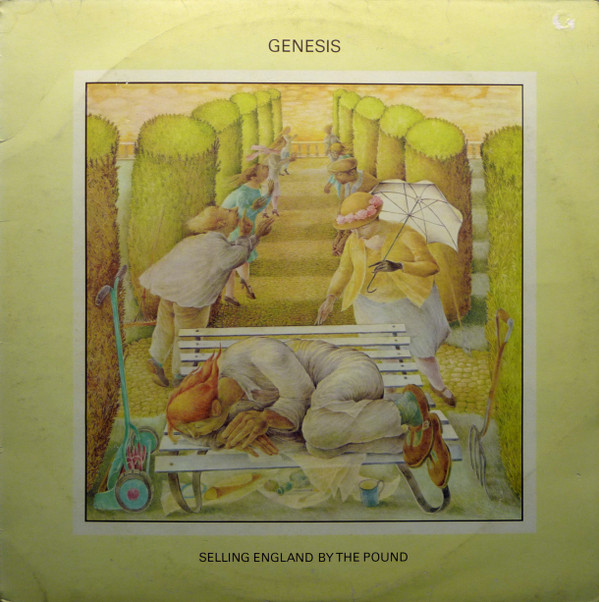
A retrospective of Genesis’ ‘Selling England By The Pound’. The band’s fifth long player from 1973 is a Progressive Rock classic that captured a changing newly decimal Britain through Mellotrons, lawnmower men and Cockney villains. Essential listening for anyone who thinks Prog Rock was all capes and codswallop. Genesis proved you could be both preposterous and profound.
GENESIS: Selling England By The Pound (Charisma)1973
There was something gloriously, quintessentially English about Genesis that set them apart from the prog rock pack cluttering up the album charts in 1973. Where Yes disappeared up their own cosmic backsides and ELP bludgeoned you with their virtuosity, Peter Gabriel and his merry band of public schoolboys crafted something altogether more peculiar and affecting with this, their fifth album.
Selling England By The Pound arrived at a curious juncture for the band. After the commercial disappointment of Foxtrot failing to break America (despite ‘Supper’s Ready’ being the sort of 23-minute epic that should have had the Yanks weeping into their cornflakes), Genesis regrouped and produced what many consider their defining statement. Recorded at Island Studios with John Burns and the band sharing production duties, this was a record that positively reeked of England in 1973: a country caught between nostalgia for its crumbling past and uncertainty about its increasingly tatty future.
The album opened with ‘Dancing With The Moonlit Knight’, which nicked its central melody from ‘I Know What I Like’ before that song even appeared. Gabriel’s lyrics were stuffed with references to Wimpy Bars, breakfast cereal mascots and Churchill’s England, painting a portrait of a nation flogging off its heritage for American consumer tat. “Can you tell me where my country lies?” he asked, and you suspected he already knew the answer. Tony Banks’ Mellotron swirled around like fog over the Home Counties while Steve Hackett’s guitar work was, as ever, economical but devastating.
‘I Know What I Like (In Your Wardrobe)’ was the obvious single, and it proved a canny choice. Built around Phil Collins’ crisp, almost funky drumming and a nursery rhyme melody, it told the story of a lawnmower man content with his lot. It was Genesis at their most accessible, which wasn’t saying much, but there was real charm in its eccentricity. The promotional film they shot, with Gabriel prancing about in a cloth cap and braces, was either brilliant or barmy. Possibly both.
But it was ‘Firth of Fifth’ that had the musos wetting themselves. Banks’ opening piano passage was genuinely beautiful, all cascading romanticism and melancholy, before the band crashed in with typical Genesis precision. Hackett’s guitar solo in the instrumental section was an absolute belter, soaring and lyrical without ever tipping into tedious showboating. If you needed to convince someone that progressive rock could be genuinely moving rather than just technically accomplished, this was the track to stick on the turntable.
‘More Fool Me’, sung by Collins, was a bit of pleasant fluff really, though his voice had a vulnerability that suited the material. ‘The Battle of Epping Forest’, however, was vintage Gabriel madness: a nine-minute saga about rival gangs of Cockney villains that name-checked half of East London and featured more characters than a Dickens novel. It was exhausting, occasionally bewildering, but never boring. The time signatures flipped about like eels while Gabriel adopted various accents and personas. You either thought it was genius or pretentious twaddle. This writer leaned towards the former.
The album closed with ‘The Cinema Show’ and ‘Aisle of Plenty’, the latter essentially a reprise that bookended the record nicely. ‘The Cinema Show’ was another lengthy piece that referenced T.S. Eliot and featured some of the most intricate playing on the record. Banks’ organ work was particularly fine, while the rhythm section of Collins and Mike Rutherford locked together with the sort of telepathy that only came from years of playing school halls and student unions together.
What was remarkable about Selling England By The Pound was how distinctly British it sounded. This wasn’t blues-rock or heavy metal or glam. It was something altogether stranger: folk melodies colliding with classical pretensions, Edwardian music hall meeting avant-garde rock, all filtered through the sensibilities of five blokes who probably read too much Tolkien at Charterhouse.
Gabriel remained one of rock’s most fascinating frontmen, a genuine oddball who could make theatrical gestures seem vital rather than risible. His lyrics here were his best yet, full of wordplay and social observation, even if they occasionally veered into sixth-form poetry territory. The rest of the band were operating at a level of musicianship that would have been intimidating if it wasn’t in service of actual songs rather than mere technical exercises.
Did this prove to be the album that broke Genesis to a wider audience? Not quite. They were far too weird, too English, too prog for that. But for those willing to enter their peculiar world, Selling England By The Pound was a rich and rewarding experience.
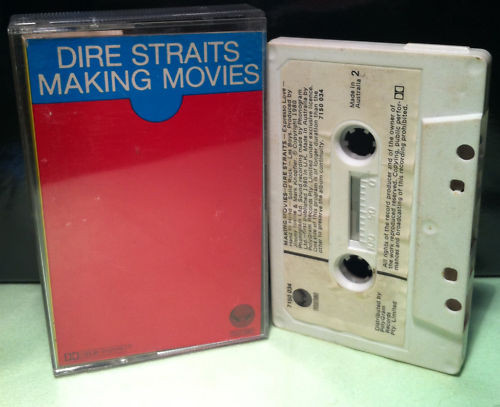
A retrospective review of Dire Straits’ 1980 album Making Movies. Knopfler’s technical brilliance meets romantic melancholy in an era that supposedly had no use for either. In my heavily late Seventies NME hack influenced style.
DIRE STRAITS: Making Movies (Vertigo) 1980
There was something deeply suspicious about a band this technically accomplished in 1980. While half of London was still thrashing about in bin liners and safety pins, Mark Knopfler’s lot turned up with an album so pristine, 38 minutes so meticulously crafted, that you half expected to find the corners mitred.
Making Movies arrived eighteen months after their self-titled debut made them improbable millionaires in America, and it was clear they’d been spending the intervening period in expensive studios rather than the back rooms of grotty pubs. Recorded at New York’s Power Station with Jimmy Iovine producing – the man who’d just finished polishing Springsteen’s The River – this was Dire Straits going for broke, or rather, going for more money than they’d already got.
The opening salvo, “Tunnel of Love,” sprawled across eight minutes like some Dylanesque fever dream filtered through a Tyneside accent. It was all fairgrounds and Spanish guitars, with Knopfler’s finger-picked lines circling each other like moths round a sodium lamp. The man played like he was being paid by the note, which he probably was.
“Romeo and Juliet” – which got played to death on Radio 1 – was the sort of thing that had sixth-formers scribbling lyrics in the back of their French textbooks for years. It was wretchedly romantic, all unrequited longing and cinema queues, with Knopfler doing his best to sound like he’d actually had his heart broken rather than just read about it in a Leonard Cohen novel.
But here was the rub: it worked. Despite themselves, despite the almost offensive levels of musicianship on display, despite the fact that punk never happened in their world, Dire Straits crafted something genuinely affecting. “Hand in Hand” swung like prime-era Dylan, while “Les Boys” – a tawdry tale of Parisian transvestites – had the sort of seediness that Bowie used to do before he discovered Switzerland and synthos.
The centrepiece, though, was “Skateaway,” a peculiar bit of New Wave-ish funk about a rollerskating girl cruising through urban decay. It had synthesizers, for God’s sake. Synthesizers! On a Dire Straits record! Pick Withers’ drumming was tighter than a gnat’s chuff, and the whole thing sounded like what might happen if Steely Dan decided to have a go at writing a hit single.
Mark Knopfler remained an enigma wrapped in a headband. His vocals sounded like he was perpetually on the verge of nodding off, yet there was a sly intelligence to his wordplay that elevated this above standard-issue soft rock tedium. He’d clearly listened to a lot of JJ Cale, a lot of Dylan, a lot of those American FM radio staples, and he wasn’t afraid to nick the best bits.
The production was, predictably, immaculate. Every hi-hat shimmer, every bass throb from John Illsley, every keyboard wash from Roy Bittan (on loan from the E Street Band, no less) sat exactly where it should. It was the sonic equivalent of a freshly Hoovered front room with the cushions all plumped up.
Which brought us back to that initial suspicion. In an era when the most exciting music was being made by people who could barely play their instruments, Dire Straits were almost confrontationally competent. They weren’t interested in year zero, in tearing it all down and starting again. They wanted to take you to the pictures, buy you chips on the way home, and maybe have a bit of a cuddle if you were lucky.
And you know what? Sometimes that was enough. Making Movies didn’t change your life or inspire you to form a band in your mate’s garage. But on a rainy Tuesday evening when you were skint and miserable and the world seemed determined to grind you down, it might just have made things seem temporarily bearable.
Some records arrive like a whisper and fade, others crash in like an avalanche and leave you stumbling in their wake. Remain in Light is one of the latter, a slab of paranoia, rhythm, and obsession that still sounds as unmoored and visionary in 2025 as it did in 1980. Forty-five years on, the album hums with the intensity of four New Yorkers trying to rethink the world, their identities, and what a pop record could do. It is both human and alien, cerebral and primal, art-school gone feral. Listening now, you realise Talking Heads did not so much make an album as invent a language for disorientation.
Part One: The Sleeve
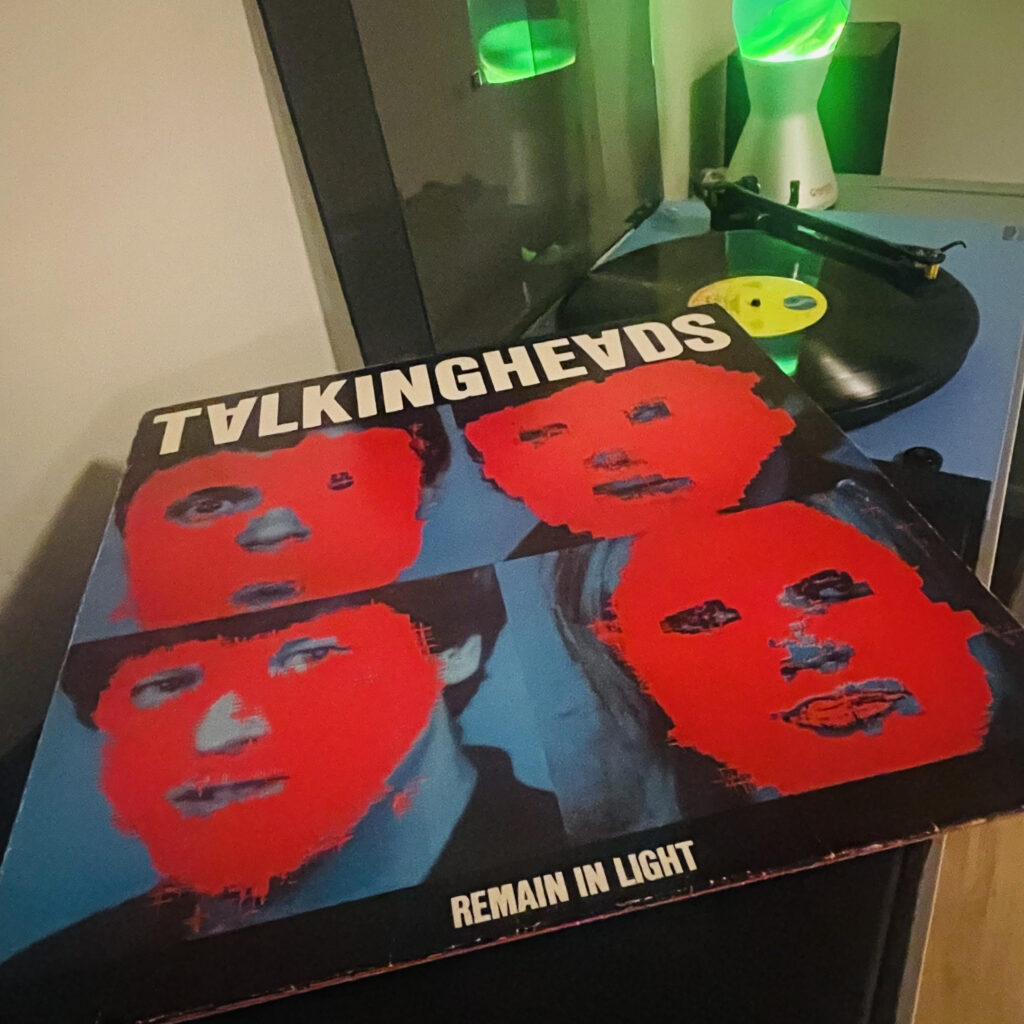
Pick up the sleeve and your first impression is confusion masquerading as design. Four faces, distorted and layered, hover in red, black, and white, a simulacrum of identity rendered through early MIT image-processing technology. The work of Tibor Kalman and M&Co, it feels both robotic and living. Your eyes register familiar features, only to be immediately unmoored. Tina Weymouth’s fascination with African masks, refracted through digital manipulation, turns the human face into a machine’s suggestion. It is uncanny, a whisper of the postmodern anxiety that would haunt the next four decades of visual culture.
Every detail matters. The typography is sharp and arresting, suggesting urgency without screaming. Fighter-bomber Avenger silhouettes and ghostly abstractions hover in the margins, hinting at violence, both literal and psychic. The design does not complement the music so much as anticipate it, a visual prelude to the interlocking chaos within. In 1980, it was a statement that identity was mutable, mediated, and constantly under negotiation. Today, that’s the norm.
Kalman’s brilliance was in making technological imperfection a part of the aesthetic. The faces are corrupted, glitched, degraded – human error filtered through a machine. This is not a record cover; it is a manifesto. By the time you slide the vinyl from its jacket, you are already prepared for disorientation. What follows is not just music, it is an ecosystem, a carefully constructed labyrinth designed to engage both body and mind.
Part Two: The Music & Legacy
Recording began at Compass Point Studios in Nassau, a sun-soaked bunker that would become a crucible for genius and frustration alike. The band was joined by Brian Eno, the unofficial fifth Head, whose influence was less about notes than architecture. He arrived with a philosophy: treat the studio as an instrument, treat chaos as composition, and do not flinch at failure. The sessions were famously intense. The band worked long, bewildering hours, layering loops, polyrhythms, and improvisations until something miraculous emerged from the mess.
The foundation was African-inspired polyrhythms, specifically the hypnotic grooves of Fela Kuti. This was not mere imitation; it was a translation of complex rhythmic systems into a New York art-rock vocabulary. Each instrument moves independently, a conversation of contradictions. Drums and percussion interlock but never collide, basslines snake around vocal hooks, and guitars oscillate between melody and texture. Adrian Belew’s guitar is both nervous and ecstatic, Jon Hassell’s trumpet drifts like a mirage, and Eno’s synthesizer textures shimmer in the spaces between. The record is dense yet breathable, controlled yet chaotic, deliberate yet accidental.
Byrne’s vocals are equally layered, a collage of obsessions and idiosyncrasies. He borrows from hip-hop cadences, ritualistic chant, and fragmented narrative, creating a delivery that is more incantation than song. The lyrics often circle existential dread with playful detachment. In “Born Under Punches”, Byrne’s voice is manic and fractured, a protagonist grappling with information overload and identity crisis. “Crosseyed and Painless” is a sermon on anxiety, paranoia, and social collapse, delivered with sharp wit and relentless rhythm.
The album’s architecture is deliberate. The first side, buoyed by kinetic energy, draws you into the labyrinth. “The Great Curve” is an ecstatic frenzy, the band locked in an ecstatic groove that simultaneously propels and destabilises. By the time “Once in a Lifetime” arrives, you are primed for reflection. The song balances existential inquiry with dance floor immediacy, Byrne pondering selfhood and entropy against a backdrop of hypnotic repetition. It is both absurd and devastatingly human.
Side two darkens the palette. “Houses in Motion” jitters with post-industrial dread, a cityscape of anxiety rendered in sound. “Seen and Not Seen” drifts toward abstraction, its protagonist dissolving into observation, a meditation on presence, absence, and perception. “Listening Wind” introduces political undercurrents, a commentary on global turbulence and American complacency filtered through dense polyrhythms and hypnotic motifs. The album closes with “The Overload”, a spectral transmission that hints at collapse and transcendence simultaneously.
The genius of Remain in Light lies in its simultaneity. It is both academic and visceral, cerebral and bodily. It occupies a transitional space where intellect and instinct cohabit uneasily but beautifully. The recording process itself becomes audible: the tape loops, studio experimentation, and improvisational layering are part of the listening experience. You hear the struggle, the trial and error, the moments of panic and revelation. This is music as architecture, as experiment, as living organism.
Culturally, the album is a negotiation of influence. The band’s engagement with African rhythms is complex, filtered through Western ears and art-school sensibility. It raises questions about appropriation, translation, and homage, but the resulting work is undeniably original. It is a fusion of ideas and sounds that challenges the listener to reconsider boundaries, genres, and expectations. The record is not just a reflection of its time, it is a critique of it, questioning identity, technology, and the very notion of pop music as a commodity.
The legacy of Remain in Light is vast. Upon release, it charted modestly, yet critics recognised its audacity. The album influenced generations of musicians, from the electronic experiments of the eighties to the worldbeat experiments of later decades. It bridged punk’s urgency with funk’s elasticity, art-school conceptualism with dancefloor immediacy. Touring the album proved difficult; the complexity and intensity of the arrangements tested the band to their limits. Yet the recordings themselves endure, a testament to ambition, collaboration, and the willingness to confront chaos head-on.
Listening today, the album resonates with a prescience that is uncanny. Byrne’s exploration of selfhood, Eno’s textural interventions, the band’s rhythmic sophistication all speak to an era increasingly dominated by technology and mediated experience. Forty-five years on, the music still feels urgent, still unsettles and energises in equal measure. It is a record that rewards repeated engagement, revealing new facets with each listen. The textures, the contradictions, the obsessive layering, all retain their power to unsettle and illuminate.
In retrospect, Remain in Light is not just an album. It is a blueprint for artistic ambition, a testament to the potential of collaboration and the thrill of experimentation. It embodies the tension between accessibility and difficulty, dance and reflection, humour and despair. Its enduring influence is evident not only in the artists who followed but in the ways it continues to challenge contemporary listeners. The record is a meditation on identity, perception, and creativity itself, an exploration that remains vital and uncontainable.
Four decades on, the album hums with life, refusing to settle into nostalgia or canonisation. It is human, machine, ritual, and meditation all at once. The visual and sonic languages it employs remain radical; the ideas embedded in its grooves still resonate. Talking Heads, at their apex, were not content with simple pop. They sought transformation, and in Remain in Light they achieved it.
Listening now, the record still demands attention. It insists on engagement, on immersion. The faces on the sleeve, the fractured rhythms, the cascading vocals – all converge to create an experience that is simultaneously exhilarating and disorienting. It is, as ever, a record that challenges, delights, and confounds.
Remain in Light remains a masterpiece because it continues to operate on multiple planes. It is art, it is music, it is philosophy, and it is ritual. It occupies a space that few albums dare to enter, and fewer still manage to navigate successfully. Forty-five years later, it retains its power, its strangeness, and its brilliance. Talking Heads created not just an album but a living organism, one that still breathes, pulses, and disrupts.
For those willing to engage fully, it remains an astonishing journey, a record that refuses to be tamed, a testament to what happens when intelligence, curiosity, and obsession collide. Remain in Light is not simply listened to. It is experienced, interrogated, and felt. It is, in every sense, timeless.
Released in 1973, at a point when Pink Floyd had already outgrown their psychedelic beginnings, The Dark Side Of The Moon arrived not as a burst of inspiration but as something carefully distilled. A record shaped on the road, sharpened in the studio, and built around a deceptively simple idea. Not fantasy or escape, but the mechanics of everyday life. Time, money, work, fear, and the slow, often unnoticed strain they place on the mind.
What follows isn’t just a review of a classic record. It’s a look at how that idea was constructed, why it connected so deeply, and how a band once defined by experimentation ended up making one of the most precise and enduring statements in modern music.
1. Sleeve
Before a note is heard, The Dark Side of the Moon has already made its point.
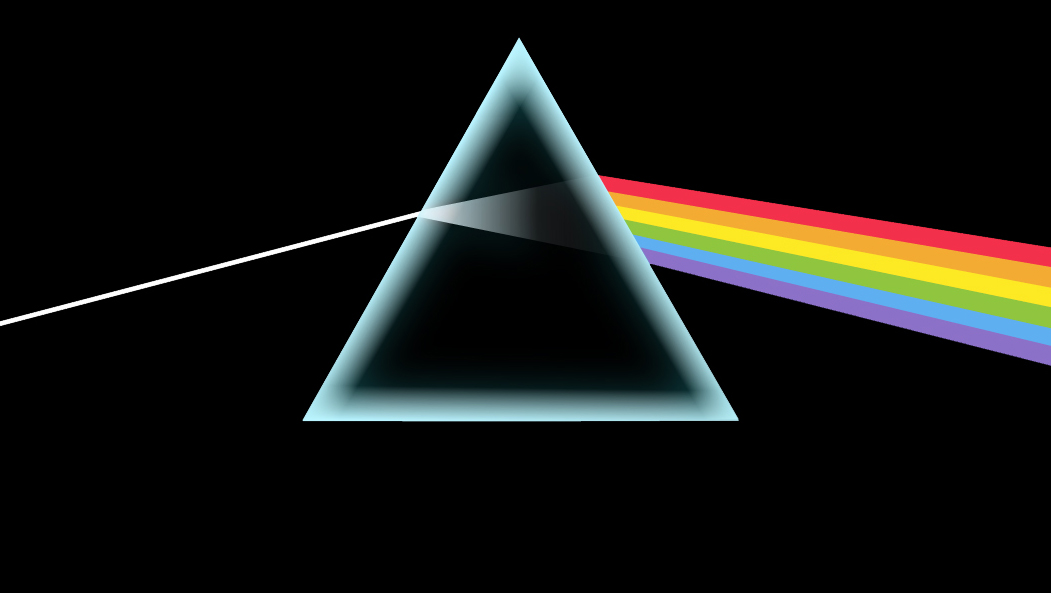
The cover, conceived by Storm Thorgerson and realised through his design partnership Hipgnosis, is almost aggressively simple. A beam of white light enters a prism, fractures into colour, exits as a spectrum against a black field. No band photograph. No title. No explanation. Just an image that feels at once scientific and faintly metaphysical.
That restraint was deliberate. Pink Floyd wanted distance from the visual clutter surrounding progressive rock. Something cleaner. More exact. Thorgerson, working alongside Aubrey Powell, drew from a physics textbook illustration of light refraction, but also from the band’s live shows, where beams of light cut through darkness with precision. The prism became a convergence point. Science, performance, and something just beyond explanation.
It also mirrors the record’s internal logic. A single source broken into its component parts, then reassembled. White light into colour. Experience into fragments. The idea of pressure refracted into time, money, fear, and mortality. It’s the concept made visible without spelling itself out.
What made it radical in 1973 was what it refused to do. Sleeve design still leaned on photography, collage, personality. Even Hipgnosis themselves were known for elaborate, often surreal imagery. Here, they stripped everything back. The result is sharper because of its absence. Nothing distracts. Nothing dates it.
The physical sleeve extended the idea. Early pressings included posters and stickers, allowing the prism to migrate beyond the record itself. Onto bedroom walls, into shared spaces, into everyday life. It stopped being packaging and became part of the culture around it.
Over time, it’s settled into design history as one of the most recognisable images in popular music. Not because it announces itself, but because it doesn’t need to. Like the album it houses, it’s controlled, precise, and quietly permanent.
2. Album
It arrived in March 1973 with the quiet confidence of a band who’d stopped chasing the ghost of Syd Barrett and instead turned their attention to something far less abstract and far more exacting. This isn’t a space record. It’s about pressure. The small, constant, grinding pressures of ordinary life and the way they accumulate until something gives.
Time slipping away without ceremony. Money warping instinct into appetite. Work becoming routine, then trap. The slow creep towards breakdown. Death as the only fixed point in the distance. Roger Waters didn’t construct a narrative. He mapped a system. Each element feeding the next, each strain bleeding into another, forming a loop that never quite releases.
By the time Pink Floyd committed it to tape at Abbey Road Studios with Alan Parsons, it had already been road-tested under the title Eclipse. That matters. This wasn’t assembled in fragments. It was honed in front of audiences until it functioned as a single, continuous piece. Even on record, it doesn’t really stop. Themes return. Voices echo. The heartbeat circles back. You’re not moving through songs. You’re contained within them.
There’s a discipline to it that still feels unusual. No indulgence. No excess. Waters provides the conceptual spine, but it’s the interplay with David Gilmour, Richard Wright and Nick Mason that gives it shape and depth. This is where the record’s quiet virtuosity sits. Not in showmanship, but in control.
Gilmour’s guitar work is exact without ever feeling clinical. His phrasing stretches time, bends it, gives it weight. Wright, often the least discussed member, is arguably the album’s tonal architect. His use of chords, space and early synthesisers creates the emotional temperature of the record. There’s a jazz sensibility to his playing, something understated but essential. Mason, too, is more than timekeeper. His drumming is economical, precise, allowing the material to breathe rather than driving it into excess.
The sound feels engineered rather than performed. Parsons’ use of tape loops, found voices and emerging studio technology binds it all together. The EMS Synthi and VCS3 systems, still relatively new at the time, aren’t used for novelty but for texture and continuity. The cash registers become rhythm. The clocks feel like impact. Even the segues, often taken for granted now, were painstakingly assembled using analogue tape, physically cut and rejoined. You can hear the craft in the joins, if you listen closely enough.
There are details that have come into sharper focus over time. Early mixes reveal alternative approaches, including longer instrumental passages and different vocal takes. The quadraphonic version, largely overseen by Parsons, shows just how ambitious the spatial design really was, with sound moving around the listener in ways that standard stereo could only hint at. Later remasters have exposed the physicality of the recordings, breaths, tape hiss, the friction of performance against machine.
The human elements remain some of its most telling. The interview snippets, gathered almost casually, now feel like a form of documentary embedded within the music. Gerry O’Driscoll’s offhand comment about death has become one of the album’s defining lines. Clare Torry’s improvised vocal, initially treated as session work, has since been recognised as a central compositional element, her later legal recognition only reinforcing how much of the album’s power lies in moments that weren’t fully understood at the time.
In the arc of Pink Floyd, this is the pivot. The point where experimentation became structure, where abstraction became communication. Earlier records hinted at ideas. Later ones, particularly Wish You Were Here and The Wall, would expand and harden them. But this is the moment where everything aligns. Concept, execution, accessibility.
Its place in popular culture is difficult to overstate. It moved beyond the usual boundaries of rock audiences and settled into everyday life. It became a staple of record collections, hi-fi demonstrations, late-night listening. It crossed generations without ever being repositioned or repackaged to do so. The longevity isn’t just commercial, it’s habitual.
And yet, for all that reach, it never feels overstated. That’s the achievement. A record built on control, on restraint, on the refusal to overplay its hand, becoming one of the most pervasive pieces of music in the modern era.
It’s often called timeless, but that misses the point. It’s rooted in its moment, shaped by post-sixties disillusionment and the creeping sense that success carries its own pressure. What’s remarkable is how little that cycle has changed.
Fifty years on, it doesn’t feel distant. It feels ongoing.
3. Urban Myth
Somewhere along the way, The Dark Side of the Moon picked up a shadow narrative. An after-hours theory that refuses to disappear.
The idea is simple. Start the album in sync with The Wizard of Oz, usually on the third roar of the MGM lion, and the two will align. Music and image falling into step. Moments of coincidence accumulating into something that feels intentional.
People point to the shift from black-and-white Kansas into colour matching the music opening out. Rhythms lining up with movement. Lyrics brushing up against scenes in ways that feel just close enough to register. It’s persuasive, in the moment. Given time, coincidence starts to feel like design.
The band have always dismissed it. There’s no evidence, and no real possibility, that it was planned. The record was built as a live piece, shaped over time, refined in the studio. It wasn’t written to picture.
What the myth reveals is something else. The way the album behaves. It’s continuous, structured, almost cinematic without attaching itself to a narrative. It invites projection. It loops, it echoes, it leaves space. Enough space for people to impose their own patterns onto it.
There’s a loose thematic overlap if you want to find it. The Wizard of Oz pulls back the curtain on illusion, revealing something ordinary behind the spectacle. Dark Side does something similar in its own way, stripping life down to its underlying pressures. But that connection is accidental, not engineered.
The myth persists because the album allows it to. It’s controlled, but open. Precise, but not closed off. People keep trying to map it onto something else, films, experiences, entire lives.
It doesn’t quite work. But it keeps working just enough to stay alive.
4. Post Script
I’ve been thinking about my own relationship to this album, and possibly other people’s. I’ve concluded that if you were aged 9 in 1971 it was an album you’d be aware of if you had an older sibling, probably a brother. Or a father with a proper stereo, the Garrard Turntable with a Shure cartridge, brushed ally 60 Watts Per Channel RMS Rotel Amp and Celestion Ditton loudspeaker set up beloved of Comet who advertised weekly in the local newspaper classifieds. Pink Floyd didn’t appear on Top Of The Pops, their band members didn’t side-hustle for other bands – so many superstars in the early seventies seemed to crop up in other bands, band swap or have solo hits, Ronnie Lane, Rod Stewart, Elton John and Roger Daltrey come to mind. Even the beloved late night DJ John Peel mimed to Maggie Mae on a mandolin for Rod Stewart on Top Of The Pops. So how would you hear any ‘Floyd tracks? I don’t even remember them being played on Alan Freeman’s Saturday Rock Show.
Another odd thing. In the period from release to when in 1977 Johnny Rotten told 15 year olds that Pink Floyd were boring, the distinctive sleeve never entranced me to by the album, nor the amazing statistics that appeared on each week’s Album Chart which was always on display behind the counter in the record shop, ‘Weeks on Chart – 310’ compared to the average of about 12.
Somewhere along the line there were enough people older than 9, with or without an older sibling or a technical father to keep this album in the U.K. album charts throughout the Seventies. And that seems to be a unique set of circumstances in my universe.
In the pantheon of rock’s great reinventions, few albums have aged as gracefully, or as mysteriously as David Bowie’s Low. Released in January 1977 to widespread bewilderment and commercial indifference, this curious hybrid of fractured pop songs and ambient soundscapes now appears, from our 2025 vantage point, to be one of the most prophetic statements in popular music’s history.
The conventional narrative surrounding ‘Low’ has always centred on geography and biography: Bowie fleeing Los Angeles and its pharmaceutical temptations for the disciplined clarity of divided Berlin, collaborating with the electronic music pioneer Brian Eno to create something entirely new. Yet recent archival research has complicated this neat story considerably. Much of the album’s foundational work actually took place at the Château d’Hérouville studios in France, months before Bowie’s Berlin sojourn began in earnest. The geographical mythology, it transpires, was partly retrospective construction, though no less meaningful for that.
What emerges most clearly, nearly half a century on, is how ‘Low’ functions as both ending and beginning. It represents the final flowering of the rhythmic obsessions that had driven Bowie through his American soul period, yet subjects those same impulses to a process of systematic deconstruction that would influence popular music for decades to come. The rhythm section of Dennis Davis and George Murray, veterans of ‘Young Americans’ and ‘Station to Station’, found themselves playing against type – their customary precision dissolved into something more impressionistic, more concerned with atmosphere than with groove.
The Brian Eno collaboration proved transformative in ways that have become clearer with time. Eno’s methodology, the famous “Oblique Strategies” cards, his insistence on removing conventional guitar solos, his suggestion that Carlos Alomar play rhythm parts without chord progressions, represented a systematic assault on rock orthodoxy. The results were songs that barely qualified as songs at all: “Breaking Glass” distils two minutes of nervous energy into treated percussion and fractured vocals, whilst “What in the World” transforms romantic yearning into something that might have been transmitted from outer space.
The album’s bipartite structure – seven relatively orthodox pop songs followed by four extended instrumental pieces – baffled RCA’s marketing department and contributed to its commercial failure in America. From today’s perspective, however, this division appears remarkably prescient. The instrumental suite that occupies ‘Low’ s second side anticipates much of what we now recognise as ambient music, electronic composition, and even certain aspects of contemporary hip-hop production. These are not songs to be sung along with but environments to be inhabited.
Recent scholarship has illuminated the extent to which these instrumentals drew from Bowie’s direct observation of Berlin’s divided landscape. “Warszawa”, despite its Polish title, was inspired by a fragment of Eastern European folk music encountered during train travel, yet the wordless vocal improvisations that crown the piece were shaped by Bowie’s response to the city’s displaced populations. The recent revelation that much of the composition employed a Chamberlin keyboard loaded with authentic folk samples adds another layer to its haunting effectiveness.
“Art Decade”, the album’s most austere moment, benefits enormously from contextualisation within Berlin’s cultural and physical landscape. The title references both artistic periods and the literal decay Bowie witnessed in the city’s bombed-out quarters. The track’s processed saxophone, actually Bowie himself, electronically treated beyond recognition – creates a soundtrack for urban desolation that prefigures everything from post-punk’s architectural obsessions to contemporary electronic music’s fascination with industrial decay.
Perhaps most remarkably, ‘Low’ anticipated many of the anxieties that characterise our current cultural moment. The paranoia that suffuses tracks such as “Always Crashing in the Same Car” was attributed at the time to pharmaceutical excess, yet it reads today as remarkably prescient about our surveillance-saturated digital existence. The isolation and disconnection that runs through the album’s emotional landscape prefigures our contemporary struggles with technology-mediated relationships and algorithmic social control.
The album’s commercial disappointment, number three in Britain, invisible in America – now appears less like failure than validation. Records of this ambition and difficulty are not intended for mass consumption; they are designed to influence everything that follows. And the influence has been extraordinary: the template ‘Low’ established can be traced through post-punk, new wave, ambient house, and contemporary art-pop. Its innovations have become so thoroughly absorbed into popular music’s vocabulary that they no longer sound revolutionary – the ultimate mark of success.
What continues to astonish is how genuinely futuristic much of Low remains. The drum sound that producer Tony Visconti achieved by positioning microphones in a stairwell – compressed, gated, artificially enhanced – established the template for 1980s pop production. Yet it originated here, in service of compositions that had no commercial ambitions whatsoever. Similarly, the harmonic treatments applied to Bowie’s vocals created textures that sound alien even today.
Recent discoveries in the Bowie estate’s archives have only confirmed ‘Low’s status as a masterpiece of studio technique. Alternate mixes recently made available reveal the extraordinary care that went into every sonic decision. The stripped-back version of “Sound and Vision” demonstrates how much archaeological work underpinned the finished product – every element feels essential, irreducible, the result of countless hours of experimentation distilled into perfect miniatures.
‘Low’ endures because it solved a problem most popular artists never recognise: how to maintain visibility whilst achieving genuine artistic invisibility. Bowie created his most personal statement by becoming deliberately less human. The electronic processing, the ambient diversions, the systematic removal of conventional rock signifiers – these represent methods of artistic evacuation, ways of escaping the personality cult that threatened to consume him.
From our current perspective, with knowledge of everything that followed – the completion of the Berlin trilogy, the commercial rehabilitation, the decades of recycling past innovations – ‘Low’ appears as Bowie’s most courageous artistic statement. It represents the sound of a major popular artist refusing the safety of established success, choosing instead to venture into genuinely uncharted musical territory.
The album concludes with “Subterraneans”, originally conceived as music for The Man Who Fell to Earth, and the piece provides an apt metaphor for the entire enterprise. It is the sound of something recognisably human being processed through alien technology, emerging transformed but not destroyed. Nearly fifty years after its creation, this remains the most accurate description of what ‘Low’ achieved – and why it continues to matter.
Nearly fifty years after its release, the Sex Pistols’ incendiary debut remains punk’s perfect storm, a molotov cocktail of working-class rage, musical brilliance, and media manipulation that changed British culture forever….
The album that didn’t just break rules – it obliterated the rulebook
Never Mind the Bollocks didn’t just land in 1977, it crashed through the plate-glass window of British society and sprayed the drawing room with cultural shrapnel. Nearly fifty years on, it still snarls like a kicked dog. In a landscape now wallpapered with playlist-core, TikTok hooks and sanitised rebellion-by-subscription, Bollocks feels like a holy relic from a time when music had the power to make the establishment sweat.
The Pistols weren’t a band in the traditional sense. They were a detonation. The result of a chemical reaction in the King’s Road boutique Sex, where Malcolm McLaren, part art school agitator, part snake-oil messiah set out to manufacture a British answer to the Ramones. What he ended up with was something far more combustible: four working-class lads with nothing to lose, contempt for the sacred, and just enough talent to weaponise it.
It was John Lydon, not McLaren, who gave the Pistols their real teeth. That infamous audition, Lydon miming Alice Cooper in a torn “I Hate Pink Floyd” T-shirt wasn’t an audition at all. It was a warning. And from the moment he snarled into a mic, Rotten was born. Not a singer in the usual sense, but a frontman who could turn a howl into a manifesto. His was a voice shaped by failed systems and boarded-up futures. You believed him not because he told the truth, but because he believed his own bile. And in a cultural moment drowning in fakes, that was radical.
His lyrics didn’t sermonise like The Clash or cartoon like the Ramones—they targeted. They named names. “The fascist regime.” “The tourists.” “The Queen.” This wasn’t abstract anger. This was brutalist literary wit, honed on council estates and spat back at a country that had turned its back on him.
Behind Rotten, the band were better than they ever get credit for. Steve Jones’ guitar work was pure sledgehammer pinched from Ronnie Wood’s toolkit and stripped of all bluesy indulgence. Paul Cook held it all together with dead-eyed discipline. And then there was Glen Matlock, the band’s melodic spine, the one who actually wrote songs. Before McLaren booted him out for liking the Beatles (the horror) in fairness his mum and dad weren’t too keen on his band membership either – Matlock laid the foundation for nearly every track that matters. Sid might’ve looked the part, but Glen sounded it.
And that brings us to Sid Vicious: the icon who couldn’t play. The most famous non-musician in music history. He brought nothing to the table musically, less than nothing, in fact but gave the tabloids something they couldn’t resist: a photogenic train wreck in safety pins and blood. He turned the band from agitators into tabloid currency, and McLaren milked every drop of it. Sid was myth in motion. His tragic end, overdosing after allegedly stabbing Nancy Spungen, would become punk’s dark parable. The image devoured the music.
But Never Mind the Bollocks is no chaotic mess. It’s a tight, brutal record, shaped by Chris Thomas, a producer fresh from Floyd’s palaces of sound, now neck-deep in spit and swearing. It shouldn’t have worked. But it did. It worked because the songs were solid, the delivery vicious, and the band at least for one special moment, utterly focused.
“Anarchy in the UK” starts with a leer and explodes into a full-throttle riot. “Pretty Vacant” is practically power pop under the sneer. And “Bodies”? Still disturbing, still necessary a razor blade of a song about abortion, trauma, and madness that no one today would dare touch.
And then there’s Art School McLaren’s marketing sorcery. Every cancelled gig, every court case, every playground rumour was stoked by him. The infamous Bill Grundy interview, the Jubilee boat stunt, contracts signed outside Buckingham Palace it was all punk as performance art. The Pistols were slashed, banned, burned, boycotted. Which, of course, meant they sold more records than God.
But you can’t sustain that level of heat. The 1978 U.S. tour, an mis-booked shambles by design saw Sid out of his mind, the band disintegrating, and Rotten fed up with being a performing monkey for the media circus. At Winterland in San Francisco, he looked out at the crowd and delivered the perfect punk epitaph: “Ever get the feeling you’ve been cheated?”
That line still echoes because it summed it all up; the manipulation, the disillusionment, the raw, ugly brilliance of it all. The Pistols didn’t burn out so much as combust in real time. And what followed, Sid’s death, McLaren’s myth-making, Lydon’s post-punk messiah rebirth in Public Image Ltd wasn’t an epilogue but a necessary failing forward.
Lydon, to his credit, didn’t retreat into parody. PiL pushed boundaries most punk bands wouldn’t touch; dub, experimentalism, post-punk minimalism. It didn’t make headlines, but it made art. Meanwhile, the world turned the Pistols into a brand. Punk became a T-shirt slogan, rebellion a marketing brief. Rotten became John Lydon again, appearing on butter ads and talk shows, but Bollocks remained.
And that’s the point. You can license the image, sell the nostalgia, but you can’t fake what this album captured. Never Mind the Bollocks is a time capsule filled with rage, wit, and electricity. It’s the sound of a band and a country on the brink. Could something like this happen today? Not a chance. The algorithms wouldn’t allow it. The PR team would step in. The snarl would be filtered and auto-tuned.
But that’s why this record matters more than ever. It reminds us that music can scare people. That songs can shake the foundations of the establishment. That sometimes, four angry kids with guitars can tell the world exactly where to stick it and be heard.
Never Mind the Bollocks isn’t just a punk album. It’s a battering ram through the front door of British culture. Nearly fifty years on, drop the needle and hear it again: that beautiful unrepeatable roar of latent energy stored in the opening chords of Holidays In The Sun.
This visceral dissection of the Pixies’ “Cactus” explores how Black Francis and Kim Deal transformed enforced separation into hypnotic art, with Steve Albini’s unforgiving production capturing every grain of dust and moment of claustrophobic desperation. From Deal’s lurking bass line to Francis’s cement-floor confessions, discover how this standout track from Surfer Rosa became a masterclass in making the deeply disturbing sound utterly conversational.
Black Francis has always been a twisted romantic, but “Cactus” – a standout track from the Pixies’ 1988 debut Surfer Rosa – finds him at his most beautifully deranged, crafting what amounts to a love letter from purgatory, set to the band’s most hypnotically sparse arrangement.
The musical architecture is deliberately claustrophobic, built around Kim Deal’s bass line that doesn’t so much groove as lurk. It’s a serpentine thing, all dusty menace and barely suppressed tension, creating the perfect sonic equivalent of that aged cement floor Francis keeps banging on about. You can practically hear the fine grey dust settling between the notes, taste the grit in every pause.
Structurally, this isn’t a song so much as a confessional booth with a backbeat. The Pixies strip everything down to its barest components – Francis’s parched distant vocals, Deal’s ghostly harmonies, and just enough instrumentation to keep the whole thing from collapsing under the weight of its own obsession. David Lovering’s drums are at the front and jarring, whilst the guitar work remains deliberately understated, all jangling chords that shimmer like Joshua Tree mirages.
But it’s the vocal interplay that transforms this from mere musical voyeurism into something genuinely unsettling. This is Francis and Deal as the ultimate dysfunctional duet – he’s the imprisoned narrator pleading from his concrete cell, she’s the distant object of desire, her voice floating in and out like radio static from the outside world. When Deal echoes his confessions, it’s unclear whether she’s offering comfort or mockery, complicity or judgment.
The lyrical content reads like evidence from a particularly disturbing court case. Francis isn’t just separated from his beloved; he’s been systematically isolated, reduced to fantasising about botanical transformation whilst begging for her “dirty dress” – not clean clothes, mind you, but something stained with her reality. It’s the ultimate fetishisation of absence, the sort of request that makes perfect sense when you’re slowly suffocating on dust and desperation.
That cactus metaphor becomes brilliantly twisted in this context – he wants to be the beautiful bloom emerging from the most forsaken conditions, the shocking pink flower against the grey industrial decay. She’s his unreachable desert rose, flowering freely whilst he’s trapped in his crumbling concrete purgatory, breathing dust and pleading for fabric scraps like some sort of textile vampire.
The genius lies in how the Pixies make this enforced separation sound almost… romantic? The way Deal’s bass undulates beneath Francis’s confessions creates a hypnotic, narcotic effect that draws you into his madness. You find yourself nodding along to what are essentially the ramblings of someone who’s been driven half-insane by isolation and desire.
Enter Steve Albini, the sonic sadist who’s never met a comfortable sound he couldn’t make deeply unsettling. His production on “Cactus” is a masterclass in controlled brutality – every element recorded with the sort of unforgiving clarity that makes you feel like you’re trapped in that concrete room alongside Francis. Albini’s genius lies in his refusal to pretty things up; instead, he captures every uncomfortable detail with surgical precision. The way he’s miked Deal’s bass makes it sound like it’s emanating from the walls themselves, all room tone and industrial hum. Francis’s vocals are recorded so intimately you can hear the dust catching in his throat, the slight rasp that suggests he’s been breathing that concrete powder for hours.
This isn’t the polished sheen of major label production – it’s the sound of someone slowly going mad in real time, captured with documentary-like fidelity. Albini understands that the Pixies’ power comes from their contradictions, so he emphasises the contrast between the song’s spare arrangement and its emotional intensity. The echo isn’t artificial reverb but actual room sound – those institutional walls bouncing Francis’s confessions back at him like an acoustic prison. Every space between notes feels pregnant with unspoken desperation, every silence loaded with the weight of enforced separation. What makes this collaboration so essential is how Albini’s aesthetic – that unflinching commitment to sonic honesty – perfectly complements the Pixies’ emotional brutality. He’s not interested in making things comfortable for the listener; like Francis trapped on his cement floor, Albini wants you to feel every grain of dust, every moment of claustrophobic desperation.
What elevates “Cactus” above mere shock tactics is its restraint. Francis doesn’t scream his perversions like some metal headcase – he croons them like lounge standards, making the deeply disturbing sound utterly conversational. It’s three minutes of audio therapy for anyone who’s ever been trapped by circumstances beyond their control, reduced to making impossible requests of impossible people.
Kim Deal’s contribution cannot be overstated – she’s not just providing backing vocals but acting as the song’s conscience, its connection to the outside world. When she harmonises with Francis’s cement-floor confessions, it’s as if she’s bearing witness to his psychological unravelling, making her complicit in whatever’s happening in that fevered brain of his.
“Cactus” is ultimately a Pixies’ masterclass in making the deeply weird sound utterly normal, the sort of song that reveals new layers of unsettling detail with each listen. It’s pop music for people whose idea of romance involves enforced separation and uncomfortable furniture. The result is a recording that sounds simultaneously intimate and alienating, like eavesdropping on someone’s breakdown through concrete walls.
Brilliant, really. And more than a bit disturbing.
Matt Johnson’s most urgent statement burns with uncomfortable relevance in our divided age.
Thirty-six years on from its release, The The’s third long-player stands as one of the most unnervingly prophetic albums of the late Eighties. While other bands were content to fiddle with samplers and worry about their haircuts, Matt Johnson already losing his was constructing a sonic manifesto that would prove to be a roadmap to our current cultural crisis.
Mind Bomb arrived in 1989 as the Berlin Wall crumbled and history supposedly ended (as Francis Fukuyama would famously argue), yet Johnson’s vision was one of perpetual conflict, religious fundamentalism, and the corrosive power of media manipulation. The album’s opening salvo, “Good Morning Beautiful”, sets the tone with its caustic examination of morning television culture, but it’s the relentless “Armageddon Days Are Here (Again)” that truly captures the album’s apocalyptic zeitgeist. Johnson’s lyrics about holy wars and the clash between East and West read like tomorrow’s headlines, not yesterday’s paranoia.
The absolutely top drawer production, helmed by Johnson himself with assistance from Warne Livesey, is a masterclass in controlled chaos. Multi-layered sampling, aggressive compression, and strategic use of space create a sound that is both claustrophobic and expansive, matching the album’s themes of global anxiety. The sonic palette ranges from the industrial clatter of “The Violence of Truth” to the tender vulnerability of “Kingdom of Rain”. Every snare hit feels like a hammer blow, every guitar line a barely contained scream.
Johnny Marr’s contributions cannot be overstated. Fresh from The Smiths’ acrimonious split, the guitarist brings a neurotic intensity to tracks like “Gravitate to Me” and “Beyond Love”. His playing here is less about the jangly romanticism of his previous band and more about channelling pure anxiety into six-string fury. The interplay between Marr’s guitar work and Johnson’s programmed rhythms creates a tension that never quite resolves, keeping the listener perpetually on edge.
Sinéad O’Connor’s appearance on “Kingdom of Rain” provides the album’s most emotionally devastating moment. Her voice, already a weapon of considerable power, oscillates between consoling whisper and wounded wail, embodying the song’s spiritual uncertainty. The track’s exploration of spiritual searching feels particularly resonant in our current age of cultural confusion, where traditional certainties have dissolved into competing narratives and alternative facts.
The album’s political content has aged with disturbing accuracy. “Armageddon Days” speaks of religious extremism and cultural conflict with a clarity that seems almost supernatural. Johnson’s warnings about the rise of fundamentalism, both Christian and Islamic, have proved grimly prescient. The line “Islam is rising, the Christians mobilising” could have been written yesterday, not in 1989. The song’s examination of how religious fervour can be weaponised for political ends has only become more relevant as we’ve witnessed the rise of authoritarian movements wrapped in religious rhetoric.
“The Beat(en) Generation” offers a scathing critique of Eighties materialism that feels equally relevant in our current age of social media narcissism and conspicuous consumption. Johnson’s voice, never conventionally attractive but always emotionally honest, delivers lines about spiritual emptiness with the fervour of a street preacher. The song’s examination of how capitalism hollows out authentic human connection has only become more pressing as we’ve become increasingly atomised and digitally mediated.
The album’s sonic adventurousness hasn’t dated either. The use of samples, field recordings, and electronic manipulation creates a sound world that feels both of its time and timeless. Tracks like “The Violence of Truth” build from minimal beginnings into towering walls of sound that mirror the album’s themes of escalating conflict and social breakdown.
Perhaps most remarkably, Mind Bomb’s pessimism feels less like Eighties angst and more like prophetic realism. Johnson’s vision of a world torn apart by religious extremism, media manipulation, and cultural confusion has largely come to pass. The album’s subtitle, “Armageddon Days Are Here (Again)”, suggests a cyclical view of history where each generation faces its own version of the apocalypse. In our current moment, with democratic institutions under stress and authoritarian movements on the rise, Johnson’s warnings feel less like artistic exaggeration and more like uncomfortable truth.
The album’s enduring power lies not just in its prescience but in its refusal to offer easy answers. Johnson doesn’t provide solutions to the problems he diagnoses; instead, he forces the listener to confront the uncomfortable realities of modern existence. In an age of increasing polarisation and cultural splintering, Mind Bomb remains a vital document of how it feels to live through the collapse of consensus reality.
Mind Bomb deserves recognition not just as a remarkable album but as a crucial historical document. It captures the exact moment when the post-war consensus began to fracture, when the Iron Curtain ‘certainties’ of the Cold War gave way to the complexities of religious and cultural conflict. That Johnson managed to channel this historical moment into something so musically compelling is testament to his vision as both artist and prophet.
In our current moment of global crisis, Mind Bomb feels less like a relic of the past and more like a survival guide for the present. It’s an album that grows more relevant with each passing year, a dark mirror reflecting our own divided times back at us with very uncomfortable clarity.
In the summer of 1973, as glam rock reached its sequinned peak and Britain grappled with economic uncertainty, Roxy Music released what may be their most uncomfortable masterpiece. Buried in the grooves of their second album For Your Pleasure, “In Every Dream Home a Heartache” presented listeners with six minutes of deeply unsettling art rock that most dismissed as typical avant-garde provocation from Bryan Ferry’s art school collective.
Half a century later, the song reads less like artistic statement and more like prophetic warning. What once seemed like an abstract meditation on consumer culture and artificial desire now feels like a documentary of our current moment, an age where human connection is increasingly mediated by technology, where intimacy can be purchased through subscription services, and where the line between authentic and artificial relationship has all but dissolved.
Five decades on, this remains Roxy Music’s most unsettling masterpiece – a six-minute fever dream that anticipated our current relationship with technology, materialism and artificial intimacy with frightening prescience. Arch art school glam rock posturing in 1973 now reads like a prophecy.
Ferry’s tale of romantic obsession with an inflatable doll has only grown more relevant in our age of OnlyFans, dating apps and parasocial relationships. The song’s exploration of commodity fetishism – literally making love to a consumer product – feels less like provocative art school trope and more like documentary realism in 2025. We’re all having relationships with objects now, aren’t we? The machines know the real us better than our friends.
The track’s structural audacity remains breathtaking. A cycling four chord progression led by a ‘cinema organ’ style Farfisa part, the song creates an unsettling foundation that mirrors its psychological terrain. Manzanera’s treated guitar lines snake through Eno’s synthesiser washes like electricity through circuitry, while Chris Thomas’s production – not Eno’s, as often misattributed – captures every whispered confession and orchestral climax with surgical precision.
Thomas, fresh from work with later The Beatles (White Album) and Pink Floyd (DSOTM), understood how to balance Roxy’s avant-garde impulses with their pop sensibilities. His production allows the song to build from intimate murmur to full orchestral delirium, mirroring the psychological trajectory of its narrator’s delusion. After the lyrical conclusion “I blew up your body/but you blew my mind!”, the song climaxes with an extended instrumental section, with the lead taken by guitarist Phil Manzanera – a moment where musical chaos perfectly embodies a psychological breakdown.
The song emerged from a specific cultural crucible: post-swinging sixties Britain, where the optimism of the previous decade had curdled into something more complex and cynical. By 1973, the utopian promises of the consumer society were revealing their hollow core, and Roxy Music – art school graduates steeped in Pop Art theory – were uniquely positioned to dissect this disillusionment.
Ferry’s lyrics don’t just describe commodity fetishism; they inhabit it completely. His delivery oscillates between tender vulnerability and creepy obsession, creating a character study that’s simultaneously sympathetic and deeply disturbing. Lines like “I bought you mail order/My plain wrapper baby” transform consumer language into intimate confession, while “Immortal and life-size/My breath is inside you” elevates plastic fantasy into genuine pathos.
This track sits at the absolute heart of the Roxy canon – more adventurous than the later smooth soul period, more emotionally complex than the debut’s art rock exercises. It bridges the gap between “Virginia Plain”’s pop art collage and “More Than This”’s new romantic melancholy, establishing a template that would prove enormously influential.
The band pioneered more musically sophisticated elements of glam rock, significantly influencing early English punk music, and provided a model for many new wave acts while innovating elements of electronic composition. The DNA of “In Every Dream Home a Heartache” can be traced through decades of subsequent music. The band’s influence ran particularly deep among bands associated with the New Wave movement of the late 70s and early 80s, especially “New Romantic” acts such as Spandau Ballet and Ultravox. The song’s fusion of art school conceptualism with emotional immediacy provided a roadmap for bands seeking to marry intellectual ambition with visceral impact.
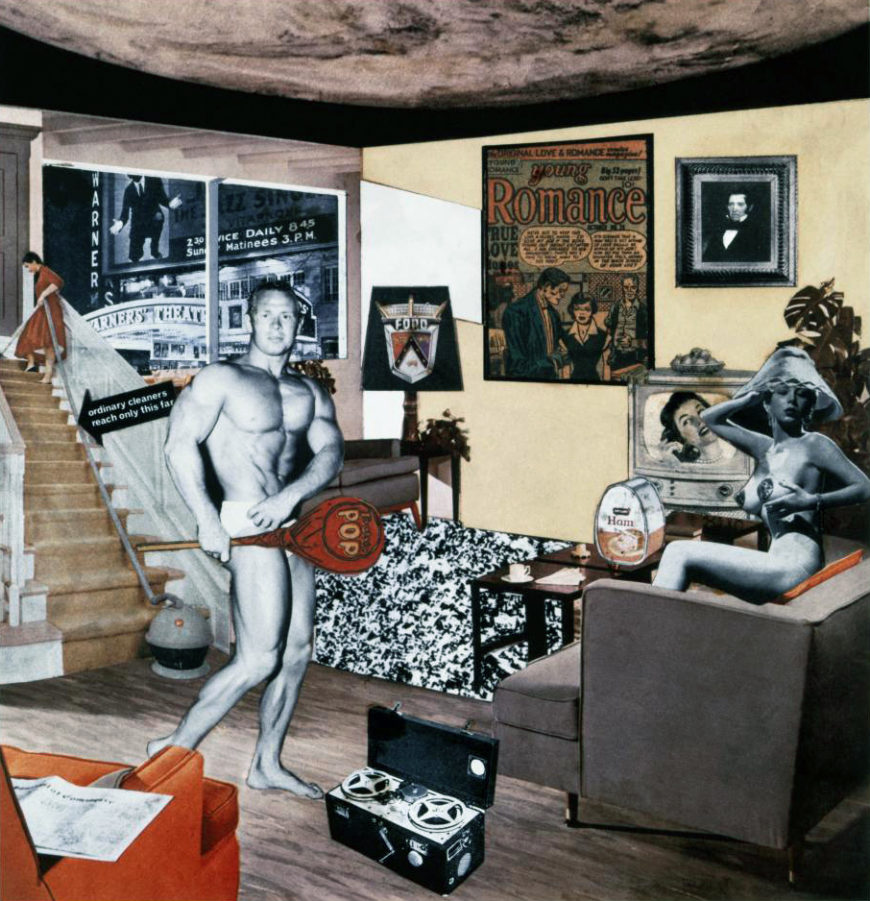
The Pop Artist and Ferry tutor / mentor Richard Hamilton connection runs deeper than surface Pop Art references. Like Hamilton’s domestic interiors in his work ‘Just what is it that makes today’s homes so different, so appealing?’ Ferry presents consumer paradise as psychological prison. The dream home becomes nightmare, the perfect woman becomes plastic fantasy. But where Hamilton maintained ironic distance, Ferry commits fully to his character’s delusion, making the critique more devastating through total emotional investment.
The song functions as both artwork and psychological case study, examining how capitalism doesn’t just sell us products but entire emotional frameworks. In 1973, this felt like avant-garde provocation. Today, it reads like anthropological field notes from our current reality.
“In Every Dream Home a Heartache” anticipated not just our technological predicament but our emotional one. In an era of AI companions, virtual relationships, and increasing social isolation, Ferry’s exploration of artificial intimacy feels less like satire and more like documentary. The song’s central question – what happens when human connection becomes another consumer product? – has never been more relevant.
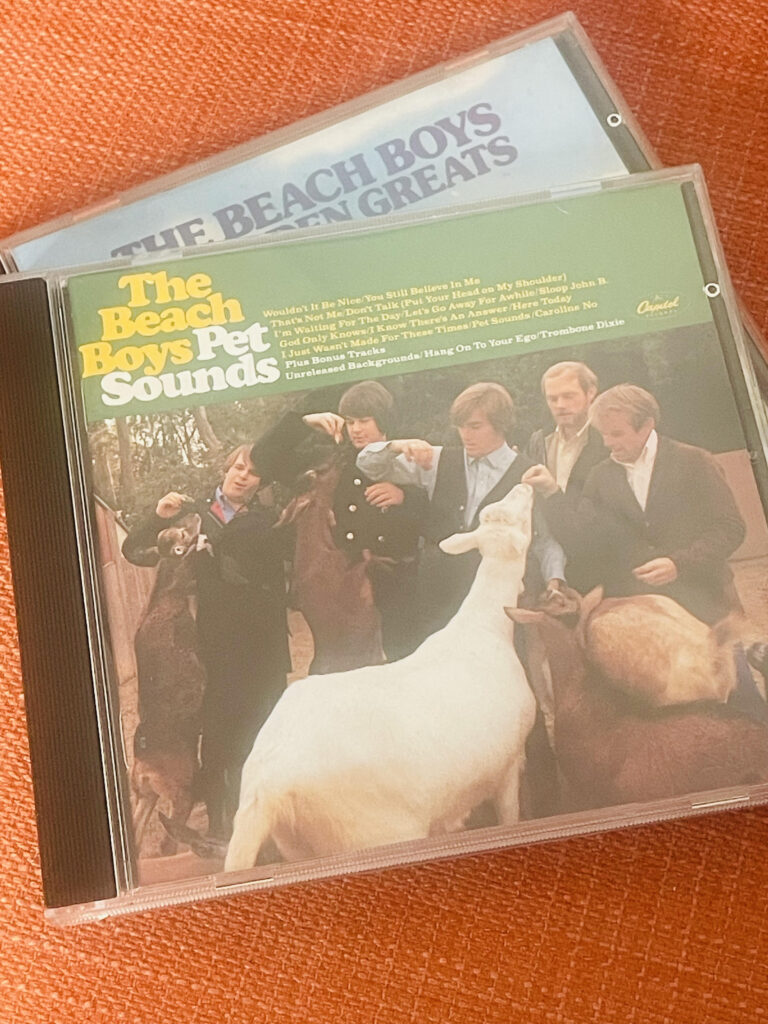
From surf music to sonic revolution: why Pet Sounds remains pop’s most extraordinary achievement and Brian Wilson’s last coherent masterpiece.
At the passing of the musically creative genius Brian Wilson, I’ve written this sixth decade reappraisal of The Beach Boys album Pet Sounds as a meditation on one of music’s most extraordinary creative achievements. A work that represents both the culmination of years of obsessive craft development and the sound of consciousness chemically expanded beyond conventional limits.
From a technical, production and arrangement perspective Pet Sounds – compared to literally everything produced beforehand anywhere is like comparing a Chevy Bel Air with a Saturn 5 rocket plus Apollo orbiter and lander. But this quantum leap didn’t emerge from nowhere. Wilson had been methodically building towards this moment since 1962, spending obsessive hours in Gold Star Studios, studying Phil Spector’s wall of sound techniques firsthand. By the time of “I Get Around,” he’d already developed an uncanny ability to hear individual instruments within dense arrangements and was experimenting with unconventional microphone placement that suggested an intuitive understanding of acoustic space.
Between 1963-1965, Wilson systematically expanded his musical vocabulary in ways that would prove crucial to Pet Sounds’ revolutionary impact. His harmonic progression from basic surf progressions to the complex jazz-influenced arrangements of “California Girls” and “Help Me Rhonda” shows us his systematic musical development. Wilson was absorbing Bach, studying Four Freshmen arrangements, and incorporating diminished chords and unexpected modulations. Simultaneously, he was cataloguing an increasingly exotic instrumental palette – harpsichord on “When I Grow Up,” orchestral arrangements on “The Warmth of the Sun,” and unusual percussion combinations that would later bloom into Pet Sounds’ bicycle bells, dog whistles, and Coca-Cola bottles.
Perhaps most significantly, Wilson’s vocal arrangements grew increasingly complex through albums like “Today!” and “Summer Days.” He was developing techniques for recording his own voice multiple times to create impossible harmonies, essentially turning himself into a one-man choir. This technical mastery meant that when his consciousness expanded, he had the tools to translate internal complexity into actual sound.
The emotional development running parallel to this technical growth was equally crucial. Wilson’s evolution from teenage surf fantasies to the adult anxieties about love, isolation, and belonging that permeate Pet Sounds wasn’t simply chemical revelation – it was the natural progression of a sensitive artist confronting the complexities of the human condition.
Substitute liquid hydrogen mixed with oxygen and a lit match with LSD and a musical genius and you’ll get Wouldn’t It Be Nice and God Only Knows here, and later Good Vibrations – his unique sounding music incredibly recorded on limiting four track equipment. It famously shook Paul McCartney to up his game and Bob Dylan has since remarked “Brian recorded Pet Sounds with four tracks, nobody else could record it with one hundred”.
Listen to Pet Sounds now, knowing what we know about Wilson’s lysergic acid adventures, and those otherworldly arrangements make perfect sense. Of course “God Only Knows” sounds like it was transmitted from heaven to Wilson’s rewired consciousness while operating on a papal frequency the rest of us can’t even tune into. But the genius wasn’t that Wilson was taking drugs – the entire suburb of Laurel Canyon was tripping in ‘66. The genius was that he was disciplined enough, focused enough, and talented enough to document his pharmaceutical journey with obsessive precision, using a toolkit of techniques he’d spent four years perfecting.
“I Just Wasn’t Made for These Times” we thought it was teenage alienation set to music. That maybe a prophetic autobiography from someone who’d already glimpsed his own future. The Theremin isn’t just an exotic instrument; it’s the faraway sound of Wilson’s cognition misfiring – in real time, beautiful but disturbing. But Wilson had been experimenting with unconventional instrumentation for years – this wasn’t random psychedelic inspiration but the culmination of systematic sound exploration.
The production techniques he described as derivative of Phil Spector and revolutionary in ‘66 now reveal themselves as the work of someone literally on another level. Wilson wasn’t just multi-tracking vocals he was seemingly attempting to capture the sound of multiple personalities having a conversation inside his head. Yet this vocal architecture built upon years of development – turning himself into a one-man choir through techniques he’d been perfecting since the early Beach Boys recordings.
Those impossibly complex arrangements on tracks like “Wouldn’t It Be Nice” aren’t showing off; they’re the musical equivalent of someone trying to make real something only he could hear in his imagination in ways difficult or impossible for lesser mortals to comprehend. But they’re also the work of someone who’d spent years absorbing Bach, studying the ‘Four Freshmen’ arrangements, and incorporating jazz harmonies that as mentioned most pop musicians couldn’t even hear, let alone execute.
What’s terrifying and brilliant is how Wilson managed to harness his disintegrating mental state and turn it into art. The drugs that were slowly destroying his grip on reality were simultaneously opening doorways to musical territories that simply don’t exist for the chemically unenhanced, a musical Doors Of Perception and where, see Aldous Huxley, heaven eventually becomes hell. Every overdub, every bizarre instrumental choice, every impossible vocal arrangement was Wilson obsessively following his rewired neural pathways to their logical conclusion – but using a musical vocabulary he’d been building methodically for years.
“Pet Sounds” the instrumental also makes more sense when viewed through this lens – it’s the sound of Wilson’s mind trying to process information through a consciousness that’s been chemically recalibrated. Those conversations between saxophone and percussion aren’t random; they’re Wilson translating internal dialogues that were becoming increasingly complex as his brain chemistry shifted, but executed with the instrumental sophistication he’d been developing since his earliest studio experiments.
Most people who’ve ingested that much LSD, in greater quantities than Syd Barrett, a similarly progressive British musical casualty and founding member of Pink Floyd, can barely tie their shoelaces, let alone orchestrate 40-piece arrangements that still sound futuristic. Wilson could do this because he’d already built the technical foundation – the chemicals didn’t create his abilities, they liberated them from conventional constraints.
But here’s the truly heartbreaking bit – we can now hear Pet Sounds as Wilson’s last completely coherent statement before the drugs and the pressure and the sheer weight of his own vision crushed him. Every perfect detail, every impossibly beautiful moment, every note that shouldn’t work but does – it’s all evidence of a mind operating at peak capacity whilst simultaneously consuming itself.
The comparative commercial failure in the America of 1966 was simply because the market wasn’t ready for avant-garde popular music made by someone now playing piano 24/7 seated in a sandbox. They wanted surf music from those nice clean-cut boys; what they got was the sound of now unkempt, long haired and bearded genius having a nervous breakdown in slow motion set to beautiful melodies. Remember that alongside the pressure generated creatively there’s financial pressure from Capitol who are ploughing dollars into the project. Yet another stress that’s under appreciated and rarely mentioned. Yes the total cost of a project might be oft quoted but not the absorption often by one sensitive creative person.
Wilson’s story since Pet Sounds – the breakdown, the bedroom years, the pills, the decline – only makes this album more precious. It’s the sound of someone touching something spiritual whilst burning up in the atmosphere of their own obsession. He gave us a glimpse of what’s possible when infinite talent meets unlimited chemical enhancement, and then paid the price for that glimpse with his sanity. Like many in era he flew close to the sun paid for it.
Pet Sounds isn’t just one of the greatest pop albums ever made – it’s a document of human consciousness pushed to its absolute limits and somehow managing to create beauty instead of chaos. Wilson took drugs that would have turned most people insane and used them to access musical dimensions that don’t exist for the rest of us. But he could only do this because he’d spent years building the technical and emotional vocabulary necessary to translate the untranslatable.
Now years later, Pet Sounds stands as both monument and warning – proof that sometimes genius requires madness, but also that madness without the foundation of obsessive craft development produces only chaos. Wilson’s achievement was combining systematic musical development with chemical consciousness expansion, creating something that transcended both.
Essential, heartbreaking, still beyond the comprehension of the majority. In era? Conpletely out there.