A deep dive retrospective into the debut album from Woking’s finest, The Jam. The politics, their suburban beginnings and the 1977 era of Punk Rock where they made their name with their own played-fast brand of Mod influenced New Wave. What self respecting chart obsessed 14 year old boy didn’t turn their school tie back to front after watching In The City on Top Of The Pops?
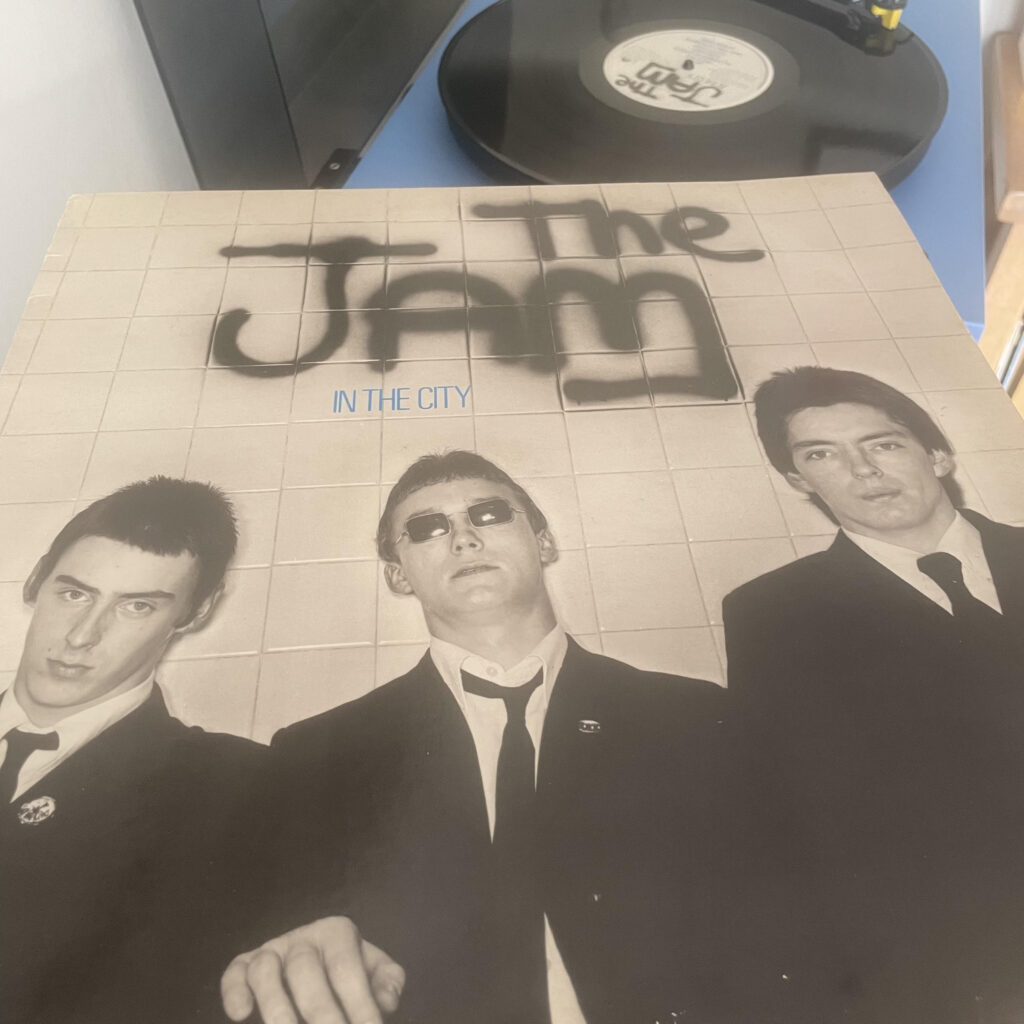
Britain, 1976 to 1977
Start with the weather. The summer of 1976 was the hottest anyone alive could remember. Reservoirs shrank, standpipes appeared in the street, and the government appointed a Minister for Drought. Within days of the appointment it rained. That is about as British as a national crisis gets, and it set the tone for a year in which very little went to plan.
Harold Wilson had resigned in the spring and left James Callaghan a country with high inflation, rising unemployment and a currency that kept sliding. By the autumn the Labour government was asking the International Monetary Fund for a loan and accepting the spending cuts that came with it. Unemployment was heading for the one and a half million mark, and school leavers were taking most of the hit. In August the Notting Hill Carnival ended in a riot. The National Front was getting bolder on the street, and the arguments about race that followed spilled into the music press and onto the stage.
For a sixteen-year-old in 1976 the message was plain. The jobs were going, the adults had no answers, and the music on the radio was Abba, Wings and a lot of Elton John. The bands that mattered to teenagers were mostly dinosaurs or exiles. Prog had run out of road. Glam had turned into cabaret. Pub rock was honest and hard-working, and it was also being played by men who looked like your dad.
Then the Sex Pistols swore on teatime television. On 1 December 1976 Bill Grundy invited them onto Thames Television’s Today programme, drew out a few four-letter words, and handed the tabloids a story that ran for weeks. Gigs were cancelled, councils passed bans, and EMI dropped the band within six weeks. In the same period The Damned put out “New Rose”, the first British punk single, and The Clash were rehearsing in a Camden warehouse. By spring 1977 the Silver Jubilee was coming, the Pistols had a single lined up that would make the Queen part of the argument, and punk had become a national row rather than a London fashion.
That is the world In The City was released into. Anyone who tells you it arrived at the start of punk has the dates wrong. It arrived at the moment the record industry finally decided to sign everybody.
Woking, and the boys who came out of it
The Jam did not come from Camden, the King’s Road or the Bromley Contingent. They came from Woking, a Surrey commuter town where people go to escape London and return to it every morning with a season ticket. Paul Weller grew up in a pebbledash semi with his father John, a builder and taxi driver who would become the band’s manager and, for a good few years, its unofficial fifth member and chief disciplinarian.
Weller met Steve Brookes and Dave Waller at school and the first version of the band came together in 1972, when Weller was fourteen. Rick Buckler, another Woking boy, joined on drums. Bruce Foxton arrived around 1973 and took over on bass, later than the others and a couple of years older than Weller. For much of the early period Foxton played lead guitar and Weller played bass. When Brookes left in 1976 the two swapped, and the line-up that would make the record was fixed: Weller on guitar and vocals, Foxton on bass and vocals, Buckler on drums.
What happened between 1972 and 1976 matters more than most punk histories allow. The Jam played for four years before anyone signed them. They did the working men’s clubs of Surrey and, with John Weller pushing the bookings, ventured north to the cabaret circuit, where a group of teenagers doing Motown and Who covers had to win over an audience that had come for the comedian and a plate of chicken and chips. In a 1970s club you either learned to hold a room or you went home. It gave them something the art-school punk bands mostly lacked, which was stamina and a habit of rehearsal. A cassette of their early practice sessions later turned up in Steve Brookes’s book Keeping the Flame, and it shows a young band that was serious about the work well before anybody was paying attention.
What they were listening to
Weller has always been open about it. The starting point was The Who, and specifically the My Generation album, which he found in the early seventies and treated as scripture. From there it ran outward to the Small Faces, The Kinks, early Beatles, Motown and Stax. He bought the clothes and the records and learned the songs. Around 1975 he saw Dr Feelgood, and Wilko Johnson’s fast, choppy, rhythm-and-lead-at-once guitar told him what was possible with one guitar and a very short temper.
None of this was fashionable in 1976. Mod was a memory, and most people under twenty did not care what kind of jacket a Small Face wore in 1966. The Jam looked odd to their own generation, and the punk audience could be hostile to a band in suits playing R&B. That was the tension the debut album carried. It sounded like punk in speed and volume, and looked and behaved like something older.
July 1976, and the trip to town
The turning point is easy to date. On 9 July 1976 Weller went up to London to see the Sex Pistols at the Lyceum, where they were third on a bill headed by the Pretty Things. He knew of them from the music press and wanted a look. He came home changed. Years later he summed it up plainly, saying there was a scene there and he wanted to be part of it. It explains most of the Jam’s next twelve months.
Woking had a stage. London had a scene. Weller started writing quicker, sharper songs about the town he lived in and the one he wanted to reach. He would tell Q magazine in 2011 that “In The City” was “a young man’s song, a suburbanite dreaming of the delights of London”. Read that back slowly, because it is the key to the album. A Londoner did not write about London this way. This came from a lad on the commuter train out of Woking who could not wait to get in.
Other accounts of the song add a further detail. Weller has said he wrote it after seeing the Pistols and The Clash, while in what he calls his Who phase. You can hear both in the record. The urgency belongs to the first two, and the chords and the harmonies belong to Pete Townshend.
Signing
The Jam worked London through the winter. They supported Wire at the Roxy in January 1977, an odd pairing that gives you an idea of how loosely the new bands were being grouped. On 22 January they played the Marquee as support to a group called Bearded Lady. In the audience was Chris Parry, a New Zealander and former drummer with the Auckland band The Fourmyula who had ended up as an A&R man at Polydor. Shane MacGowan, later of The Pogues, had told him to go and look.
Parry signed them within weeks. The terms were not generous. The advance was £6,000, with a royalty of six per cent, and the deal initially covered a single. Polydor soon took up an option that stretched the contract to four years and four albums. That is a lot of album for a band who had not made one. It is also the reason the group were in a studio while their contemporaries were still arguing with lawyers. According to one account, CBS’s chairman Maurice Oberstein phoned John Weller at the last minute with an offer said to be three times Polydor’s. By then Parry already had the band recording, and John Weller declined.
Parry is worth a paragraph of his own. He produced the first two albums alongside Vic Smith, who now goes by Vic Coppersmith-Heaven. He went on to found Fiction Records and sign The Cure. He was also, by most later accounts, the man who understood that the Jam were a pop group at heart and did not need to be pushed into being something angrier.
The sessions
The band cut demos in February, at a small studio in Soho by one account, and these were eventually released as The Polydor Demos in the reissue set. The album itself was recorded in March 1977 at Polydor’s own studio at 17 to 19 Stratford Place, off Oxford Street. It was done fast. Weller was eighteen. He would turn nineteen five days after the record came out.
Bruce Foxton’s memory of the sessions, given to MusicRadar years later, is refreshingly unmythologised. The album was more or less the live set, recorded live and played very quickly. He says you can hear it speeding up as it goes, and he adds that it does not matter, because the excitement was captured. He is right. The record’s biggest flaw and its biggest virtue are the same thing.
A reviewer at Sounds in 1977 wrote that the album sounded rushed, as though the band had been hurled into a studio before they were quite ready. The fairest reply is that they had. The songs were road-tested and the playing was tight. What was missing was time to shape the sound, and the result is a thin, trebly mix in which Buckler’s drums crash around at the front and Foxton’s bass does more of the melodic work than the mix admits. Punk records were being made quickly and cheaply that spring, and the label wanted the single out while the tour was on.
Release
“In The City” came out on 29 April 1977 and reached number 40. It is two minutes nineteen of tremolo guitar, a rolling bassline and a shouted chorus, and it got the group onto Top of the Pops. One retrospective claims the Jam were the first New Wave band to appear on the programme, which I would treat with care because several acts had a claim, but they were certainly among the first.
The album followed on 20 May and reached number 20. The timing tells its own story. The Damned had put out their debut in February. The Clash and The Stranglers released theirs in April, three weeks before the Jam. The Pistols would not get Never Mind the Bollocks out until October. So in May 1977, what the shops had was a run of debut records from London punk bands, and one from Woking that had a Batman theme on it.
The band had also joined The Clash’s White Riot tour from 1 May, though only for part of its run. It put them in front of the biggest punk crowds in the country, and it tied them to the scene in the eyes of the press.
The album
Side one opens with “Art School”, and if you want to understand what the Jam sounded like in the spring of 1977, play the first thirty seconds. It is guitar-led, fast and slightly messy in a way that is obviously intended. The Rickenbacker 330 that Weller played then has a jangle that no punk guitarist wanted, and he plays it like a stick. Foxton’s bass rides underneath. The sound is closer to 1965 than 1977 and much faster than either.
“I’ve Changed My Address” follows and keeps the pace, and then the record slows just enough for a cover of Larry Williams’s “Slow Down”, which The Beatles had also recorded. It is played straight, and you can tell the group regarded it as a favour to the ancestors. “I Got By in Time” is a solid tune that never quite finds the hook you expect from it.
“Away from the Numbers” is the first sign of the writer Weller was about to become. It is about not wanting to be counted, and in the way it moves between sections and leaves room for the bass it points to All Mod Cons rather than back to the pubs of Woking. Ceremony’s retrospective describes it as power chords fused with R&B melodies, and that is close. Side one closes with the theme from Batman, the 1960s television series, written by Neal Hefti. It is a throwaway and it is delivered as a throwaway. It is also a clue. A band at the front of punk who put the Batman theme on their debut are telling you they do not take the rules seriously.
Side two starts with the single. The introduction is Foxton’s bassline, arriving as a fast-moving pulse over which Weller’s guitar cuts in, and then the vocal enters with a lyric about uniformed men and the right to kill, a line that reads oddly now. It sounds like a protest and it works as one, though Weller was eighteen and was not writing a manifesto. The lyric’s real subject is the phrase “the young idea”, which is sung as the chorus and sounds like it came off a badge.
There is a footnote to the song that has become part of Jam folklore. The bass figure resurfaced a few months later on the Sex Pistols’ “Holidays in the Sun”. Weller has told the story of a run-in with Sid Vicious over it, and the accounts of who hit whom vary with the teller. Whatever happened, the resemblance is real, and it is a compliment.
“Sounds from the Street” and “Non-Stop Dancing” keep the momentum going. They are the least distinctive stretch of the album, quick and shouty, and the lyrics circle familiar territory of youth, noise and impatience. “Time for Truth” is the direct political song. Weller lines up the politicians for a kicking and does it in a way that sounds heartfelt and a little naive. It is worth knowing that around this time he told the NME that the band would vote Conservative at the next election. He changed his mind soon enough, and it is a useful reminder that in 1977 no one in the Jam had a settled politics, only a settled dislike of being talked down to.
“Takin’ My Love” shows the R&B and soul roots underneath the speed. “Bricks and Mortar” closes the record with a complaint about redevelopment, the spoiling of old streets by new concrete. It is the closest thing on the album to a preview of the songs he would write about Britain over the next five years, where the target was the whole country and not just the councils.
Twelve tracks, two covers, not much over half an hour. It does not outstay its welcome.
What it does well, and what it doesn’t
The strengths are energy, tunes and precision. The band is tight, and Buckler and Foxton in particular sound like a unit that has spent four years playing in rooms where mistakes are punished. The tunes are better than those on most punk debuts. The vocal is confident. Weller is a much more musical singer than the Pistols’ Johnny Rotten or The Clash’s Joe Strummer, and the harmonies with Foxton have a pop quality that was rare in the scene.
The weaknesses are equally clear. The production is thin. Some of the songs are filler, and one or two are pastiche. The lyrics are teenage in a way that Weller himself outgrew within twelve months. Most tellingly, the album shows a band still working out whether it is a punk group with mod tastes or a mod group with punk pace. The Who influence is so strong in places that some listeners at the time heard a tribute act, and the charge was not entirely unfair. It was a limited way of hearing it. A tribute band does not usually write “Away from the Numbers” or take an album to number 20.
Later views
Time has been kind to the record without turning it into a masterpiece. Fans tend to place it below All Mod Cons, Setting Sons and Sound Affects, which is where it belongs. Pitchfork reviewed it as part of the reissue programme. The 40th anniversary box set, 1977, was released in October 2017 and collected the album, its follow-up, the February demos, live recordings and the Peel sessions.
The band members have looked back on it with varying degrees of fondness. Foxton remains proud of it and talks warmly about the thrill of hearing the single in his local pub. He has also pointed out that the record company and the audience wanted a repeat, and that the group were already moving toward ballads and acoustic guitars when they made the next single, “All Around the World”. That single went to number 13 in July. The second album, This Is the Modern World, followed in November, only six months after the first and widely thought of as the rushed one.
Rick Buckler died on 17 February 2025. In later life he felt that Weller had been given too much of the credit for the band’s catalogue at the expense of the rhythm section. Listen to the record and the point is easy to accept. The drums on “In The City” do the work of pulling the whole thing forward, and Foxton’s bass is an equal partner. In 1977 they were the best rhythm section in the new bands, and they still sound like it.
Verdict
In The City is not the finest Jam album, and it is not a punk record in the way Never Mind the Bollocks or The Clash is. It is a small-town group taking its chance and taking it well. There are perhaps five genuinely excellent songs. There is a great single. There is a set of musicians who could play, and a teenager who was about to learn to write.
The best way to hear it is as a document of one moment: the spring of 1977, when the guitars were loud, the government was on its knees, and a lad from Woking with a Rickenbacker and a good haircut looked at the city on the horizon and decided to catch the train. It sounds like someone who has not been let down yet. Within two years he would be writing about buses, tube stations and the ordinary cruelty of British life, and the music would be far better. This record is where the lad from the suburbs starts.
Play it loud. It only lasts half an hour.
Sources: Wikipedia entries for In the City, the song, and The Jam; Record Collector Magazine (The Roots of Weller, When You’re Young, 1977: Don’t Dictate); MusicRadar (Bruce Foxton, 2012); Far Out Magazine; Paul Weller Fan Podcast, episode 76 (Chris Parry); thejam.org.uk; Ceremony (Paul Weller retrospective).