Four decades on, Robert Smith’s darkest hour remains a towering monolith of despair
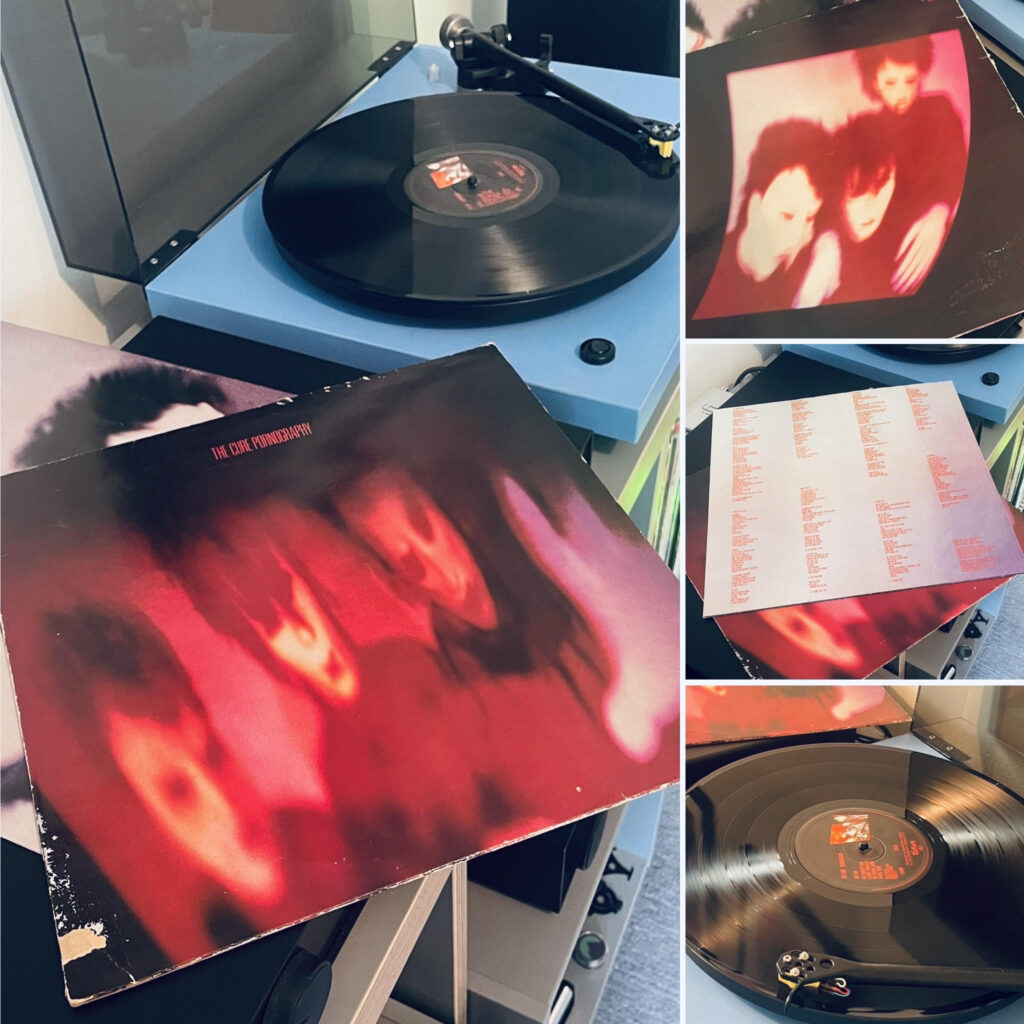
The year is 1982. A pre-Falklands War Thatcher’s Britain is strangling itself, unemployment queues stretch round the block, at RAK studios – the production home of Mickie Most… a mentally exhausted The Cure trio including an actually suicidal Robert Smith are busy raiding the local off-licence and dropping LSD while constructing Pornography. An album set to be a valedictory, instead the fourth of many but in retrospect the most unforgiving album in their catalogue. This is not a weeping song, it’s a weeping album of relentless despair deep in the trenches. I’m trying to think of more angst ridden vinyl before this, Leonard Cohen? he doesn’t touch the sides.
To pin down Pornography’s genre is like trying to nail jelly to the wall blindfolded. Is it goth? Well, it certainly helped birth the movement, though Smith and co. were likely too busy drowning in their own existential mire to notice they were creating a blueprint for a thousand even paler imitators. Post-punk seems closer to the mark, the album shares DNA with the abrasive experimentation of Wire and the introverted intensity of Joy Division, yet it possesses a peculiar self aware grandiosity that sometimes flirts with progressive rock’s theatrical impulses.
The opener, “One Hundred Years,” remains one of the most genuinely unsettling pieces of music committed to vinyl as confirmed by a thousand other reviews over the decades. Simon Gallup’s bass doesn’t so much play as it lurches, each note feeling like a death rattle echoing through a Victorian mausoleum. Lol Tolhurst’s drums don’t keep time, they mark the countdown to apocalypse with Swiss precision. Over it all, Smith’s open but discordant guitar work writhes and contorts like something in its final death throes, whilst his vocals deliver pronouncements of doom with the authority of a biblical prophet having a particularly bad day, ‘Stroking your hair while the patriots are shot’. Cheery.
Smith’s lyrics here read like dispatches from a post-nuclear wasteland, all “caressing an old man” and visions of flesh rotting in slow motion. “It doesn’t matter if we all die,” he intones with the casual indifference of someone reading the shipping forecast, before launching into imagery that makes JG Ballard’s crash fetishists seem positively life-affirming. The repeated invocation of “ambition” becomes less a call to achievement than a bitter mockery of human striving in the face of inevitable decay. It’s dystopian poetry delivered with the matter-of-fact brutality that only someone contemporaneously truly acquainted with despair could muster.
The album’s themes are hardly subtle. Death, execution, decay, sexual obsession, and psychological collapse aren’t just lyrical preoccupations here, they’re the very fabric from which the music is woven. The title track itself is a gruelling eight-minute descent into total madness.
What’s remarkable, and this is an album that has needed the space of time to fully appreciate – but listening back now, is how individual virtuosity serves the album’s suffocating atmosphere rather than showing off for its own sake. A polar opposite of prog. Gallup’s bass playing is masterful, his lines on “The Hanging Garden” provide both melodic anchor and rhythmic propulsion whilst never losing sight of the song’s essential bleakness. Lol Tolhurst, soon to eschew drums for keyboards, proves his worth with drumming that’s both primitive and sophisticated, knowing precisely when to pummel and when to restrain.
You’re drawn into the narrative so deeply that by the time The Hanging Garden begins the assumption is hung as in executed, then you think well, The Hanging Gardens of Babylon were decorative – but by the end you’re covering your face as the animals die. Oh well.
Pornography exists in its own ecosystem, hermetically sealed from the outside world. It’s an album that doesn’t court your affection so much as dare you to spend time in its company. The fact that it spawned a thousand goth clubs and launched a million black-clad disciples is almost beside the point, this is music that transcends subcultural boundaries through sheer force of vision.
Four decades later, as Britain – indeed the world once again finds itself wrestling with its demons, Pornography sounds less like a relic of its time and more like a prophetic statement. It remains The Cure’s most uncompromising work, a 43-minute journey into the abyss that somehow manages to be simultaneously utterly miserable and strangely life-affirming. A album that could leave you with a thousand yard stare. Give me your eyes that I might see, a blind man kissing my hand.
Essential listening, but if you’ve just begun a course of anti-depressants read the side effects first.
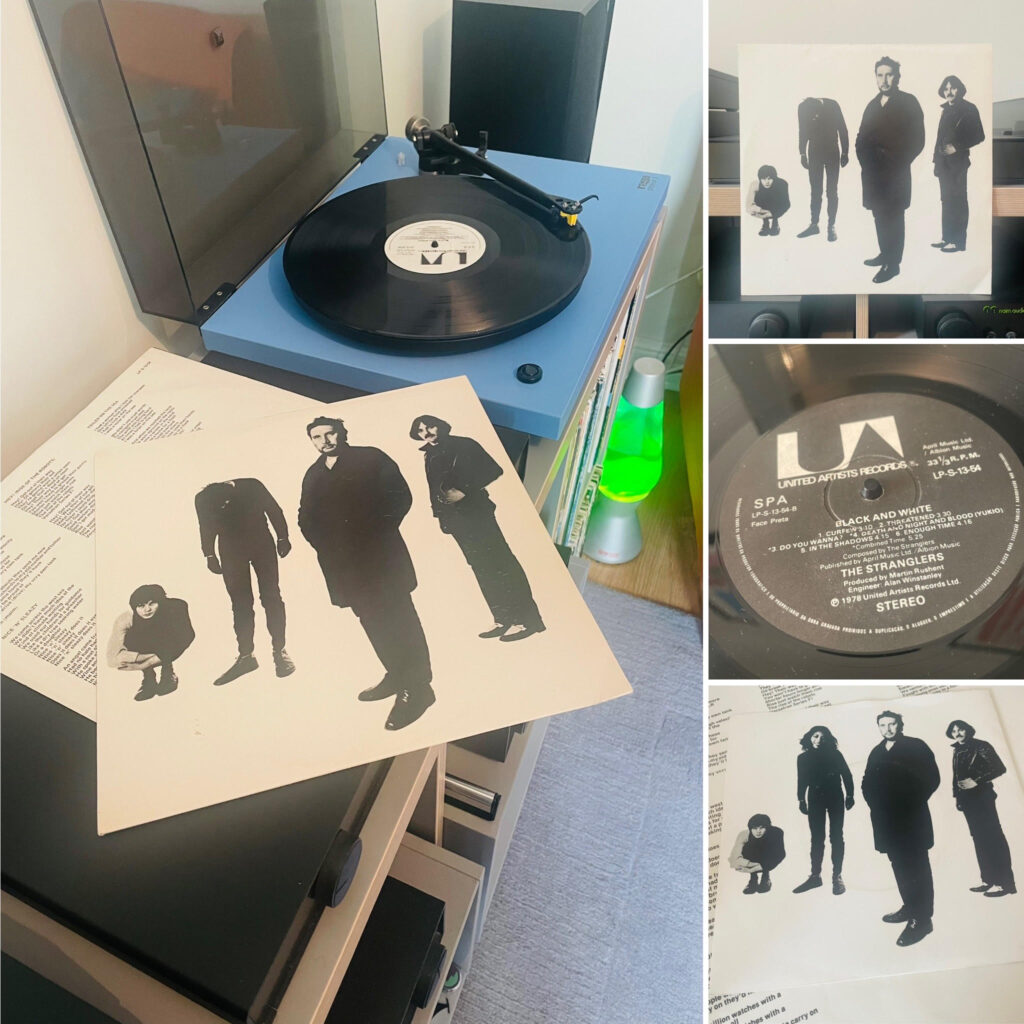
The Stranglers’ genre-defying third album Black and White.
‘The album’s greatest achievement, visible only in retrospect, is how it managed to bridge multiple worlds simultaneously. It’s European art-rock disguised as British punk, progressive complexity wrapped in new wave accessibility, academic sophistication delivered with street-level aggression. This wasn’t difficult third album confusion, it was cultural synthesis of the highest order.‘
The Stranglers in their original line-up have always been an awkward bunch to pin down. Too clever by half for the three-chord merchants, too hard for the art school crowd, and now, nearly five decades later, it’s clear that with Black and White, they were mapping out musical territory that the rest of us are still catching up to. This third LP finds Hugh Cornwell and his merry band of misanthropes wandering off into uncharted territory.
Make no mistake about it, this was never your standard punk fare, and time has only made that more obvious. The album’s position in their canon is rather like that of The Beatles’ Sgt. Pepper or Bowie’s Low – it’s when the band stopped being what people expected and took a hard fork and became something else entirely. Where Rattus Norvegicus and No More Heroes could still be filed under “angry young men with guitars,” Black and White reveals The Stranglers as something far more prescient: a band of genuine musical ability who understood that punk’s three-chord limitations were a creative dead end. Dave Greenfield’s keyboards, which seemed so alien to punk orthodoxy in 1978, now sound like a direct line to everything from Joy Division’s atmospheric menace to Depeche Mode’s electronic romanticism.
The album’s opener sets a tone that, viewed from today’s perspective, feels remarkably contemporary. There’s a European sensibility at work here that becomes more significant when you consider Cornwell’s academic background, his time pursuing doctoral studies in Sweden had clearly broadened his musical horizons beyond the parochial concerns of British punk. This is music that breathes Continental air, influenced as much by krautrock and European art movements as by the Ramones or The Sex Pistols. It’s telling that while their punk contemporaries were busy becoming parodies of themselves, The Stranglers were quietly absorbing influences from across the North Sea. “Let me tell you about Sweden!”
The musical sophistication that seemed so controversial at the time now appears as the album’s greatest strength. Jean-Jacques Burnel’s bass doesn’t just anchor these songs; it prowls through them with a melodic complexity that prefigures the art-rock basslines of bands like Radiohead. His French background, combined with Cornwell’s Scandinavian academic experience, created a cultural perspective that was uniquely European within the context of British punk, something that seemed like pretension in 1978 but reads as genuine cosmopolitanism today.
Which brings us to the question of genre, now settled by history’s verdict. This wasn’t punk, it was post-punk before the term existed, nascent yet to be defined new wave, and death and night and blood darkwave a full decade before any Goths claimed it. The progressive rock DNA in instrumental passages and influences that so scandalised the Peaches punk faithful in 1978 now seem like natural evolution rather than betrayal. There’s art-rock sensibilities that align them more to Bryan Ferry’s Roxy Music than Brian James’ era The Damned. When viewed alongside the career trajectories of contemporaries who stayed “pure,” The Stranglers’ willingness to embrace musical sophistication looks like wisdom rather than sell-out.
The pre-Stranglers ice-cream selling Jet Black’s drumming is phenomenal and displays the kind of precision that made contemporaries envious and now sounds like a masterclass in restraint and power. His technical ability, which punk doctrine suggested was somehow inauthentic, has aged far better than the amateur enthusiasm of many of his contemporaries. This was always about more than attitude, it was about creating something genuinely new from the wreckage of rock orthodoxy.
The production, courtesy of Martin Rushent, has aged remarkably well. That claustrophobic intensity, the sense of menace lurking in the spaces between notes, a kind of negative space threat, points directly towards the atmospheric post-punk that would dominate the early eighties. Rushent understood what The Stranglers were reaching for, a sound that was simultaneously ancient and futuristic, rooted in European classical traditions but pointing towards electronic possibilities.
The European influences run deeper than mere musical technique. Cornwell’s academic sojourn in Sweden exposed him to Nordic social democratic thinking, Scandinavian cultural pessimism, and a Continental intellectual tradition that was light-years removed from punk’s British working-class romanticism. You can hear it in the album’s lyrical sophistication, its philosophical undertones, its refusal to offer simple answers to complex questions. This wasn’t just rebellion, it was critique, informed by a broader cultural perspective than most British bands or songwriters could muster.
Lyrically, the album now reads as remarkably prescient social commentary rather than simple provocation. The themes of dystopian late stage capitalism, existential threat, social breakdown and cultural exhaustion that seemed left field shocking in 1978 now feel like accurate prophecy. The Stranglers weren’t just chronicling the decline of British society, they were anticipating the cultural fragmentation and the rise and fall of the Internet and social media that would define the following decades.
The album’s greatest achievement, visible only in retrospect, is how it managed to bridge multiple worlds simultaneously. It’s European art-rock disguised as British punk, progressive complexity wrapped in new wave accessibility, academic sophistication delivered with street-level aggression. This wasn’t difficult third album confusion, it was cultural synthesis of the highest order.
Looking back across the landscape of late-seventies music, Black and White now appears as one of the most innovative albums of its era. While The Clash were already retreating into reggae and rockabilly nostalgia and The Sex Pistols had combusted spectacularly, The Stranglers were quietly creating a template for alternative music that would influence generations of musicians. From the atmospheric post-punk of Joy Division to the electronic experimentation of Kraftwerk’s British disciples, the DNA of Black and White can be traced through decades of innovative music.
In the end, history has vindicated The Stranglers’ refusal to stay within punk’s narrow confines. What seemed like betrayal in 1978 now looks like vision, a recognition that musical progress required synthesis rather than purity, sophistication rather than simplicity, European cosmopolitanism rather than parochial nationalism. Hugh Cornwell’s Swedish academic experience, Jean-Jacques Burnel’s French cultural background, and the band’s collective refusal to be constrained by British musical traditions created something genuinely unique in the landscape of late-seventies music.
Black and White remains uncomfortable listening, but for different reasons now. In an era of algorithmic predictability and focus-grouped lo-fi rebellion, there’s something genuinely subversive about music that refuses easy categorisation. The Stranglers were always outsiders, even within punk’s supposedly inclusive chaos. With Black and White, they staked out territory so far from any mainstream that it took many decades to recognise its importance. Uncomfortable listening for uncomfortable times, which is exactly as it should be, and exactly why it matters more today than ever. What’s that in the shadows?
Eighteen Months of Madness in the Heart of Hollywood. The ex-Beatle’s wildest period yet – sex, booze, and Rock’n’Roll excess that nearly destroyed a legend.
Right, so you think you know John Lennon? The peaceful Beatle, the ‘Bed-In’ revolutionary, the bloke who gave us “Imagine”? Well, think again, because between October 1973 and early 1975, our John went completely barmy in Los Angeles – and we do mean completely. They’re calling it his “Lost Weekend,” though at eighteen months, it’s more like a lost year and a half.
It all started when Yoko threw him out of their Dakota apartment. Yes, you heard right – she actually booted him out, told him to go find himself or some such psychological bollocks. “Go away and have your midlife crisis somewhere else,” was apparently the gist of it. So off trots Lennon to La-La Land with May Pang, Yoko’s 23-year-old assistant, who’d been hand-picked by Mrs Lennon herself to keep an eye on her wayward husband.
What followed was a period of such spectacular debauchery that even Keith Moon would’ve raised an eyebrow. Lennon, aged 33 and supposedly a reformed character, promptly went completely off the rails in the most American way possible.
First stop was a beach house in Santa Monica that quickly became legendary for all the wrong reasons. Lennon surrounded himself with a motley crew of musicians, hangers-on, and fellow piss heads who turned the place into something resembling a Rock’n’Roll commune crossed with a rehabilitation centre – except nobody was trying to get clean.
The core gang included Harry Nilsson (already well on his way to drinking himself to death), Ringo Starr (taking a break from his own marriage difficulties), Keith Moon (just because), and a rotating cast of session musicians, groupies, and general wastrels. They called themselves “The Hollywood Vampires” – which tells you everything you need to know about their priorities.
Days would start around noon with cocaine and brandy, move on to more serious drinking by mid-afternoon, and end with everyone unconscious in various compromising positions around dawn. Lennon, who’d supposedly given up the hard stuff years earlier, was necking everything he could get his hands on – whisky, vodka, tequila, you name it. The man who once sang about peace and love was now starting fights in nightclubs and getting thrown out of venues across Los Angeles.
The nadir came in March 1974 at the Troubadour club, where Lennon and Nilsson had gone to catch an Ann Peebles show. Both absolutely legless, they proceeded to heckle the poor woman throughout her set. When staff tried to quiet them down, Lennon apparently shouted something unrepeatable about the management’s parentage and stormed off to the toilets.
But here’s where it gets properly weird – instead of using the gents, our revolutionary hero decided to relieve himself in a cupboard, emerging with a sanitary towel stuck to his forehead like some demented tribal marking. The press had a field day, of course. “BEATLE JOHN’S TOILET SCANDAL” screamed the headlines, and suddenly the man who’d once been the most respected musician in the world was reduced to a laughing stock.
The incident became symbolic of everything wrong with Lennon’s LA period. Here was a bloke who’d written some of the most important songs of the decade, reduced to pissing in cupboards and wearing feminine hygiene products as headgear. It was pathetic, really.
Amazingly, amidst all this chaos, Lennon was still trying to make music. The problem was, he was too pissed most of the time to do it properly. Recording sessions for what would become “Walls and Bridges” were exercises in frustration, with Lennon turning up hours late, completely bladdered, and unable to remember lyrics he’d written the day before.
Producer Jack Douglas later described the sessions as “like trying to record with a very talented ghost who kept disappearing.” Lennon would start a take, wander off mid-song, and return hours later having forgotten what they were working on. It’s a miracle the album turned out as well as it did.
The saving grace was May Pang, who somehow managed to keep some semblance of order in the chaos. Twenty years younger than Lennon and completely out of her depth, she nevertheless became his anchor during this period. She’d drag him out of bars, clean him up for recording sessions, and generally prevent him from killing himself through sheer stupidity.
If you want to know how mental things got, consider this: Lennon thought it would be a brilliant idea to record an album of Rock’n’Roll covers with Phil Spector producing. Yes, that Phil Spector – the gun-toting maniac who was already showing signs of the complete breakdown that would later land him in prison for murder.
The sessions, held at various LA studios throughout 1974, were legendary for their dysfunction. Spector would turn up armed (literally), paranoid, and completely controlling. Lennon, meanwhile, was usually drunk and belligerent. The two would spend hours arguing about arrangements while session musicians sat around collecting overtime pay.
One session ended with Spector firing a gun in the studio and then disappearing with the master tapes, leaving Lennon with nothing to show for weeks of work. It was like something out of a Martin Scorsese film, except it was real life and nobody was laughing.
The thing is, beneath all the chaos and self-destruction, you could sense Lennon was actually quite miserable. This wasn’t the joyful excess of a rock star living it up – this was the desperate flailing of a man who’d lost his way completely.
Friends from the period describe him as paranoid, lonely, and increasingly aware that he was making a complete tit of himself. The press coverage was universally awful, his music was suffering, and worst of all, he was alienating himself from the son he claimed to love more than anything.
Julian was still back in England with Cynthia, and Lennon’s contact with the boy was sporadic at best. When he did ring, he was often too drunk to hold a proper conversation. It’s heartbreaking, really – here was a man who’d sung about love and peace, completely unable to maintain relationships with the people who mattered most to him.
The long and winding road back… By late 1974, even Lennon’s legendary constitution was showing signs of wear. He’d put on weight, looked terrible in photos, and was developing a reputation as one of Hollywood’s most unreliable talents. Studio executives were starting to avoid him, club owners were banning him, and his behaviour was becoming genuinely concerning to those around him.
The wake-up call came when he collapsed during a recording session, apparently from exhaustion and alcohol poisoning. Rushed to hospital, he spent several days recovering while doctors told him in no uncertain terms that his lifestyle was unsustainable.
It was then that May Pang apparently sat him down for a serious conversation about his future. According to those close to the situation, she basically told him he could continue on his current path and probably die, or he could sort himself out and try to salvage something from the wreckage of his life.
The irony is that throughout this entire period, Lennon was in regular contact with Yoko back in New York. She’d ring him every few days, ostensibly to check on his wellbeing but apparently also to monitor his behaviour. Some cynics suggest the whole “Lost Weekend” was orchestrated by Yoko from the beginning – a way of letting Lennon get all his middle-aged rebellion out of his system while keeping him on a very long leash.
Whether that’s true or not, by early 1975 it was clear that Lennon was ready to return to New York and his wife. The LA experiment had run its course, leaving behind a trail of damaged relationships, wasted opportunities, and some genuinely questionable musical decisions.
But here’s the thing – as much as the Lost Weekend period was a disaster in human terms, it also produced some of Lennon’s most honest and vulnerable music. “Walls and Bridges” contains some genuinely affecting songs about loneliness and regret, while the eventually completed “Rock’n’Roll” album, despite its troubled genesis, showed Lennon reconnecting with his musical roots in ways that would influence his later work.
So what do we make of John Lennon’s Lost Weekend? Was it a necessary period of self-exploration, or just eighteen months of expensive self-indulgence? The truth, as usual, probably lies somewhere in between.
On one hand, it’s hard to have much sympathy for a millionaire rock star whose idea of finding himself involves drinking himself senseless in beach houses while his assistant-turned-girlfriend cleans up after him. The whole thing reeks of middle-class privilege and self-pity taken to absurd extremes.
On the other hand, there’s something genuinely tragic about watching one of the most important artists of his generation lose himself so completely. Lennon’s music had always been about honesty and emotional truth, and in some perverse way, his LA breakdown was probably the most honest thing he’d done in years.
The period also demonstrated something important about the nature of creativity and self-destruction in rock music. While the myth of the tortured artist is largely bollocks, there’s no denying that some of our greatest musicians have produced their most powerful work while falling apart personally. Lennon’s Lost Weekend wasn’t pleasant to witness, but it was undeniably real in a way that his more controlled periods sometimes weren’t.
Perhaps most importantly, it showed that even John Lennon – the man who’d helped change popular music forever – was still fundamentally human, still capable of making spectacular mistakes and learning from them. The fact that he eventually sorted himself out, returned to New York, and spent his final years as a devoted father and husband suggests that the Lost Weekend, for all its chaos, might have been a necessary part of his journey.
Whether it was worth eighteen months of madness is another question entirely. But then again, that’s Rock’n’Roll for you – never simple, never clean, and never quite what you expect from the outside.
Whatever gets you thru the night eh?
*The author wishes to acknowledge that this piece is based on publicly available information and interviews from the period, and that some details remain disputed by those involved.
#nowplaying John Lennon – Walls and Bridges (1974)
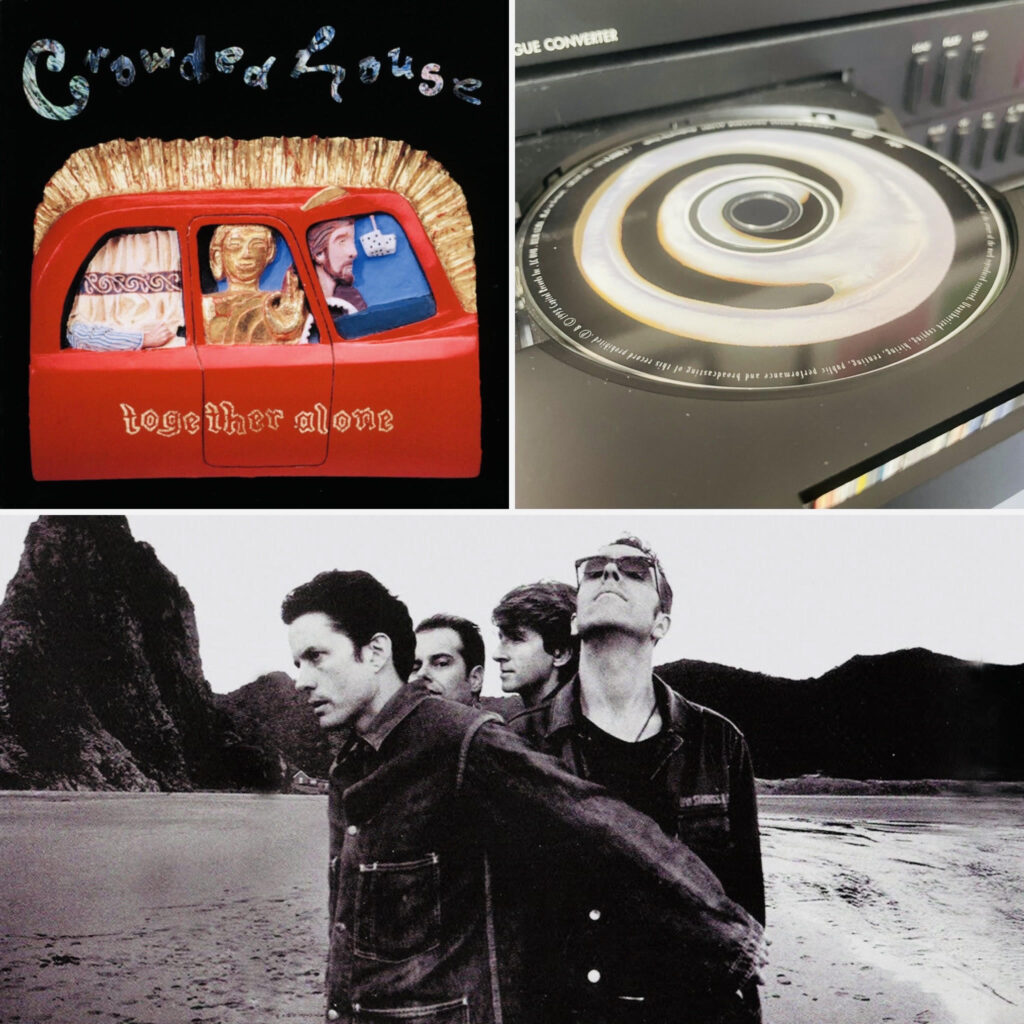
Thirty-two years on, and Together Alone still sounds like nothing else in the Crowded House catalogue. What seemed like a bewildering left turn in 1993 now reveals itself as the band’s most prescient work, a record that anticipated the alt-rock soul-searching of the late nineties whilst remaining utterly, defiantly itself. Neil Finn’s mob wandered off into the spiritual wilderness armed with nothing but a fistful of melodies and Martin Glover’s sonic wizardry, and what they dragged back from the void was this peculiar, haunting beast that sounds like it was recorded in some ancient Maori temple with the ghosts of a thousand ancestors whispering sweet harmonies into the mixing desk.
History has been kind to Together Alone. What critics initially dismissed as commercial suicide now reads as artistic bravery of the highest order. The title, which once seemed like undergraduate philosophising, now carries genuine weight, this is music for our atomised age, for contemplating connection and disconnection whilst doom scrolling at 3am, wondering where it all went wrong and why the notifications never stop.
The genius of Youth’s production has aged magnificently. The man who gave us Killing Joke’s industrial nightmares somehow coaxed sounds out of Finn and company that still shimmer and breathe like living things decades later. Gone were the pristine pop perfections of their earlier work, replaced by something altogether more organic and mysterious. Listen now and you can hear the DNA of everything from Radiohead’s OK Computer to Bon Iver’s falsetto folk, Youth was crafting the sound of millennial melancholy years before anyone knew what to call it. The drums sound like they’re echoing through cathedral spaces, the guitars drift in and out of focus like half-remembered dreams, and Finn’s voice floats above it all with an otherworldly detachment that’s genuinely unsettling.
The opening salvo sets the tone perfectly a rolling, hypnotic rhythm that builds into something approaching transcendence before dissolving into the ether. It’s pop music, Jim, but not as we know it. This is Crowded House wrestling with their demons in public, and Youth has given them the sonic palette to paint their neuroses in glorious Technicolor.
Finn’s songwriting has taken a decidedly introspective turn. Where once he dealt in universal truths wrapped in sugar-sweet melodies, here he’s digging deeper into the psyche, exploring themes of isolation, connection, and the peculiar melancholy that comes with success. The man sounds genuinely troubled, and it suits him.
The production shines brightest on the album’s more experimental moments. Youth has layered in all manner of mysterious sounds, backwards vocals, found sounds, studio trickery that would make Kevin Shields weep with envy. Yet it never feels gimmicky or overwrought. Every sonic flourish serves the songs, adding depth and texture without overwhelming Finn’s essentially human songwriting.
That said, Together Alone isn’t without its problems. At times, the band seem so determined to avoid their pop past that they forget what made them special in the first place. A few tracks meander when they should soar, and the overall mood is so consistently downbeat that you occasionally long for the simple joy of their earlier work. ‘Why are you listening to that depressing music?’ it is not, but it can be downbeat.
But these are minor quibbles with what history has revealed to be an essential record. Crowded House risked everything to make something genuinely personal and challenging, and Youth gave them the sonic framework to create what now stands as their most influential work. It wasn’t their biggest seller, but it was their boldest statement the record that proved they were artists first, hit-makers second.
In our current age of manufactured vulnerability and algorithmic angst, Together Alone stands as proof that real emotional complexity can’t be coded or commodified. It’s a grower, this one and the kind of record that reveals new secrets with each listen, the kind that soundtracks both Instagram stories and genuine moments of crisis in equal measure.
Three decades later, Martin Glover’s achievement becomes even clearer. He took New Zealand’s finest export and helped them create their masterpiece, a record that sounds more relevant now than it did then. The kids discovering it on Spotify don’t know they’re listening to the future of indie rock, circa 1993. Seems like Youth may not be wasted on the young after all.
In the pantheon of rock’s cerebral mavericks, Brian Peter George Jean-Baptiste de la Salle Eno AKA Brian Eno or just plain Eno stands as our premier egghead-in-residence, the boffin who turned knob-twiddling into an art form, and made the recording studio a canvas rather than a mere tool. While lesser mortals bang away at their instruments with workmanlike dedication, Eno approaches music as just another colour on his palette.
The roots of Eno’s glorious dilettantism lie not in the cramped smoky clubs of London but in the rarefied air of art school conceptualism. Before he became the feather-boa’d synth wizard of Roxy Music, before he produced landmark albums for everyone from Talking Heads to U2, before he invented ambient music while flat on his back after being walloped by a taxi, young Brian was just another paint-splattered art student at Ipswich’s Suffolk College, soaking up ideas that would later transform rock music.
“Art school didn’t teach me how to paint, it taught me how to think about why I might want to paint in the first place.” – Brian Eno.
This intellectual approach, questioning the very foundations of why we make art became the cornerstone of his musical methodology, a perpetual askance glance at rock’s tedious conventions.
At Ipswich, Eno fell under the spell of teacher and mentor Tom Phillips, a walking encyclopedia of avant-garde approaches whose influence on our hero cannot be overstated. Phillips; painter, composer, translator, and all-round Renaissance gadabout introduced the young Eno to the work of John Cage, to the mind-bending possibilities of chance operations and indeterminacy. Phillips’ own masterwork, “A Humument,” in which he transformed a Victorian novel into a series of visual poems by painting over the text, leaving selected words visible, demonstrated how one might create new meaning by obscuring the old, a strategy Eno would later deploy in his oblique collaborations with David Bowie.
“Tom showed me that art wasn’t about technical skill, it was about context, about framing experiences.” This revelation liberated the technically limited Eno, allowing him to approach music as conceptual art rather than a craft to be mastered. When he later joined Roxy Music, he proudly proclaimed his musical illiteracy as a virtue rather than a handicap.
The conceptual art movement that dominated British art schools in the late ’60s provided Eno with his intellectual toolkit. Here was an approach that valued ideas over execution, process over product, and systems over virtuosity, catnip for a mind as restlessly curious as Eno’s. From conceptualism came his fascination with self-generating systems, with setting up musical experiments and then stepping back to see what might happen. His famous Oblique Strategies cards (created with artist Peter Schmidt) with those cryptic injunctions like “Honour thy error as a hidden intention” or “Emphasise differences” are pure conceptual art, placing process above outcome.
While most rock musicians have historically treated their art school past as a brief bohemian holiday before getting down to the serious business of power chords and stadium tours, Eno has remained defiantly committed to the art school perspective. His collaborative approach, turning musicians into components in his sonic experiments derives directly from the workshop methodologies of art school. When he produced Talking Heads’ “Remain in Light,” he was essentially running the band through a series of conceptual exercises, treating David Byrne and company as materials rather than auteurs.
Even Eno’s celebrated ambient works, gossamer soundscapes made for the comedown room, can be traced back to the “expanded cinema” experiments he witnessed as an art student. These multimedia environments, combining film, light shows, and sound, were attempts to create immersive experiences rather than discrete works of art. When Eno later described ambient music as being “as ignorable as it is interesting,” he was channeling the art school notion that art need not demand attention but might instead modify an environment.
What separates Eno from the legions of other art school graduates who’ve strayed into rock’s territory is his ability to translate rarefied conceptual approaches into works that connect emotionally. His productions for U2 may have been informed by systems thinking and process art, but they also made the Irish bombast merchants sound bloody enormous. His solo works might be exercises in cybernetic theory, but they’re also strangely moving, capturing melancholy and wonder in their abstract washes.
In an age when rock has largely abandoned its art school flirtations in favour of earnest authenticity or technical showboating, Eno remains our most eloquent reminder that popular music can be a laboratory for ideas as well as emotions. The art school influence that formed him, that combination of intellectual rigour and playful experimentation continues to inform his work, whether he’s producing pop stars or creating video installations.
As we face another decade of dreary singer-songwriters emoting over acoustic guitars, we need Eno’s art school sensibility more than ever. With Eno, thinking about music can be as revolutionary as playing it.
Brian Eno attended Ipswich Art School, Winchester College of Art 1964-66 & 1966-69.
—
Art Pop / Pop Art: a study of the influences of art school, famous artists and movements on pop and rock music. Those institutions where failure is motivation, where the eccentric and pretentious emerge into the fascinating space where art and music meet.
Or How The ‘Young British Artists’ Shaped Brit Pop’s Visual Punch
In the crestfallen capital of post-Thatcher Britain, a gang of art school chancers were regurgitating ideas from Duchamp, the Sixties pop artists and sculptors and flogging them to Charles Saatchi. Simultaneously a surge of British Indie and alternative sounding guitar bands were getting more airplay on the radio, particularly the BBC under the reformational stewardship of Matthew Bannister who had recruited a number of new DJs like Steve Lamacq and Jo Wylie to reboot Radio One in an edgier style.
What nobody predicted was how the parallel universes of art and pop would once again collide to create the defining visual grammar of 90s British music.
The romance began, as these things often do, in a pub. The Groucho Club, to be precise, where Damien Hirst, not yet the multi-millionaire formaldehyde merchant fell in with Alex James and the Blur contingent. Before long, Hirst was directing their “Country House” video: a technicolor romp through English eccentricity that matched the band’s own savage pastiche of national identity.
But it was Hirst’s work for The Fat of the Land that truly codified the YBA-pop connection. That fluorescent green crab on The Prodigy’s 1997 album wasn’t just a cover it was a declaration of intent. Like Liam Howlett’s sonic assaults, Hirst’s visual sensibility took the familiar and made it menacing. Both operated in the sweet spot between attraction and repulsion. Both understood that England’s green and pleasant land had mutated into something altogether more radioactive.
If Hirst brought biological horror to pop’s visual palette, Julian Opie brought clinical detachment. His now-iconic portraits of Blur for their “Best Of” compilation reduced the band to cartoon glyphs a style later ripped off by every advertising agency with a MacBook and a deadline.
“I wanted something that looked like it could be a road sign” – Julian Opie.
What he delivered was the perfect visual metaphor for Britpop itself: simplified, bold, immediately recognisable, yet somehow hollow at its core.
The genius of Opie’s approach wasn’t lost on other acts. When Pulp needed artwork that captured their own arch commentary on British life, they turned to Blue Source and Peter Saville designers who shared the YBA knack for elevating the everyday to art status without sacrificing its essential seediness.
The cross-pollination went beyond album covers. Rachel Whiteread’s concrete casts of negative spaces found their musical equivalent in Radiohead’s OK Computer both capturing the uncanny valley between the familiar and the alienating. Meanwhile, Gavin Turk’s bronze sculptures disguised as trash bags offered a perfect visual companion to Elastica’s brief, brilliant dissection of post-punk’s cadaver.
What united the YBAs and their musical counterparts wasn’t just postcodes or drug dealers. It was attitude, that peculiarly British talent for elevating amateurism to high concept. Both scenes took working-class signifiers, ran them through an art school mangle, and sold them back to the middle classes as an authentic experience.
The Britpop bands, like the YBAs, understood that in post-Empire Britain, nostalgia was the most profitable natural resource. Both mined it ruthlessly while pretending to critique it. Both ended up with Turner Prizes, front covers, and country houses. Both eventually collapsed under the stellar weight of their own contradictions.
If art is about preservation, then the YBA-Britpop alliance succeeded wildly. While the music industry was still trying to shift plastic discs, artists like Sam Taylor-Wood (who would later direct videos for The Pet Shop Boys and feature films about John Lennon) and Tracey Emin (whose neon scrawls would adorn countless indie venues later London train stations) were already thinking about legacy.
The ultimate YBA contribution to British music wasn’t aesthetic but commercial, they taught bands that provocation plus self-mythologising equals longevity. When Albarn and Hirst finally opened their short-lived restaurant Pharmacy in Notting Hill, it wasn’t just a business venture but a perfect symbol: both scenes had transformed from rebellion to institution, from outsider art to investment opportunity.
Two decades on, as YBA works fetch stratospheric sums at auction, the true legacy emerges. What seemed like a movement was really just a moment when Britain briefly convinced itself that its cultural decline could be repackaged as ironic ascendancy. The artwork remains, like Hirst’s shark, suspended in time not quite dead, not quite alive, but impossible to ignore.
—
Art Pop / Pop Art: a study of the influences of art school, famous artists and movements on pop and rock music. Those institutions where failure is motivation, where the eccentric and pretentious emerge into the fascinating space where art and music meet.
Or the glamour and concept alliance that shaped pop culture’s visual aesthetic.
In the pantheon of British art-rock partnerships, none carries quite the heavyweight intellectual punch nor the sly wit of the decades long association between Roxy Music’s dandy-in-chief Bryan Ferry and the godfather of British pop art, Richard Hamilton. While other rock stars dabbled in art school pretensions before scuttling back to three-chord thrashings when the going got conceptually tough, Ferry, ever the immaculate contrarian, took the scenic route, transforming himself from Hamilton’s eager student into a living canvas that reflected his mentor’s most audacious ideas about art, commerce and the slippery space between.
Back in the linoleum corridors of Newcastle University’s fine art department in the mid-1960s, before glam had even begun to glitter, young Bryan was absorbing Hamilton’s radical postmodernism like a shark-eyed sponge in a stylish blazer. Hamilton, already famous for his 1956 collage “Just what is it that makes today’s homes so different, so appealing?” that paradigm-shattering mash-up of consumer culture was quietly planting seeds in Ferry’s fertile imagination. What Hamilton offered wasn’t just art theory, but an escape route from the grey industrial North, a passport to a world where high concept and low culture could dance an elegant tango.
“Richard taught me to think about the whole package, the idea that presentation and context were as important as content. That was revolutionary in the ’60s. He made me understand that the frame around the picture was part of the picture.”
What a picture Ferry went on to paint. When Roxy Music erupted into the stagnant pool of early ’70s rock like some bizarrely elegant alien invasion, the Hamilton influence was everywhere. From the name a take on cinema brands of the era, the band’s self-titled 1972 debut album with its airbrushed model cover (simultaneously celebrating and critiquing glamour), to the meticulous attention paid to every visual detail of their stage presentation. Ferry wasn’t just fronting a band; he was curating a multi-sensory installation that Hamilton would have understood implicitly.
Let’s linger on that debut album sleeve for a moment, a veritable manifesto of pop art principles wrapped around twelve inches of vinyl. The cover, with model Kari-Ann Muller striking a classic 1950s pin-up pose in a candy-pink and blue airbrushed dreamscape, is Hamilton’s lessons made flesh. It’s nostalgic yet futuristic, glamorous yet ironic, handcrafted yet mechanical. The hyper-real airbrushing technique (executed by Ferry’s art school colleague Nicholas de Ville) creates that same uncanny advertising sheen that Hamilton had been deconstructing since the ’50s. The key difference? While Hamilton was exposing the artifice of consumer culture, Ferry was gleefully embracing it with a knowing wink that transformed potential kitsch into high concept.
“We were interested in creating a new kind of sleeve. Something that commented on the history of glamour photography while participating in it. Richard had shown me that you could reference the past without being trapped by it.” Bryan Ferry.
Hamilton himself was delighted by the album’s visual approach. “Bryan understood something I’d been trying to articulate for years,” he told me. “That in consumer culture, parody and celebration are not opposites but parts of the same continuum.”
For “For Your Pleasure” in 1973, the Hamilton influence grew even more pronounced. The cover featured model Amanda Lear (rumored to be Salvador Dalí’s muse) in leather, clutching a snarling black panther on a leash against a nocturnal cityscape, a hyper-stylized, almost surreal tableau that pushed the interplay between high and low culture even further. The nighttime setting, the fashion model posing as dominatrix, the tamed wild animal all created a collage effect that was pure Hamilton in its juxtaposition of seemingly unrelated elements to create new meanings.
“The second album cover was like a film still from a movie that didn’t exist, that’s something Richard taught me, the power of the implied narrative, the story that exists in the viewer’s imagination.” Bryan Ferry.
The cover’s most Hamiltonian feature was its self-referential quality, with the Roxy Music logo appearing as a neon sign within the image itself, a meta touch that collapsed the distance between the product and its packaging. This was pop art’s self-referencing loop in action: the band becoming part of their own iconography even as they were creating it.
These weren’t mere record sleeves they were manifestos of intent, visual thesis statements that positioned Roxy Music not just as musicians but as cultural curators. In both covers, Ferry was applying Hamilton’s lessons about the erosion of boundaries between advertising, art, and mass media, creating images that functioned simultaneously as commercial packaging and conceptual art pieces.
The irony, of course and with these two, irony is always lurking like a well-dressed assassin, is that while Hamilton was deconstructing consumer culture, Ferry was busy constructing himself as the ultimate luxury consumer item. “I’ve always been a product, just one with exceptional quality control.”
Hamilton watched his protégé’s rise with wry amusement commenting, “Bryan understood something essential about modern art, that it’s not about authenticity anymore, but about the manipulation of surfaces and signs.” Coming from another artist, this might have sounded like criticism. From Hamilton, it was the highest form of praise.
The two men’s aesthetic overlap found its most explicit expression in the cover art for Roxy Music’s 1979 album “Manifesto,” where the mannequin theme seemed to directly reference Hamilton’s explorations of the artificial and the constructed. But their most profound connection wasn’t in the obvious visual quotations, but in their shared understanding that in late-capitalism, style isn’t superficial it’s the substance itself.
While punk’s angry children were spitting at the system, Ferry and Hamilton were doing something far more subversive: they were reflecting it back at itself, distorted just enough to reveal its beautiful absurdity. Hamilton’s collages and Ferry’s croon both presented a world of perfect surfaces with just enough disruption to make you question everything you were seeing and hearing.
“We were never interested in shocking people, shock is too easy, too temporary. We wanted to seduce people into thinking differently.” Bryan Ferry.
As the decades rolled by, the student arguably overtook the master in terms of cultural impact, with Ferry’s suave persona infiltrating popular consciousness far beyond Hamilton’s art-world fame. Yet Hamilton never seemed to resent his former pupil’s celebrity. “Bryan took my ideas dancing and I rather like the places they’ve been.”
Their relationship endured until Hamilton’s death in 2011, a rare example of an artistic influence that evolved into something like friendship, albeit one conducted with very British reserve. Ferry’s touching statement after Hamilton’s passing, “he taught me to think, not what to think” perhaps best captures what made their connection so fruitful.
In an age where most rock stars’ art school backgrounds amount to little more than convenient biography footnotes, the Ferry-Hamilton axis stands as something far more profound: a genuine intellectual exchange that helped shape the visual grammar of pop culture. Their shared obsession with nostalgia, glamour, irony and artifice created a feedback loop between fine art and pop music that we’re still hearing and seeing today.
Next time you’re watching some elegantly disheveled pop star deconstructing celebrity while simultaneously embodying it, spare a thought for the dandy and the professor from Newcastle who wrote that playbook decades ago and played it with infinitely more style.
Bryan Ferry attended Newcastle College of Art, 1964-1968
—
Art Pop / Pop Art: a study of the influences of art school, famous artists and movements on pop and rock music. Those institutions where failure is motivation, where the eccentric and pretentious emerge into the fascinating space where art and music meet.
Or The Artistic Polymath Destroyed By Extreme Curiosity
‘Nobody knows where you are, how near or how far? Shine on you crazy diamond’. In the kaleidoscopic tumult of British psychedelia, no figure looms larger, or more tragically, than Roger Keith “Syd” Barrett. The founding genius of Pink Floyd didn’t just fall through the cracks of reality; he plummeted into an abyss of his own creation, one splashed with the vibrant hues of his artistic obsessions and ultimately poisoned by the very substances that initially seemed to unlock his creative potential.
Barrett was never merely a musician. In the drab landscape of post-war Cambridge, young Syd emerged as a polymath: a guitarist, singer, songwriter and, crucially, a visual artist whose sensibilities were formed in the crucible of fine art rather than the sweaty backrooms of rhythm and blues clubs.
Before Pink Floyd, Barrett studied at the Camberwell School of Arts, where he absorbed the anarchic spirit of Dadaism and the dreamy abstraction of Impressionism like a sponge. His early paintings reveal a fascination with fractured perspectives and sunburnt colours that would later infiltrate his songwriting. While his contemporaries were slavishly copying American blues records, Barrett was deconstructing reality itself, approaching music as another form of visual expression.
What Barrett understood, was that sound could be manipulated like paint. He wasn’t thinking in terms of chord progressions but in terms of colours and textures.
The Dadaist influence on Barrett’s work remains criminally under-appreciated. Dada that nihilistic art movement born in the carnage of World War I rejected reason and logic in favour of nonsense and intuition. Sound familiar? Barrett’s lyrics often read like they’ve been assembled using Tristan Tzara’s and JG Ballard’s cut-up technique: disconnected fragments forming a surreal collage of childhood memories, literary allusions and cosmic observations.
When Barrett sang about “a mouse in a hole” or “cats that were glass,” he wasn’t indulging in whimsy for its own sake. He was applying the Dadaist principle of deliberate irrationality as a means of liberation from conventional thinking. His songs were audio manifestations of Marcel Duchamp’s readymades ordinary objects (or in Barrett’s case, ordinary phrases) elevated to art through context and presentation.
His compositions twisted conventional song structures into new shapes, playing with silence and noise in ways that mirrored the Dadaists’ fascination with chaos and chance. The extended improvisations of early Floyd performances weren’t just drug-induced noodling; they were attempts to translate the spontaneity of Dadaist performance art into music.
If Dada provided the conceptual framework for Barrett’s art, Impressionism supplied its visual vocabulary. Like Monet or Renoir, Barrett was obsessed with capturing the ephemeral nature of perception, those fleeting moments when reality seems to shimmer and dissolve.
His guitar playing, with its liquid phrasing and emphasis on texture over technique, sought to replicate the Impressionists’ fascination with light. The shimmering cascades of notes in “Interstellar Overdrive” evoke the same sense of dissolved reality as Monet’s water lilies. Both ask: what happens when you stop trying to depict the world as it is and start exploring how it feels to perceive it?
Barrett’s use of the Binson Echorec delay unit wasn’t just a trendy effect; it was an attempt to smear sound across time in the same way the Impressionists smeared paint across canvas. His goal wasn’t to reproduce reality but to capture its subjective experience the way perception fragments and reforms in the mind’s eye.
Enter LSD, the accelerant that would both fuel Barrett’s artistic vision and ultimately consume it. When Barrett first dropped acid in 1965, it seemed to crystallize his artistic philosophy. Here was a substance that made manifest the very ideas he’d been exploring: the fragmentation of perception, the dissolution of boundaries, the revelatory power of irrationality.
“After Syd started taking acid,” recalled Pink Floyd drummer Nick Mason, “his music became more extreme. It was as if he was trying to recreate the experience through sound.”
The early Pink Floyd light shows, with their oil projections and stroboscopic effects, weren’t just psychedelic window dressing. They were Barrett’s attempt to create a total sensory environment that merged music and visuals into a unified art form – a kind of synaesthetic experience that would break down the barriers between sight and sound.
For a brief, incandescent moment, it worked. Barrett’s LSD use seemed to unlock new creative possibilities, allowing him to translate his visual art sensibilities into music with unprecedented clarity. The songs on “The Piper at the Gates of Dawn” are remarkable for their visual quality, they don’t just tell stories; they paint pictures, conjuring landscapes of the mind with a vividness that remains unmatched.
But the acid that illuminated Barrett’s vision soon began to obscure it. By late 1967, his behavior had become increasingly erratic. The man who had once meticulously constructed sonic collages now stood immobile on stage, detuning his guitar to produce discordant noises or simply staring into space.
Some saw this as a continuation of his Dadaist provocations, a deliberate subversion of performance conventions. Others recognized the darker truth: Barrett was no longer in control of his art or himself. The boundaries between creator and creation had dissolved entirely.
“Looking back,” said Roger Waters years later, “it’s clear that Syd was trying to disappear into his art. He wasn’t just making music about fragmented perception; his perception was actually fragmenting.”
Barrett’s final recordings with Pink Floyd reveal an artist caught between brilliance and disintegration. “Jugband Blues”, his last contribution to the band’s catalog, is a harrowing document of self-dissolution. When he sings, “I’m most obliged to you for making it clear that I’m not here,” it’s less a lyric than a dispatch from the frontiers of a disintegrating personality.
After his departure from Pink Floyd, Barrett retreated further into his painting, producing abstract works that became increasingly chaotic and dark. His brief solo career yielded moments of fractured beauty, but the coherence that had once held his artistic vision together had unraveled.
Barrett’s tragedy wasn’t just that he lost his mind, it’s that he lost it in pursuit of an artistic ideal. He wasn’t a cautionary tale about rock excess but about the dangers of pushing perception to its limits. Like Icarus, he flew too close to the sun, and the wax that held his wings together, his fragile sense of self, melted away.
In the end, Barrett chose silence over chaos, retreating to his mother’s house in Cambridge where he returned to painting and gardening, refusing to engage with his musical past. The man who had once sought to translate the visual into the auditory now lived in a world of private visions, inaccessible to the rest of us.
What remains is a body of work that stands as one of the most successful attempts to merge the visual and the auditory in popular music. Barrett didn’t just write songs; he created sensory experiences that translated the theories of Dadaism and Impressionism into a new language of sound.
In doing so, he mapped the furthest reaches of perception, both its wonders and its dangers, its Heaven and Hell, and while the journey ultimately cost him his creative voice, the maps he left behind continue to guide generations of artistic explorers who wisely choose to venture a little less far into the unknown.
Syd Barrett studied at Camberwell College of Art 1964-66
—
Art Pop / Pop Art: a study of the influences of art school, famous artists and movements on pop and rock music. Those institutions where failure is motivation, where the eccentric and pretentious emerge into the fascinating space where art and music meet.
The introduction to my book Art Pop / Pop Art: a study of the influences of art school, famous artists and movements on pop and rock music. Those institutions where failure is motivation, where the eccentric and pretentious emerge into the fascinating space where art and music meet.
The Art School Revolution in Rock
It begins with paint splashes before guitar slashes. Hands stained with pigment before calloused by strings. Art school corridors have pumped more revolutionary blood into rock’s system than any conservatory ever could.
Consider the transformative parade of daubers-turned-rockers: Townshend with his windmill arm and operatic ambitions; Ferry, the suave pop-art provocateur; Bowie, that “chameleon, comedian, Corinthian and caricature”; Eno, the polymath dismantling sound like a child with a particle accelerator. This holy lineage stretches from The ‘Stones’ Keith Richards to Pulp’s Jarvis Cocker, with countless visionaries between.
What these visual thinkers brought wasn’t mere decoration but destruction, the impulse to tear down and rebuild. While classically trained musicians polished scales, the art school brigade posed a more subversive question: “Why make music this way at all?”
Canvas and Chord
The art school mentality transformed how music was conceived, packaged, and performed. Album artwork became an extension of the sonic statement. Warhol’s banana for the Velvet Underground announcing its art-house credentials before needle touched vinyl; his provocative zipper for the Rolling Stones. Consider too The Factory, not just Warhol’s silver-walled playground but the Manchester institution founded by art graduate Tony Wilson, who understood that bands like Joy Division and New Order needed proper framing.
Stage design reflected this visual thinking. Bowie’s transformations weren’t costume changes but conceptual renovations, each persona a living installation. Talking Heads’ David Byrne expanded concerts into performance art with his oversized suit and mechanical movements, a visual commentary no conservatory graduate would likely conceive.
The Clash’s aesthetic – sartorially and musically – owed everything to collage techniques from art school. The Pollock splattered Paul Simonon, a serial truant whose father assigned him to copy artistic masters, brought this sensibility to bass playing. Even Malcolm McLaren emerged from art school understanding bands as living artistic movements. Situationist provocateurs with amplifiers.
Conceptual Experimentation
Art school didn’t just transform music’s appearance, it fundamentally altered its sound. The dismantling of rock orthodoxy owes its framework to the experimental ethos of the art studio.
Brian Eno, having ‘Crashed his plane and walked away from it’ emerging from art school with concepts borrowed from John Cage, approached sound as malleable material. His Oblique Strategies cards instructing musicians to “Honour thy error as hidden intention” represented pure art school methodology. His ambient works treated music as environment rather than event, as gallery installation rather than narrative.
Pete Townshend’s concept albums weren’t mere song collections but gestures toward larger meaning, rock equivalents of installation art. His generation’s rebellion against rock’s three-minute constraints paralleled the art world’s expansion beyond traditional frames.
Post-punk’s angular assault on convention (prefigured by Eno’s “Third Uncle” from 1974), Wire’s stark minimalism, and Gang of Four’s razor-sharp deconstructions reflected critical theory central to 1970s art education. These weren’t just songs but sonic arguments – musical essays slicing through cultural assumptions with surgical precision.
A Lyrical Lens
The art school contingent’s most distinctive contribution may have been their observational sharpness. Ian Dury’s Pop Art tribute “Reasons To Be Cheerful, Part 3″ and Ray Davies’ character studies offer forensic examinations of English society, affectionate yet unsparing, finding universal truth in specific detail, 20th Century Hogarth .
Jarvis Cocker brought similar precision to his dissections of class dynamics and sexual politics. His lyrics function as short films, zooming in on telling details with Kubrickian focus. “If you called your dad he could stop it all, yeah!”
Even punk’s compression owed something to art school techniques, the ability to convey volumes through minimal means, musical guerrilla marketing. Steve Jones’ power chords and Joe Strummer’s manifestos demonstrated economy of expression. Bowie’s cut-up lyrical approach borrowed directly from Dadaists and William Burroughs. Creating meaning through collision rather than exposition.
A Broader Brush
This cross-pollination wasn’t merely stylistic but ideological. Pop Art’s appropriation of commercial imagery found its musical equivalent in sampling. Dadaism’s absurdist protest resonated through punk’s deliberate confrontation. Bauhaus principles influenced post-punk’s stark functionalism, literally embodied in the angular sound of that eponymous band.
Perhaps most crucially, art school’s emphasis on vision over technical prowess gave permission to prioritise expression over virtuosity. Three chords became sufficient if they were your three chords, played your way, serving your vision. This democratization of music-making owed everything to art school’s validation of the authentic voice; an ethic continued by Art Brut with their song “Formed a Band.”
A Continuing Legacy
This fertile cross-contamination continues today, though institutional pathways have multiplied. Digital landscapes enable new visual-sonic collaborations, while genres like hip-hop have developed visual literacy and sampling aesthetics paralleling art school methodologies, albeit minestrone of intellectual property.
What remains constant is the revolutionary potential when visual thinking collides with sonic exploration. When the eye informs the ear and conceptual frameworks shatter musical conventions. From The Beatles to Blur, popular music’s most interesting corners have been mapped by those who see sound as colour, approach composition as collage, and understand music as a multi-sensory experience.
The art school radicalisation of rock wasn’t merely accidental but a necessary infusion indeed rock’s periodic salvation from its own orthodoxies. Long may paint-stained (or mouse-clicking) fingers reach for guitars, synthesisers, and samplers. As you will realise from the following chapters, our ears and entertainment depend on it.