Four Faces, One Parka: The Who’s Quadrophenia at Full Throttle
After a break, a 45renegade rock and roll long read.
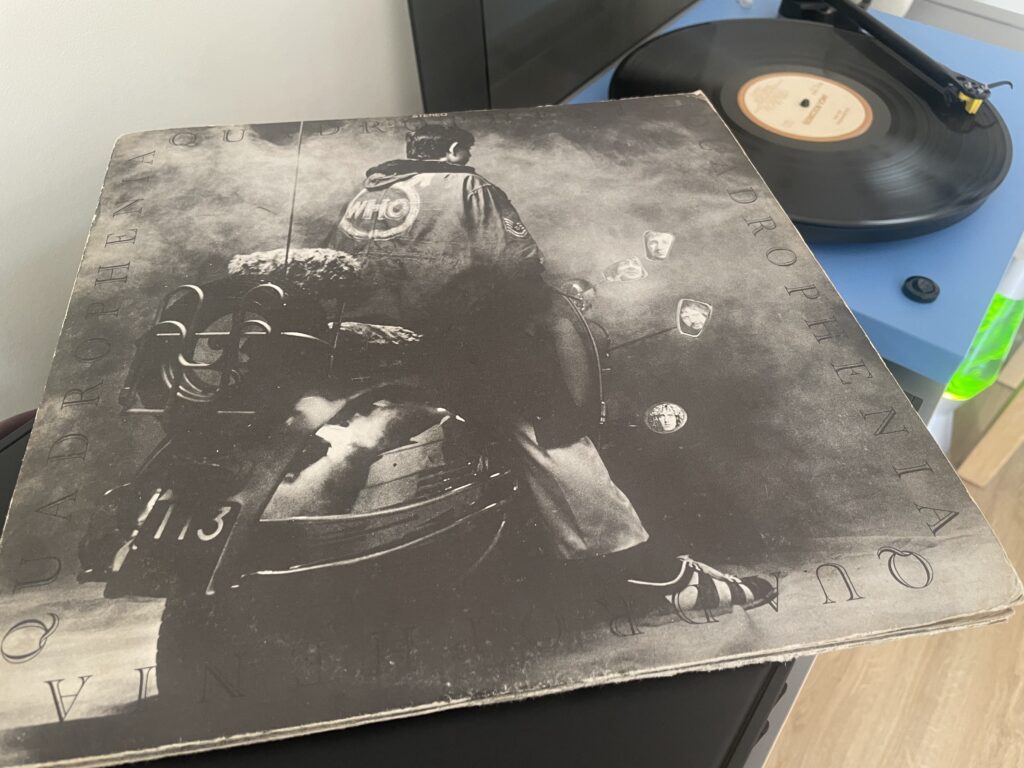
There is a particular kind of arrogance required to follow a masterpiece with an act of self-demolition, and Pete Townshend has never been short of it. By fifteen minutes into Quadrophenia, the listener has already been drowned, half deafened and abandoned on a rain-lashed beach with nothing but a scooter horn for company. That is precisely the point. This was never going to be a comfortable record, and comfort was never what The Who were selling. What they were selling, in the autumn of 1973, was a working-class boy’s nervous breakdown scored for a rock band that had, by its own reckoning, gone slightly mad trying to make it.
Released as a double album on 26 October 1973 on Track Records, Quadrophenia arrived heavy with expectation. Here was a band fresh from the twin triumphs of Tommy and Who’s Next, the former having invented the rock opera more or less by accident, the latter standing as the tightest, most muscular thing they had ever put on wax. Townshend, never a man to repeat a trick when a bigger one was available, decided the follow-up would be his masterwork: a return to the mod scene that had made The Who in the first place, told through the eyes of a fictional teenager called Jimmy Cooper, and structured around the idea that Jimmy’s cracked personality contained four distinct selves, one for each member of the group. It is a conceit so audacious it could easily have collapsed under its own cleverness. That it mostly doesn’t is the whole story of why this record still matters.
The Concept: A Mirror Cracked Into Four
The title itself is a piece of Townshend wordplay, a splicing of “schizophrenia” with the “quadrophonic” surround sound format the industry was flirting with at the time, itself never quite catching on the way stereo had. But the real meaning sits closer to home. Jimmy is a mod, one of the pilled-up, scooter-riding, sharp-suited kids who had swarmed Brighton and Margate a decade earlier, and his four warring facets are drawn directly from the four members of the band that made him. Daltrey supplies “a tough guy, a helpless dancer”. Entwistle is “a romantic”. Moon, inevitably, is “a bloody lunatic”. Townshend himself settles for “a beggar, a hypocrite”, which tells you rather a lot about how the album’s author saw his own contribution to the story.
Townshend later called it “a sort of musical Clockwork Orange”, and there is something of Alex’s alienation in Jimmy’s arc: a lad chewed up by dead-end work, indifferent parents, a girl who prefers his best mate, and a subculture that promises belonging and delivers only another set of rules to break against. Set explicitly in London and Brighton in 1965, the record trades on the mods and rockers riots that had scandalised middle England the year before, using that moral panic as the backdrop for a story that is really about something much smaller and much more universal: a boy who cannot work out who he is, surrounded by people who claim to know exactly who they are and are almost certainly lying.
What separates Quadrophenia from Tommy is that Townshend was no longer working in symbolism and pinball metaphor. He was writing what he knew. This was his own adolescence, transplanted onto a fictional narrator, full of purple hearts necked on a Brighton-bound train, of humiliating scenes at the family dinner table, of a scooter wrecked in a fit of self-disgust and a final, ambiguous reckoning on a rock out at sea. The record ends not with resolution but with a kind of exhausted clarity, Jimmy stripped of his parka, his pills and his illusions, asking only to be washed clean by something bigger than himself. Whether he lives, dies, or simply grows up is left deliberately unresolved, which is more or less the correct way to end a story about being seventeen.
Production: Chaos in Battersea
The making of Quadrophenia is as much a part of its legend as anything printed on the sleeve. Work began as early as May 1972, but was repeatedly derailed. Entwistle and Daltrey were off making solo records, Moon was distracted by film work, and Townshend himself had a failed multimedia project called Lifehouse still smouldering in the background, its wreckage supplying several of the songs that would eventually surface here. When serious sessions resumed in the summer of 1973, the band’s own new studio, a converted building on Thessaly Road in Battersea nicknamed The Kitchen, was still a building site, plaster dust and all. The solution was to wheel in Ronnie Lane’s Mobile Studio and use it as a makeshift control room while the walls went up around them, which gives you some idea of the seat-of-the-pants energy that runs through the finished record.
Engineering fell to a young American named Ron Nevison, hired more or less by accident and kept on because the band liked what they heard. It was, by his own account, easily the biggest and most technically demanding session he had worked on, and it shows: this is an album stitched together from multi-track synthesiser sequences, sound effects lifted from crashing waves and pouring rain, and a wall of overdubbed brass, all of it performed by Entwistle himself, who by all accounts simply picked up a French horn and got on with it. The band had originally hoped to mix the whole thing in true quadrophonic sound, hence the title, but the format’s technical limitations in 1973 meant the ambition was quietly abandoned in favour of an unusually wide and detailed stereo mix instead. It remains one of the most sonically ambitious rock records of its decade, layered and cinematic in a way few guitar bands were even attempting.
Behind the desk, the record marks a genuine fracture. Kit Lambert, the band’s co-manager and the man who had shaped their sound and their sensibility since the mid-sixties, had drifted into addiction and irrelevance by this point, and his relationship with the group broke down for good during these sessions. He was gone from their day-to-day affairs by the time the album reached the shops, though he retained an executive producer credit as a formality. It is tempting, and probably not wrong, to hear some of the record’s themes of betrayal and abandoned mentors as bleeding directly out of that collapsing relationship. The Who, in other words, made a self-produced record about a boy losing faith in the adults around him while quietly losing faith in one of their own.
There is one more piece of production trivia worth dwelling on, and it says something about how records were actually consumed in 1973 rather than how we imagine they were. The original pressing was what the trade called an auto-coupled release, meaning the two discs were not sequenced the way a listener might expect. Record one carried sides one and four, while record two carried sides two and three, an arrangement that looks like a pressing plant error until you remember the record changer, that now-vanished piece of hi-fi furniture with a fat spindle capable of stacking several LPs at once. Load record one onto the spindle followed by record two on top, and the mechanism would drop and play side one, then side two, in correct running order, without anybody needing to get up. Flip both discs over together and sides three and four would follow in the same fashion. It meant a single owner with a decent changer, or two mates each bringing a copy round, could in theory let the whole eighty-one minute story unfold uninterrupted, an oddly appropriate bit of engineering for a record so preoccupied with continuity and character. It also explains why generations of vinyl collectors, encountering an original Track pressing for the first time and finding sides one and four sharing a disc, have assumed for a moment that they have stumbled on a factory mispress rather than a perfectly deliberate piece of 1973 thinking.
The Personnel: Four Men, Playing Themselves
If Tommy had been Townshend’s story told through the band, Quadrophenia is the band telling Townshend’s story about themselves, and every player rises to the size of the task.
Entwistle’s playing throughout is extraordinary, not least on the opening salvo “The Real Me”, which he has described as essentially a bass solo with vocals attached, and it is hard to disagree. It stands as one of the great recorded bass performances in rock, muscular and melodic at once, and it sets the tone for an album on which “The Ox” is arguably the single most important instrumentalist in the room. His brass arrangements, all performed and overdubbed by himself, give the record its widescreen, almost orchestral quality.
Moon, for his part, delivers what would prove to be his last truly focused studio performance with the band, chaotic and thrilling in equal measure, a man playing as though the kit might escape him at any moment, which by 1973 it very nearly could. Daltrey, so often accused across the band’s catalogue of merely delivering Townshend’s words, finds the role of his career here, particularly on the closing “Love, Reign o’er Me”, where he pushes his voice to a raw, torn extreme that remains one of the definitive vocal performances of the entire classic rock era. And Townshend, credited as sole writer of every note and word on the album, a first and only occurrence in the band’s catalogue, plays guitar with a controlled fury throughout while quietly running the whole ambitious apparatus of synthesisers, orchestration and structure from behind the scenes. He would later call it the best music he had ever written, and on his own instrument’s evidence, it is hard to argue.
The Songs: Seventeen Tracks, One Long Exhale
Across four sides and more than eighty minutes, the record moves with a cinematic patience that rewards, and frankly demands, a single uninterrupted sitting. The opening instrumental collage, “I Am the Sea”, drifts in on surf and gull cries before dissolving into snatches of the four character themes that will recur throughout, “Love, Reign o’er Me”, “Helpless Dancer”, “Bell Boy” and “Doctor Jimmy”, planted here like seeds that will not fully flower for another eighty minutes. It is a device lifted straight from film scoring, and it works.
“The Real Me” then detonates the album proper, all coiled fury and domestic frustration, before the record settles into its narrative stride: the wounded nostalgia of “Cut My Hair”, the desperate pill-popping travelogue of “5:15” as Jimmy rides the train to Brighton, the aching, semi-autobiographical “I’m One”, and the extraordinary “The Rock”, an instrumental piece so densely orchestrated it could stand as a symphonic movement in its own right. “Bell Boy” gives Moon his moment in the narrative spotlight, playing the washed-up former mod hero Ace Face now reduced to fetching towels at a seafront hotel, a piece of very English, very bitter irony about what happens to youth movements once the youth grows up. “Drowned”, written originally as a devotional piece for Meher Baba before being repurposed for Jimmy’s near-suicidal despair, remains one of the rawest, least ornamented things here, and arguably the most purely felt. It all resolves in “Love, Reign o’er Me”, a genuine peak of the entire rock opera form, Daltrey’s voice cracking open over Townshend’s piano and strings in a moment of catharsis that has lost none of its power in fifty years of imitation.
Reception: A Nation Struggling to Keep Up
Critical response on first landing was broadly enthusiastic, if occasionally bewildered by the sheer scale of the thing. Newsweek’s Hubert Saal placed it among rock’s great milestone records. Melody Maker’s Chris Welch called it a masterpiece, the Who at their absolute peak, “sap flowing from the roots of their creation”. Within NME’s own pages the following year, Nigel Rogers went further still, hailing it as the greatest exposition of the rock and roll ethic yet committed to vinyl, a judgement plenty of readers at the time would have thought overblown and which fifty years of hindsight has done nothing to disprove. Rolling Stone’s Lenny Kaye offered the more ambivalent, and in retrospect the more accurate, verdict: The Who at their most symmetrical and most cinematic, and also their most maddening, an album whose ambition occasionally outran its own listenability.
Commercially it did rather better than the reviews suggested it might, going gold on the day of release and platinum within forty-eight hours, eventually reaching number two on both the UK and US album charts, the band’s highest ever placing in America, kept off the top only by Elton John. The touring party that followed was, by every account including Townshend’s own, a genuine disaster. The backing tapes required to reproduce the synthesiser and sound effect parts live were unreliable to the point of sabotage, and the Newcastle date that November ended with Townshend hauling his sound engineer bodily across the mixing desk before smashing his own guitar in fury when the tape sync failed yet again during “5:15”. By February 1974 the band had quietly dropped most of the album from the set. It would be twenty-two years before they attempted it properly again.
Legacy: The Long Afterlife of a Mod Kid
If the initial tour was a wound, the years since have more than healed it. The 1979 film adaptation, directed by Franc Roddam and featuring a young Sting as the doomed Ace Face, arrived at the precise moment of Britain’s mod revival, and did more than perhaps anything else to cement the album’s mythology, dragging the whole story to a new generation of parka-wearing scooter kids who had been in short trousers first time round. Townshend himself has been unambiguous about where it sits in the band’s story, telling NME in 2011 that he had come to regard Quadrophenia as the last truly definitive Who album, the point at which the story, and perhaps the band itself, effectively ended.
It has since taken its place, with little serious argument, among the small handful of rock operas that actually work as records rather than curiosities, name-checked by everyone from Q magazine’s list of the hundred greatest British albums to Rolling Stone’s five hundred greatest albums of all time. The Who returned to it properly in 1996 for a one-off Prince’s Trust performance, then again on a dedicated 2012 to 2013 world tour performing the album in full, and a 2011 Director’s Cut box set unearthed Townshend’s original home demos, revealing just how much careful editing turned a sprawling autobiography into something closer to disciplined cinema.
Fifty years on, what still strikes hardest about Quadrophenia is not its scale, though the scale remains genuinely startling for a band working with 1973 technology in a half-built Battersea studio, but its honesty. This was four men in their late twenties writing about being seventeen and getting it exactly, uncomfortably right: the pills, the parkas, the pack mentality, the sudden lonely comedown on a rain-swept rock when the tribe has scattered and there is nobody left to impress. Jimmy never quite finds himself. Neither, in the end, did the mod movement that spawned him. But the record that tells his story remains one of the very few genuine peaks British rock has ever reached, and it has lost none of its nerve in the telling.
Steve Coulter writes on pop art, punk culture and the music that made them at 45renegade.co.uk.