This Blondie Parallel Lines review comes forty-eight years after the album first appeared in the U.K. It is a record I have lived with for most of my life. It follows a band that began before Punk in the cheap rooms of downtown New York, took a wrong turn or two, found an audience in Britain and then made one of the great pop albums of the decade with a producer who wrote hits for glam rock bands. It also covers the disco single that upset the punk purists, the iconic striped sleeve the band did not want, and the dirty shoes.
45renegade Long Reads
Blondie, Parallel Lines (Chrysalis, 1978)
Chrysalis released Parallel Lines on 8 September 1978. By then Blondie had made two albums, moved labels and changed line-up. They also had a big hit in Britain that America had mostly ignored. What they made next sold in the millions. It took the speed and noise of downtown New York punk and gave it proper choruses.
Downtown
Debbie Harry was born in Miami in 1945, adopted as a baby and raised in New Jersey. By the early 1970s she had sung in a folk-rock group, the Wind in the Willows, waited tables at Max’s Kansas City and spent a spell as a Playboy Club bunny. In 1973 she joined a girl trio called the Stilettos and met the guitarist Chris Stein, a Brooklyn art school graduate. They became a couple and a songwriting partnership. By 1974 the Stilettos had become Blondie, named after the catcalls Harry got from passing truck drivers.
Drummer Clem Burke, bassist Gary Valentine and keyboard player Jimmy Destri completed the first proper line-up. They played the same rooms as the Ramones, Television, Talking Heads and Patti Smith: CBGB and Max’s. They did not fit neatly. Most of that scene sold aggression or art. Blondie sold tunes. Their reference points were girl groups like the Shangri-Las, surf instrumentals, bubblegum pop and cheap science fiction films. Harry, with her cropped platinum hair and cool delivery, looked like a 1950s film star who had wandered into a fight. The band pushed back on the pin-up treatment with badges and T-shirts reading “Blondie is a group”.
Two albums and a contract problem
The debut, Blondie, came out in December 1976 on Private Stock. Richard Gottehrer, who had co-written “My Boyfriend’s Back” in the 1960s, produced it. The songs (“X Offender”, “In the Flesh”, “Rip Her to Shreds”, “Kung Fu Girls”) sounded like sixties pop played at punk speed and with a wink. American sales were modest. Australia reacted differently. After the TV show Countdown picked up the clip for “In the Flesh”, it became a major hit there.
The relationship with Private Stock soured, and in 1977 Chrysalis, run by Terry Ellis and Chris Wright, bought out the contract. Valentine also left that year. Frank Infante and Nigel Harrison arrived, and Blondie became a six-piece.
Plastic Letters followed in February 1978. It is an uneven record, with the sound of a band that had to deliver an album quickly. Two singles saved it. “Denis” was a 1963 song by Randy and the Rainbows, refitted with a bit of Harry’s French, and it reached number two in Britain. Valentine’s “(I’m Always Touched by Your) Presence, Dear” got to number ten. The album made number ten in the UK and only 72 in the US. It was clear which country was paying attention.
Britain
The British connection began before Plastic Letters. In March 1977 Blondie toured the UK supporting Iggy Pop, with David Bowie playing keyboards in Iggy’s band. British music papers were already friendly. British pop audiences, raised on glam and the three-minute single, understood a band that mixed guitars with hooks. On Top of the Pops Blondie were pop stars. In New York they were still a cult act.
Britain gave them what their home city had not: hit singles and a fanbase that treated them as a chart group without any embarrassment. The gap between what the band wanted to be and how much of the American industry saw them was the problem the next record had to solve.
Enter Mike Chapman
Chrysalis wanted a producer who knew how to make hits. Manager Peter Leeds and the label steered Mike Chapman towards the band. Born in Nambour, Queensland, Chapman had moved to London in the 1960s and teamed up with Nicky Chinn. Their songs for Sweet (“Blockbuster”, “Ballroom Blitz”), Suzi Quatro (“Can the Can”) and Mud (“Tiger Feet”) were built on stomping rhythms and choruses a whole playground could shout. By 1978 Chapman was producing in America, with hits for Exile (“Kiss You All Over”) and Nick Gilder (“Hot Child in the City”).
The match was not welcomed by everyone. Clem Burke was keen, but Debbie Harry knew Chapman only by reputation and was wary. Chapman put it down to geography: they were New York and he was LA. Her doubts faded once she played him early versions of “Heart of Glass” and “Sunday Girl” and he liked what he heard. The sessions began at the Record Plant in New York in late June 1978, so the British link is Chapman’s pedigree and the UK audience that had already made the band’s case.
By his own account, the band’s playing was poor when rehearsals for the album began, and he told them they would have to play better. He wanted tight, precise playing, clean arrangements and nothing that drifted. That suited Burke, a Keith Moon devotee whose drumming is busy but well controlled here. Chapman did not sand the band down into something polite. The guitars are still loud and the tempos still fast. What changed was focus. Every track has a job, a hook and a finish.
The record
Side one. “Hanging on the Telephone” opens the album. It is a cover of a song by the Nerves, written by Jack Lee, and Blondie turn it into a two-minute jolt that works as a mission statement. Harry sounds bored and desperate in the same breath, and the drums do the shouting.
“One Way or Another”, credited to Harry and Harrison, is the album’s best-known cut after the singles. Harry has said it was inspired by an ex-boyfriend who would not leave her alone, and the mix of menace and fun explains why crowds still love it. “Picture This” is straight pop with a tune you can hum after one listen, and it reached number twelve in the UK.
Then the record gets stranger. “Fade Away and Radiate”, written by Stein, is slow and eerie, with guest guitar from Robert Fripp of King Crimson. It shows that the band could hold a mood as well as a beat. “Pretty Baby” is bright and wry. “I Know but I Don’t Know” is Infante’s song, sung as a duet with Harry. It is the plainest rock track on the record, and the weakest link on side one, though it is competent and sits well in the running order.
Side two. Destri’s “11:59” is fast and tight, with his keyboards driving the chorus. Jack Lee returns with “Will Anything Happen?”, a nervous, jumpy track with a lot of tension. “Sunday Girl”, written by Stein, is the gentlest of the singles. It is wistful, bouncy and immediate, and it gave the band another British number one in 1979.
Then comes “Heart of Glass”, which needs its own section.
“I’m Gonna Love You Too” is a Buddy Holly cover, a nod to the 1950s roots that ran through the whole band. The closer, “Just Go Away”, is short, brisk and hard. It lands like a door slamming, and that is the right way to end an album that never outstays itself. The whole thing runs about thirty-nine minutes.
The disco song
Blondie wrote “Heart of Glass” around 1974 and 1975 under the title “Once I Had a Love”. Fans and bootleggers called it “the disco song”. Early versions were slower and looser. By 1978 disco was everywhere, and New York, Studio 54 included, was its capital. Blondie’s downtown peers tended to treat it with suspicion.
Chapman pushed the band to finish it as a dance record. The reference points were Kraftwerk and the work Giorgio Moroder did with Donna Summer. The track uses a Roland CR-78 drum machine, Destri’s synthesisers, chiming guitar and a cool, almost robotic vocal from Harry, with Burke playing to the machine’s pulse. It is precise and slightly chilly, and that is its strength. The lyric is about a love gone wrong, and the mechanical rhythm makes the sadness sharper.
Some fans took the disco turn as a betrayal of punk. The record-buying public did not. “Heart of Glass” reached number one in the UK and then in the US. The Disco Demolition Night riot in Chicago in July 1979 shows how hostile some rock fans were to the genre, so the band took a real risk. It paid off, and Blondie kept working with dance music. “Call Me” (1980) was a Moroder collaboration, and “Rapture” (1981), with its rap verse, became the first US number one to feature rapping.
The sleeve
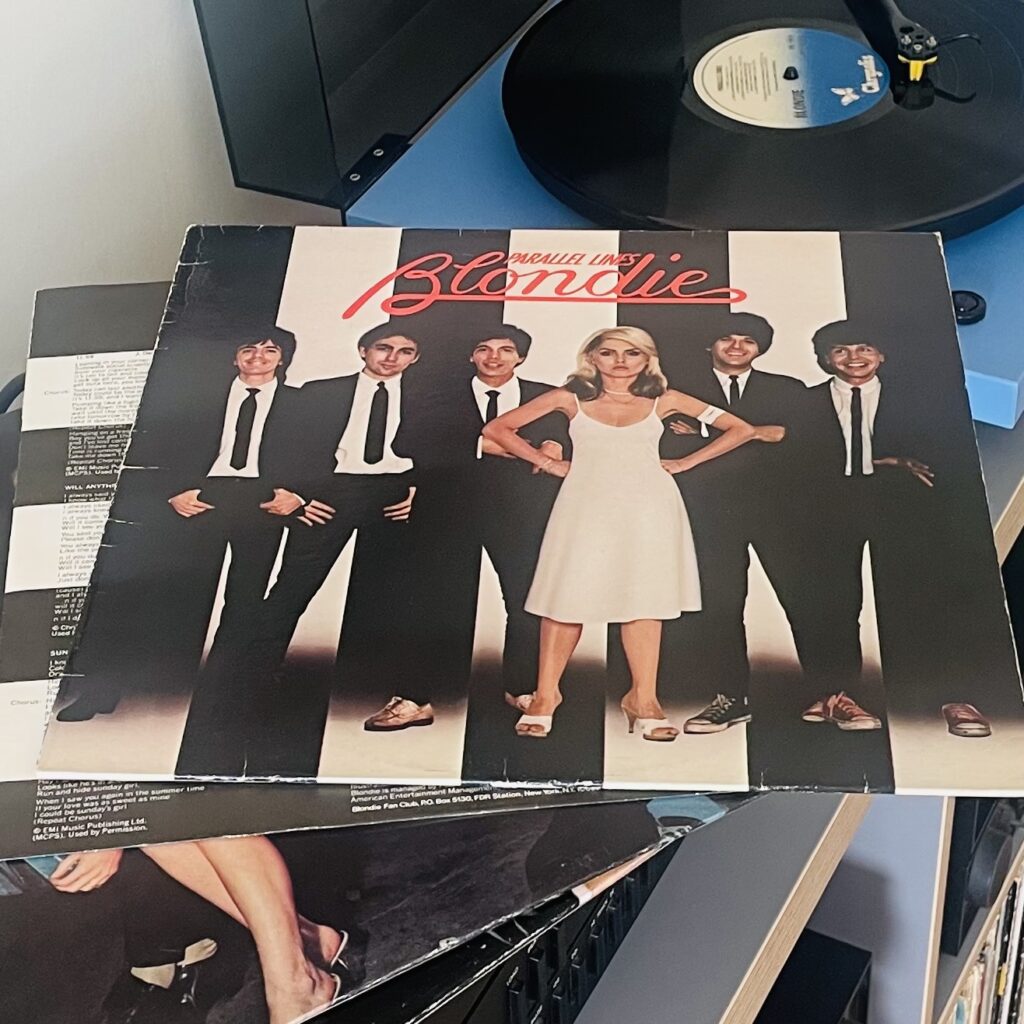
The cover is almost as well known as the songs. The photographer was Edo Bertoglio, hired by Roberta Bayley, the New York punk scene’s unofficial house photographer. Bertoglio came from Warhol’s circle. Ramey Communications handled the art direction and design, with lettering by Jerry Rodriguez and illustration by Frank Duarte. The background is a set of black and white stripes, and the red title text is the only part of the image that is not black and white (apart from a subtle dark tint of a pair of red Converse). Five men in dark suits and thin ties stand in a line, and the ties echo the stripes. Harry stands at the centre in a white dress and heels, hands on hips, without a smile. On the reverse Debbies heels are replaced with facsimile teal boots.
The stripes solved a practical problem. With the band at odds, manager Peter Leeds has said he could not get a usable group photograph, so each member was given their own black or white stripe and photographed separately. The band were told they could choose their own frames, but Leeds picked the single shot in which the men grin behind a stern Debbie. Harry recalled the shock of finding the artwork finished without the band’s approval, and Chris Stein said they had wanted to look more rock and roll. The cover also reflected Leeds’s view of the group. He saw Blondie as Debbie Harry with a band, which neither she nor the band wanted, and the sleeve became a symbol of manipulation that helped end his time as manager. Harry has never rated the design.
The title itself came from an unused song by Harry, whose lyrics were printed on the first vinyl release, a neat little trivia piece.
Then there are the shoes. The back sleeve photographs each member’s footwear. Burke wears Converse in a different colour on each foot, and Harrison wears Converse with Mr Spock socks. One writer calls the casual shoes the only clue that the band are not quite what the suits suggest. Sneakers were normal wear around CBGB, so the scene link is there. The suits and the smiles were not the band’s choice, though, and the shoes look like the one part of the shoot that stayed their own.
Reception and afterlife
The album took a while to catch fire. “Hanging on the Telephone” reached number five in the UK singles chart and “Picture This” number twelve, but the real lift came in early 1979, when “Heart of Glass” pulled the album to the top of the British chart. In the US it peaked at number six. Estimates put worldwide sales above 20 million, though the exact figure is disputed. It remains the band’s biggest seller and appears on best-of-decade lists with little argument.
Chapman went on to produce the follow-up, Eat to the Beat, in 1979. Warhol painted Harry in 1980, a fitting seal for a band that had always been half pop art.
Verdict
Parallel Lines works because nobody compromised. The punk edge stayed, and so did the pop instinct. Chapman did not tame Blondie. He gave them tools to make their strengths hit harder: sharper choruses, cleaner sound, faster edits. The record still has one or two lesser cuts, and “I Know but I Don’t Know” is the obvious one. Everything else earns its place.
It also solved the band’s problem. They had been a New York curiosity with a British hit. After this album they were a global act that had beaten the punk snobs and the disco snobs together. Forty-odd years on, it still sounds quick, sharp and unforced.
Personally
I have had a relationship with Blondie since early 1978, though obviously not an actual one. Debbie was just about old enough to be my mother, something a few people miss. It began when my friend bought Plastic Letters on the strength of “(I’m Always Touched by Your) Presence, Dear”.
I have earned coin from them since I was 15, probably paid in Mintola chocolate bars. I drew Debbie portraits for friends on the inside covers of exercise books, a five minute turn with a 2B pencil. More recently I made my own pop art piece, Cut Out & Keep Debbie, an imaginary 600mm NME front cover for the week Eat to the Beat went platinum in the UK.
I am an aficionado of anything NYC, CBGB, punk and new wave, and I have played my Blondie vinyl for nearly five decades. What’s your favourite Blondie track or album? Any other CBGBs bands rock your boat? Say hi on the socials IG @ 45renegade