In 1981 two men put preachers, exorcists and Lebanese singers over funk grooves and called it an album. Remain In Light is the Talking Heads album everyone knows. Byrne and Eno’s leftfield fork in the road My Life In The Bush Of Ghosts is the one you find later, on first play marvel at it’s creativity and recognise that nothing like it came before, only later. Same producer, a recognisable appetite for polyrhythm, recorded in the same window, but pointedly stranger. The ‘Heads built a groove and let Byrne’s nerves ride on top. Byrne and Eno gave the lead vocal to strangers: a preacher, a radio host, an exorcist, a Lebanese singer, a crowd of chanting Algerians.
There were no affordable samplers to hand, so every voice was lifted, looped and locked to the beat on tape. Three years later Art Of Noise would chase a similar idea with a Fairlight and a pop budget, and much of the decade, hip-hop included, would follow. What comes next is a look at why the partnership worked, what the record cost them, and why it still sounds like it is arriving rather than looking back.
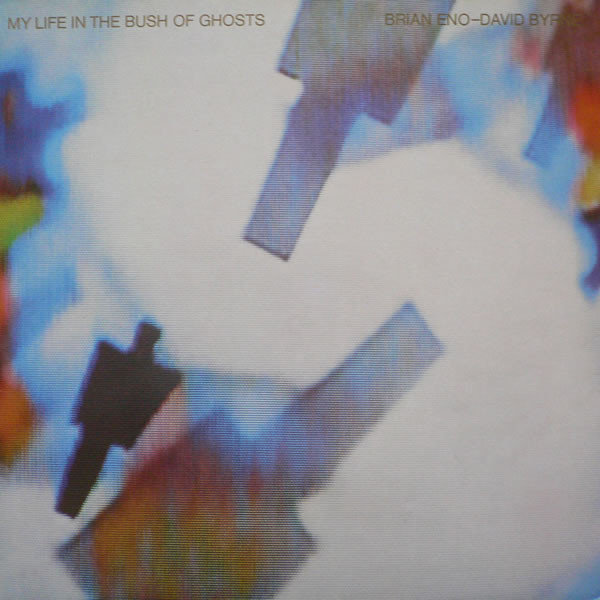
The fifth Talking Head steps sideways
By the end of the 1970s Brian Eno had a job title nobody had given him. Talking Heads fans called him the fifth Talking Head, and the band did little to argue. He had produced More Songs About Buildings And Food in 1978 and Fear Of Music in 1979, and he was about to produce the album that would settle his reputation with them, Remain In Light.
Between the second and the third, Eno and David Byrne slipped off to make something that was not a Talking Heads record at all.
The setting matters. Byrne was the nervous, wiry frontman of a New York band who had already worked out that he did not need to sound like a rock singer. Eno was the former Roxy Music synth player who had spent the decade making ambient records, producing Bowie and Devo-era oddities, and collecting ideas the way other people collect stamps. Both were bored by the standard shape of a song: verse, chorus, guitar solo, applause.
They shared a different appetite. They wanted to know what happened if the voice was not theirs.
Where it came from
Fear Of Music had already hinted at the plan. “I Zimbra”, with its borrowed Dadaist poem and its tangle of cross-rhythms, was a Byrne and Eno trial run for the jungle-funk they wanted to build properly. Eno had also been absorbing the work of trumpeter Jon Hassell, whose Fourth World idea mixed ancient and modern, East and West, and non-Western rhythms with electronic treatment. Byrne, meanwhile, was deep in African music, with Fela Kuti’s Afrobeat as a central touchstone.
Put those enthusiasms in one room and you get the method. Rather than write songs and then find a singer, they would find voices first. Preachers on American radio. A radio phone-in host. Algerian Muslims chanting. A Lebanese singer, Dunya Younes. They would lift those voices, loop them, and build rhythm tracks underneath until the borrowed words sounded like they had always belonged there.
The title comes from a 1954 novel by the Nigerian writer Amos Tutuola. Byrne said in his 2006 liner notes that neither of them had read the book. They liked the phrase, and felt it summed up what the record was about. That is a very Eno way to pick a title, and a very Byrne way to go along with it.
Why they gel
It is tempting to say Eno brought the textures and Byrne brought the hooks, and there is some truth in that. The pop pulse inside “America Is Waiting” and “Help Me Somebody” sounds like Byrne. The dense, shimmering weather inside “Mea Culpa” and “Regiment” sounds like Eno. But the split is too neat.
What actually made the pairing work is that their weaknesses cancelled out.
Eno, left alone, tends to drift towards the beautiful and the still. His ambient records are exquisite and they ask very little of the listener’s body. Byrne, left alone, tends towards the anxious and the intellectual, a man in a suit at a very odd party. Put the two together and the stillness gets a pulse, while the nerves get a larger room to move in.
There is also the matter of ego. Both men were willing to remove themselves from the centre. Eno described his role on this record as less of a singer and more of a curator. Byrne was equally content to let a stranger’s sermon do the lead vocal. Few frontmen would volunteer for that. It takes confidence to hand your album to an unnamed Reverend and trust it will hold.
The rhythm section helped. They brought in Bill Laswell and Tim Wright on bass, Chris Frantz and Prairie Prince on drums, Busta Jones, percussionist Steve Scales, and Robert Fripp on guitar. Frantz was, of course, also the Talking Heads drummer, and the result was a record that borrowed that band’s polyrhythmic ambition without borrowing the songs.
The record itself
The album opens with “America Is Waiting”, a radio host’s anger set to a clipped, nervy groove. It sounds like a news bulletin sliding into a dance floor. From there the strongest tracks are the ones where the voice and the rhythm lock together so tightly that you stop noticing the join.
“Help Me Somebody” is the neatest trick. A preacher’s plea is chopped and looped until he sounds like a soul singer working a hook. “The Jezebel Spirit” is more alarming. It takes a real exorcism on tape and treats it as raw material, with the possessed voice and the preacher’s commands pushed over a steady, unnerving beat. It remains hard to listen to without feeling that you have wandered into a room you were not invited into.
“Regiment” and “The Carrier” are where the Middle Eastern voice meets the funk, and they are among the most beautiful things either man has done. “A Secret Life” lets the weather in, and gives Eno his ambient moment before the record closes.
None of it sounds sampled in the modern sense. There were no samplers available to them in the usual sense. They worked with tape, edits and patience, and the joins are audible in a way that gives the record a hand-made, slightly haunted quality that clean digital work rarely achieves.
Late, and then troubled
The record was made mostly in the gap between Fear Of Music and Remain In Light, but it came out second. Remain In Light arrived in October 1980. My Life In The Bush Of Ghosts followed on 25 February 1981, delayed by several months while the pair chased clearances for the many voices they had borrowed.
The odd running order meant a side project landed after the band’s masterpiece, which is part of why people hear the two records as companions. Remain In Light was the last album Eno produced for Talking Heads in this period, and Byrne turned his attention back to the band after Bush Of Ghosts.
Then there was “Qu’ran”. The track set chanted verses from the Qur’an to music, and the Islamic Council of Great Britain objected, considering it blasphemous. Byrne and Eno pulled it from later pressings and replaced it with “Very, Very Hungry”. Byrne later said they had been feeling very cautious about the whole thing. The track was left off the 2006 expanded reissue as well, and without comment, which sits oddly with the album’s own history.
How it landed in 1981
The honest answer is: confusingly.
Talking Heads fans who bought it expecting more of the band’s brittle, bright funk found a record with almost no conventional singing. Rolling Stone’s Jon Pareles gave it real credit as a feat of tape editing and rhythmic invention, but he raised stubborn questions about borrowing from other people’s cultures and religious moments. He said the exorcism had been used for the duo’s own purposes and trivialised. That argument has never gone away, and I think it is fair to keep it in the room.
Others heard something else, and the album did build a following among people interested in tape work and non-Western rhythm. Jon Hassell himself was less pleased. By one account he found the album too commercial, and he was reportedly offended by the way Eno had applied what he had learnt from Hassell’s own work. Even a great creative partnership leaves some bruises on third parties.
On the charts, it was not a smash. It was a record that grew by reputation, not by sales.
What has emerged since
The long view has been kind. Hank Shocklee of the Bomb Squad has named it as an influence on the production work behind Public Enemy. Kate Bush has said it left a deep mark on popular music, and Pink Floyd’s Richard Wright recalled it knocking him sideways. The idea runs on from here to Art Of Noise, who in 1984 took cut-and-paste found sound to the pop charts with a Fairlight and a producer’s budget, and then on to hip-hop collage, trip-hop, DJ Shadow and the whole sample-based tradition. Art Of Noise had the better machines. Byrne and Eno had the idea first, and did it with tape and patience.
There is a legal footnote worth adding. When De La Soul’s early albums were stuck off streaming services for years, the cause was uncleared samples of well-known pop records, and a legal climate that turned harsh after the 1991 Biz Markie ruling. Byrne and Eno were not free of trouble. Their release was held up for months by clearances, and “Qu’ran” was pulled. But they started from a better position. Many of their sources were obscure recordings, including field and ethnomusicology records, they chased permission before release, and they got there before the lawyers had a precedent to wave. Crediting where possible helped, but it was the order of events, clear first and release second, that kept the record in print. Aggregate critic scores now sit in the high eighties.
In 2006 the album was reissued for its 25th anniversary with a remaster and seven previously unreleased tracks: “Pitch To Voltage”, “Two Against Three”, “Vocal Outtakes”, “New Feet”, “Defiant”, “Number 8 Mix” and “Solo Guitar With Tin Foil”. A film by Bruce Conner accompanied “Mea Culpa”. Reviewers were split on the extras. The more interesting move was a website where Byrne and Eno released the separate parts of “Help Me Somebody” and “A Secret Life” for anyone to remix. At the time that was a surprisingly early bet on open remix culture, and a few years ahead of where the industry was heading.
The pair have kept returning to each other. They made Everything That Happens Will Happen Today in 2008, an album of far more conventional songs. In November 2025 they released a new co-written single, “T Shirt”, with Dev Hynes on piano. This year Rough Trade included the album in its 50th anniversary vinyl series, which tells you where it now sits in the canon.
Verdict
Some albums win because they were right at the time. This one won because it was wrong in an interesting way, and then the world slowly caught up.
It is not an easy listen. It is not always a comfortable one either, and the questions about whose voices these were, and whether they were fairly used, are legitimate ones. But it remains the high point of the Byrne and Eno partnership, a record in which two clever, restless men found a way to disappear from their own music and let strangers do the singing.
You may think of yourself as a creative person until you set yourself beside Brian Eno. His real gift here was not playing or singing. It was knowing when to step back, hand the microphone to a stranger and let a tape loop make the decisions. Even he borrowed, as Jon Hassell’s grumbles remind us. The skill was in what he did with the loan.
Forty-five years on, it still sounds like a radio tuned to a station that does not quite exist yet.