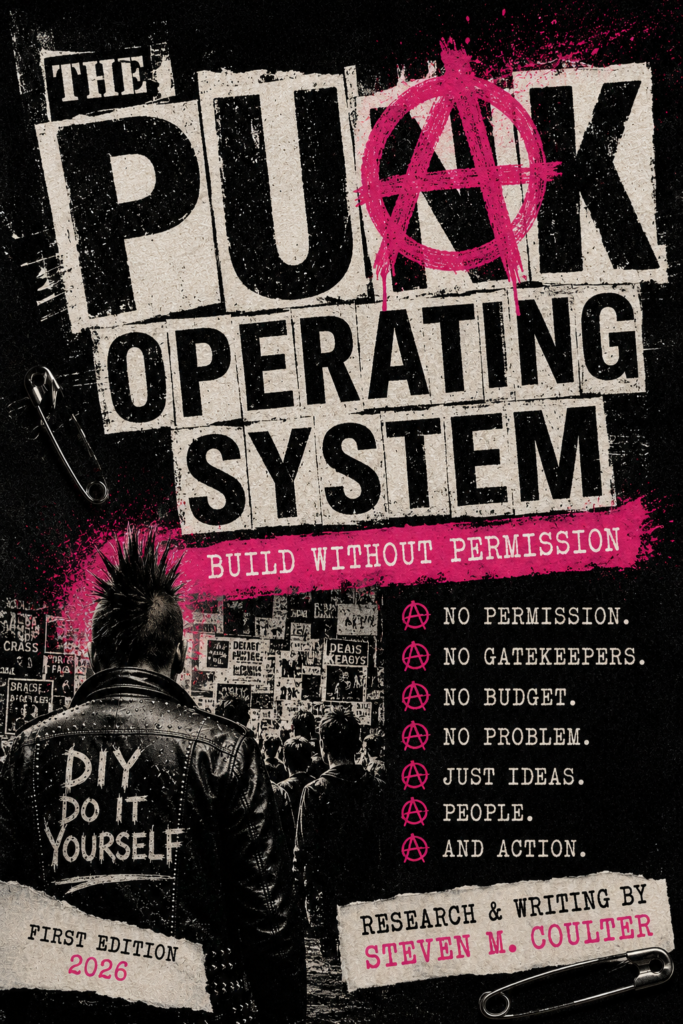
Punk was never just a sound. It was a working method.
No permission. No gatekeepers. No budget. Just ideas, people and action.
That is the thinking behind my new e-book, The Punk Operating System: Build Without Permission.
In the late 1970s the music industry was closed, expensive and slow. So punk built its own. Fanzines on borrowed photocopiers. Labels run from spare rooms. Shows in hired halls. Records sold by post. Independence was a practical decision, not a pose.
The same pattern keeps turning up in open source software, independent publishing and small business today:
▪ Self-sufficiency over waiting for approval ▪ Attention earned, not bought ▪ Community before scale ▪ Constraints as a method ▪ Ethics as limits, not slogans
This is not a history of punk, and it is not a how-to manual. It looks at how independence is built, what it costs, and when to walk away.
Ten chapters, with examples from Fugazi, Rough Trade, Linux, Patagonia and Craigslist.
If you are building something without anyone’s permission, this one is for you.
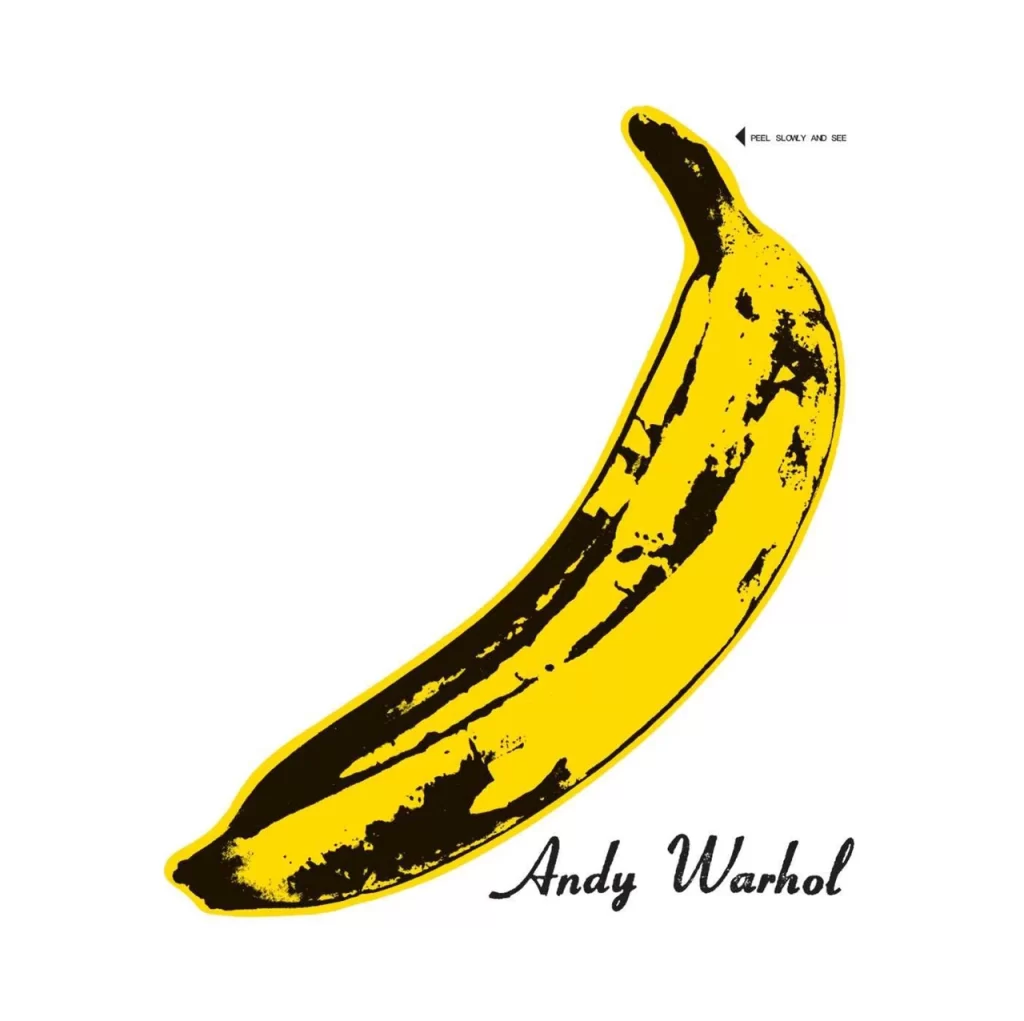
Hardly anyone bought it. The figure usually given is around 10,000 copies in the first year, which is a guess, but nobody disputes the estimate or relevance. The album crept to number 171 on the Billboard chart, sat there briefly and dropped away. Radio ignored it. With Sixties sensibilities some shops refused to stock it. It came out in March 1967, between Sgt. Pepper and the Monterey festival, and it was a record about drug dealers, sadomasochism and the grey misery of a Manhattan morning, with a banana on the front.
Brian Eno later said that everyone who bought a copy went off and formed a band. He was exaggerating, and he said it in an interview rather than carving it in stone, but the instinct was right. Bowie, Iggy Pop, Patti Smith, Television, the Ramones, Roxy Music, Joy Division, Sonic Youth, R.E.M. and the Jesus and Mary Chain all took something from it. Most of them heard it years late, from a second-hand copy or a friend’s older brother. The album did its work on a delay.
Four people and a loft
Lou Reed grew up in Freeport, Long Island, on doo-wop and rhythm and blues. At Syracuse University he studied under the poet Delmore Schwartz, who drank hard, talked brilliantly and told his students that writing mattered more than almost anything. Reed took that to heart. After graduating he landed a job at Pickwick Records, writing cheap imitation hits for budget compilations, often in an afternoon. People tend to forget this part. Reed could write a hook on demand, and the best songs on the album are proper pop songs that happen to be dressed in filth.
John Cale came from a Welsh mining village and trained as a classical violist and pianist. A scholarship took him to America, where he drifted into the New York avant-garde and ended up playing in La Monte Young’s Theatre of Eternal Music, a group that held single notes for hours. Cale arrived in rock with a head full of drones and no interest in the twelve-bar blues. He turned his viola into something closer to a ship’s horn, and it gave the band a sound that no one else had.
Sterling Morrison, an old friend of Reed’s from Syracuse, played guitar and is usually the one left out of the story. He shouldn’t be. Morrison’s lines wind around Reed’s rhythm playing with a calm precision, and they stop the noisier songs from falling apart.
Maureen Tucker was the last piece, and arguably the strangest. She played standing up, with mallets rather than sticks, on a bass drum laid on its side, and she hardly touched a cymbal. She never played a fill. Her beat just kept going, flat and insistent, like a pulse you couldn’t turn off. Drummers in the punk and indie scenes learned from her that leaving things out can hit harder than putting them in.
They called themselves the Velvet Underground after a trashy paperback about sexual subcultures that Cale had picked up off a pavement. Reed and Cale shared a cheap apartment on Ludlow Street on the Lower East Side. They rehearsed constantly, argued constantly and wrote about the life going on outside the window.
What they were writing about
Pop in 1966 was getting brighter. The Beatles were making Revolver. Brian Wilson was building Pet Sounds. Dylan had gone electric. California was filling up with flowers and long guitar solos. Reed wrote about scoring heroin.
“I’m Waiting for the Man” is a plain report of a white kid taking the train up to Harlem with twenty-six dollars. The piano pounds one chord over and over, and the band drives along like someone walking too fast through a street he doesn’t trust. Nobody in the song is a hero or a victim. Everyone just wants the afternoon to be over.
“Heroin” is harder to listen to. Reed doesn’t warn you off the drug and he doesn’t sell it to you either. The band speeds up and slows down with the rush, Cale’s viola screams, Tucker’s drums lurch ahead and fall back, and the whole thing ends up sounding like a person sinking and surfacing. It remains one of the most disturbing things ever recorded in a pop format, mainly because it keeps its opinions to itself.
“Venus in Furs” takes its title from Sacher-Masoch’s nineteenth-century novel. Cale’s viola drone gives it the sound of a ceremony held in a cellar somewhere in eastern Europe, and Tucker thumps out a slow march underneath. Fifty-odd years on it still sounds like it was made by people who had been told the rules and decided against them.
Then there is the other half of the record, which the reputation for decadence tends to bury. “Sunday Morning” opens the album with a celesta chime and a lullaby tune, sung by Reed in a voice that sounds tired and slightly nervous. “Femme Fatale” and “I’ll Be Your Mirror” are tender songs, sung by Nico, built from plain words and simple chords. “I’ll Be Your Mirror” in particular is about as direct a love song as any written in the sixties. It is often said to be about Nico herself, though Reed gave different answers at different times.
“Black Angel’s Death Song” is the oddity, a stuttering poem over a scraping viola that was apparently too much even for the club where they played it. “European Son” closes the record with a long, deliberately wrecked jam full of feedback and smashing glass, dedicated to Delmore Schwartz. It is a loud goodbye, and plenty of listeners still skip it.
The range is what makes the album. They could be vicious and gentle on the same side of the record, and they never apologised for either.
Warhol
By 1965 Andy Warhol was already famous. The soup cans and the Marilyns had made him the most talked-about artist in America, and his studio, the Factory, had become the place where painters, models, drag queens, poets, hangers-on and addicts mixed. Warhol wanted to try his hand at managing a band, partly out of curiosity and partly because it fitted his idea of art as something you could make in any medium.
The group was found playing at the Café Bizarre in Greenwich Village, where the film-maker Barbara Rubin took Warhol and his associate Paul Morrissey to watch them. A deal followed. Warhol would present the band as part of a travelling multimedia show called the Exploding Plastic Inevitable, a sensory assault of live music, projected films, strobe lights and dancers, with Gerard Malanga cracking a whip across the stage. It was designed to overwhelm, and it did.
Warhol’s actual contribution to the album is smaller than the legend suggests. He paid for the first recording sessions, which gave the band the freedom to work without a label breathing down their necks, and he lent them his reputation. He is credited as producer, but by most accounts he sat in the control room and said very little. The engineering was handled by Norman Dolph, and when Verve took on the record, Tom Wilson tidied the final mixes. Wilson had produced Dylan’s electric records and he knew how to get rough music onto vinyl without scrubbing out its character. He rarely gets the credit he deserves.
Warhol did make one decision that changed the group. He wanted a female singer, and he had a particular one in mind.
Nico
Christa Päffgen, known as Nico, was born in Cologne in 1938. She had modelled, appeared briefly in Fellini’s La Dolce Vita, and made a single produced by Jimmy Page. Her voice was low, flat and strongly accented, with a coldness that made every line sound like it was coming from the far end of a corridor. Reed, Cale and Morrison were not delighted to have her foisted on them, and Reed in particular resented the attention she attracted.
The pairing worked anyway. Her singing on “Femme Fatale,” “I’ll Be Your Mirror” and “All Tomorrow’s Parties” gave the record a ghostly counterweight to Reed’s street-level sneer. “All Tomorrow’s Parties” is the standout, a grand, slow piano figure over a hammering rhythm, with Nico delivering a portrait of glamour that sounds like a party and a wake at the same time. Warhol is said to have rated it as his favourite song by the group.
She left after this one record and went on to make a run of bleak, brilliant solo albums, several of them produced by Cale. Her work here is a large part of what gives the record its mood.
Making it
The recording was messy. The first sessions took place in April 1966 at Scepter Studios, a cheap and run-down place in Manhattan. The band got through a lot of material in a few days, including early versions of “Heroin,” “Venus in Furs” and “Waiting for the Man.” Some of those takes surfaced much later as bonus material, and they are worth hearing for their rawness.
The tapes then went west. Verve, part of MGM, took on the album and brought in Wilson, and a few tracks were recorded or redone in Los Angeles. “Sunday Morning” was written late, after the label asked for something that could be released as a single. It is slightly funny that one of the album’s gentlest moments exists because a record company wanted a hit.
The record was finished in 1966 and didn’t come out until March 1967. The delay had several causes: the label dithered, Verve was busy with Zappa’s Freak Out!, and there was a legal complaint from Eric Emerson, a Factory regular whose photograph appeared on the back of the sleeve. The first copies were pulled and the sleeve was altered. When the album finally arrived, nobody at the label put much weight behind it.
The banana
The cover is a Warhol design, and it is as simple as album covers get: a yellow banana on a white ground, with his signature across it. On the first pressings the banana was a sticker. Pull it off and you found a pink, flesh-coloured banana underneath, with the instruction “Peel slowly and see” printed beside it. It is a joke that doesn’t take long to land.
The sleeve was fiddly and costly to make, and it added to the delays. It also shaped how the album was received. The Warhol name sold copies to the art crowd and put off the rock audience, who took the record for a pretentious sideshow. The band’s name appeared in small type on the back, and Nico’s barely at all. Still, the image outlasted the sales figures. It is now one of the most reproduced sleeves in history, printed on bags and t-shirts and hung in galleries.
Why it didn’t sell
Bad timing counts for a lot. The album arrived in the middle of the psychedelic boom, when audiences wanted colour, optimism and big guitar jams, and it had nothing to offer them. Radio programmers found the subject matter unacceptable, and the label had no idea how to promote it. MGM was far more comfortable with jazz and middle-of-the-road pop.
Critics didn’t help. A few were kind, but many dismissed the record as noise or as an art-world stunt. Rolling Stone didn’t exist yet, so the kind of writing that might have explained the band had nowhere to appear. The live shows were famous in New York and baffling elsewhere, and touring the rest of America turned out to be difficult.
The band also fell apart internally. Reed and Warhol clashed, and by the end of 1966 the group had split from their manager. The follow-up, White Light/White Heat, came out in early 1968 and was louder and nastier, as if the band was deliberately closing the door on a wider audience. Cale was out by the end of 1968. The group carried on without him and made two much gentler albums, but the original line-up never recorded together again.
The long fuse
What saved the album was other musicians. Bowie got hold of an acetate through his manager in 1966 and was playing “I’m Waiting for the Man” on stage before the record had even come out. He kept the Velvets in his head for years, and in 1972 he co-produced Reed’s Transformer. Iggy Pop and the Stooges took the rawness. Jonathan Richman of the Modern Lovers worshipped the band. The New York punk scene of the mid-seventies, from Television to Patti Smith to the Ramones, treated them as ancestors. In Britain, Roxy Music, Siouxsie and the Banshees, Joy Division and later the Jesus and Mary Chain all drew on the same combination of cold detachment, repetitive rhythm and noise.
The reasons are fairly simple. The record showed that you didn’t need virtuosity to make serious music. You needed three chords, a steady beat, something to say and the nerve to say it. For a teenager in 1976 with a cheap guitar and a bad attitude, that was permission.
The critical verdict has since turned all the way round. The album sits high on most greatest-ever lists, and Rolling Stone put it in the top twenty of its 2003 ranking. The Library of Congress added it to the National Recording Registry in 2006.
Sorting the legend from the facts
A few of the stories that cling to this album deserve a second look. Warhol is often described as its producer, which is true on the credits and not in the studio. The claim that nobody bought it overstates things slightly, since it did chart, though the sales were poor by any measure. The line about every buyer starting a band is Eno’s joke, repeated until it hardened into fact. And the idea that the band loathed Nico is too tidy. Reed in particular found her presence awkward, but they wrote some of their most beautiful songs for her, and the album would be much weaker without her.
One more point is easy to miss. The record wasn’t recognised as a classic in the seventies. Its standing built slowly through the eighties and nineties, as punk, post-punk and indie created an audience that already spoke the language.
Playing it now
Put the record on today and the first thing you notice is how little it sounds like 1967. Tucker’s drumming could sit on an album from any decade since. Cale’s viola still sounds odd. Reed’s lyrics are still blunt, and they still don’t flinch.
It isn’t an easy listen from start to finish, and it was never meant to be. The run from “Sunday Morning” to “Waiting for the Man” to “Femme Fatale” to “Venus in Furs” swings between tenderness and menace so quickly that it can feel like whiplash. “European Son” at the end is a test of patience. Stay with it anyway.
A few people in a rented loft, a rich patron with a taste for the odd, and a banana made a record that almost nobody wanted. Within ten years it was everywhere.
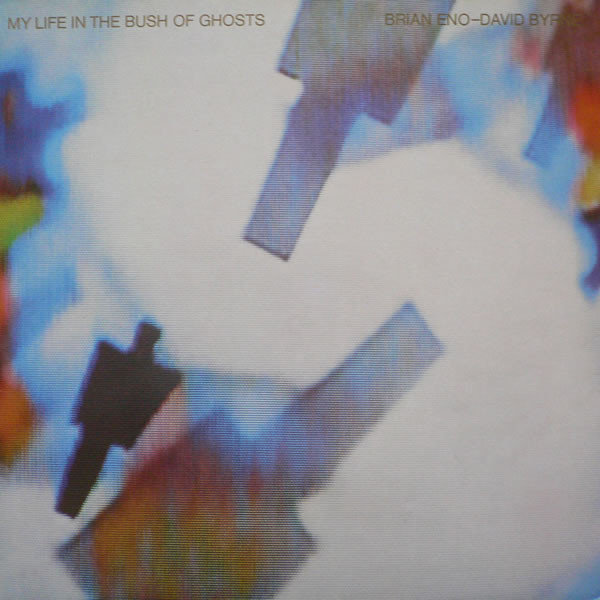
In 1981 two men put preachers, exorcists and Lebanese singers over funk grooves and called it an album.Remain In Light is the Talking Heads album everyone knows. Byrne and Eno’s leftfield fork in the road My Life In The Bush Of Ghosts is the one you find later, on first play marvel at it’s creativity and recognise that nothing like it came before, only later. Same producer, a recognisable appetite for polyrhythm, recorded in the same window, but pointedly stranger. The ‘Heads built a groove and let Byrne’s nerves ride on top. Byrne and Eno gave the lead vocal to strangers: a preacher, a radio host, an exorcist, a Lebanese singer, a crowd of chanting Algerians.
There were no affordable samplers to hand, so every voice was lifted, looped and locked to the beat on tape. Three years later Art Of Noise would chase a similar idea with a Fairlight and a pop budget, and much of the decade, hip-hop included, would follow. What comes next is a look at why the partnership worked, what the record cost them, and why it still sounds like it is arriving rather than looking back.
The fifth Talking Head steps sideways
By the end of the 1970s Brian Eno had a job title nobody had given him. Talking Heads fans called him the fifth Talking Head, and the band did little to argue. He had produced More Songs About Buildings And Food in 1978 and Fear Of Music in 1979, and he was about to produce the album that would settle his reputation with them, Remain In Light.
Between the second and the third, Eno and David Byrne slipped off to make something that was not a Talking Heads record at all.
The setting matters. Byrne was the nervous, wiry frontman of a New York band who had already worked out that he did not need to sound like a rock singer. Eno was the former Roxy Music synth player who had spent the decade making ambient records, producing Bowie and Devo-era oddities, and collecting ideas the way other people collect stamps. Both were bored by the standard shape of a song: verse, chorus, guitar solo, applause.
They shared a different appetite. They wanted to know what happened if the voice was not theirs.
Where it came from
Fear Of Music had already hinted at the plan. “I Zimbra”, with its borrowed Dadaist poem and its tangle of cross-rhythms, was a Byrne and Eno trial run for the jungle-funk they wanted to build properly. Eno had also been absorbing the work of trumpeter Jon Hassell, whose Fourth World idea mixed ancient and modern, East and West, and non-Western rhythms with electronic treatment. Byrne, meanwhile, was deep in African music, with Fela Kuti’s Afrobeat as a central touchstone.
Put those enthusiasms in one room and you get the method. Rather than write songs and then find a singer, they would find voices first. Preachers on American radio. A radio phone-in host. Algerian Muslims chanting. A Lebanese singer, Dunya Younes. They would lift those voices, loop them, and build rhythm tracks underneath until the borrowed words sounded like they had always belonged there.
The title comes from a 1954 novel by the Nigerian writer Amos Tutuola. Byrne said in his 2006 liner notes that neither of them had read the book. They liked the phrase, and felt it summed up what the record was about. That is a very Eno way to pick a title, and a very Byrne way to go along with it.
Why they gel
It is tempting to say Eno brought the textures and Byrne brought the hooks, and there is some truth in that. The pop pulse inside “America Is Waiting” and “Help Me Somebody” sounds like Byrne. The dense, shimmering weather inside “Mea Culpa” and “Regiment” sounds like Eno. But the split is too neat.
What actually made the pairing work is that their weaknesses cancelled out.
Eno, left alone, tends to drift towards the beautiful and the still. His ambient records are exquisite and they ask very little of the listener’s body. Byrne, left alone, tends towards the anxious and the intellectual, a man in a suit at a very odd party. Put the two together and the stillness gets a pulse, while the nerves get a larger room to move in.
There is also the matter of ego. Both men were willing to remove themselves from the centre. Eno described his role on this record as less of a singer and more of a curator. Byrne was equally content to let a stranger’s sermon do the lead vocal. Few frontmen would volunteer for that. It takes confidence to hand your album to an unnamed Reverend and trust it will hold.
The rhythm section helped. They brought in Bill Laswell and Tim Wright on bass, Chris Frantz and Prairie Prince on drums, Busta Jones, percussionist Steve Scales, and Robert Fripp on guitar. Frantz was, of course, also the Talking Heads drummer, and the result was a record that borrowed that band’s polyrhythmic ambition without borrowing the songs.
The record itself
The album opens with “America Is Waiting”, a radio host’s anger set to a clipped, nervy groove. It sounds like a news bulletin sliding into a dance floor. From there the strongest tracks are the ones where the voice and the rhythm lock together so tightly that you stop noticing the join.
“Help Me Somebody” is the neatest trick. A preacher’s plea is chopped and looped until he sounds like a soul singer working a hook. “The Jezebel Spirit” is more alarming. It takes a real exorcism on tape and treats it as raw material, with the possessed voice and the preacher’s commands pushed over a steady, unnerving beat. It remains hard to listen to without feeling that you have wandered into a room you were not invited into.
“Regiment” and “The Carrier” are where the Middle Eastern voice meets the funk, and they are among the most beautiful things either man has done. “A Secret Life” lets the weather in, and gives Eno his ambient moment before the record closes.
None of it sounds sampled in the modern sense. There were no samplers available to them in the usual sense. They worked with tape, edits and patience, and the joins are audible in a way that gives the record a hand-made, slightly haunted quality that clean digital work rarely achieves.
Late, and then troubled
The record was made mostly in the gap between Fear Of Music and Remain In Light, but it came out second. Remain In Light arrived in October 1980. My Life In The Bush Of Ghosts followed on 25 February 1981, delayed by several months while the pair chased clearances for the many voices they had borrowed.
The odd running order meant a side project landed after the band’s masterpiece, which is part of why people hear the two records as companions. Remain In Light was the last album Eno produced for Talking Heads in this period, and Byrne turned his attention back to the band after Bush Of Ghosts.
Then there was “Qu’ran”. The track set chanted verses from the Qur’an to music, and the Islamic Council of Great Britain objected, considering it blasphemous. Byrne and Eno pulled it from later pressings and replaced it with “Very, Very Hungry”. Byrne later said they had been feeling very cautious about the whole thing. The track was left off the 2006 expanded reissue as well, and without comment, which sits oddly with the album’s own history.
How it landed in 1981
The honest answer is: confusingly.
Talking Heads fans who bought it expecting more of the band’s brittle, bright funk found a record with almost no conventional singing. Rolling Stone’s Jon Pareles gave it real credit as a feat of tape editing and rhythmic invention, but he raised stubborn questions about borrowing from other people’s cultures and religious moments. He said the exorcism had been used for the duo’s own purposes and trivialised. That argument has never gone away, and I think it is fair to keep it in the room.
Others heard something else, and the album did build a following among people interested in tape work and non-Western rhythm. Jon Hassell himself was less pleased. By one account he found the album too commercial, and he was reportedly offended by the way Eno had applied what he had learnt from Hassell’s own work. Even a great creative partnership leaves some bruises on third parties.
On the charts, it was not a smash. It was a record that grew by reputation, not by sales.
What has emerged since
The long view has been kind. Hank Shocklee of the Bomb Squad has named it as an influence on the production work behind Public Enemy. Kate Bush has said it left a deep mark on popular music, and Pink Floyd’s Richard Wright recalled it knocking him sideways. The idea runs on from here to Art Of Noise, who in 1984 took cut-and-paste found sound to the pop charts with a Fairlight and a producer’s budget, and then on to hip-hop collage, trip-hop, DJ Shadow and the whole sample-based tradition. Art Of Noise had the better machines. Byrne and Eno had the idea first, and did it with tape and patience.
There is a legal footnote worth adding. When De La Soul’s early albums were stuck off streaming services for years, the cause was uncleared samples of well-known pop records, and a legal climate that turned harsh after the 1991 Biz Markie ruling. Byrne and Eno were not free of trouble. Their release was held up for months by clearances, and “Qu’ran” was pulled. But they started from a better position. Many of their sources were obscure recordings, including field and ethnomusicology records, they chased permission before release, and they got there before the lawyers had a precedent to wave. Crediting where possible helped, but it was the order of events, clear first and release second, that kept the record in print. Aggregate critic scores now sit in the high eighties.
In 2006 the album was reissued for its 25th anniversary with a remaster and seven previously unreleased tracks: “Pitch To Voltage”, “Two Against Three”, “Vocal Outtakes”, “New Feet”, “Defiant”, “Number 8 Mix” and “Solo Guitar With Tin Foil”. A film by Bruce Conner accompanied “Mea Culpa”. Reviewers were split on the extras. The more interesting move was a website where Byrne and Eno released the separate parts of “Help Me Somebody” and “A Secret Life” for anyone to remix. At the time that was a surprisingly early bet on open remix culture, and a few years ahead of where the industry was heading.
The pair have kept returning to each other. They made Everything That Happens Will Happen Today in 2008, an album of far more conventional songs. In November 2025 they released a new co-written single, “T Shirt”, with Dev Hynes on piano. This year Rough Trade included the album in its 50th anniversary vinyl series, which tells you where it now sits in the canon.
Verdict
Some albums win because they were right at the time. This one won because it was wrong in an interesting way, and then the world slowly caught up.
It is not an easy listen. It is not always a comfortable one either, and the questions about whose voices these were, and whether they were fairly used, are legitimate ones. But it remains the high point of the Byrne and Eno partnership, a record in which two clever, restless men found a way to disappear from their own music and let strangers do the singing.
You may think of yourself as a creative person until you set yourself beside Brian Eno. His real gift here was not playing or singing. It was knowing when to step back, hand the microphone to a stranger and let a tape loop make the decisions. Even he borrowed, as Jon Hassell’s grumbles remind us. The skill was in what he did with the loan.
Forty-five years on, it still sounds like a radio tuned to a station that does not quite exist yet.
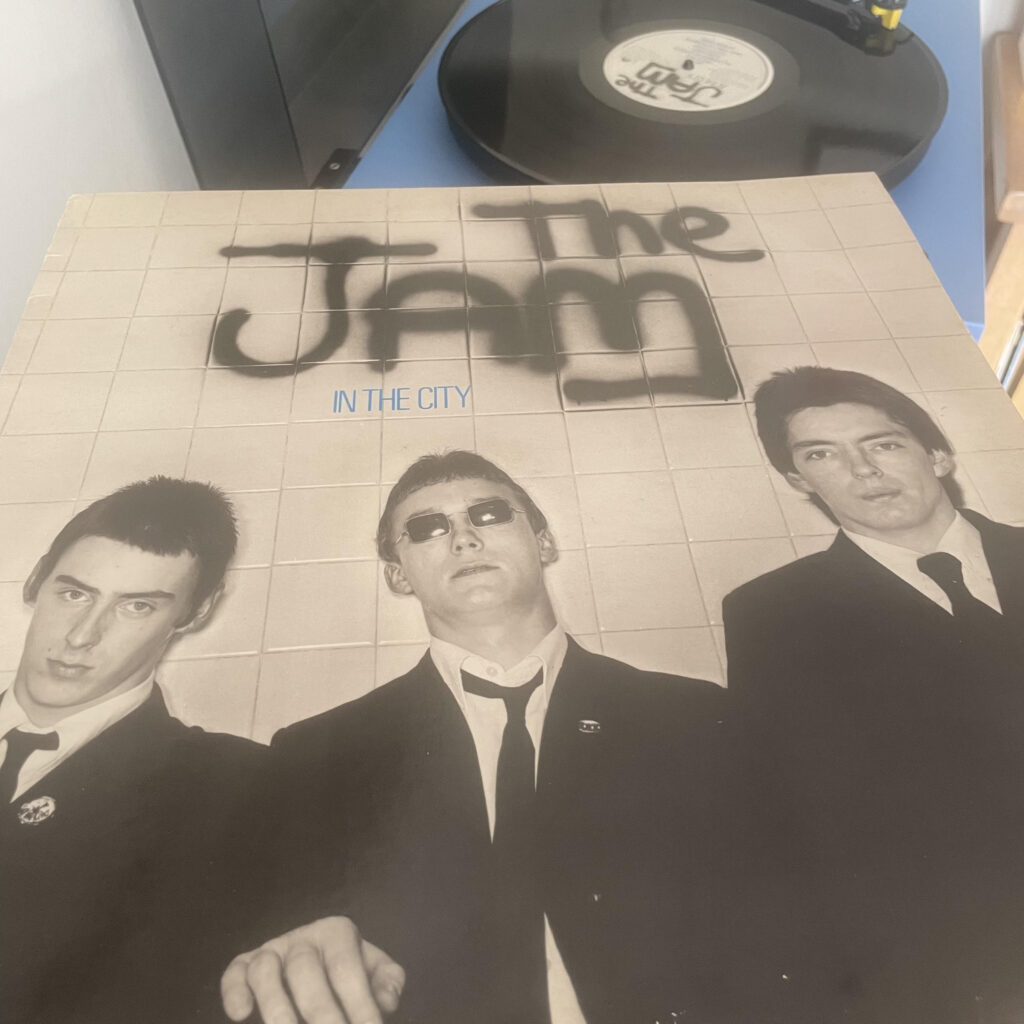
A deep dive retrospective into the debut album from Woking’s finest, The Jam. The politics, their suburban beginnings and the 1977 era of Punk Rock where they made their name with their own played-fast brand of Mod influenced New Wave. What self respecting chart obsessed 14 year old boy didn’t turn their school tie back to front after watching In The City on Top Of The Pops?
Britain, 1976 to 1977
Start with the weather. The summer of 1976 was the hottest anyone alive could remember. Reservoirs shrank, standpipes appeared in the street, and the government appointed a Minister for Drought. Within days of the appointment it rained. That is about as British as a national crisis gets, and it set the tone for a year in which very little went to plan.
Harold Wilson had resigned in the spring and left James Callaghan a country with high inflation, rising unemployment and a currency that kept sliding. By the autumn the Labour government was asking the International Monetary Fund for a loan and accepting the spending cuts that came with it. Unemployment was heading for the one and a half million mark, and school leavers were taking most of the hit. In August the Notting Hill Carnival ended in a riot. The National Front was getting bolder on the street, and the arguments about race that followed spilled into the music press and onto the stage.
For a sixteen-year-old in 1976 the message was plain. The jobs were going, the adults had no answers, and the music on the radio was Abba, Wings and a lot of Elton John. The bands that mattered to teenagers were mostly dinosaurs or exiles. Prog had run out of road. Glam had turned into cabaret. Pub rock was honest and hard-working, and it was also being played by men who looked like your dad.
Then the Sex Pistols swore on teatime television. On 1 December 1976 Bill Grundy invited them onto Thames Television’s Today programme, drew out a few four-letter words, and handed the tabloids a story that ran for weeks. Gigs were cancelled, councils passed bans, and EMI dropped the band within six weeks. In the same period The Damned put out “New Rose”, the first British punk single, and The Clash were rehearsing in a Camden warehouse. By spring 1977 the Silver Jubilee was coming, the Pistols had a single lined up that would make the Queen part of the argument, and punk had become a national row rather than a London fashion.
That is the world In The City was released into. Anyone who tells you it arrived at the start of punk has the dates wrong. It arrived at the moment the record industry finally decided to sign everybody.
Woking, and the boys who came out of it
The Jam did not come from Camden, the King’s Road or the Bromley Contingent. They came from Woking, a Surrey commuter town where people go to escape London and return to it every morning with a season ticket. Paul Weller grew up in a pebbledash semi with his father John, a builder and taxi driver who would become the band’s manager and, for a good few years, its unofficial fifth member and chief disciplinarian.
Weller met Steve Brookes and Dave Waller at school and the first version of the band came together in 1972, when Weller was fourteen. Rick Buckler, another Woking boy, joined on drums. Bruce Foxton arrived around 1973 and took over on bass, later than the others and a couple of years older than Weller. For much of the early period Foxton played lead guitar and Weller played bass. When Brookes left in 1976 the two swapped, and the line-up that would make the record was fixed: Weller on guitar and vocals, Foxton on bass and vocals, Buckler on drums.
What happened between 1972 and 1976 matters more than most punk histories allow. The Jam played for four years before anyone signed them. They did the working men’s clubs of Surrey and, with John Weller pushing the bookings, ventured north to the cabaret circuit, where a group of teenagers doing Motown and Who covers had to win over an audience that had come for the comedian and a plate of chicken and chips. In a 1970s club you either learned to hold a room or you went home. It gave them something the art-school punk bands mostly lacked, which was stamina and a habit of rehearsal. A cassette of their early practice sessions later turned up in Steve Brookes’s book Keeping the Flame, and it shows a young band that was serious about the work well before anybody was paying attention.
What they were listening to
Weller has always been open about it. The starting point was The Who, and specifically the My Generation album, which he found in the early seventies and treated as scripture. From there it ran outward to the Small Faces, The Kinks, early Beatles, Motown and Stax. He bought the clothes and the records and learned the songs. Around 1975 he saw Dr Feelgood, and Wilko Johnson’s fast, choppy, rhythm-and-lead-at-once guitar told him what was possible with one guitar and a very short temper.
None of this was fashionable in 1976. Mod was a memory, and most people under twenty did not care what kind of jacket a Small Face wore in 1966. The Jam looked odd to their own generation, and the punk audience could be hostile to a band in suits playing R&B. That was the tension the debut album carried. It sounded like punk in speed and volume, and looked and behaved like something older.
July 1976, and the trip to town
The turning point is easy to date. On 9 July 1976 Weller went up to London to see the Sex Pistols at the Lyceum, where they were third on a bill headed by the Pretty Things. He knew of them from the music press and wanted a look. He came home changed. Years later he summed it up plainly, saying there was a scene there and he wanted to be part of it. It explains most of the Jam’s next twelve months.
Woking had a stage. London had a scene. Weller started writing quicker, sharper songs about the town he lived in and the one he wanted to reach. He would tell Q magazine in 2011 that “In The City” was “a young man’s song, a suburbanite dreaming of the delights of London”. Read that back slowly, because it is the key to the album. A Londoner did not write about London this way. This came from a lad on the commuter train out of Woking who could not wait to get in.
Other accounts of the song add a further detail. Weller has said he wrote it after seeing the Pistols and The Clash, while in what he calls his Who phase. You can hear both in the record. The urgency belongs to the first two, and the chords and the harmonies belong to Pete Townshend.
Signing
The Jam worked London through the winter. They supported Wire at the Roxy in January 1977, an odd pairing that gives you an idea of how loosely the new bands were being grouped. On 22 January they played the Marquee as support to a group called Bearded Lady. In the audience was Chris Parry, a New Zealander and former drummer with the Auckland band The Fourmyula who had ended up as an A&R man at Polydor. Shane MacGowan, later of The Pogues, had told him to go and look.
Parry signed them within weeks. The terms were not generous. The advance was £6,000, with a royalty of six per cent, and the deal initially covered a single. Polydor soon took up an option that stretched the contract to four years and four albums. That is a lot of album for a band who had not made one. It is also the reason the group were in a studio while their contemporaries were still arguing with lawyers. According to one account, CBS’s chairman Maurice Oberstein phoned John Weller at the last minute with an offer said to be three times Polydor’s. By then Parry already had the band recording, and John Weller declined.
Parry is worth a paragraph of his own. He produced the first two albums alongside Vic Smith, who now goes by Vic Coppersmith-Heaven. He went on to found Fiction Records and sign The Cure. He was also, by most later accounts, the man who understood that the Jam were a pop group at heart and did not need to be pushed into being something angrier.
The sessions
The band cut demos in February, at a small studio in Soho by one account, and these were eventually released as The Polydor Demos in the reissue set. The album itself was recorded in March 1977 at Polydor’s own studio at 17 to 19 Stratford Place, off Oxford Street. It was done fast. Weller was eighteen. He would turn nineteen five days after the record came out.
Bruce Foxton’s memory of the sessions, given to MusicRadar years later, is refreshingly unmythologised. The album was more or less the live set, recorded live and played very quickly. He says you can hear it speeding up as it goes, and he adds that it does not matter, because the excitement was captured. He is right. The record’s biggest flaw and its biggest virtue are the same thing.
A reviewer at Sounds in 1977 wrote that the album sounded rushed, as though the band had been hurled into a studio before they were quite ready. The fairest reply is that they had. The songs were road-tested and the playing was tight. What was missing was time to shape the sound, and the result is a thin, trebly mix in which Buckler’s drums crash around at the front and Foxton’s bass does more of the melodic work than the mix admits. Punk records were being made quickly and cheaply that spring, and the label wanted the single out while the tour was on.
Release
“In The City” came out on 29 April 1977 and reached number 40. It is two minutes nineteen of tremolo guitar, a rolling bassline and a shouted chorus, and it got the group onto Top of the Pops. One retrospective claims the Jam were the first New Wave band to appear on the programme, which I would treat with care because several acts had a claim, but they were certainly among the first.
The album followed on 20 May and reached number 20. The timing tells its own story. The Damned had put out their debut in February. The Clash and The Stranglers released theirs in April, three weeks before the Jam. The Pistols would not get Never Mind the Bollocks out until October. So in May 1977, what the shops had was a run of debut records from London punk bands, and one from Woking that had a Batman theme on it.
The band had also joined The Clash’s White Riot tour from 1 May, though only for part of its run. It put them in front of the biggest punk crowds in the country, and it tied them to the scene in the eyes of the press.
The album
Side one opens with “Art School”, and if you want to understand what the Jam sounded like in the spring of 1977, play the first thirty seconds. It is guitar-led, fast and slightly messy in a way that is obviously intended. The Rickenbacker 330 that Weller played then has a jangle that no punk guitarist wanted, and he plays it like a stick. Foxton’s bass rides underneath. The sound is closer to 1965 than 1977 and much faster than either.
“I’ve Changed My Address” follows and keeps the pace, and then the record slows just enough for a cover of Larry Williams’s “Slow Down”, which The Beatles had also recorded. It is played straight, and you can tell the group regarded it as a favour to the ancestors. “I Got By in Time” is a solid tune that never quite finds the hook you expect from it.
“Away from the Numbers” is the first sign of the writer Weller was about to become. It is about not wanting to be counted, and in the way it moves between sections and leaves room for the bass it points to All Mod Cons rather than back to the pubs of Woking. Ceremony’s retrospective describes it as power chords fused with R&B melodies, and that is close. Side one closes with the theme from Batman, the 1960s television series, written by Neal Hefti. It is a throwaway and it is delivered as a throwaway. It is also a clue. A band at the front of punk who put the Batman theme on their debut are telling you they do not take the rules seriously.
Side two starts with the single. The introduction is Foxton’s bassline, arriving as a fast-moving pulse over which Weller’s guitar cuts in, and then the vocal enters with a lyric about uniformed men and the right to kill, a line that reads oddly now. It sounds like a protest and it works as one, though Weller was eighteen and was not writing a manifesto. The lyric’s real subject is the phrase “the young idea”, which is sung as the chorus and sounds like it came off a badge.
There is a footnote to the song that has become part of Jam folklore. The bass figure resurfaced a few months later on the Sex Pistols’ “Holidays in the Sun”. Weller has told the story of a run-in with Sid Vicious over it, and the accounts of who hit whom vary with the teller. Whatever happened, the resemblance is real, and it is a compliment.
“Sounds from the Street” and “Non-Stop Dancing” keep the momentum going. They are the least distinctive stretch of the album, quick and shouty, and the lyrics circle familiar territory of youth, noise and impatience. “Time for Truth” is the direct political song. Weller lines up the politicians for a kicking and does it in a way that sounds heartfelt and a little naive. It is worth knowing that around this time he told the NME that the band would vote Conservative at the next election. He changed his mind soon enough, and it is a useful reminder that in 1977 no one in the Jam had a settled politics, only a settled dislike of being talked down to.
“Takin’ My Love” shows the R&B and soul roots underneath the speed. “Bricks and Mortar” closes the record with a complaint about redevelopment, the spoiling of old streets by new concrete. It is the closest thing on the album to a preview of the songs he would write about Britain over the next five years, where the target was the whole country and not just the councils.
Twelve tracks, two covers, not much over half an hour. It does not outstay its welcome.
What it does well, and what it doesn’t
The strengths are energy, tunes and precision. The band is tight, and Buckler and Foxton in particular sound like a unit that has spent four years playing in rooms where mistakes are punished. The tunes are better than those on most punk debuts. The vocal is confident. Weller is a much more musical singer than the Pistols’ Johnny Rotten or The Clash’s Joe Strummer, and the harmonies with Foxton have a pop quality that was rare in the scene.
The weaknesses are equally clear. The production is thin. Some of the songs are filler, and one or two are pastiche. The lyrics are teenage in a way that Weller himself outgrew within twelve months. Most tellingly, the album shows a band still working out whether it is a punk group with mod tastes or a mod group with punk pace. The Who influence is so strong in places that some listeners at the time heard a tribute act, and the charge was not entirely unfair. It was a limited way of hearing it. A tribute band does not usually write “Away from the Numbers” or take an album to number 20.
Later views
Time has been kind to the record without turning it into a masterpiece. Fans tend to place it below All Mod Cons, Setting Sons and Sound Affects, which is where it belongs. Pitchfork reviewed it as part of the reissue programme. The 40th anniversary box set, 1977, was released in October 2017 and collected the album, its follow-up, the February demos, live recordings and the Peel sessions.
The band members have looked back on it with varying degrees of fondness. Foxton remains proud of it and talks warmly about the thrill of hearing the single in his local pub. He has also pointed out that the record company and the audience wanted a repeat, and that the group were already moving toward ballads and acoustic guitars when they made the next single, “All Around the World”. That single went to number 13 in July. The second album, This Is the Modern World, followed in November, only six months after the first and widely thought of as the rushed one.
Rick Buckler died on 17 February 2025. In later life he felt that Weller had been given too much of the credit for the band’s catalogue at the expense of the rhythm section. Listen to the record and the point is easy to accept. The drums on “In The City” do the work of pulling the whole thing forward, and Foxton’s bass is an equal partner. In 1977 they were the best rhythm section in the new bands, and they still sound like it.
Verdict
In The City is not the finest Jam album, and it is not a punk record in the way Never Mind the Bollocks or The Clash is. It is a small-town group taking its chance and taking it well. There are perhaps five genuinely excellent songs. There is a great single. There is a set of musicians who could play, and a teenager who was about to learn to write.
The best way to hear it is as a document of one moment: the spring of 1977, when the guitars were loud, the government was on its knees, and a lad from Woking with a Rickenbacker and a good haircut looked at the city on the horizon and decided to catch the train. It sounds like someone who has not been let down yet. Within two years he would be writing about buses, tube stations and the ordinary cruelty of British life, and the music would be far better. This record is where the lad from the suburbs starts.
Play it loud like you’re packed into the 100 Club for half an hour.
On 23 April 1976, Sire Records put out a 29-minute LP by four men from Queens who dressed alike, played fast and shared a surname that none of them was born with. It cost $6,400 to make. It reached number 111 on the Billboard chart, its singles missed the chart altogether, and radio mostly ignored it. Fifty years on, it is one of the most copied records in rock.
This piece looks at where the band came from, what New York was doing around them, how the album was made, whether it was the first punk album, and what happened when the Ramones flew to London in the summer of 1976 and met the people who would build British punk.
Forest Hills
The Ramones came from Forest Hills, a residential part of Queens, and the story starts with school friends. John Cummings and Thomas Erdelyi played in a garage band called the Tangerine Puppets in 1966 and 1967. They later got to know Douglas Colvin, who had moved to the area from Germany, and Jeffrey Hyman, who had been singing in a glam band called Sniper since 1972.
In early 1974 Cummings and Colvin asked Hyman to join them as drummer. Colvin wanted to sing and play guitar, and a friend, Richie Stern, was meant to play bass. After a few rehearsals it was clear Stern could not play bass. Colvin moved to bass and kept singing, Cummings became the only guitarist, and the band had a gap behind the kit. Erdelyi was acting as manager and kept sitting down to show auditioning drummers what he wanted. Eventually he took the stool himself. Hyman moved to the front.
The name came from a scrap of Beatles trivia. In the Silver Beetles days Paul McCartney checked into hotels as Paul Ramon. Colvin liked it, became Dee Dee Ramone, and the others followed: Johnny, Joey and Tommy. They were not related, but the fake family did the job. A gang with a uniform is easier to remember than four separate guitarists, and the matching leather jackets and torn jeans made the point before anyone heard a note.
What they listened to matters more than the name. The Stooges and the New York Dolls were in there, but so were girl groups, the Beach Boys, bubblegum and the British Invasion. Tommy Ramone later said “Judy Is a Punk” was built on Herman’s Hermits’ “I’m Henry VIII, I Am”. The Ramones did not reject pop. They stripped it to the frame and played it at speed.
They played their first show on 30 March 1974 at Performance Studios in Manhattan. The songs were fast and short, and most ran under two minutes.
The Bowery
Downtown Manhattan had two rooms that mattered: Max’s Kansas City, which had a reputation from the Warhol years, and CBGB, a bar on the Bowery that had been set up for country and blues and ended up hosting something else entirely. The Ramones made their CBGB debut on 16 August 1974, opening for Angel and the Snake, a prototype Blondie.
Legs McNeil, who co-founded Punk magazine the following year, remembered the black leather jackets and the wall of noise as the band counted in each song. What struck him most was a simple point of difference: “These guys were not hippies.”
That sentence explains a lot about 1974. Rock had grown long-haired, self-serious and expensive. The bands filling stadiums played long solos on records that took months to make. In a small room on the Bowery, a band with no solos and a seventeen-minute set was a rebuke. By the time the album came out, they had played CBGB seventy-four times.
They were not alone. Television, the Patti Smith Group, Talking Heads, Blondie, Johnny Thunders’ Heartbreakers and Richard Hell were all working the same circuit, and they sounded nothing like each other. Talking Heads played some of their earliest shows in support of the Ramones. The scene had no shared sound. What it shared was a rejection of the big-rock model, and the Ramones were the plainest version of that rejection.
Getting signed
Lisa Robinson, an editor at Hit Parader, saw the band and began writing about them. She then pressed Danny Fields, who had worked with the Stooges and the MC5, to manage them. He agreed in November 1975. Fields brought in Craig Leon as producer, and Leon helped persuade Sire president Seymour Stein to come and see them.
Stein signed them in late 1975. Sire offered to release a single, “You’re Gonna Kill That Girl”. The band said no and asked for an album. Sire agreed on one condition: the studio bill would come out of their advance. So the Ramones paid for their own debut, which helps explain the budget.
Seven days at Plaza Sound
The album was recorded at Plaza Sound, a studio on the eighth floor of Radio City Music Hall, in early 1976. Sources differ on whether sessions began in January or February. All agree on the numbers: about a week, with three days for the instruments and four for the vocals, at a cost of $6,400.
Leon said years later that the budget forced the speed, but that it was all the time they needed. The techniques were old-fashioned, close to how the Beatles were recorded, on four tracks. Leon then added overdubbing and doubling, which gave the guitars more weight than a bare live take would have.
That is the trick of the record. It sounds crude, but it is not sloppy. Johnny Ramone’s guitar is a dense, even buzz, with every chord struck downwards, and the bass and drums lock on to it. The songs are arranged. Nothing wanders. Fourteen tracks fit into just over 29 minutes because nobody wastes a bar.
The songs
“Blitzkrieg Bop” opens the record with a chant that works like a football terrace song. Tommy Ramone often pointed to the Bay City Rollers as a model for that kind of shout-along hook, and the joke that a tartan pop band fed the first punk hit is worth keeping. The title borrows the language of war, the tune borrows from pop, and the whole thing runs about two minutes.
The rest of side one is a run of short, blunt sketches. “Beat on the Brat” has a cheerful singalong tune wrapped around a violent idea. “Judy Is a Punk” is a two-line character study. “I Wanna Be Your Boyfriend” is a slow, sweet song with bells in the mix, and it proves the band could write a proper ballad when they wanted to. “Now I Wanna Sniff Some Glue” (does anyone, anywhere even sniff glue now?) and “I Don’t Wanna Go Down to the Basement” are teenage complaint delivered with a straight face, and the humour is dry enough that some listeners missed it at the time.
Side two is darker in places. “53rd & 3rd” is Dee Dee’s song about male hustlers on that Manhattan corner, and it treats its subject without flinching or fuss. “Let’s Dance” is a cover of the Chris Montez hit from 1962, a reminder of how much of this music / scene came from the early 1960s. “Havana Affair”, “Listen to My Heart” and “Today Your Love, Tomorrow the World” complete a set that swings between romance, boredom and menace inside a few minutes.
There is one rule the album never breaks: no solos. Joey Ramone’s voice, a nasal Queens croon, sits on top of Johnny’s dense block of chords and refuses to show off. The effect is comic and unsettling at once. The songs are about glue, hustling and violence, but they are played with the bright tunefulness of a pop group, and that gap gives them their edge.
The sleeve
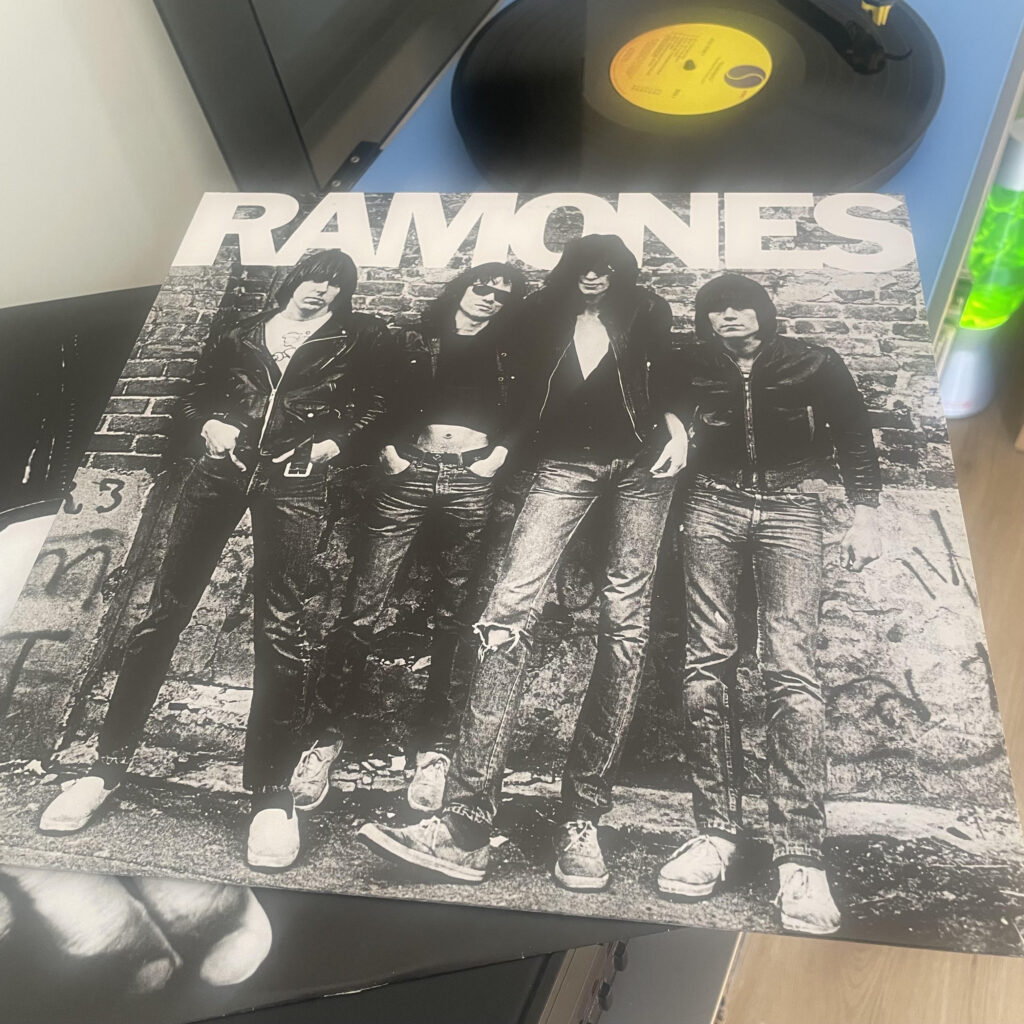
The cover is a photograph by Roberta Bayley, black and white, grainy and lo-fi of the four band members leaning against a brick wall in their jackets and jeans. Sire paid $125 for it. It has been imitated more often than almost any other sleeve in rock. The title in bold Franklin Gothic all-capital letters, tightly spaced and set as large as possible across the top of the photo followed on the band’s subsequent albums. The band’s eagle logo, adapted from the US presidential seal, came from Arturo Vega, who worked closely with them, and it turned the group into a brand before that word was common in music.
What happened next
The reception was thin. Few critics reviewed it on release, and most who did were neutral. Radio ignored it. In America it stalled at number 111, and it took decades to reach a gold certificate. In the UK it did not chart at all. The follow-up, Leave Home, reached number 45 there in 1977, Rocket to Russia reached 60, Road to Ruin reached 32, and End of the Century reached 14 in 1980. Britain needed time, and the band needed to go there first.
The album’s standing grew slowly and then all at once. It was later placed on the US National Recording Registry, and it now sits near the top of most lists of essential 1970s records.
Was it the first punk album?
It depends on what you mean, the (perpetual) debate is always more useful than the answer.
If “punk” means a spirit, a stance or a set of ancestors, then the Stooges, the MC5, the Velvet Underground and the New York Dolls got there first. The Modern Lovers’ proto-New Wave album was recorded in the early 1970s but did not come out until 1976. Patti Smith’s Horses arrived in 1975, and it is a punk record in attitude but not in sound.
If “punk” means a complete sound, with short songs, fast tempos, no solos, a uniform and a sense of humour, then the Ramones got there first on record. Nicholas Rombes, who wrote the 33⅓ book on the album, and the critic Stephen Thomas Erlewine have both described it as the first album labelled punk rock.
The competition is close but later. Blondie’s debut appeared in late 1976. The Saints’ single “(I’m) Stranded” came out in Australia in September 1976, the first punk record from outside the US, and Ed Kuepper has said that hearing the Ramones a month before recording made him think his band had been beaten at their own game. The Damned’s “New Rose” was the first British punk single in October 1976. The Sex Pistols’ “Anarchy in the U.K.” followed in November. Album by album, the Saints’ (I’m) Stranded and the Damned’s Damned Damned Damned both came out in February 1977, the Clash’s debut in April, and Never Mind the Bollocks in October.
So the fair answer is this. The Ramones made the first album that sounds the way punk records would sound for the next decade, and they made it before most of the people who copied it had recorded a note. Whether you call that “first” depends on how much weight you give the Stooges. I would call the Stooges the parents and the Ramones the first child.
London, July 1976
The Ramones went to Britain because there was interest in the band there. They had grown up on British music and were pleased to be going. Two shows were booked.
The first was on Sunday 4 July, the American bicentennial, at the Roundhouse in Camden. The Ramones supported the Flamin’ Groovies, with the Stranglers also on the bill, and played in front of somewhere between two and three thousand people. That was more than they had played to in total up to then, as Danny Fields recalled. He also said it did not feel legendary at the time.
Two details in the folklore need correcting. First, the Sex Pistols and the Clash were not at the Roundhouse. Both were in Sheffield that night, playing the Black Swan pub, and it was the Clash’s first ever gig. Second, the Roundhouse crowd was full of the people who mattered anyway. Members of the Damned were there, as were Gaye Advert, Adam Ant, Shane MacGowan and Chrissie Hynde.
The reviews split along familiar lines. The NME said the band had turned the old hippy hall into the sleaziest garage in London. Melody Maker‘s Allan Jones called them moronic, which, given the song titles, was not entirely unfair.
The next night, Monday 5 July, they headlined Dingwalls, a Camden club that held about 500. This time the Pistols and the Clash were in the room. That includes Brit Punk Royalty like: Joe Strummer, Paul Simonon, John Lydon, Glen Matlock, Sid Vicious, Chrissie Hynde again, and Brian James, Rat Scabies and Captain Sensible of the Damned. They saw a band play short songs at speed and stop only to count in the next one. Strummer, remembering it later, said you could not slide a cigarette paper between any two of their songs. He also called the first album “the first word of Punk”. Now watch clips of early Clash gigs, they’re going at 100mph in their spray painted boiler suits.
The visit did not create British punk. The Pistols had been playing for months, and the 100 Club scene was already forming. What the Ramones gave the British bands was proof that a full, professional-sounding record could be made at this speed with this little, and a sense that there was somewhere for it to go. John Robb has described the night as one where nearly every band seemed to speed up overnight.
Pen Pals With The Damned
The Damned are the British band most closely tied to that week, and the link is easy to follow.
Brian James had been in London SS, the group that also passed through Mick Jones and Tony James, and he formed the Damned with drummer Rat Scabies. They found Dave Vanian, a gravedigger by day who dressed like a vampire, on vocals, and Captain Sensible on bass. They took the name from Visconti’s film and from Village of the Damned. Accounts of the band’s early days say James played Sensible records by the Stooges and the Ramones as a kind of induction. Whatever the exact details, the Ramones were on the turntable before they were on the stage.
All three of the band’s future core were in the crowd on 4 and 5 July. Two days later, on 6 July, the Damned made their own stage debut at the 100 Club. Sensible has since said the Ramones “kickstarted the whole thing” in Britain, and the timing supports him. The Damned then did what the Ramones had done in New York: they got there first. “New Rose” came out on Stiff on 22 October 1976, produced by Nick Lowe at Pathway Studios in Islington, and it was the first single from a British punk band. It beat the Sex Pistols’ “Anarchy in the U.K.” by about five weeks. Damned Damned Damned followed on 18 February 1977, the first British punk album, and it ended with a Stooges cover, which tells you where their heads were.
The debt ran back the other way as well. In April 1977 the Damned played four nights at CBGB, the first British punk band to do so. Sensible has said the club emptied the room and started soundchecking for a second show on the same day, which was not how things worked at home. The British band that owed the most to the Ramones was now playing the Ramones’ own room.
The record does not show the two bands sharing a UK tour in these early months, so the relationship is better described as mutual recognition than partnership. The bands exchanged handwritten letters, you might say punk-pen pals in the era of expensive long distance phone calls well before social media and direct messaging and before The Ramones returned to Britain in December 1977 on their second UK tour, with the Rezillos supporting at Newcastle City Hall on 20 December, and the New Year’s Eve show at London’s Rainbow Theatre was recorded for the live album It’s Alive. By then the audience they had barely met the year before had turned into a country that knew every word.
Verdict
Ramones is self evidently not the most musically complex album of its year, it is not meant to be. It is the most economical. It shows that a band could do more by subtracting things than by adding them, and that a joke, a hook and a tempo could carry a record. Every good short song since has some of it.
The reputation can get in the way of the record. It is funny and precise, and it is over before you have time to get bored. Put it on. It will be finished in half an hour, and you will probably want to hear it again.
A Few Facts
Released: 23 April 1976, Sire Records
Recorded: Plaza Sound, Radio City Music Hall, New York, early 1976
Producer: Craig Leon
Length: 14 tracks, 29:04
Cost: $6,400 funded by the band
Chart: US 111, no UK chart placing on release
First UK shows: Roundhouse, 4 July 1976; Dingwalls, 5 July 1976
This Blondie Parallel Lines review comes forty-eight years after the album first appeared in the U.K. It is a record I have lived with for most of my life. It follows a band that began before Punk in the cheap rooms of downtown New York, took a wrong turn or two, found an audience in Britain and then made one of the great pop albums of the decade with a producer who wrote hits for glam rock bands. It also covers the disco single that upset the punk purists, the iconic striped sleeve the band did not want, and the dirty shoes.
45renegade Long Reads
Blondie, Parallel Lines (Chrysalis, 1978)
Chrysalis released Parallel Lines on 8 September 1978. By then Blondie had made two albums, moved labels and changed line-up. They also had a big hit in Britain that America had mostly ignored. What they made next sold in the millions. It took the speed and noise of downtown New York punk and gave it proper choruses.
Downtown
Debbie Harry was born in Miami in 1945, adopted as a baby and raised in New Jersey. By the early 1970s she had sung in a folk-rock group, the Wind in the Willows, waited tables at Max’s Kansas City and spent a spell as a Playboy Club bunny. In 1973 she joined a girl trio called the Stilettos and met the guitarist Chris Stein, a Brooklyn art school graduate. They became a couple and a songwriting partnership. By 1974 the Stilettos had become Blondie, named after the catcalls Harry got from passing truck drivers.
Drummer Clem Burke, bassist Gary Valentine and keyboard player Jimmy Destri completed the first proper line-up. They played the same rooms as the Ramones, Television, Talking Heads and Patti Smith: CBGB and Max’s. They did not fit neatly. Most of that scene sold aggression or art. Blondie sold tunes. Their reference points were girl groups like the Shangri-Las, surf instrumentals, bubblegum pop and cheap science fiction films. Harry, with her cropped platinum hair and cool delivery, looked like a 1950s film star who had wandered into a fight. The band pushed back on the pin-up treatment with badges and T-shirts reading “Blondie is a group”.
Two albums and a contract problem
The debut, Blondie, came out in December 1976 on Private Stock. Richard Gottehrer, who had co-written “My Boyfriend’s Back” in the 1960s, produced it. The songs (“X Offender”, “In the Flesh”, “Rip Her to Shreds”, “Kung Fu Girls”) sounded like sixties pop played at punk speed and with a wink. American sales were modest. Australia reacted differently. After the TV show Countdown picked up the clip for “In the Flesh”, it became a major hit there.
The relationship with Private Stock soured, and in 1977 Chrysalis, run by Terry Ellis and Chris Wright, bought out the contract. Valentine also left that year. Frank Infante and Nigel Harrison arrived, and Blondie became a six-piece.
Plastic Letters followed in February 1978. It is an uneven record, with the sound of a band that had to deliver an album quickly. Two singles saved it. “Denis” was a 1963 song by Randy and the Rainbows, refitted with a bit of Harry’s French, and it reached number two in Britain. Valentine’s “(I’m Always Touched by Your) Presence, Dear” got to number ten. The album made number ten in the UK and only 72 in the US. It was clear which country was paying attention.
Britain
The British connection began before Plastic Letters. In March 1977 Blondie toured the UK supporting Iggy Pop, with David Bowie playing keyboards in Iggy’s band. British music papers were already friendly. British pop audiences, raised on glam and the three-minute single, understood a band that mixed guitars with hooks. On Top of the Pops Blondie were pop stars. In New York they were still a cult act.
Britain gave them what their home city had not: hit singles and a fanbase that treated them as a chart group without any embarrassment. The gap between what the band wanted to be and how much of the American industry saw them was the problem the next record had to solve.
Enter Mike Chapman
Chrysalis wanted a producer who knew how to make hits. Manager Peter Leeds and the label steered Mike Chapman towards the band. Born in Nambour, Queensland, Chapman had moved to London in the 1960s and teamed up with Nicky Chinn. Their songs for Sweet (“Blockbuster”, “Ballroom Blitz”), Suzi Quatro (“Can the Can”) and Mud (“Tiger Feet”) were built on stomping rhythms and choruses a whole playground could shout. By 1978 Chapman was producing in America, with hits for Exile (“Kiss You All Over”) and Nick Gilder (“Hot Child in the City”).
The match was not welcomed by everyone. Clem Burke was keen, but Debbie Harry knew Chapman only by reputation and was wary. Chapman put it down to geography: they were New York and he was LA. Her doubts faded once she played him early versions of “Heart of Glass” and “Sunday Girl” and he liked what he heard. The sessions began at the Record Plant in New York in late June 1978, so the British link is Chapman’s pedigree and the UK audience that had already made the band’s case.
By his own account, the band’s playing was poor when rehearsals for the album began, and he told them they would have to play better. He wanted tight, precise playing, clean arrangements and nothing that drifted. That suited Burke, a Keith Moon devotee whose drumming is busy but well controlled here. Chapman did not sand the band down into something polite. The guitars are still loud and the tempos still fast. What changed was focus. Every track has a job, a hook and a finish.
The record
Side one. “Hanging on the Telephone” opens the album. It is a cover of a song by the Nerves, written by Jack Lee, and Blondie turn it into a two-minute jolt that works as a mission statement. Harry sounds bored and desperate in the same breath, and the drums do the shouting.
“One Way or Another”, credited to Harry and Harrison, is the album’s best-known cut after the singles. Harry has said it was inspired by an ex-boyfriend who would not leave her alone, and the mix of menace and fun explains why crowds still love it. “Picture This” is straight pop with a tune you can hum after one listen, and it reached number twelve in the UK.
Then the record gets stranger. “Fade Away and Radiate”, written by Stein, is slow and eerie, with guest guitar from Robert Fripp of King Crimson. It shows that the band could hold a mood as well as a beat. “Pretty Baby” is bright and wry. “I Know but I Don’t Know” is Infante’s song, sung as a duet with Harry. It is the plainest rock track on the record, and the weakest link on side one, though it is competent and sits well in the running order.
Side two. Destri’s “11:59” is fast and tight, with his keyboards driving the chorus. Jack Lee returns with “Will Anything Happen?”, a nervous, jumpy track with a lot of tension. “Sunday Girl”, written by Stein, is the gentlest of the singles. It is wistful, bouncy and immediate, and it gave the band another British number one in 1979.
Then comes “Heart of Glass”, which needs its own section.
“I’m Gonna Love You Too” is a Buddy Holly cover, a nod to the 1950s roots that ran through the whole band. The closer, “Just Go Away”, is short, brisk and hard. It lands like a door slamming, and that is the right way to end an album that never outstays itself. The whole thing runs about thirty-nine minutes.
The disco song
Blondie wrote “Heart of Glass” around 1974 and 1975 under the title “Once I Had a Love”. Fans and bootleggers called it “the disco song”. Early versions were slower and looser. By 1978 disco was everywhere, and New York, Studio 54 included, was its capital. Blondie’s downtown peers tended to treat it with suspicion.
Chapman pushed the band to finish it as a dance record. The reference points were Kraftwerk and the work Giorgio Moroder did with Donna Summer. The track uses a Roland CR-78 drum machine, Destri’s synthesisers, chiming guitar and a cool, almost robotic vocal from Harry, with Burke playing to the machine’s pulse. It is precise and slightly chilly, and that is its strength. The lyric is about a love gone wrong, and the mechanical rhythm makes the sadness sharper.
Some fans took the disco turn as a betrayal of punk. The record-buying public did not. “Heart of Glass” reached number one in the UK and then in the US. The Disco Demolition Night riot in Chicago in July 1979 shows how hostile some rock fans were to the genre, so the band took a real risk. It paid off, and Blondie kept working with dance music. “Call Me” (1980) was a Moroder collaboration, and “Rapture” (1981), with its rap verse, became the first US number one to feature rapping.
The sleeve
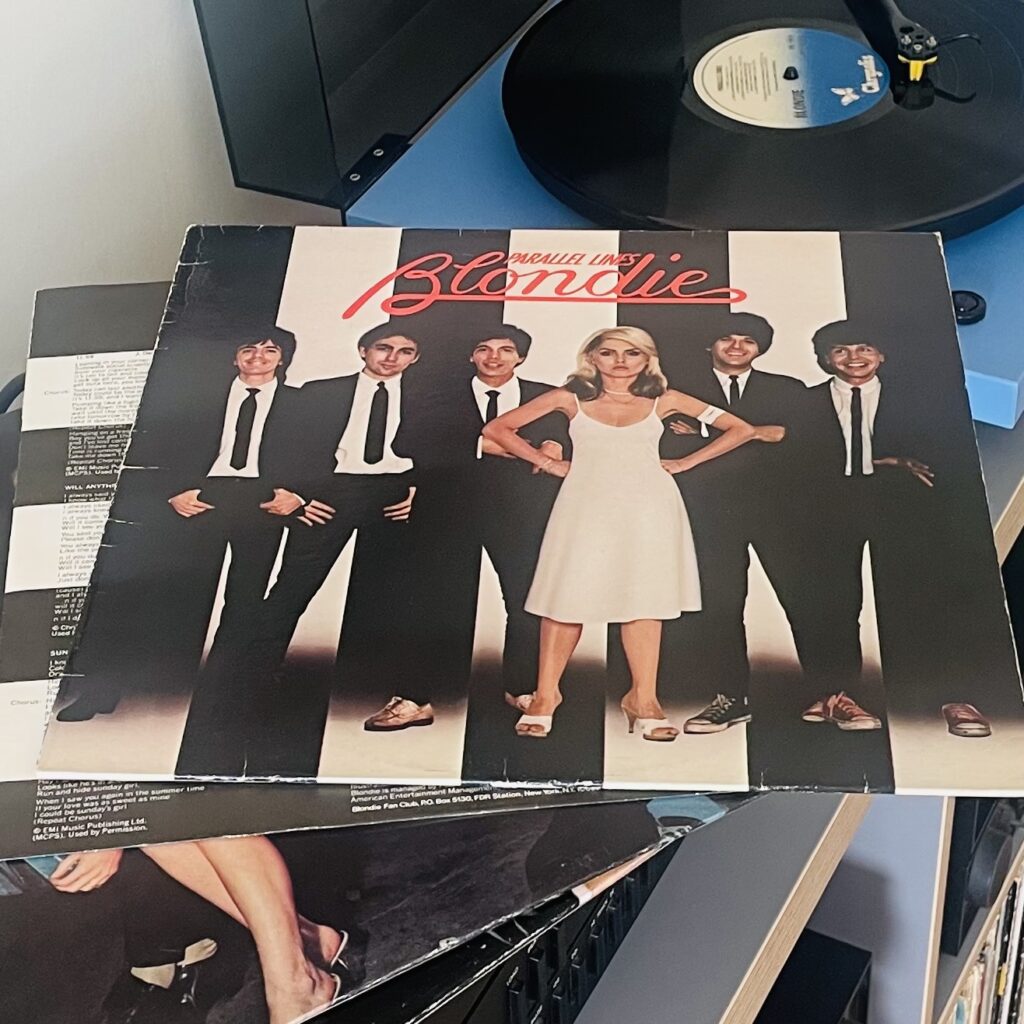
The cover is almost as well known as the songs. The photographer was Edo Bertoglio, hired by Roberta Bayley, the New York punk scene’s unofficial house photographer. Bertoglio came from Warhol’s circle. Ramey Communications handled the art direction and design, with lettering by Jerry Rodriguez and illustration by Frank Duarte. The background is a set of black and white stripes, and the red title text is the only part of the image that is not black and white (apart from a subtle dark tint of a pair of red Converse). Five men in dark suits and thin ties stand in a line, and the ties echo the stripes. Harry stands at the centre in a white dress and heels, hands on hips, without a smile. On the reverse Debbies heels are replaced with facsimile teal boots.
The stripes solved a practical problem. With the band at odds, manager Peter Leeds has said he could not get a usable group photograph, so each member was given their own black or white stripe and photographed separately. The band were told they could choose their own frames, but Leeds picked the single shot in which the men grin behind a stern Debbie. Harry recalled the shock of finding the artwork finished without the band’s approval, and Chris Stein said they had wanted to look more rock and roll. The cover also reflected Leeds’s view of the group. He saw Blondie as Debbie Harry with a band, which neither she nor the band wanted, and the sleeve became a symbol of manipulation that helped end his time as manager. Harry has never rated the design.
The title itself came from an unused song by Harry, whose lyrics were printed on the first vinyl release, a neat little trivia piece.
Then there are the shoes. The back sleeve photographs each member’s footwear. Burke wears Converse in a different colour on each foot, and Harrison wears Converse with Mr Spock socks. One writer calls the casual shoes the only clue that the band are not quite what the suits suggest. Sneakers were normal wear around CBGB, so the scene link is there. The suits and the smiles were not the band’s choice, though, and the shoes look like the one part of the shoot that stayed their own.
Reception and afterlife
The album took a while to catch fire. “Hanging on the Telephone” reached number five in the UK singles chart and “Picture This” number twelve, but the real lift came in early 1979, when “Heart of Glass” pulled the album to the top of the British chart. In the US it peaked at number six. Estimates put worldwide sales above 20 million, though the exact figure is disputed. It remains the band’s biggest seller and appears on best-of-decade lists with little argument.
Chapman went on to produce the follow-up, Eat to the Beat, in 1979. Warhol painted Harry in 1980, a fitting seal for a band that had always been half pop art.
Verdict
Parallel Lines works because nobody compromised. The punk edge stayed, and so did the pop instinct. Chapman did not tame Blondie. He gave them tools to make their strengths hit harder: sharper choruses, cleaner sound, faster edits. The record still has one or two lesser cuts, and “I Know but I Don’t Know” is the obvious one. Everything else earns its place.
It also solved the band’s problem. They had been a New York curiosity with a British hit. After this album they were a global act that had beaten the punk snobs and the disco snobs together. Forty-odd years on, it still sounds quick, sharp and unforced.
Personally
I have had a relationship with Blondie since early 1978, though obviously not an actual one. Debbie was just about old enough to be my mother, something a few people miss. It began when my friend bought Plastic Letters on the strength of “(I’m Always Touched by Your) Presence, Dear”.
I have earned coin from them since I was 15, probably paid in Mintola chocolate bars. I drew Debbie portraits for friends on the inside covers of exercise books, a five minute turn with a 2B pencil. More recently I made my own pop art piece, Cut Out & Keep Debbie, an imaginary 600mm NME front cover for the week Eat to the Beat went platinum in the UK.
I am an aficionado of anything NYC, CBGB, punk and new wave, and I have played my Blondie vinyl for nearly five decades. What’s your favourite Blondie track or album? Any other CBGBs bands rock your boat? Say hi on the socials IG @ 45renegade
‘Just a Symptom of the Moral Decay That’s Growing in the Heart of the Country’
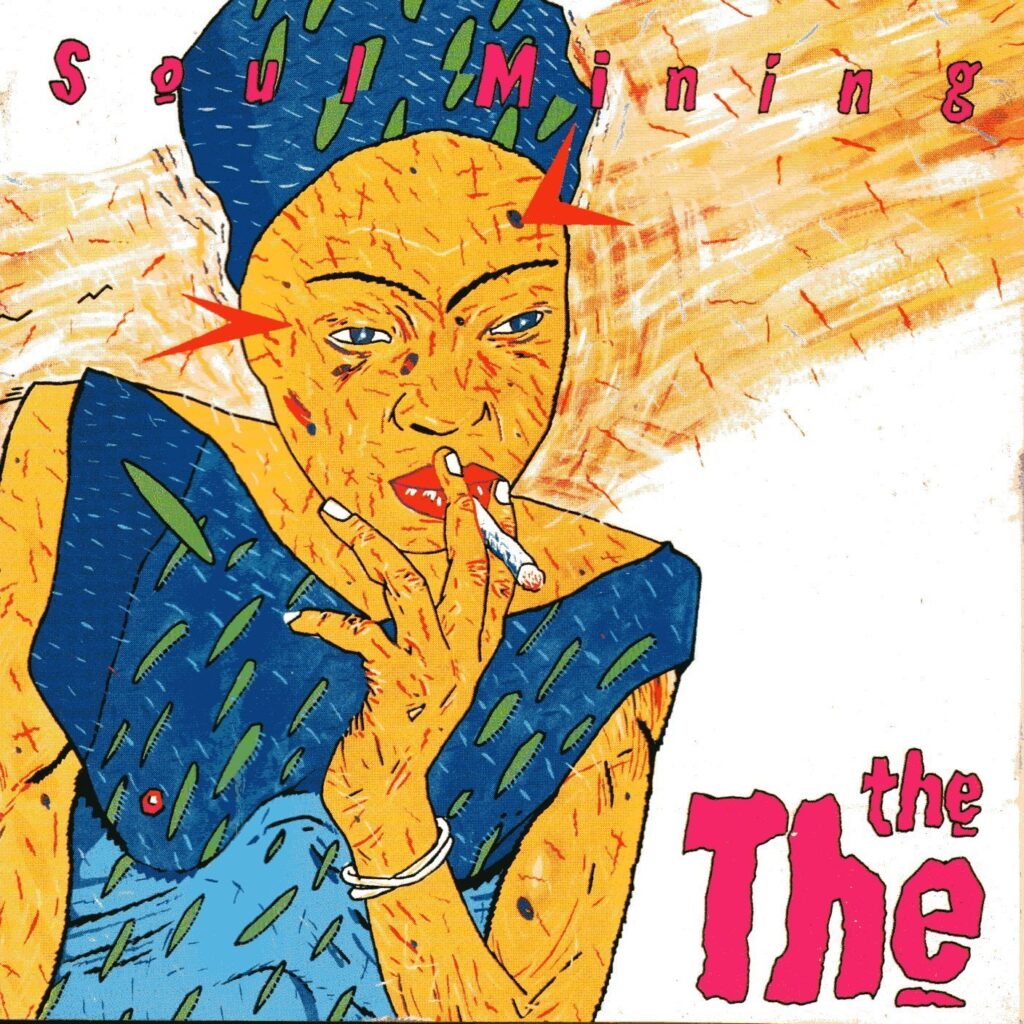
the The, Soul Mining. Some Bizzare/Epic, 21 October 1983
Most British pop in 1983 danced or shouted. Soul Mining sat in the dark and took stock.
Matt Johnson was in his early twenties. He had already made one strange, private record. Now he made seven songs that blended synth-pop, jazz, funk, blues and tape-loop experiment, describing two things at once: a man coming apart and a country coming apart. The album sold steadily, later went gold in the UK, and has never dated because it was never in fashion. Four decades on, it sounds like a warning that was mistaken for a mood.
Britain in 1983
Margaret Thatcher took office in May 1979. Her government cut public spending and fought inflation with high interest rates and tight control of the money supply. Industry took the hit. Factories, steelworks and shipyards closed, and by early 1982 unemployment had passed three million. The inner cities erupted in 1981, in Brixton, Toxteth and elsewhere.
The Falklands War in 1982 restored her standing. In June 1983 she won a landslide, helped by a Labour Party in disarray and an opposition split between Labour and the SDP-Liberal Alliance. The miners’ strike was a year away. Soul Mining came out four months after the election, into a country that had just re-elected the government that was closing its factories.
That timing matters. The record does not sound like protest. Protest assumes someone is listening. It sounds like the morning after a lost argument, when the result is in and the consequences are still arriving.
The man behind the name
Johnson was born in London in 1961 and grew up in a pub family in East London. His father ran the Two Puddings in Stratford for almost forty years. Johnson has said the blues came up through the floorboards. He had been in bands since the age of eleven.
After leaving school he spent something like eighteen months to two years alone, mostly in his bedroom with tape recorders, long walks and books. He calls it a hothouse. It made him a one-man studio. He taught himself tape looping, read up on musique concrète, and learned to build a record by layering his own parts. Burning Blue Soul came out on 4AD in 1981 under his own name and was later reissued as a The The album. It cost about £1,800, and he made it while signing on.
Johnson’s politics
Johnson is left of centre by instinct but no party man. He distrusts every institution: state, church, press and party alike. He has said his quarrel with America is with the corporate powers that steer its foreign policy, not with Americans. He lived in New York for several years and calls downtown Manhattan his spiritual home. He reads geopolitics most nights and has spoken of wanting to write about the people behind the people, without preaching.
Later records made this explicit. Infected (1986) took on Thatcherite Britain and the Cold War with open anger. Mind Bomb (1989) turned on religious fundamentalism and drew mixed reviews for it. In 2002 he walked away from the music business, citing bad publishing and management deals that leave mid-sized bands in debt while their records earn fortunes for others. That is the same suspicion of power, applied to his own trade.
Soul Mining is the quieter, earlier version. The politics arrive as weather. Unemployment, decline and the feeling of being stuck in a place that no longer needs you run through the record, but the songs are about people, not policy. A slogan dates within a year. A person waiting for a job that will not come still reads as true.
Making the record
Work began in spring 1982 in New York, where a twenty-year-old Johnson cut “Uncertain Smile” and “Perfect” with producer Mike Thorne on London Records’ money. When CBS signed him instead, those sessions were dropped and he started again in London. He bought a Portastudio, a Fender Strat, an Omnichord, a couple of small synths and a Roland TR-606 drum machine, and wrote the songs lying on the floor of his flat. With no sequencer, he played parts for ten minutes at a time and used the takes as loops.
The album was then made in Shoreditch at John Foxx’s Garden studio, co-produced with engineer Paul Hardiman, who had worked with Wire. Zeke Manyika, Thomas Leer, Jim Thirlwell and Jools Holland guested. It was mixed at Martin Rushent’s Genetic Sound. Johnson wanted something cinematic, wide and deep, and he did not want two guitars, bass and drums. The full cast and what connects them is in Part 2.
The songs
I’ve Been Waitin’ for Tomorrow (All of My Life). The opener runs on Manyika’s vicious drumming and Leer’s restless synth, built from long loops. The title says it all: a life spent waiting for something to start. The eager rhythm and the deferred hope pull against each other, and that tension sets the tone for the rest.
This Is the Day. Wix Wickens (credited as “Wicks”) plays accordion and Paul Boyle plays fiddle, giving the intro the feel of a French street café. It is the one bright song and the best loved. The opening line turns the old blues line about waking up in the morning on its head. It reached only number 71 in 1983. A reworked version, “That Was the Day”, reached number 17 in 1993, and the original has since turned up in Guardians of the Galaxy Vol. 3 and Netflix’s One Day. Even here the day is passing.
The Sinking Feeling. This is the political centre. The title works twice: the private dread of the small hours and the public sense of a nation going under. Johnson has called it and “The Twilight Hour” the more insecure songs on the record. It reads as a portrait of a man and a country going down together.
Uncertain Smile. It opens on a homemade tape loop of African-sounding percussion, then settles into chiming guitars and synthetic strings. The song grew from a demo called “Cold Spell Ahead”. It is about a relationship where nobody knows what anybody feels. Holland’s piano solo was recorded in essentially one take, and it is among the finest in pop. It runs like a party in the next room, then stops, and the unease returns.
The Twilight Hour. A slow, late-night piece that lets the album breathe. It is closer to a confession than a song.
Soul Mining. The title track has a downcast, Afro-tinged synth pulse. The title states the method: dig into yourself and use whatever you find, however ugly.
Giant. Johnson’s own favourite closes the album. Industrial rhythms, deep bass and chanting build a long groove that keeps shifting and never resolves. My reading is that it is about scale, the feeling of being small beside something too large to fight.
The human condition, without a filter
The lyrics deal with insecurity in relationships, social alienation and dream imagery. Johnson writes about loneliness, desire, jealousy, self-disgust, drink, fear and the slow pressure of time, and he does not tidy any of it into a lesson. There is no last-verse rescue. A song may argue itself towards hope and lose.
He is not a poet of wit, like Morrissey, or of abstraction, like Ian Curtis. He is closer to a reporter of the interior, someone who writes down what he feels at three in the morning and leaves it as written. That is why the record has aged so well. The details of 1983 fall away and the feelings stay.
The music is also generous. Jazz-tinged piano, live percussion, fiddle and accordion sit beside the synths and drum machine. The contrast is deliberate: the sound invites you in and the words tell you the truth.
Reception and afterlife
Johnson refused to appear on the sleeve or to tour. He doubted the record could be played live, since samplers were not yet affordable, and he did hundreds of interviews instead. The European sleeve is a painting by his brother Andy Dog of one of Fela Kuti’s wives holding a joint, and the typeface was drawn by his girlfriend Fiona Skinner.
The label added “Perfect” to the end of some editions without his approval. He fought to have it removed and finally succeeded in 2002. The song began life under the title “Screw Up Your Feelings”.
The 2002 remaster was compressed hard, by Johnson’s own admission. For the 2014 anniversary box he had the tapes remastered at Abbey Road with barely any processing, and he says they sounded as if they had been recorded a week earlier. In 2024 he released Ensoulment, the first The The album in twenty-four years.
Verdict
The album’s central mood is precarity: the ground is not solid and nobody in charge is coming to help. Every decade since has produced its own version of that feeling, and Soul Mining still fits. It does not tell you what to think. It shows you what it felt like and lets you reach your own conclusion.
It is not an easy album to love. It is an easy one to trust.
Part 2, The Web Behind the Record, is a reference guide to the people, studios, machines and management that shaped the album, and to why it shares so much with its 1983 neighbours.
Soul Mining, Part 2: The Web Behind the Record
Part 1 reviewed the songs. This is the reference guide: who managed, played and produced, where it was made, on what equipment, and why the record shares so much with the synth-pop of 1983.
Management: Stevo and Some Bizzare
Stevo Pearce was a Dagenham club promoter who talked Sounds into printing his Futurist chart of new electronic acts. Some Bizzare began in 1981 with a compilation of unsigned bands including Depeche Mode, Soft Cell, The The and Blancmange. It worked more as a management umbrella than a conventional label. The roster later took in Marc Almond, Cabaret Voltaire, Einstürzende Neubauten, Foetus, Swans, Coil and Psychic TV.
His method was to get major labels to fund recordings while he kept ownership. Soft Cell’s number one with “Tainted Love” in 1981 gave him leverage. Johnson lived the sharp end of it: London Records paid for his first New York trip with nothing in writing, then CBS signed him. Stevo is also said to have licensed Soul Mining to more than one label.
Johnson credits Stevo with running the best label in Britain for about three years, before he wrecked it. He remembers the acts as a close scene, with Soft Cell, Psychic TV, Cabaret Voltaire, Foetus, Einstürzende Neubauten, Test Dept and Swans hanging out together. Any problems were with Stevo, not the bands.
People
Marc Almond. Johnson was a member of Marc and the Mambas for their first two albums and played guitar on Torment and Toreros. Almond returned the favour in 1982 by joining Johnson on guitar and vocals for a run of Marquee shows in Soho.
J.G. Thirlwell (Foetus). He appears on Soul Mining as “Frank Want”, building a rhythm from pots and pans taken from the studio kitchen. The same credit appears on the Mambas record. He also guested on the Mambas as Foetus.
Zeke Manyika. The Orange Juice drummer turned up three days late and then produced the drum sound on the opener.
Thomas Leer. He plays synth on the opener. His one-man single “Private Plane” was what convinced Johnson he could work without a band.
Jools Holland. He played the “Uncertain Smile” solo in one take on a Yamaha C3 grand, having arrived in leathers on a Norton in summer heat.
Wix Wickens, Paul Boyle and Andy Duncan. Accordion, fiddle and drums on “This Is the Day”. Wickens later became Paul McCartney’s musical director.
Steve Sherlock. A core Mambas member. His flute and sax appear on tracks from Johnson’s shelved Pornography of Despair sessions, which ended up on the 12-inch of “Uncertain Smile”.
Wire. Wire’s Bruce Gilbert and Graham Lewis co-produced Burning Blue Soul. Hardiman had engineered for Wire, and Thorne produced Wire’s early records.
Design. Andy Dog painted the sleeve and Fiona Skinner drew the typeface.
Producers and studios
Mediasound, New York, 1982. The first “Uncertain Smile” and “Perfect”, produced by Mike Thorne, who had produced Soft Cell’s debut. Johnson liked Thorne’s sound but found it soft. Stevo fell out with Thorne, and Johnson switched to Paul Hardiman, who gave the sound more edge.
The Garden, Shoreditch. John Foxx’s studio, where the main work was done. Foxx was a founder of Ultravox. Johnson later ran the studio with Miloco until 2012.
Advision and Sarm West, London. Used for the 1983 version of “Uncertain Smile” and for “This Is the Day”.
Genetic Sound. Martin Rushent’s studio, where the album was mixed. Rushent produced the Human League’s Dare.
Trident, London. Where the Mambas made both albums. Flood co-produced Torment and Toreros with Almond and later produced Depeche Mode.
Equipment
Johnson’s own list is modest: a Portastudio, a Fender Strat, a Suzuki Omnichord, a couple of small synths and a Roland TR-606 drum machine, with Tannoy speakers for monitoring. He had no sequencer, so he played parts for ten minutes at a time and used the takes as loops. His earliest work used an Akai tape machine, a Big Muff pedal and echo boxes.
The rest came from outside the machines: a homemade tape loop of percussion on “Uncertain Smile”, pots and pans on the kitchen floor, a good grand piano in a good room, and an accordion and a fiddle. One retailer’s sleeve notes claim the drum machines came from the Human League’s studio. Johnson’s own account contradicts that, so treat it as folklore.
The accordion and the café
The intro to “This Is the Day” is one of the album’s signature sounds. Johnson wanted no fixed line-up, so fiddle and accordion could sit on one song and cellos and synthesiser on another. The French street-café feel is a fair reading of that pairing.
There is a thread to support it. The Mambas’ Torment and Toreros, which Johnson played on in 1983, mixed vaudeville with French chanson and covered Jacques Brel. The same circle was absorbing the same influences. Johnson also recalls a French journalist asking why nearly all his songs were in minor keys, a habit he had never noticed.
Why the 1983 sound overlaps
Listen to Soul Mining with contemporaries and it shares ground with New Order’s Power, Corruption and Lies, the Human League, Heaven 17 and Depeche Mode. The reasons are practical.
Shared rooms and people. A small circle of London studios and a few producers served many acts. Thorne, Rushent and Flood moved between artists, so techniques and textures travelled with them.
Cheap electronics. Drum machines, sequencers and small synths became affordable, so a solo artist could make a full record at home. Johnson’s TR-606 and Portastudio sit at the modest end of that shift. The bigger acts had the same idea with larger budgets.
Post-punk players turning to electronics. Wire alumni, John Foxx and Thomas Leer all came from punk and its aftermath, not conservatory training. They favoured rhythm and texture over virtuosity, and they crossed over between bands.
A label system built on introductions. The 1981 Some Bizzare Album put Soft Cell, Depeche Mode, Blancmange and The The on one disc. Depeche Mode then moved to Mute, but the friendships stayed.
New York club music. The Thorne sessions were made in New York, and the early 1980s club scene there is a stated influence on the album. Dance rhythms with dark lyrics were the common target.
Major-label money. CBS, Phonogram and London funded proper studios and polished mixes, which pushed rough electronic demos towards a cleaner, wider sound.
Where Soul Mining differs
The overlap is in the sheen, not the method. Johnson worked from tape loops and musique concrète, layered his own parts, then brought in live players: drums, piano, fiddle, accordion, percussion from the kitchen. Africa, the blues and jazz piano all sit inside the electronics. New Order and the Human League built their sound on sequencers and machines. Soul Mining used the machines as a frame and filled it with people. That is why it belongs to its year and still sounds like nothing else from it.
Four Faces, One Parka: The Who’s Quadrophenia at Full Throttle
After a break, a 45renegade rock and roll long read.
There is a particular kind of arrogance required to follow a masterpiece with an act of self-demolition, and Pete Townshend has never been short of it. By fifteen minutes into Quadrophenia, the listener has already been drowned, half deafened and abandoned on a rain-lashed beach with nothing but a scooter horn for company. That is precisely the point. This was never going to be a comfortable record, and comfort was never what The Who were selling. What they were selling, in the autumn of 1973, was a working-class boy’s nervous breakdown scored for a rock band that had, by its own reckoning, gone slightly mad trying to make it.
Released as a double album on 26 October 1973 on Track Records, Quadrophenia arrived heavy with expectation. Here was a band fresh from the twin triumphs of Tommy and Who’s Next, the former having invented the rock opera more or less by accident, the latter standing as the tightest, most muscular thing they had ever put on wax. Townshend, never a man to repeat a trick when a bigger one was available, decided the follow-up would be his masterwork: a return to the mod scene that had made The Who in the first place, told through the eyes of a fictional teenager called Jimmy Cooper, and structured around the idea that Jimmy’s cracked personality contained four distinct selves, one for each member of the group. It is a conceit so audacious it could easily have collapsed under its own cleverness. That it mostly doesn’t is the whole story of why this record still matters.
The Concept: A Mirror Cracked Into Four
The title itself is a piece of Townshend wordplay, a splicing of “schizophrenia” with the “quadrophonic” surround sound format the industry was flirting with at the time, itself never quite catching on the way stereo had. But the real meaning sits closer to home. Jimmy is a mod, one of the pilled-up, scooter-riding, sharp-suited kids who had swarmed Brighton and Margate a decade earlier, and his four warring facets are drawn directly from the four members of the band that made him. Daltrey supplies “a tough guy, a helpless dancer”. Entwistle is “a romantic”. Moon, inevitably, is “a bloody lunatic”. Townshend himself settles for “a beggar, a hypocrite”, which tells you rather a lot about how the album’s author saw his own contribution to the story.
Townshend later called it “a sort of musical Clockwork Orange”, and there is something of Alex’s alienation in Jimmy’s arc: a lad chewed up by dead-end work, indifferent parents, a girl who prefers his best mate, and a subculture that promises belonging and delivers only another set of rules to break against. Set explicitly in London and Brighton in 1965, the record trades on the mods and rockers riots that had scandalised middle England the year before, using that moral panic as the backdrop for a story that is really about something much smaller and much more universal: a boy who cannot work out who he is, surrounded by people who claim to know exactly who they are and are almost certainly lying.
What separates Quadrophenia from Tommy is that Townshend was no longer working in symbolism and pinball metaphor. He was writing what he knew. This was his own adolescence, transplanted onto a fictional narrator, full of purple hearts necked on a Brighton-bound train, of humiliating scenes at the family dinner table, of a scooter wrecked in a fit of self-disgust and a final, ambiguous reckoning on a rock out at sea. The record ends not with resolution but with a kind of exhausted clarity, Jimmy stripped of his parka, his pills and his illusions, asking only to be washed clean by something bigger than himself. Whether he lives, dies, or simply grows up is left deliberately unresolved, which is more or less the correct way to end a story about being seventeen.
Production: Chaos in Battersea
The making of Quadrophenia is as much a part of its legend as anything printed on the sleeve. Work began as early as May 1972, but was repeatedly derailed. Entwistle and Daltrey were off making solo records, Moon was distracted by film work, and Townshend himself had a failed multimedia project called Lifehouse still smouldering in the background, its wreckage supplying several of the songs that would eventually surface here. When serious sessions resumed in the summer of 1973, the band’s own new studio, a converted building on Thessaly Road in Battersea nicknamed The Kitchen, was still a building site, plaster dust and all. The solution was to wheel in Ronnie Lane’s Mobile Studio and use it as a makeshift control room while the walls went up around them, which gives you some idea of the seat-of-the-pants energy that runs through the finished record.
Engineering fell to a young American named Ron Nevison, hired more or less by accident and kept on because the band liked what they heard. It was, by his own account, easily the biggest and most technically demanding session he had worked on, and it shows: this is an album stitched together from multi-track synthesiser sequences, sound effects lifted from crashing waves and pouring rain, and a wall of overdubbed brass, all of it performed by Entwistle himself, who by all accounts simply picked up a French horn and got on with it. The band had originally hoped to mix the whole thing in true quadrophonic sound, hence the title, but the format’s technical limitations in 1973 meant the ambition was quietly abandoned in favour of an unusually wide and detailed stereo mix instead. It remains one of the most sonically ambitious rock records of its decade, layered and cinematic in a way few guitar bands were even attempting.
Behind the desk, the record marks a genuine fracture. Kit Lambert, the band’s co-manager and the man who had shaped their sound and their sensibility since the mid-sixties, had drifted into addiction and irrelevance by this point, and his relationship with the group broke down for good during these sessions. He was gone from their day-to-day affairs by the time the album reached the shops, though he retained an executive producer credit as a formality. It is tempting, and probably not wrong, to hear some of the record’s themes of betrayal and abandoned mentors as bleeding directly out of that collapsing relationship. The Who, in other words, made a self-produced record about a boy losing faith in the adults around him while quietly losing faith in one of their own.
There is one more piece of production trivia worth dwelling on, and it says something about how records were actually consumed in 1973 rather than how we imagine they were. The original pressing was what the trade called an auto-coupled release, meaning the two discs were not sequenced the way a listener might expect. Record one carried sides one and four, while record two carried sides two and three, an arrangement that looks like a pressing plant error until you remember the record changer, that now-vanished piece of hi-fi furniture with a fat spindle capable of stacking several LPs at once. Load record one onto the spindle followed by record two on top, and the mechanism would drop and play side one, then side two, in correct running order, without anybody needing to get up. Flip both discs over together and sides three and four would follow in the same fashion. It meant a single owner with a decent changer, or two mates each bringing a copy round, could in theory let the whole eighty-one minute story unfold uninterrupted, an oddly appropriate bit of engineering for a record so preoccupied with continuity and character. It also explains why generations of vinyl collectors, encountering an original Track pressing for the first time and finding sides one and four sharing a disc, have assumed for a moment that they have stumbled on a factory mispress rather than a perfectly deliberate piece of 1973 thinking.
The Personnel: Four Men, Playing Themselves
If Tommy had been Townshend’s story told through the band, Quadrophenia is the band telling Townshend’s story about themselves, and every player rises to the size of the task.
Entwistle’s playing throughout is extraordinary, not least on the opening salvo “The Real Me”, which he has described as essentially a bass solo with vocals attached, and it is hard to disagree. It stands as one of the great recorded bass performances in rock, muscular and melodic at once, and it sets the tone for an album on which “The Ox” is arguably the single most important instrumentalist in the room. His brass arrangements, all performed and overdubbed by himself, give the record its widescreen, almost orchestral quality.
Moon, for his part, delivers what would prove to be his last truly focused studio performance with the band, chaotic and thrilling in equal measure, a man playing as though the kit might escape him at any moment, which by 1973 it very nearly could. Daltrey, so often accused across the band’s catalogue of merely delivering Townshend’s words, finds the role of his career here, particularly on the closing “Love, Reign o’er Me”, where he pushes his voice to a raw, torn extreme that remains one of the definitive vocal performances of the entire classic rock era. And Townshend, credited as sole writer of every note and word on the album, a first and only occurrence in the band’s catalogue, plays guitar with a controlled fury throughout while quietly running the whole ambitious apparatus of synthesisers, orchestration and structure from behind the scenes. He would later call it the best music he had ever written, and on his own instrument’s evidence, it is hard to argue.
The Songs: Seventeen Tracks, One Long Exhale
Across four sides and more than eighty minutes, the record moves with a cinematic patience that rewards, and frankly demands, a single uninterrupted sitting. The opening instrumental collage, “I Am the Sea”, drifts in on surf and gull cries before dissolving into snatches of the four character themes that will recur throughout, “Love, Reign o’er Me”, “Helpless Dancer”, “Bell Boy” and “Doctor Jimmy”, planted here like seeds that will not fully flower for another eighty minutes. It is a device lifted straight from film scoring, and it works.
“The Real Me” then detonates the album proper, all coiled fury and domestic frustration, before the record settles into its narrative stride: the wounded nostalgia of “Cut My Hair”, the desperate pill-popping travelogue of “5:15” as Jimmy rides the train to Brighton, the aching, semi-autobiographical “I’m One”, and the extraordinary “The Rock”, an instrumental piece so densely orchestrated it could stand as a symphonic movement in its own right. “Bell Boy” gives Moon his moment in the narrative spotlight, playing the washed-up former mod hero Ace Face now reduced to fetching towels at a seafront hotel, a piece of very English, very bitter irony about what happens to youth movements once the youth grows up. “Drowned”, written originally as a devotional piece for Meher Baba before being repurposed for Jimmy’s near-suicidal despair, remains one of the rawest, least ornamented things here, and arguably the most purely felt. It all resolves in “Love, Reign o’er Me”, a genuine peak of the entire rock opera form, Daltrey’s voice cracking open over Townshend’s piano and strings in a moment of catharsis that has lost none of its power in fifty years of imitation.
Reception: A Nation Struggling to Keep Up
Critical response on first landing was broadly enthusiastic, if occasionally bewildered by the sheer scale of the thing. Newsweek’s Hubert Saal placed it among rock’s great milestone records. Melody Maker’s Chris Welch called it a masterpiece, the Who at their absolute peak, “sap flowing from the roots of their creation”. Within NME’s own pages the following year, Nigel Rogers went further still, hailing it as the greatest exposition of the rock and roll ethic yet committed to vinyl, a judgement plenty of readers at the time would have thought overblown and which fifty years of hindsight has done nothing to disprove. Rolling Stone’s Lenny Kaye offered the more ambivalent, and in retrospect the more accurate, verdict: The Who at their most symmetrical and most cinematic, and also their most maddening, an album whose ambition occasionally outran its own listenability.
Commercially it did rather better than the reviews suggested it might, going gold on the day of release and platinum within forty-eight hours, eventually reaching number two on both the UK and US album charts, the band’s highest ever placing in America, kept off the top only by Elton John. The touring party that followed was, by every account including Townshend’s own, a genuine disaster. The backing tapes required to reproduce the synthesiser and sound effect parts live were unreliable to the point of sabotage, and the Newcastle date that November ended with Townshend hauling his sound engineer bodily across the mixing desk before smashing his own guitar in fury when the tape sync failed yet again during “5:15”. By February 1974 the band had quietly dropped most of the album from the set. It would be twenty-two years before they attempted it properly again.
Legacy: The Long Afterlife of a Mod Kid
If the initial tour was a wound, the years since have more than healed it. The 1979 film adaptation, directed by Franc Roddam and featuring a young Sting as the doomed Ace Face, arrived at the precise moment of Britain’s mod revival, and did more than perhaps anything else to cement the album’s mythology, dragging the whole story to a new generation of parka-wearing scooter kids who had been in short trousers first time round. Townshend himself has been unambiguous about where it sits in the band’s story, telling NME in 2011 that he had come to regard Quadrophenia as the last truly definitive Who album, the point at which the story, and perhaps the band itself, effectively ended.
It has since taken its place, with little serious argument, among the small handful of rock operas that actually work as records rather than curiosities, name-checked by everyone from Q magazine’s list of the hundred greatest British albums to Rolling Stone’s five hundred greatest albums of all time. The Who returned to it properly in 1996 for a one-off Prince’s Trust performance, then again on a dedicated 2012 to 2013 world tour performing the album in full, and a 2011 Director’s Cut box set unearthed Townshend’s original home demos, revealing just how much careful editing turned a sprawling autobiography into something closer to disciplined cinema.
Fifty years on, what still strikes hardest about Quadrophenia is not its scale, though the scale remains genuinely startling for a band working with 1973 technology in a half-built Battersea studio, but its honesty. This was four men in their late twenties writing about being seventeen and getting it exactly, uncomfortably right: the pills, the parkas, the pack mentality, the sudden lonely comedown on a rain-swept rock when the tribe has scattered and there is nobody left to impress. Jimmy never quite finds himself. Neither, in the end, did the mod movement that spawned him. But the record that tells his story remains one of the very few genuine peaks British rock has ever reached, and it has lost none of its nerve in the telling.
Steve Coulter writes on pop art, punk culture and the music that made them at 45renegade.co.uk.
A ball crosses a line. Somewhere inside it, a microchip has already decided the outcome, and a graph spits out a blip that ends the argument before it’s even started, Cristiano Ronaldo moves on, Luka Modric goes home. A goal! No it’s offside. VAR confirms it. Nobody’s shouting at anyone. The game just continues, the spectators deflating, like a balloon that’s been let down gently rather than popped.
Cricket does the same trick with Snicko, a sound wave shaped like an edge, replayed in slow motion until the umpire’s finger becomes a formality rather than a verdict. Tennis got rid of line judges in the big matches altogether. It’s all electronic now. The ball is either in or out, and a machine says so, and that’s that.
I miss the arguing.
Not because I think the machines are wrong. They’re almost never wrong, that’s probably the problem. I miss the universally respected Dickie Bird up on his toes, finger raised, gesticulating an LBW that half the ground thought was plumb and the other half thought was scandalous, both halves would go home still convinced of their own version of events. I miss John McEnroe stopping a match cold to have a five minute full-blown row about chalk dust, because a man’s entire emotional state could hinge on whether a mark on grass was one millimetre this way or that. That wasn’t tennis breaking down. That was tennis, proper.
Here’s the thing about a wrong decision made by a human being under pressure: you remember it forever. A correct decision confirmed by a sensor, you forget by half time.
Which brings me to Abu Dhabi.
If you want the perfect proof of this, you don’t need to go looking for old grainy footage of umpires getting it wrong in 1958. You need Michael Masi, one lap, and a decision that will be argued about for as long as Formula One exists as a sport people care about.
The short version, for anyone who missed it: final F1 race of the 2021 season, title on the line between Hamilton and Verstappen, a late safety car, and a race director who made a call about which lapped cars could and couldn’t unlap themselves that directly manufactured a one-lap shootout finish instead of the race petering out under yellow flags. Verstappen on new tyres won the title on the last lap. Hamilton, by most reasonable readings of the sporting regulations as written, should have won the race in a parade under safety car conditions with the rules applied as they’d always been applied.
Five years on and it’s still not settled. It’ll never be settled. People will be arguing about Michael Masi’s headset on Internet forums in 2050 – if such things still exist.
And that’s exactly my point. Nobody talks about the pit stop that took 1.9 seconds instead of 1.8. But those of a certain age nostalgically compare the Tyrrell team in 1972 changing Jackie Stewarts’ wheels at a more leisurely pace. Nobody’s still arguing about a VAR offside from three seasons ago, because there’s nothing to argue about, the machine measured it and the machine was right. But Masi’s call wasn’t a measurement. It was a judgement, made by a stressed man on a radio channel full of screaming team principals, and judgement is the one thing that’s still allowed to be wrong, still allowed to be argued over, still allowed to define an era.
We built all this technology to remove human error from sport. Fair enough, on the face of it, nobody wants a championship title decided by a bad offside call that replays show was obviously wrong. But what we’ve actually removed isn’t error. It’s the argument itself, and it turns out the argument was doing more work than we gave it credit for. It’s what turned a match into a story. It’s what gave a decision a second life in the pub afterwards, the retelling, the re-litigating, the bloke in his armchair who still isn’t over it.
Masi proves the counterfactual perfectly, because his decision was almost certainly the wrong one, and that’s precisely why we’re all still talking about it. A machine wouldn’t have got it wrong. But nobody would remember it either.
Slow, human, fallible sport gave us Dickie Bird’s finger and McEnroe’s meltdowns and a race director’s fatal call on a headset. Fast, precise, electronic sport gives us certainty. I think we yearn for the slow lane really.
Because of that I’m not sure certainty was ever what we actually wanted.
First the closure of the Crossroads Motel, now Droitwich went quiet again on Saturday. So did the two old masts at Westerglen and Burghead. Nearly a hundred years of continuous service, switched off, and barely a murmur outside the people who notice such things. But something left the country that day worth marking before it slides out of memory the way the signal itself just has: the Shipping Forecast, in the form generations grew up with, gone from long wave for good. Long Wave, that sonorous alternative to Medium Wave before the ubiquity of Frequency Modulation and Digital Analogue Broadcasts.
If you’ve ever lain awake and caught it, you know what it does to a room. Viking, North Utsire, South Utsire, Forties, Cromarty. A litany of sea areas that most listeners will never arrive in, delivered in a cadence that hasn’t shifted in decades, by a voice that behaves as though you’re out there somewhere in the dark and it means to get you home. It never was just weather. It was one of the last things the whole of Britain heard at the same hour, in the same words, meaning the same thing to a trawlerman off Rockall and an insomniac in West Sussex. Pure utility dressed as ritual. A country that agrees on almost nothing still agreed on that.
Then there’s the stranger fact, the one that lifts this clear of nostalgia altogether. By long-standing account, the Royal Navy’s Trident submarines, submerged somewhere in the Atlantic with the nation’s deterrent aboard, listened for Radio 4 on long wave as proof that home was still there. Broadcasts continuing meant Britain continuing. Broadcasts stopping, and staying stopped, meant the commander broke open the letter of last resort, handwritten by the Prime Minister, and acted on instructions meant for a world that no longer existed. The same gentle voice that told a fisherman what the wind was doing over Dogger was, on that reading, the pulse against which the end of everything would have been measured.
This British institution carries on elsewhere, on other frequencies. This isn’t its funeral. But the signal that carried it for a century, and the quiet idea behind it, that a nation holds together through small shared rituals nobody has to think about, asking nothing of anyone and binding everyone anyway, has gone dark. It went without so much as a headline.
Keep letting these things go one at a time, each one too small on its own to be worth the fight, and sooner or later we’ll look up from our ‘smart’ phones and find there’s nothing left that we all still do together.