Released in 1973, at a point when Pink Floyd had already outgrown their psychedelic beginnings, The Dark Side Of The Moon arrived not as a burst of inspiration but as something carefully distilled. A record shaped on the road, sharpened in the studio, and built around a deceptively simple idea. Not fantasy or escape, but the mechanics of everyday life. Time, money, work, fear, and the slow, often unnoticed strain they place on the mind.
What follows isn’t just a review of a classic record. It’s a look at how that idea was constructed, why it connected so deeply, and how a band once defined by experimentation ended up making one of the most precise and enduring statements in modern music.
1. Sleeve
Before a note is heard, The Dark Side of the Moon has already made its point.
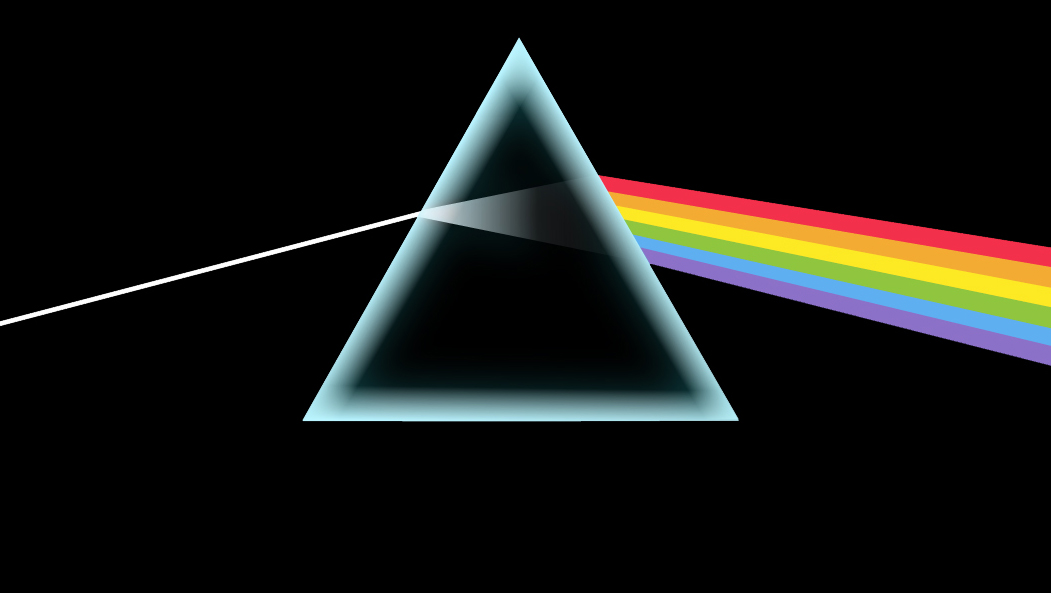
The cover, conceived by Storm Thorgerson and realised through his design partnership Hipgnosis, is almost aggressively simple. A beam of white light enters a prism, fractures into colour, exits as a spectrum against a black field. No band photograph. No title. No explanation. Just an image that feels at once scientific and faintly metaphysical.
That restraint was deliberate. Pink Floyd wanted distance from the visual clutter surrounding progressive rock. Something cleaner. More exact. Thorgerson, working alongside Aubrey Powell, drew from a physics textbook illustration of light refraction, but also from the band’s live shows, where beams of light cut through darkness with precision. The prism became a convergence point. Science, performance, and something just beyond explanation.
It also mirrors the record’s internal logic. A single source broken into its component parts, then reassembled. White light into colour. Experience into fragments. The idea of pressure refracted into time, money, fear, and mortality. It’s the concept made visible without spelling itself out.
What made it radical in 1973 was what it refused to do. Sleeve design still leaned on photography, collage, personality. Even Hipgnosis themselves were known for elaborate, often surreal imagery. Here, they stripped everything back. The result is sharper because of its absence. Nothing distracts. Nothing dates it.
The physical sleeve extended the idea. Early pressings included posters and stickers, allowing the prism to migrate beyond the record itself. Onto bedroom walls, into shared spaces, into everyday life. It stopped being packaging and became part of the culture around it.
Over time, it’s settled into design history as one of the most recognisable images in popular music. Not because it announces itself, but because it doesn’t need to. Like the album it houses, it’s controlled, precise, and quietly permanent.
2. Album
It arrived in March 1973 with the quiet confidence of a band who’d stopped chasing the ghost of Syd Barrett and instead turned their attention to something far less abstract and far more exacting. This isn’t a space record. It’s about pressure. The small, constant, grinding pressures of ordinary life and the way they accumulate until something gives.
Time slipping away without ceremony. Money warping instinct into appetite. Work becoming routine, then trap. The slow creep towards breakdown. Death as the only fixed point in the distance. Roger Waters didn’t construct a narrative. He mapped a system. Each element feeding the next, each strain bleeding into another, forming a loop that never quite releases.
By the time Pink Floyd committed it to tape at Abbey Road Studios with Alan Parsons, it had already been road-tested under the title Eclipse. That matters. This wasn’t assembled in fragments. It was honed in front of audiences until it functioned as a single, continuous piece. Even on record, it doesn’t really stop. Themes return. Voices echo. The heartbeat circles back. You’re not moving through songs. You’re contained within them.
There’s a discipline to it that still feels unusual. No indulgence. No excess. Waters provides the conceptual spine, but it’s the interplay with David Gilmour, Richard Wright and Nick Mason that gives it shape and depth. This is where the record’s quiet virtuosity sits. Not in showmanship, but in control.
Gilmour’s guitar work is exact without ever feeling clinical. His phrasing stretches time, bends it, gives it weight. Wright, often the least discussed member, is arguably the album’s tonal architect. His use of chords, space and early synthesisers creates the emotional temperature of the record. There’s a jazz sensibility to his playing, something understated but essential. Mason, too, is more than timekeeper. His drumming is economical, precise, allowing the material to breathe rather than driving it into excess.
The sound feels engineered rather than performed. Parsons’ use of tape loops, found voices and emerging studio technology binds it all together. The EMS Synthi and VCS3 systems, still relatively new at the time, aren’t used for novelty but for texture and continuity. The cash registers become rhythm. The clocks feel like impact. Even the segues, often taken for granted now, were painstakingly assembled using analogue tape, physically cut and rejoined. You can hear the craft in the joins, if you listen closely enough.
There are details that have come into sharper focus over time. Early mixes reveal alternative approaches, including longer instrumental passages and different vocal takes. The quadraphonic version, largely overseen by Parsons, shows just how ambitious the spatial design really was, with sound moving around the listener in ways that standard stereo could only hint at. Later remasters have exposed the physicality of the recordings, breaths, tape hiss, the friction of performance against machine.
The human elements remain some of its most telling. The interview snippets, gathered almost casually, now feel like a form of documentary embedded within the music. Gerry O’Driscoll’s offhand comment about death has become one of the album’s defining lines. Clare Torry’s improvised vocal, initially treated as session work, has since been recognised as a central compositional element, her later legal recognition only reinforcing how much of the album’s power lies in moments that weren’t fully understood at the time.
In the arc of Pink Floyd, this is the pivot. The point where experimentation became structure, where abstraction became communication. Earlier records hinted at ideas. Later ones, particularly Wish You Were Here and The Wall, would expand and harden them. But this is the moment where everything aligns. Concept, execution, accessibility.
Its place in popular culture is difficult to overstate. It moved beyond the usual boundaries of rock audiences and settled into everyday life. It became a staple of record collections, hi-fi demonstrations, late-night listening. It crossed generations without ever being repositioned or repackaged to do so. The longevity isn’t just commercial, it’s habitual.
And yet, for all that reach, it never feels overstated. That’s the achievement. A record built on control, on restraint, on the refusal to overplay its hand, becoming one of the most pervasive pieces of music in the modern era.
It’s often called timeless, but that misses the point. It’s rooted in its moment, shaped by post-sixties disillusionment and the creeping sense that success carries its own pressure. What’s remarkable is how little that cycle has changed.
Fifty years on, it doesn’t feel distant. It feels ongoing.
3. Urban Myth
Somewhere along the way, The Dark Side of the Moon picked up a shadow narrative. An after-hours theory that refuses to disappear.
The idea is simple. Start the album in sync with The Wizard of Oz, usually on the third roar of the MGM lion, and the two will align. Music and image falling into step. Moments of coincidence accumulating into something that feels intentional.
People point to the shift from black-and-white Kansas into colour matching the music opening out. Rhythms lining up with movement. Lyrics brushing up against scenes in ways that feel just close enough to register. It’s persuasive, in the moment. Given time, coincidence starts to feel like design.
The band have always dismissed it. There’s no evidence, and no real possibility, that it was planned. The record was built as a live piece, shaped over time, refined in the studio. It wasn’t written to picture.
What the myth reveals is something else. The way the album behaves. It’s continuous, structured, almost cinematic without attaching itself to a narrative. It invites projection. It loops, it echoes, it leaves space. Enough space for people to impose their own patterns onto it.
There’s a loose thematic overlap if you want to find it. The Wizard of Oz pulls back the curtain on illusion, revealing something ordinary behind the spectacle. Dark Side does something similar in its own way, stripping life down to its underlying pressures. But that connection is accidental, not engineered.
The myth persists because the album allows it to. It’s controlled, but open. Precise, but not closed off. People keep trying to map it onto something else, films, experiences, entire lives.
It doesn’t quite work. But it keeps working just enough to stay alive.
4. Post Script
I’ve been thinking about my own relationship to this album, and possibly other people’s. I’ve concluded that if you were aged 9 in 1971 it was an album you’d be aware of if you had an older sibling, probably a brother. Or a father with a proper stereo, the Garrard Turntable with a Shure cartridge, brushed ally 60 Watts Per Channel RMS Rotel Amp and Celestion Ditton loudspeaker set up beloved of Comet who advertised weekly in the local newspaper classifieds. Pink Floyd didn’t appear on Top Of The Pops, their band members didn’t side-hustle for other bands – so many superstars in the early seventies seemed to crop up in other bands, band swap or have solo hits, Ronnie Lane, Rod Stewart, Elton John and Roger Daltrey come to mind. Even the beloved late night DJ John Peel mimed to Maggie Mae on a mandolin for Rod Stewart on Top Of The Pops. So how would you hear any ‘Floyd tracks? I don’t even remember them being played on Alan Freeman’s Saturday Rock Show.
Another odd thing. In the period from release to when in 1977 Johnny Rotten told 15 year olds that Pink Floyd were boring, the distinctive sleeve never entranced me to by the album, nor the amazing statistics that appeared on each week’s Album Chart which was always on display behind the counter in the record shop, ‘Weeks on Chart – 310’ compared to the average of about 12.
Somewhere along the line there were enough people older than 9, with or without an older sibling or a technical father to keep this album in the U.K. album charts throughout the Seventies. And that seems to be a unique set of circumstances in my universe.